
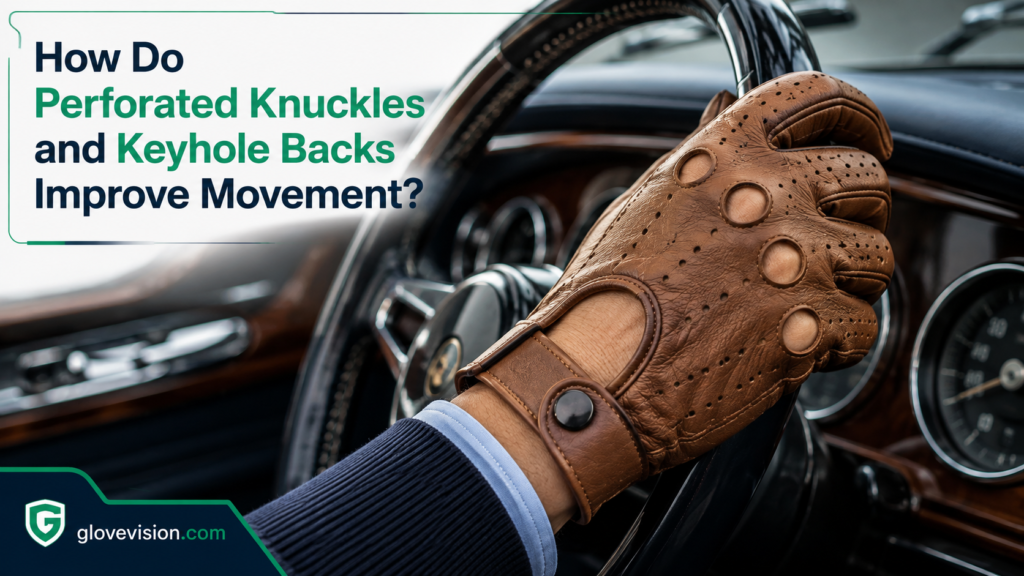
How Do Perforated Knuckles and Keyhole Backs Improve Movement?
Driving Glove Openings become relevant when the hand closes around a steering wheel: finger joints flex, knuckles project, the dorsal hand changes shape, and the wrist-transition area shifts. Continuous backhand material must then stretch, fold, or reposition across several moving zones at once.
Driving Glove Openings may relieve some localized tension by interrupting material across these movement zones, while small perforations primarily support localized airflow. Driving Glove Openings cannot compensate for stiff material, poor pattern geometry, restrictive seams, unstable closures, or incorrect sizing.
Functional qualification: Driving Glove Openings do not improve driving skill or prevent accidents. Movement and control compatibility must be checked only while away from traffic or inside a safely parked and secured vehicle.
What Are the Main Types of Driving Glove Openings?
Driving Glove Openings include small perforations, larger knuckle cutouts, keyhole backs, and other dorsal openings, but those features should not be treated as interchangeable. The important question is where material has been interrupted and what movement or airflow task that change can plausibly serve.
What Are Driving-Glove Perforations?
Perforations are small punched holes commonly placed across finger or backhand panels. They primarily create localized airflow paths and remove relatively little material, so their mechanical contribution to flexibility is usually limited and construction-dependent. For a wider look at complete Driving Glove construction and hand control, the opening must be evaluated as one part of the whole glove.
What Are Driving-Glove Knuckle Openings?
Knuckle openings are larger cutouts positioned over or near flexing finger joints. By interrupting a continuous dorsal panel, they may provide space for joint projection and allow adjacent leather or textile panels to shift rather than tighten directly across the knuckle.
What Is a Driving-Glove Keyhole Back?
A keyhole back is a shaped opening across the dorsal hand or near the wrist transition, commonly paired with a strap or stud. It can act as an expansion zone, but its effect depends on where the opening sits relative to the wearer’s anatomy and how the closure controls the surrounding panel.
What Is a Broader Dorsal Cutout?
Dorsal cutout is a broad term that can include keyholes, open-back designs, wristwatch cutouts, movement-oriented openings, or decorative cutouts. Traditional appearance alone does not prove a functional benefit; the traditional Driving Glove features and styling context should remain separate from verified movement function.
Why Must Driving Glove Openings Be Distinguished?
Perforations, knuckle holes, keyholes, and broader cutouts differ in size, placement, material removal, coverage, structural influence, airflow, and movement effect. Dents documents knuckle holes, a keyhole back, perforated fingers, fourchettes, quirks, and an adjustable closure on one Winchester model, which is useful as product-specific construction evidence rather than a universal template. [Dents]

How Do Driving Glove Openings Accommodate Knuckle Flexion?
Driving Glove Openings can reduce localized resistance when a larger cutout is aligned with a joint that becomes more prominent during hand closure. The mechanism is material-tension relief, not a guaranteed increase in total hand range of motion.
What Happens to the Knuckles During Hand Closure?
As the fingers flex, the dorsal geometry of the hand changes: knuckles project, skin and panel positions shift, and continuous glove material may need to stretch, fold, or migrate. Three-dimensional hand-posture research supports the broader principle that dorsal lengths, web-space geometry, and surface areas change with posture. [3D Hand]

The change is not limited to a single point at each knuckle. As the proximal finger segments rotate and the joints become more prominent, tension can spread into the surrounding dorsal panels and finger bases. This is why an opening that merely looks centered while the hand is flat may become misaligned during closure. Functional alignment should be judged through the movement range the glove is actually expected to accommodate.
How Can Knuckle Openings Interrupt Material Tension?
A correctly placed knuckle cutout removes material over a projecting joint, potentially reducing continuous resistance and allowing neighboring panels to reposition. That may reduce local bunching during repeated closure, but the amount of relief depends on the glove pattern and material.
A larger cutout can act as a local discontinuity in the backhand panel, giving projecting anatomy somewhere to move without forcing the same amount of material to stretch directly over the joint. The surrounding edges still carry load, so edge shape, reinforcement, seam stiffness, and material recovery determine whether the relief remains smooth or simply shifts pressure to another location.
Why Does Knuckle-Opening Alignment Matter?
The opening must correspond with the wearer’s knuckle position, finger length, intended flexion zone, surrounding seams, and the glove’s movement path. A visually attractive opening that sits above or below the actual joint may provide little useful accommodation.
What Happens When Knuckle Openings Are Misaligned?
Misalignment can create edge pressure, pinching, twisting, unnecessary skin exposure, distorted fit, or continued restriction. General glove-fit research also supports the principle that inappropriate sizing can interfere with manual performance; those findings should not be converted into direct steering-performance claims. [Fit]
Can Small Perforations Replace Knuckle Openings?
No automatic equivalence exists. Small perforations remove much less material and primarily provide localized airflow, whereas a larger knuckle opening can create a distinct space around a projecting joint. Their roles should remain separate.
How Do Driving Glove Openings Accommodate Dorsal and Wrist Movement?
Driving Glove Openings can also interrupt material across the broader back of the hand or near the wrist transition. A keyhole back works as part of a pattern-and-closure system: its usefulness depends on whether the opening sits where the wearer actually expands or bends.
How Does the Dorsal Hand Change During Grip?
As the hand closes, the knuckles project, the backhand can change width and surface area, tendons shift beneath the skin, and material may draw toward the wrist. The glove therefore needs enough pattern accommodation to follow those changes without excessive pulling.
How Can a Keyhole Back Create Expansion Space?
A keyhole can interrupt a continuous dorsal panel and allow the edges to separate slightly as the hand changes shape. This may reduce localized tension and bunching near the backhand or wrist transition, but the effect is geometry-specific.
The useful movement is often small and distributed rather than dramatic. As the dorsal hand broadens, the keyhole edges may separate slightly while adjacent panels rotate or translate around the opening. If the opening is too high, too low, too narrow, or restrained by an overtight closure, the glove may show the traditional feature without delivering meaningful accommodation at the wearer’s actual expansion zone.
How Does the Wrist Closure Interact With a Keyhole Back?
A suitable strap or stud can bridge the opening, control effective circumference, and stabilize glove position while still allowing limited expansion. Overtightening can cancel that benefit and create a new restriction. Restelli describes wrist flexibility and movement benefits for one specific fingerless model; those remain manufacturer claims about that product, not universal biomechanical proof. [Restelli]
Does Every Keyhole Back Improve Wrist Mobility?
No. A keyhole positioned mainly over the dorsal hand may accommodate hand expansion more than wrist flexion. Whether it influences the wrist depends on how far the opening reaches into the wrist-transition zone and how the surrounding cuff and closure are shaped.
When Is a Keyhole Back Mainly Decorative?
It may be primarily stylistic when it misses the tension zone, surrounding material remains restrictive, the closure prevents useful edge separation, or other panels provide most of the glove’s flexibility. Heritage appearance should not be treated as mechanical evidence.
A useful distinction is whether the opening changes with the hand. If the keyhole remains visually unchanged while surrounding panels still pull tightly across the dorsal hand, its movement contribution may be limited. Conversely, a small controlled change in edge spacing can be functional even when it is not dramatic. The relevant evidence is coordinated movement, not the visual prominence of the cutout.
Which Construction Factors Determine How Driving Glove Openings Perform?
Driving Glove Openings do not work in isolation. Material elasticity, finger-panel geometry, seams, fit, lining status, and wrist retention determine whether a cutout actually relieves tension or simply removes coverage.
How Does Material Affect Driving Glove Openings?
Elasticity, thickness, stiffness, recovery, surface finish, moisture response, and wear determine how much the backhand can follow the hand before an opening is needed. A flexible material may require less relief than a stiff one, but no universal opening size follows from material name alone.
Material recovery is especially important around cutout edges. A compliant material may deform and return without leaving the opening permanently enlarged, while a stiffer or fatigued material may transfer stress into stitching or adjacent panels. Driving Glove Openings therefore cannot be evaluated only by how large they appear; the same geometry can behave differently when thickness, elasticity, edge reinforcement, moisture, and wear change.
How Do Fourchettes Affect Finger Movement?
Fourchettes are the panels between fingers, not openings. Their shape and seams influence finger spacing, lateral movement, flexion, and interior volume. Dents attributes finger flexibility to fourchettes on one Winchester model, reinforcing that cutouts are only one part of the movement system. [Dents]
How Do Quirks Support Localized Fit?
Where present, quirks are small inserts around finger-base or web-space transitions. They may help shape those areas and reduce localized pulling, but not every Driving Glove contains them and they should not be described as cutouts.
How Does Seam Placement Affect Movement Openings?
Seams crossing flexion zones, stiff cutout-edge stitching, interior pressure, or poorly reinforced edges can cancel the intended relief. General glove-construction research supports the broader principle that layer arrangement and construction can affect tactile sensitivity and finger or wrist motion, without proving a direct benefit for any driving glove. [Construction]
How Does Unlined Construction Interact With Openings?
An unlined glove may reduce material bulk and allow the principal outer material to move more directly with the hand, but it may also make seams more noticeable and provide less supporting material around a cutout. See why some Driving Gloves omit a separate lining for the full lining-specific trade-offs.
How Does Fit Affect Driving Glove Openings?
Poor fit can move an opening away from the intended joint, rotate the palm, increase dorsal tension, create edge pressure, or destabilize the wrist. The same construction-versus-movement principle appears in other glove categories, including glove protection-and-dexterity trade-offs, but those contexts should not be treated as direct driving-glove evidence.
Fit determines whether the geometry remains synchronized with the hand. Excess length can let knuckle holes drift away from the joints, while insufficient width can pull the entire backhand toward one side. In either case, the visible cutout may be present yet fail its movement purpose. Driving Glove Openings should therefore be evaluated as part of a fitted pattern, not as isolated decorations added after sizing.

How Should Driving Glove Openings Be Function-Checked?
Driving Glove Openings should be judged by how the exact glove behaves on the wearer, not by the number or size of holes. The check should confirm anatomical alignment, natural movement, stable closure, and predictable contact without treating openings as a driving-performance guarantee.
How Should Knuckle-Opening Alignment Be Checked?
Confirm that each opening corresponds with the intended joint, stays aligned as the fingers close, does not press into the knuckle edge, does not twist surrounding material, and does not cause palm rotation or skin pinching.
How Should Keyhole-Back Expansion Be Checked?
Observe whether the keyhole accommodates dorsal expansion without excessive edge distortion, bunching toward the wrist, closure movement, or loss of glove position. The opening should return to its intended alignment when the hand relaxes.
How Should Complete Hand Movement Be Tested?
Away from traffic or in a safely parked and secured vehicle, check full hand opening, comfortable closure, finger flexion, thumb movement, wrist flexion and extension, steering-wheel contact, deliberate repositioning, and deliberate release. Protective-glove studies reinforce that complete construction and conditions can change manual dexterity, but those results do not rank Driving Glove Openings. [Dexterity]
Repeat the movement slowly several times rather than judging a single closure. Watch whether knuckle openings stay centered, whether the keyhole edges separate and recover smoothly, and whether the wrist closure remains stable as the hand opens again. Driving Glove Openings should support repeatable motion without pinching, delayed panel return, edge rolling, or progressive drift away from the anatomical zones they are intended to accommodate.
Which Problems Show That Driving Glove Openings Are Failing?
Warning signs include knuckle-edge pressure, misaligned openings, backhand pulling, palm rotation, wrist restriction, material bunching, torn edges, failed stitching, closure migration, pain, or numbness. Any one of these can negate the intended movement accommodation.
When Should Damaged Driving Glove Openings Trigger Replacement?
Reassess or replace the glove when cutout edges tear, stitching separates, openings stretch out of anatomical alignment, the closure no longer stabilizes the hand, surrounding material becomes distorted, or reliable hand movement can no longer be maintained.

Conclusion
Driving Glove Openings may support movement by removing or interrupting material across areas that project, expand, or tighten during hand closure. Knuckle openings can accommodate joint projection, keyhole backs can create dorsal expansion space, and small perforations primarily support localized airflow rather than the same degree of mechanical relief.
The useful result depends on the complete glove: material elasticity, finger panels, quirks where present, seams, anatomical fit, closure stability, opening dimensions, and condition. Larger or more numerous openings are not automatically better, and no cutout can correct an incorrectly sized or otherwise restrictive glove.
Frequently Asked Questions
Are Perforations and Knuckle Openings the Same?
No. Perforations are small punched holes primarily associated with localized airflow. Knuckle openings are larger cutouts positioned around joint-flexion zones.
Do Knuckle Openings Make Driving Gloves More Flexible?
They may reduce localized material tension over projecting joints when correctly positioned. Their effectiveness depends on alignment, size, material, seams, fit, and pattern geometry.
Do Small Perforations Improve Hand Movement?
Their primary contribution is usually localized airflow. They may slightly change material compliance but do not create the same expansion space as larger cutouts.
Does a Keyhole Back Improve Wrist Movement?
It may accommodate dorsal expansion or movement near the wrist transition, depending on its position and shape. A keyhole located mainly over the hand should not automatically be credited with improving wrist mobility.
Can Driving Glove Openings Correct a Tight Glove?
No. Openings may relieve localized tension, but they cannot correct insufficient finger length, inadequate palm width, restrictive seams, thumb misalignment, or an unsuitable size.