
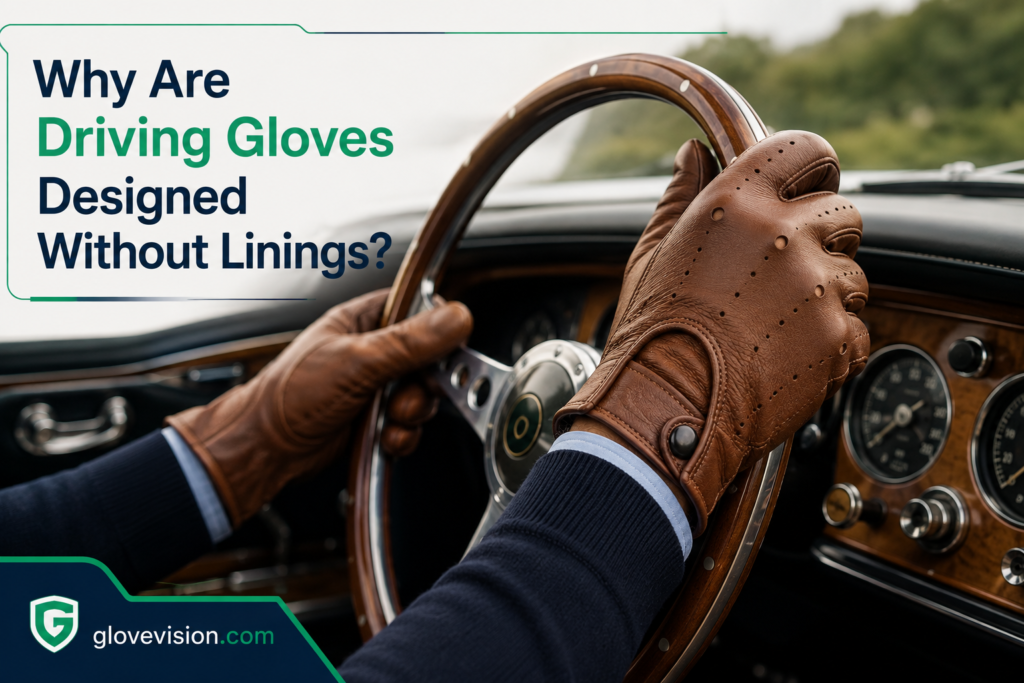
Why Are Driving Gloves Designed Without Linings?
Some Driving Gloves omit a separate lining so fewer material layers sit between the hand and the vehicle controls. The hand may contact the interior surface of the glove’s principal outer material directly, although reinforcements, bindings, elastic, closures, seams, or multiple panels can still be present.
Lower-bulk construction may support closer fit, tactile contact, palm stability, and finger movement, but it also changes warmth, moisture, seam-contact, comfort, and durability trade-offs. Unlined construction is a design choice, not proof that a glove will fit correctly, grip consistently, or improve vehicle control.
Functional qualification: Unlined Driving Gloves do not improve driving skill or prevent crashes. Any glove that slips, bunches, restricts movement, catches during hand repositioning, or interferes with required controls should not be used. Complete fit and control checks must be performed only while the vehicle is safely parked and secured.
Why Are Unlined Driving Gloves Made Without a Separate Inner Layer?
Some Unlined Driving Gloves are designed without a separate continuous interior layer because fewer layers may reduce bulk and potential layer movement. That can let the outer glove sit closer to the hand, but it does not make the glove automatically thinner, more breathable, more secure, or better for steering.
What Does “Unlined” Mean in Driving Gloves?
“Unlined” means no separate textile, fleece, fur, or insulating layer continuously covers the relevant interior. It does not mean the glove is made from one material or one panel. The reverse surface of leather, seam finishing, edge binding, palm reinforcement, grip overlays, and closure components are not themselves a lining. For the broader purpose and modern control role of the category, see the broader history and control role of Driving Gloves.
How Can Removing the Lining Reduce Glove Bulk?
Removing a separate layer can reduce material depth inside the palm and fingers. This may preserve usable interior space, reduce palm folds, and let the principal material conform more directly to the hand. The benefit still depends on the pattern, thickness, stiffness, seams, and sizing of the finished glove.
How Can a Lining Move Separately From the Outer Glove?
A separate lining can, in some constructions, wrinkle, shift at the fingertips, bunch in the palm, or move slightly behind the shell. A well-built lined glove does not necessarily develop these problems, and the absence of a lining does not guarantee perfect internal stability.
Why Are Some Unlined Driving Gloves Intended for Warmer Conditions?
Lower insulation and lower material volume can make some unlined designs appropriate where warmth is not the main requirement. Perforated or open-back constructions may also be paired with unlined interiors. A Dents fingerless model, for example, is described by its maker as unlined to support closer fit and grip; that is a product-specific design claim, not proof for the entire category. [Dents]
How Do Unlined Driving Gloves Influence Steering-Wheel Feedback?
Unlined Driving Gloves may preserve a more direct path for pressure, texture, movement, and position cues because the hand is separated from the steering surface by fewer layers. Directness is not the same as better control: stable fit and predictable release remain necessary.
How Does Material Thickness Affect Steering-Wheel Sensation?
Reduced material depth may make steering-wheel position, texture, local pressure, movement, and early slip cues easier to perceive in some gloves. General glove research shows that glove thickness and construction can influence grip and manual performance, but those results do not directly test Unlined Driving Gloves. [Grip] The same thickness-versus-feedback principle is discussed in how glove thickness changes task performance, without transferring disposable-glove materials or barrier requirements to driving.
How Can Unlined Construction Reduce Delayed Layer Movement?
With no separate continuous lining, there is no lining-to-shell interface to shift independently. A stable unlined design may therefore move more directly with the hand and preserve palm alignment. That advantage disappears if the outer glove itself stretches, rotates, folds, or fits poorly.
How Does Palm Friction Affect Unlined Driving Gloves?
Friction depends on the outer material, steering-wheel covering, moisture, wear, contamination, pressure, fit, and any surface treatment. Unlined construction does not establish whether palm friction is high, low, consistent, or appropriate. The broader principle is explained in palm friction and grip behavior; this does not imply that Unlined Driving Gloves use industrial palm coatings.
Why Is Maximum Steering-Wheel Friction Not the Goal?
Useful contact must permit both stable holding and deliberate repositioning. Excessive friction can make the glove catch, twist around the hand, increase localized pressure, or make release less predictable. University of Waterloo ergonomics guidance similarly emphasizes that gloves can alter sensitivity, effective hand size, and grip effort; it is general human-factors guidance rather than automotive performance testing. [Ergonomics]
When Does Direct Feedback Stop Being Useful?
More direct sensation is not beneficial when the glove slips, bunches, rotates, restricts movement, creates pressure, becomes saturated, catches during repositioning, or interferes with secondary controls. Control quality depends on the complete hand–glove–vehicle interface rather than layer count alone.
How Do Unlined Driving Gloves Affect Fit and Finger Movement?
Unlined Driving Gloves may reduce interior material volume, but useful close fit depends on anatomical patterning rather than tightness alone. The glove must stay aligned with the palm, fingers, thumb, and wrist while allowing deliberate opening, closure, repositioning, and access to smaller controls.
How Can Unlined Construction Support Closer Fit?
Less interior material may reduce palm volume, fingertip separation, and hand-to-shell movement. Research on sports gloves indicates that fit and material interact with comfort and hand performance, but those findings should be treated as general hand-performance evidence rather than direct vehicle-control testing. [Fit]
How Do Unlined Driving Gloves Affect Finger Articulation?
The fingers and thumb must flex, extend, open, close, and reposition without excessive resistance at the joints, palm crease, knuckles, or wrist. Protective-glove research shows that different glove constructions can influence manual dexterity, but it does not measure steering performance. [Dexterity] A separate cross-context example of protection-and-dexterity trade-offs reinforces the principle without treating mechanic gloves as substitutes for Driving Gloves.
Why Does Seam Placement Matter More in Bare Interiors?
Without a separate lining between the skin and interior seams, poor seam placement may be easier to feel. Finger-web rubbing, fingertip pressure, local bulk, palm pressure, or restricted flexion can cancel the benefit of a lower-bulk interior.
How Should Unlined Driving Gloves Be Fit-Checked?
Before driving, and while away from moving traffic, confirm limited excess fingertip material, smooth palm placement, natural thumb alignment, full comfortable finger flexion, stable wrist position, and no internal rotation. Painful tension, numbness, pinching, or pressure is a rejection signal rather than evidence of a “performance” fit.
Which Fit Problems Cancel the Low-Bulk Benefit?
Excess interior space, palm folds, tight finger webs, restricted closure, misaligned seams, thumb pulling, glove rotation, pain, or numbness all undermine the intended low-bulk contact advantage. A glove can be unlined and still fit badly.
Which Features Make Unlined Driving Gloves Function Correctly?
Unlined Driving Gloves work as a complete construction system. Material flexibility, interior surface, seams, perforations, knuckle openings, and wrist stabilization all influence whether fewer layers translate into stable, comfortable, controllable contact.
Which Materials Can Be Used in Unlined Driving Gloves?
Possible constructions include leather, synthetic leather, technical textiles, and hybrids. The important variables are flexibility, interior texture, thickness, stretch, friction, moisture behavior, and wear—not the material name alone. A traditional appearance belongs to traditional Driving Glove construction and styling unless the functional claim can be supported separately.
How Does the Interior Material Surface Affect Comfort?
When the hand contacts the principal material directly, surface texture, softness, dye or finish stability, moisture absorption, stretch, and skin contact become more noticeable. A leather species or trade name does not by itself establish comfort or suitability.
How Do Internal and External Seams Affect Unlined Driving Gloves?
External seams may reduce some interior seam contact, while internal seams may be protected from external abrasion. Either arrangement can succeed or fail depending on seam thickness, location, durability, finger shape, and pressure zones. There is no universal seam layout that is automatically best.
How Do Perforations and Knuckle Openings Affect Unlined Driving Gloves?
These features may support localized air exchange, reduce material tension, help flexion, or preserve traditional styling. Their actual benefit depends on hole size, placement, surrounding material, fit, and airflow. They can also reduce coverage, create edge wear, gap, or pinch.
How Can Wrist Closures Stabilize Unlined Driving Gloves?
A suitable wrist closure may help maintain glove position, reduce hand-to-glove movement, support palm alignment, and control the cuff opening. Overtightening can create restriction, and no closure can correct an incorrect size or poorly shaped pattern.
When Should Unlined Driving Gloves Be Rejected or Replaced by a Lined Alternative?
Unlined Driving Gloves should be judged by the actual conditions in which they are used. Lower bulk can be useful only while warmth, moisture, comfort, fit, and access to controls remain adequate.
When Can Cold Make Unlined Driving Gloves Unsuitable?
An unlined design may not provide enough insulation, wind protection, cold-surface separation, or long-duration warmth. A lined alternative can be more suitable when it supplies the required warmth without becoming bulky, unstable, or restrictive around the vehicle controls.
How Can Perspiration Affect Unlined Driving Gloves?
Interior dampness may change material softness, friction, hand movement, drying time, and long-term material condition. Perforations do not guarantee dry hands, and an unlined interior does not automatically manage moisture better than a lined one.
When Can a Lining Improve Interior Comfort?
A suitable lining may provide softer skin contact, moisture management, reduced seam contact, warmth, light cushioning, or easier donning. Those benefits must be balanced against the additional bulk and any potential for independent layer movement.
Which Functional Problems Require Immediate Rejection?
Reject or reassess a glove that slips on the steering wheel, rotates around the hand, bunches in the palm, restricts finger or thumb movement, catches during repositioning, causes pain or numbness, or prevents reliable use of required controls.
When Should Worn Unlined Driving Gloves Be Replaced?
Replacement or reassessment is appropriate when palm behavior becomes unpredictable, seams separate, the material stretches beyond stable fit, contact-zone holes appear, the closure fails, friction becomes inconsistent, or reliable control interaction can no longer be verified.
Conclusion
Some Unlined Driving Gloves omit a separate interior layer to reduce bulk and possible layer movement, creating a closer hand-to-glove interface that may preserve tactile feedback, palm stability, and finger articulation. The absence of a lining does not make the glove single-material, automatically thin, or inherently better for steering.
Final suitability depends on the exact outer material, thickness, seams, anatomical fit, palm friction, climate, moisture, vehicle controls, and current condition. A lined glove can be the better choice when warmth or interior comfort is more important, while any unlined glove that slips, bunches, rotates, restricts movement, or blocks required controls should be changed, omitted, or replaced.
Frequently Asked Questions
Are All Driving Gloves Unlined?
No. Some Driving Gloves omit a separate lining to reduce bulk, while others use linings for warmth, comfort, cushioning, easier donning, or moisture management.
Do Unlined Driving Gloves Provide Better Steering Feel?
They may provide more direct contact because fewer material layers separate the hand from the steering wheel. Actual feedback still depends on fit, thickness, stiffness, seams, material, steering surface, moisture, and condition.
Are Unlined Driving Gloves Better for Warm Weather?
They may suit conditions where low insulation and reduced bulk are priorities, but unlined construction does not guarantee ventilation, cooling, or dry hands.
Are Lined Driving Gloves Worse for Vehicle Control?
No. A stable, correctly fitted, low-bulk lining may preserve adequate control while providing warmth or interior comfort. Problems arise when the complete glove becomes bulky, unstable, or restrictive.
When Should Unlined Driving Gloves Not Be Used?
Do not use them when they provide insufficient warmth, slip, bunch, rotate, restrict movement, cause pressure, interfere with controls, or no longer maintain a stable fit.