
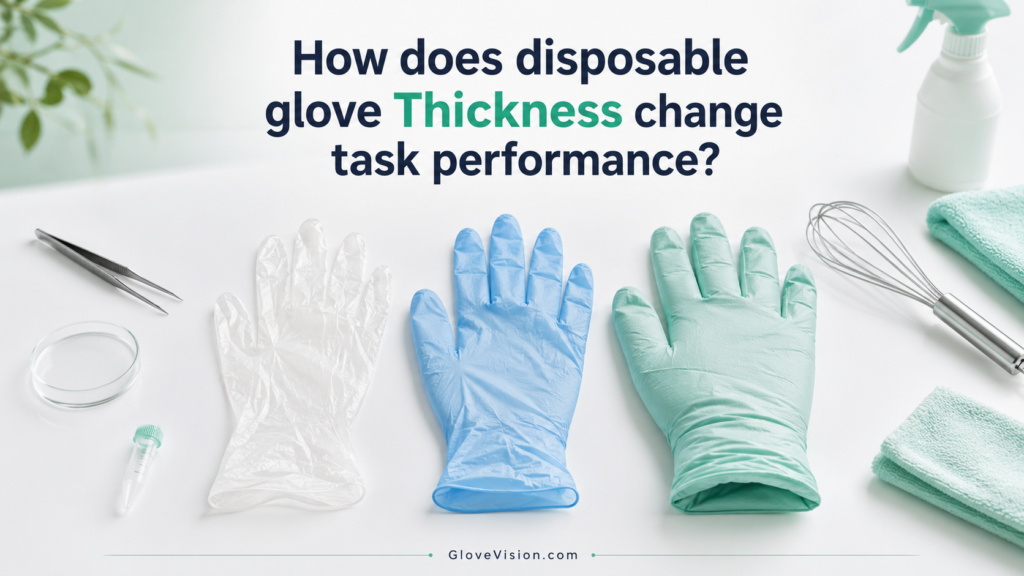
How does disposable glove thickness change task performance?
Disposable glove thickness changes task performance by altering tactile feedback, finger dexterity, grip feel, hand effort, durability, and barrier feel. Thickness adds a physical layer between the hand and task, so it can affect tactile sensitivity, dexterity, grip control, fatigue, durability, and barrier feel, but thickness alone does not prove chemical, puncture, medical, sterile, chemotherapy, or food-contact suitability.
This page explains thickness and tactile feedback, thin and thicker glove barrier trade-offs, task-based thickness selection, fit and fatigue control, tear or degradation response, and a final Disposable Gloves task-performance checklist.
This article provides educational guidance about Disposable Gloves thickness, tactile sensitivity, dexterity, fatigue, barrier trade-offs, task selection, fit, and failure response and does not replace product labeling, manufacturer documentation, chemical compatibility data, Safety Data Sheets, medical glove category requirements, sterile procedure protocols, food-safety rules, facility policy, hand hygiene procedures, or exposure-response protocols. The exact glove material, thickness, formulation, fit, task, chemical, contact duration, medical category, food-contact condition, and local procedure must determine which Disposable Gloves are suitable.
Why does Disposable Gloves thickness affect tactile sensitivity, dexterity, and hand fatigue?
Disposable Gloves thickness affects tactile sensitivity, dexterity, and hand fatigue because the glove layer changes how much the hand can feel, how precisely fingers move, and how much effort repeated tasks require.
Thickness selection belongs inside the wider category because Disposable Gloves differ by material choice, thickness, color signals, and short-use limits.
How does thickness affect touch feedback?
Thickness affects touch feedback by adding a physical layer between the skin and the work surface.
As the layer becomes thicker or stiffer, users may notice less sensitivity to fine texture, small surface changes, light pressure, tiny object edges, subtle grip feedback, or delicate instrument feel. The effect still depends on material, texture, fit, glove design, and the exact task.
How does thickness affect dexterity?
Thickness affects dexterity when a thicker glove layer reduces fine fingertip movement or precise object control.
This can matter during small part handling, clinical precision tasks, laboratory manipulation, food plating, electronics assembly, detailed cleaning, or tool control, but thinner Disposable Gloves are not automatically better unless the task risk and product documentation support them.
How does thickness affect hand fatigue?
Thickness can affect hand fatigue when thicker or stiffer Disposable Gloves require more effort during repeated finger flexion, gripping, or long wear.
Fatigue risk depends on glove material, glove thickness, stiffness, fit, wear duration, task repetition, grip force, hand size, and user sensitivity. Persistent cramping, numbness, or loss of control should be escalated through the relevant workplace or occupational-health process rather than treated as a simple thickness issue.
What should the article avoid saying?
The article should avoid saying that thicker gloves are always safer, thinner gloves are always better for dexterity, or thickness alone proves task safety.
Thickness alone does not prove puncture protection, chemical protection, medical-grade safety, sterile readiness, chemotherapy protection, food-contact suitability, or a uniform fatigue outcome for every user.
How do thin and thicker Disposable Gloves differ in barrier and performance limits?
Thin and thicker Disposable Gloves differ in barrier and performance limits because thickness can change tactile feel, durability, flexibility, comfort, and perceived protection without proving task safety by itself.
Clinical glove selection needs category control because medical gloves differ through clinical contact, sterile barrier needs, and precision fit.
How should thin Disposable Gloves be described?
Thin Disposable Gloves should be described as options that may support tactile sensitivity and dexterity when the task requires close finger control and the product documentation supports the use.
Thin gloves may fit short-contact, low mechanical-stress tasks where chemical exposure is not expected, but they may be less suitable for sharp, abrasive, long-duration, or chemically demanding tasks unless labeling and compatibility data support that use.
How should thicker Disposable Gloves be described?
Thicker Disposable Gloves should be described as options that may improve durability, tear resistance, or perceived protection in some products while reducing tactile feedback or flexibility.
Thicker designs may reduce fine-motor control, comfort, grip feel, or long-wear tolerance, and thickness ranges vary by manufacturer, material, measurement location, and product category.
Why is thickness not enough to prove barrier safety?
Thickness is not enough to prove barrier safety because glove performance depends on material, formulation, design, intended use, compatibility data, and documentation.
Patient-care use may require category-specific products because Examination Gloves are built for routine clinical contact, ambidextrous use, and standard fit. FDA describes medical gloves as disposable PPE for medical procedures and examinations and includes examination, surgical, and chemotherapy gloves in that medical category. [FDA]
Why should AQL not be used as a puncture-strength score?
AQL should not be used as a puncture-strength score because AQL is sampling or leak-quality information, not a puncture-resistance, tensile-strength, or dexterity rating.
In the medical glove context, AQL is tied to sampling plans and leakage defects for patient examination gloves and surgeons’ gloves. [eCFR] It should not be used to claim one glove is mechanically stronger or better for dexterity, fatigue, chemical compatibility, puncture resistance, or task suitability.
| Thickness Factor | Possible Benefit | Possible Trade-Off | Task Impact | Verification Needed |
|---|---|---|---|---|
| Thin glove layer | Better tactile feel in some tasks | Less perceived durability | Small parts, food plating, light-duty handling | Product label, task stress, contact duration |
| Standard thickness | Balanced feel and barrier feel in some products | Not automatically right for every task | Routine handling when documented | Material, fit, intended use |
| Thicker glove layer | More durability or barrier feel in some products | Reduced feel, flexibility, or comfort | Mechanical stress, repeated handling | Product data and tear/puncture info where available |
| Stiffer material | May feel more protective | More hand effort and fatigue | Long wear, gripping, repetitive tasks | Fit, stiffness, wear duration, user feedback |
| Chemical exposure | Thickness may matter in some cases | Material compatibility matters more | Disinfectants, solvents, oils, hazardous drugs | Exact chemical, concentration, duration, compatibility data |
| Medical use | Category labeling controls use | Thickness alone does not prove medical suitability | Patient care, surgical, chemotherapy tasks | Medical, sterile, or chemotherapy-tested labeling |
| AQL | Leak-quality sampling context | Not puncture or dexterity score | Medical glove quality discussions | Use only in correct category context |
Which tasks may require thicker Disposable Gloves based on mechanical, chemical, or exposure risk?
Tasks may require thicker Disposable Gloves when mechanical stress, chemical exposure, clinical category, food-contact condition, or handling duration creates a documented need for more durability or barrier performance.
When may thicker Disposable Gloves be useful for mechanical stress?
Thicker Disposable Gloves may be useful for mechanical stress when product documentation shows improved durability for rough surfaces, repeated handling, gripping, packaging edges, or longer wear.
They are not the same as cut-resistant gloves or puncture-proof gloves, so sharp but non-cut-resistant contact risks, abrasive materials, repeated tearing, or long wear should trigger product-data review rather than a thickness assumption.
When may thicker Disposable Gloves be relevant in clinical settings?
Thicker Disposable Gloves may be relevant in clinical settings only when the glove category, procedure, product documentation, sterile requirements, and facility protocol support that use.
Sterile procedures require a different glove category because Surgical Gloves are shaped by sterile exposure, anatomical shaping, and precision fit. Higher-risk or sterile procedures may require procedure-appropriate sterile surgical gloves, facility-approved double-gloving protocols, indicator glove systems where used, and sterile-field requirements.
When may thicker Disposable Gloves be relevant for chemical tasks?
Thicker Disposable Gloves may be relevant for some chemical tasks, but material compatibility and permeation data are more important than thickness alone.
Chemical selection should not rely on thickness alone because Chemical-Resistant Lab Gloves require material matching and handling-fit verification. For hazardous drugs or chemotherapy agents, use gloves specifically tested or labeled for that purpose according to applicable facility policy and product documentation. FDA medical glove guidance provides labeling context for chemotherapy claims, but it does not make an untested thick glove suitable for hazardous-drug handling. [FDA]
When may thin Disposable Gloves be more appropriate?
Thin Disposable Gloves may be more appropriate when tactile sensitivity, short contact, low mechanical stress, frequent changes, light-duty handling, high dexterity, or minimal grip force is the priority.
Thin gloves still need task support from product labeling, material choice, fit, and facility approval, especially when chemicals, abrasion, food-contact rules, or clinical category requirements are involved.
How should food-service tasks be handled?
Food-service tasks should be handled by matching Disposable Gloves to material, food type, contact duration, temperature, tear risk, local food-safety rules, product documentation, and facility policy.
Food-service thickness choice should stay task-based because Food Handling Gloves focus on food contact, task discipline, and short-duration barrier needs. Fat, heat, and food contact should not be treated as one universal rule for all Disposable Gloves.
Define whether the task is clinical, food-service, lab, cleaning, chemical, light-duty, precision, or mechanical-stress handling.
Look for rough surfaces, abrasive materials, repeated gripping, packaging edges, sharp contact, or repeat tearing.
If chemicals, disinfectants, solvents, oils, hazardous drugs, or cleaning agents are involved, verify compatibility data.
Confirm medical-grade, sterile surgical, chemotherapy-tested, or food-contact documentation when required.
Decide whether the task requires fine tactile feedback, grip feel, fingertip control, or long-wear comfort.
Choose a glove whose thickness, material, fit, and documentation match the task and facility policy.
Identify task → check stress → check chemical exposure → check category → compare dexterity need → select a documented glove option.
How should operators fit Disposable Gloves to balance protection, dexterity, and fatigue?
Operators should fit Disposable Gloves to balance protection, dexterity, and fatigue by choosing the best-fitting approved size, matching fit to task precision, donning gently, monitoring hand effort, and integrating hand hygiene.
Step 1: Select the best-fitting approved size
The best-fitting approved size is the Disposable Glove size that stays secure without restricting circulation, thumb movement, fingertip control, palm fit, cuff position, or safe task performance.
The goal is controlled fit, not maximum tightness. Severe webbing tension, restricted thumb movement, loose fingertips, palm bunching, cuff slippage, or reduced task control should trigger a size or model review.
Step 2: Match glove fit to task precision
Glove fit should match task precision because fingertip control, tactile feel, grip stability, and movement range affect performance.
Precision tasks may require better fingertip fit and tactile feel, while heavier handling may require more durability, but the glove must still allow safe grip and movement.
Step 3: Don gloves without overstretching
Disposable Gloves should be donned without overstretching because aggressive pulling can stress the cuff, palm, or finger areas before the task begins.
Don gloves gently and replace them if donning creates visible damage, cuff tearing, finger stress, or palm distortion.
Step 4: Monitor fatigue during use
Fatigue should be monitored during use because hand effort, cramping, numbness, or loss of control can signal a mismatch between glove size, thickness, stiffness, task duration, and grip force.
If fatigue appears, reassess glove size, thickness, material stiffness, task duration, grip force, need for breaks, and alternative glove models without diagnosing a medical condition.
Step 5: Integrate hand hygiene
Disposable Gloves do not replace hand hygiene.
Hands should be cleaned before donning and after glove removal according to the relevant healthcare, food-service, laboratory, or workplace procedure, and gloves should be removed carefully to reduce hand contamination. [CDC]
Correct approved size selected for the task and facility product list.
Fingertips are controlled without excess loose material.
Palm does not bunch, and thumb movement is not restricted.
Webbing tension, cuff slippage, and circulation restriction are absent.
Tactile feel and grip stability match the work being performed.
Hand effort, cramping, numbness, or loss of control is watched during use.
Cuff, palm, and fingers are not overstretched during donning.
Hand-cleaning procedure is followed before and after glove use when required.
What corrective actions address tearing, puncture, swelling, or degradation in Disposable Gloves?
Corrective actions for tearing, puncture, swelling, or degradation in Disposable Gloves should start with stopping the task safely, removing the compromised glove, following hand hygiene or exposure protocol, and replacing it with a documented suitable option.
Cleaning-agent contact needs separate review because Cleaning Gloves are shaped by household chemical exposure, lining, reuse care, and task fit.
What should happen after a tear or puncture?
After a tear or puncture, the user should stop the task safely, remove the compromised Disposable Glove, follow the applicable hand hygiene or exposure-response procedure, and replace it before continuing.
Disposable gloves should be changed as soon as feasible when torn, punctured, or when barrier function is compromised. [OSHA]
What should happen after mechanical overstress?
After mechanical overstress, repeated tearing, cuff splits, fingertip holes, or palm stress should trigger task reassessment and product-choice review.
The corrective action may be a better fit, a different thickness, a different material, a task-specific tool, or a non-disposable protective system when the task exceeds Disposable Gloves limits.
What should happen after chemical swelling or softening?
After chemical swelling or softening, the glove should be treated as incompatible or unsupported until manufacturer compatibility data and the relevant Safety Data Sheet are reviewed.
Swelling, softening, cracking, stickiness, or visible degradation means thickness did not prove chemical suitability, and chemical contact should be managed through product-specific compatibility data and facility chemical procedure.
What should happen after suspected exposure?
After suspected exposure, the user should stop safely and follow the relevant workplace exposure protocol for the substance or biological material involved.
Blood/body-fluid, hazardous drug, chemical, or food-contamination events should not be self-managed through glove replacement alone; facility procedure and, when relevant, occupational-health review should control the response. [OSHA]
| Failure Signal | Immediate Action | Likely Meaning | Next Verification |
|---|---|---|---|
| Tear or puncture | Stop, remove, hygiene or exposure response, replace | Barrier failure | Fit, task stress, material, thickness |
| Repeated tearing | Pause task and reassess product | Mechanical mismatch | Durability data, alternative glove or tool |
| Cuff or seam split | Discard glove and review donning | Overstretch or poor fit | Size, donning method, glove design |
| Swelling or softening | Stop chemical contact and remove safely | Possible incompatibility | Chemical, concentration, SDS, compatibility data |
| Cracking or stickiness | Treat as degradation | Material breakdown | Manufacturer permeation or degradation data |
| Suspected exposure | Follow exposure protocol | Task may exceed glove support | Facility procedure and documented glove category |
Which checklist verifies that Disposable Gloves match task-specific thickness and performance needs?
A Disposable Gloves thickness and task performance checklist verifies that the selected glove matches the task through material, thickness, fit, dexterity need, durability, chemical compatibility, medical or food category, hand hygiene, and failure-response readiness.
Disposable Gloves thickness and task performance checklist
Disposable Gloves thickness and task performance checklist use should begin before the glove is selected, not after a failure occurs.
The checklist should confirm task stress, tactile need, intended use, category labeling, chemical compatibility, fit, fatigue risk, hand hygiene procedure, and replacement rules before the glove is placed into routine use.
Clinical, food-service, laboratory, cleaning, chemical, precision, or mechanical-stress task is clearly identified.
Glove material and formulation are known, not assumed from thickness.
Thickness and measurement location are checked when relevant to task performance.
Tactile sensitivity, fingertip control, grip feel, and long-wear comfort are appropriate for the task.
Exact chemical, concentration, contact duration, SDS, and manufacturer compatibility data are reviewed when chemicals are involved.
Medical, examination, sterile surgical, or chemotherapy-tested labeling is confirmed when required.
AQL is treated as sampling or leak-quality context, not puncture strength, dexterity, fatigue, or task-performance proof.
Approved size, fingertip control, palm fit, thumb movement, cuff stability, and fatigue indicators are checked.
Relevant workplace, healthcare, food-service, or lab hand hygiene procedure is included.
Tears, punctures, swelling, softening, degradation, or suspected exposure have a clear stop-remove-replace-escalate pathway.
Conclusion
Disposable Glove Thickness changes task performance by changing how the hand feels surfaces, controls small movements, grips objects, manages repeated flexion, and experiences barrier feel.
The safest selection logic is not “thin is best” or “thick is safest.” Disposable Gloves should be chosen by material, formulation, thickness, fit, intended use, task stress, chemical compatibility, medical or food category, contact duration, documentation, facility policy, hand hygiene, and a clear response plan for compromised gloves.
Frequently Asked Questions
Does thicker Disposable Gloves material always mean better protection?
No. Thicker Disposable Gloves material does not always mean better protection because material, formulation, compatibility, task stress, fit, and product documentation determine suitability.
Do thin Disposable Gloves improve dexterity?
Thin Disposable Gloves may improve dexterity for some low-stress precision tasks, but thin gloves are not automatically suitable for chemical, sharp, abrasive, medical, or long-duration tasks.
Can thickness prove chemical resistance?
No. Thickness alone cannot prove chemical resistance; chemical suitability requires exact chemical, concentration, contact duration, glove material, glove thickness, and manufacturer compatibility or permeation data.
Is AQL a puncture-resistance score?
No. AQL is not a puncture-resistance score; it is sampling or leak-quality information in specific glove categories, especially medical glove contexts.
When should thicker Disposable Gloves be considered?
Thicker Disposable Gloves may be considered when mechanical stress, repeated tearing, longer wear, or specific exposure risk is present, but the glove must be documented for the task.
Do Disposable Gloves replace hand hygiene?
No. Disposable Gloves do not replace hand hygiene; hands should be cleaned before donning and after removal according to the relevant healthcare, food-service, laboratory, or workplace procedure.