
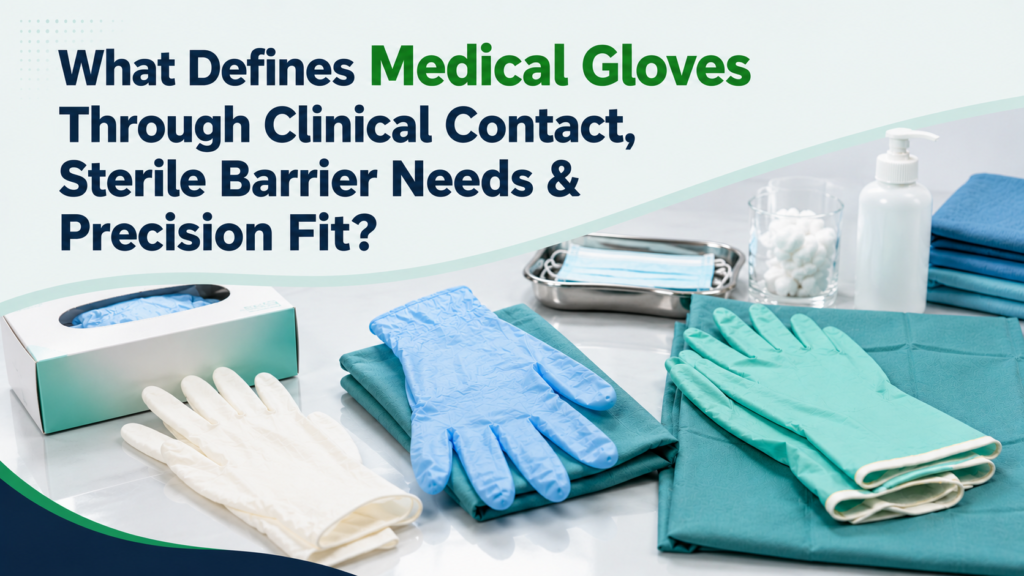
What Defines Medical Gloves Through Clinical Contact, Sterile Barrier Needs & Precision Fit?
Medical gloves are defined by clinical contact type, sterile barrier need, material suitability, barrier integrity, precision fit, and verification requirements.
This page explains what medical gloves are, how clinical contact changes glove choice, when sterile versus non-sterile use matters, how examination, surgical, and chemotherapy-related contexts differ, how common materials compare, what AQL and labeling can verify, how fit and change-out affect safe use, why failures happen, and which checklist helps confirm selection before clinical use or purchase.
This article is for educational medical glove-selection guidance only and does not replace facility infection-control procedures, workplace PPE rules, manufacturer instructions, SDS guidance, or professional clinical evaluation. For examination, surgical, chemotherapy, chemical, infectious-fluid, or regulated healthcare tasks, verify glove labeling, barrier claims, material limits, exposure conditions, and workplace requirements before relying on a glove for protection.
What are medical gloves, and how are they different from general disposable gloves?
Medical gloves are disposable gloves intended for medical use, while general disposable gloves may not meet medical-use labeling or performance expectations.
Medical gloves are a clinical-use category that can include patient examination gloves, surgical gloves, and certain chemotherapy-related gloves when the product is labeled and verified for that purpose. The key difference is intended medical use: “disposable” only describes replacement style, while “medical” depends on labeling, performance expectations, and clinical-use claims.
Medical gloves support barrier protection, but they do not replace hand hygiene, correct donning, correct removal, timely replacement, or facility infection-control procedures. FDA describes medical gloves as PPE used during medical procedures and examinations, and CDC guidance reinforces that gloves do not replace hand hygiene. [FDA] [CDC]
Confirm whether the task needs examination, surgical, chemotherapy-related, or another labeled medical glove category.
Check whether the glove supports expected fluid, contamination, tear, puncture, and task-duration demands.
Use labeling, manufacturer instructions, facility policy, and special exposure data before relying on the glove.
Why does clinical contact type change the medical glove you need?
Clinical contact type changes the medical glove you need because routine examination, fluid exposure, sterile procedures, and hazardous-drug handling place different demands on barrier integrity and verification.
Routine examination contact usually needs a labeled examination glove and task-based change-out. Fluid or contamination exposure adds barrier stress and cuff-control concerns. Sterile procedure contact requires a sterile glove category and controlled procedure rules. Hazardous-drug or chemotherapy-related contact requires product-specific testing, labeling, exposure-duration limits, and workplace procedures.
Exam glove use starts with the contact profile because routine clinical contact defines examination glove use.
| Contact Type | Main Risk | Suitable Medical Glove Category | Sterile Need | Verification Step |
|---|---|---|---|---|
| Routine patient examination | Routine contamination control and patient contact | Examination gloves | Usually non-sterile unless labeled or required | Medical labeling, material, powder-free status, facility policy |
| Fluid or contamination exposure | Higher barrier stress, glove contamination, cuff or fit failure | Medical glove type matched to task | Depends on procedure | Barrier integrity, glove condition, cuff security, task duration |
| Sterile procedure contact | Sterile field contamination and lower failure tolerance | Surgical gloves | Sterile required | Sterile labeling, package integrity, donning compatibility, procedure policy |
| Hazardous-drug or chemotherapy-related contact | Drug permeation or chemical exposure risk | Chemotherapy-related medical gloves when tested and labeled | Depends on task and facility policy | Manufacturer data, permeation testing, exposure duration, hazardous-drug procedures |
How do examination, surgical, and chemotherapy-related medical gloves differ?
Examination, surgical, and chemotherapy-related medical gloves differ by clinical setting, sterility requirement, barrier tolerance, fit control, and special-use verification.
Medical glove selection starts with category separation because examination vs surgical gloves differ in sterility, fit control, and procedure demands in sterility, fit control, and procedure demands.
How do examination gloves fit routine clinical use?
Examination gloves fit routine patient examination, non-sterile clinical contact, contamination control, and general medical tasks where a disposable clinical barrier is needed.
Routine clinical glove choice depends on sterile status because examination sterile status depends on labeling and use context. Medical labeling, material, powder-free status, size range, barrier claims, and facility policy should still be checked before use.
Exam glove selection starts with exposure because routine-contact exposure defines whether the glove is being used for general barrier support or a higher-risk clinical situation.
How do surgical gloves fit sterile procedure use?
Surgical gloves fit surgical or sterile procedure contexts where sterile packaging, anatomical fit, tactile sensitivity, and barrier reliability are more demanding.
Surgical tasks demand stricter verification because surgical barrier control requires stricter verification. Sterile labeling, surgical-use claims, sizing system, donning compatibility, and surgical-use requirements should be verified without turning the page into a sterile technique manual.
Surgical barrier expectations are stricter because sterile exposure defines surgical glove use.
How do chemotherapy-related gloves fit hazardous-drug handling?
Chemotherapy-related medical gloves fit certain hazardous-drug handling contexts only when the glove is specifically tested, labeled, and verified for that type of exposure.
Chemotherapy-related use requires specific claims, manufacturer data, exposure-duration limits, and workplace hazardous-drug procedures. ASTM D6978 is a verification concept for chemotherapy-drug permeation assessment, but it does not make every medical glove suitable for every drug or duration. [NIOSH] [OSHA]
| Medical Glove Type | Primary Setting | Sterile or Non-Sterile | Main Barrier Need | Verification Before Use |
|---|---|---|---|---|
| Examination gloves | Routine patient examination, non-sterile clinical contact, general medical tasks | Usually non-sterile unless labeled otherwise | Routine clinical barrier support and contamination control | Medical labeling, material, powder-free status, size, barrier claims, facility policy |
| Surgical gloves | Surgery, sterile procedures, operating-room contexts | Sterile | Lower failure tolerance, tactile control, surgical barrier reliability | Sterile labeling, sizing system, donning compatibility, surgical-use requirements |
| Chemotherapy-related gloves | Certain chemotherapy or hazardous-drug handling tasks | Depends on product and task | Resistance to specified hazardous-drug permeation under tested conditions | ASTM D6978 or applicable testing, manufacturer data, exposure duration, workplace procedures |
| Other labeled medical gloves | Specialized clinical tasks | Depends on claim | Task-specific barrier support | Intended use, labeling, manufacturer instructions, facility policy |
How do sterile barrier needs change medical glove selection?
Sterile barrier needs change medical glove selection because sterile procedure work requires different packaging, handling, fit control, and verification than routine non-sterile clinical contact.
Non-sterile medical gloves can support routine clinical contact when sterile technique is not required. Sterile surgical gloves are used when the clinical procedure requires sterile-use conditions, valid sterile packaging, package integrity, controlled donning compatibility, and procedure policy.
Sterile procedure use depends on preparation and packaging because surgical sterilization supports sterile glove use. Sterility does not prove chemical, puncture, cut, chemotherapy, or universal procedure suitability.
Procedure control depends on fit because anatomical fit improves surgical glove control.
| Use Type | Sterile Requirement | Typical Glove Category | Fit Concern | Verification Needed |
|---|---|---|---|---|
| Routine clinical contact | Usually non-sterile unless facility policy or task requires otherwise | Examination gloves | Fast fit, cuff security, tactile control | Medical labeling, task fit, change-out rule |
| Minor clinical contact with fluid risk | Depends on task and facility procedure | Examination or task-specific medical gloves | Barrier stress, cuff control, glove condition | Barrier claims, glove condition, task duration |
| Sterile procedure work | Sterile required | Surgical gloves | Anatomical fit, tactile sensitivity, controlled donning | Sterile labeling, package integrity, surgical-use claim |
| Hazardous-drug handling | Depends on procedure and workplace controls | Chemotherapy-related medical gloves when tested and labeled | Layering, fit, exposure duration | Manufacturer data, permeation testing, hazardous-drug procedure |
| Chemical exposure | Not controlled by sterility alone | Chemical-verified glove system | Material compatibility and contact duration | SDS, compatibility chart, manufacturer data |
How do medical glove materials differ across latex, nitrile, vinyl, neoprene, and polyisoprene?
Medical glove materials differ by elasticity, tactile sensitivity, puncture behavior, allergy concerns, chemical limits, comfort, and task suitability.
Material choice should be treated as one part of verification, not a shortcut to clinical approval. Latex, nitrile, vinyl, neoprene or chloroprene, and polyisoprene can serve different clinical needs, but product labeling and task conditions still control suitability.
How does latex function as a medical glove material?
Latex can provide strong elasticity, comfort, and tactile sensitivity in medical gloves, but natural rubber latex proteins may trigger allergy in sensitized users.
How does nitrile function as a medical glove material?
Nitrile is widely used as a latex-free medical glove material with broad clinical utility, but chemical or hazardous-drug suitability still depends on the specific exposure and product data.
How does vinyl function as a medical glove material?
Vinyl medical gloves can fit short, low-fluid, lower-stress examination tasks, but lower elasticity can limit fit control and barrier reliability under higher task stress.
How do neoprene or chloroprene function as medical glove materials?
Neoprene or chloroprene medical gloves can offer synthetic alternatives where latex avoidance, comfort, elasticity, and certain resistance needs matter.
How does polyisoprene function as a medical glove material?
Polyisoprene can provide latex-like comfort and tactile feel without natural rubber latex proteins, but it still needs task-specific verification.
| Material | Common Medical Use | Strength | Limitation | Best Verification Question |
|---|---|---|---|---|
| Latex | Exam and surgical gloves where allowed | Elasticity, comfort, tactile sensitivity | Natural rubber latex allergy risk | Is latex allowed for this user, facility, and task? |
| Nitrile | Exam gloves and some special-use medical gloves | Latex-free option, broad clinical utility, puncture resistance context | Chemical and chemotherapy suitability is product-specific | Is this exact nitrile glove labeled and tested for the exposure? |
| Vinyl | Short, lower-stress examination tasks | Cost-sensitive, latex-free, easy donning | Lower elasticity and fit control | Is the task low-fluid, short-duration, and low-stress? |
| Neoprene / chloroprene | Exam or surgical alternatives | Synthetic comfort and flexibility | Claims vary by product | Does labeling support the intended clinical use? |
| Polyisoprene | Often surgical or high-tactility contexts | Latex-like feel without natural rubber latex proteins | Still requires task-specific verification | Is sterile status, fit, and intended use verified? |
How do AQL, leak resistance, and labeling help verify medical glove barrier quality?
AQL, leak resistance, and labeling help verify medical glove barrier quality by showing whether the glove meets defined quality expectations and intended-use claims.
AQL means Acceptable Quality Level, a batch sampling quality concept used to evaluate allowable defect levels under specified inspection conditions. A lower AQL number generally indicates a stricter allowable defect threshold, but AQL is not universal task approval.
Leak resistance and medical labeling help users understand barrier quality and intended use, but they do not prove suitability for every procedure, drug, chemical, or exposure duration.
| Term | What It Means | What It Helps Verify | What It Does Not Prove |
|---|---|---|---|
| AQL | Batch sampling concept for allowable defect levels | Quality expectations for defects such as leaks | Suitability for every procedure, drug, chemical, or exposure duration |
| Leak resistance | Evidence that gloves are evaluated for leaks or pinhole defects | Basic barrier quality | Puncture-proof or chemical-proof protection |
| Medical labeling | Intended medical-use claim | Whether the glove is sold for exam, surgical, sterile, chemotherapy, or other medical use | Universal suitability across all clinical tasks |
| Sterile labeling | Sterile-use packaging and claim | Whether glove is intended for sterile procedure use | Correct surgical technique or procedure suitability |
| Powder-free status | No added donning powder | Powder-related exposure reduction | Allergy-proof or irritation-proof use |
| Chemotherapy-related claim | Special-use claim for certain hazardous-drug contexts | Need for permeation testing and manufacturer verification | Protection against all drugs, durations, or procedures |
How should medical glove fit, donning, change-out, and disposal be handled safely?
Medical glove fit, donning, change-out, and disposal should be handled as barrier-control steps that protect fit, reduce contamination risk, and support clinical procedure rules.
If a glove is too tight, check palm tension, finger strain, thumb web stress, hand fatigue, and tearing risk. If a glove is too loose, check fingertip excess, palm bunching, cuff slippage, grip loss, and handling errors.
Gloves should be donned with clean, dry hands according to facility procedures. Torn, punctured, heavily contaminated, or task-contaminated gloves should be changed promptly, and glove removal should limit skin and surface contamination before hand hygiene. CDC guidance says gloves should be discarded between patients and not washed for reuse in healthcare contexts. [CDC]
Fit control matters more in procedure work because precision fit affects surgical glove control.
| Situation | What to Check | Why It Matters | Safer Action |
|---|---|---|---|
| Glove feels too tight | Palm tension, finger strain, thumb web stress, fatigue | Excessive stretch can increase tearing and discomfort | Re-check size and task duration |
| Glove feels too loose | Fingertip excess, palm bunching, cuff slippage | Poor fit can reduce control and increase handling errors | Choose a better-fitting size or glove style |
| Before patient care | Clean, dry hands and facility procedure | Wet or contaminated hands can affect donning and hygiene | Follow hand hygiene and donning procedure |
| During clinical task | Tear, puncture, contamination, fluid exposure | Barrier integrity can fail during use | Replace promptly according to procedure |
| Between patients or task zones | Patient/contact change, body-site change, clean-to-dirty movement | Gloves can transfer contamination | Change gloves and perform hand hygiene per policy |
| After removal | Skin contact, surface contact, disposal route | Removal can contaminate hands or surfaces | Remove carefully, discard properly, perform hand hygiene |
Why do medical gloves fail during clinical use, and how can common failures be corrected?
Medical gloves fail during clinical use when the glove category, material, fit, task stress, exposure type, or change-out rule does not match the clinical task.
Failure signals should be treated as screening clues, not as blame. Tearing, wet-grip loss, irritation, chemical mismatch, hazardous-drug mismatch, and overuse all point back to category choice, labeling, material limits, fit control, or facility procedure.
Barrier monitoring becomes more important in higher-risk procedure settings because indicator undergloves can help reveal barrier breaches.
Why do medical gloves tear at the thumb web, palm, or fingertips?
Medical gloves that tear at the thumb web, palm, or fingertips usually indicate wrong size, excessive stretch, weak material for the task, long wear time, sharp contact, or poor donning technique.
Why do medical gloves lose grip in wet clinical conditions?
Medical gloves can lose grip in wet clinical conditions when the glove finish, fingertip texture, surface contamination, or size does not match the handling task.
Why can medical gloves cause itching, redness, dryness, rash, or irritation?
Medical glove-related itching, redness, dryness, rash, or irritation can come from latex proteins, rubber accelerators, powder residue, sweat, occlusion, friction, soaps, or repeated glove use.
Why is hazardous-drug or chemical use unsafe without verification?
Hazardous-drug or chemical use is unsafe without verification because medical glove labeling does not automatically prove resistance to every chemical, drug, concentration, or exposure duration.
Why is wearing or reusing medical gloves too long a failure risk?
Wearing or reusing medical gloves too long creates failure risk because disposable clinical barriers can tear, become contaminated, degrade, or transfer contamination between tasks.
| Failure Signal | Likely Cause | Safer Correction | Better Owner Page or Tool |
|---|---|---|---|
| Tears at thumb web, palm, or fingertips | Wrong size, excessive stretch, weak material, sharp contact, long wear, poor donning | Re-check size, material, task stress, and replacement frequency | Fit/sizing tool URL missing — do not link |
| Loses grip in wet clinical conditions | Smooth finish, wet surfaces, contamination, poor fingertip texture | Consider textured fingertips, appropriate glove finish, correct size, and task-specific grip needs | Examination or surgical child page if clinically specific |
| Itching, redness, dryness, rash, or irritation | Latex proteins, accelerators, powder residue, sweat, occlusion, friction, soaps, repeated use | Stop suspected glove, document pattern, consider powder-free or synthetic alternatives, seek guidance if persistent | Allergy tracker URL missing — do not link |
| Used for chemical or hazardous-drug handling without verification | Assuming all medical gloves provide chemical protection | Check compatibility, breakthrough/permeation data, manufacturer instructions, and hazardous-drug procedures | Hazard page URL missing — do not link |
| Worn too long or reused | Cost-saving, poor change-out rules, misunderstanding disposable limits | Replace according to task, contamination, damage, patient/contact change, and facility policy | Care/change-out page URL missing — do not link |
Which checklist helps verify medical glove selection before clinical use or purchase?
A medical glove verification checklist helps confirm category, clinical contact type, sterile need, material, labeling, barrier quality, precision fit, change-out rules, special exposure limits, and correct routing before clinical use or purchase.
The verification process should begin with the medical glove category, then confirm material, barrier quality information, sterile or non-sterile requirements, fit and tactile demand, change-out and disposal rules, special exposure limits, and deeper routing when the exact owner page or tool URL is available.
- ☐ Identify whether the task needs examination gloves, surgical gloves, chemotherapy-related gloves, or another labeled medical glove type.
- ☐ Confirm that the glove is labeled for the intended medical use.
- ☐ Check whether the task requires sterile or non-sterile gloves.
- ☐ Confirm the glove material and any latex or accelerator concerns.
- ☐ Review barrier quality information such as leak resistance, AQL context, and manufacturer instructions.
- ☐ Check whether the glove is powder-free if clinical policy or user sensitivity requires it.
- ☐ Match fit, fingertip control, palm tension, cuff security, and tactile demand to the task.
- ☐ Confirm change-out and disposal rules for patient/contact changes, contamination, tearing, puncture, or task switching.
- ☐ Verify special exposure limits for chemotherapy drugs, chemicals, infectious fluids, or prolonged wet contact.
- ☐ Route deeper decisions to the correct child page or approved tool only when the exact URL is supplied.
Pre-use verification: Medical glove selection should be treated as a clinical screening and verification step, not a guarantee of protection. For examination, surgical, chemotherapy, chemical, infectious-fluid, or regulated healthcare tasks, users should follow manufacturer labeling, workplace infection-control procedures, SDS guidance where relevant, and applicable clinical or regulatory standards.
Conclusion
Medical gloves are clinical barrier tools defined by contact type, sterile barrier need, material suitability, barrier integrity, precision fit, and verification discipline.
The category alone does not guarantee protection. Clinical, chemical, chemotherapy, or regulated tasks require manufacturer labeling, facility policy, applicable standards, and task-specific verification before a medical glove is relied on for protection.
Frequently Asked Questions
Are medical gloves the same as disposable gloves?
Medical gloves are not the same as general disposable gloves because medical gloves are intended for medical use and should meet medical-use labeling and performance expectations. General disposable gloves should not be assumed medical-grade.
When are sterile medical gloves needed?
Sterile medical gloves are needed when the clinical procedure requires a sterile barrier and controlled sterile-use conditions. Routine examination use is usually non-sterile unless labeling, policy, or the task requires otherwise.
What is the difference between examination gloves and surgical gloves?
Examination gloves are usually used for routine non-sterile clinical contact, while surgical gloves are used for sterile procedure contexts with stricter fit, packaging, and barrier expectations.
Are nitrile medical gloves always chemotherapy-safe?
Nitrile medical gloves are not automatically chemotherapy-safe because chemotherapy-related use depends on product-specific testing, labeling, exposure duration, and manufacturer data. ASTM D6978 is a verification concept, not a blanket approval for all nitrile gloves.
Does AQL prove a medical glove is safe for every clinical task?
AQL does not prove a medical glove is safe for every clinical task because it is a defect-sampling quality concept, not a universal task-suitability approval. Task, material, labeling, and exposure still matter.
Do medical gloves replace hand hygiene?
Medical gloves do not replace hand hygiene because hands can still become contaminated during glove use, removal, or task transitions. Hand hygiene before and after glove use should follow facility policy.
When should medical gloves be changed?
Medical gloves should be changed when they are torn, punctured, contaminated, used between patients or task zones, or no longer suitable for the clinical task. Facility procedure and infection-control rules should control the final change-out decision.