
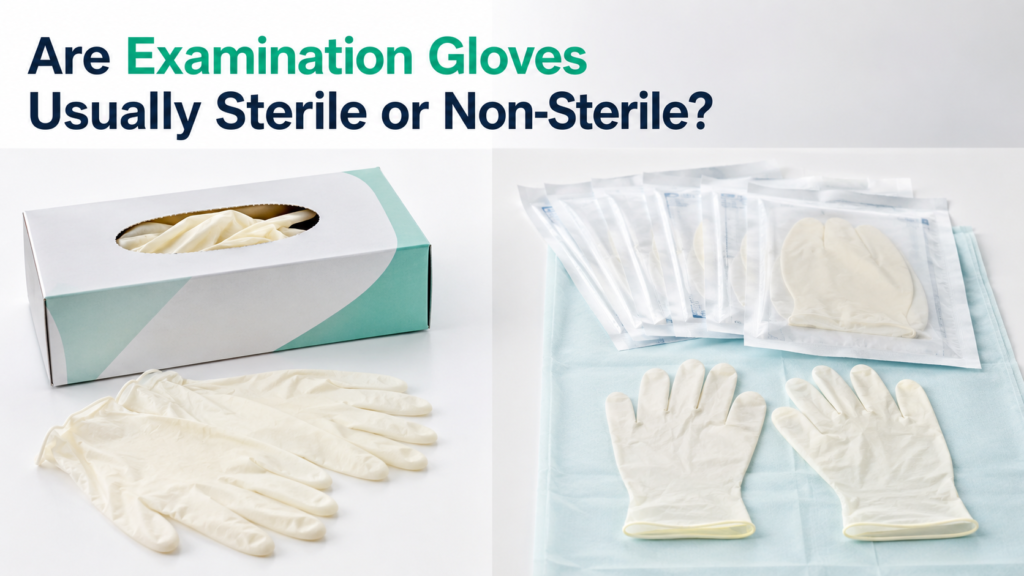
Are Examination Gloves Usually Sterile or Non-Sterile?
Examination Gloves used for routine clinical care are generally non-sterile, although sterile Examination Gloves are available for selected clinical or aseptic tasks. Examination Gloves sterility does not convert the product into a Surgical Glove, and the exact procedure and facility protocol control the correct selection.
This page explains non-sterile meaning, sterile versus non-sterile differences, sterility versus AQL, procedure-based selection, donning and change-out, package and contamination mistakes, and final sterility and use verification.
This article provides educational guidance about Examination Glove sterility and does not replace product labeling, facility infection-control procedures, clinical training, sterile-technique requirements, or task-specific PPE assessment. The exact procedure and local protocol must determine whether sterile, non-sterile, Surgical, or specialist gloves are required.
What is the usual sterility status of Examination Gloves?
Examination Gloves used during routine clinical care are generally non-sterile and commonly supplied in multi-glove dispenser boxes.
Examination Gloves belong to the wider category because medical gloves. Non-sterile products are common because routine clinical contact.
Are Examination Gloves usually sterile or non-sterile?
Examination Gloves are usually non-sterile when used for routine patient examination and other non-surgical clinical activities. The WHO glove-use leaflet distinguishes non-sterile Examination Gloves, sterile Examination Gloves, and Surgical Gloves, which supports a cautious category distinction rather than an absolute rule. [WHO]
Routine non-sterile products are commonly supplied in dispenser boxes for fast replacement, but sterile versions also exist for selected procedures where the exact protocol requires them.
What does non-sterile mean for Examination Gloves?
Non-sterile means the Examination Gloves are not labeled and packaged with a sterile product claim. It does not mean household, general-purpose, unregulated, reusable, or automatically unsuitable for patient care. [FDA]
Suitability still depends on patient Examination Glove labeling, intended use, the clinical task, product condition, and facility protocol.
Which routine tasks commonly use non-sterile Examination Gloves?
Non-sterile Examination Gloves commonly support routine clinical tasks when gloves are indicated and a sterile barrier is not required.
Examples may include routine physical examinations, venipuncture, blood or body-fluid contact, mucous-membrane contact, non-intact-skin contact, specimen handling, contaminated-equipment handling, and other approved non-surgical tasks. The exact procedure controls selection; a body site alone does not create a universal sterility rule.
Are sterile Examination Gloves available?
Sterile Examination Gloves are available for selected clinical or aseptic tasks that require a sterile patient Examination Glove rather than a Surgical Glove.
FDA 510(k) K232039 provides a product-specific official example of sterile powder-free nitrile Examination Gloves; that record confirms availability, not universal procedure approval. [FDA 510(k)]
How do sterile and non-sterile Examination Gloves differ?
Sterile and non-sterile Examination Gloves differ mainly in their sterile claim, packaging, and intended clinical use, while both remain patient Examination Gloves when labeled for examination use.
Sterility is only one distinction because Examination vs Surgical Gloves.
How are non-sterile Examination Gloves packaged?
Non-sterile Examination Gloves are commonly supplied in multi-glove dispenser boxes for rapid access during routine clinical care.
Box dispensing supports high-turnover use, but the dispenser area still needs clean handling and storage. Packaging alone does not prove task suitability.
How are sterile Examination Gloves packaged?
Sterile Examination Gloves are supplied in packaging designed to maintain their labeled sterile status until the package is opened or compromised.
Package configuration varies. The seal, dryness, damage status, storage condition, and labeled use period must be checked before use.
Does sterile packaging make an Examination Glove a Surgical Glove?
Sterile packaging does not make an Examination Glove a Surgical Glove because category depends on intended use, labeling, regulatory status, construction, sizing, and performance claims. [FDA]
A sterile patient Examination Glove may support selected non-surgical tasks, but a surgical procedure requires a glove intended and labeled for surgical use.
What is the primary distinction?
Non-sterile Examination Gloves support routine non-sterile care.
Sterile Examination Gloves support selected sterile non-surgical tasks when the procedure and facility protocol require a sterile patient Examination Glove.
Surgical Gloves are intended and labeled for surgical procedures and should not be replaced by sterile Examination Gloves.
| Attribute | Non-Sterile Exam Gloves | Sterile Exam Gloves | Surgical Contrast | Limit |
|---|---|---|---|---|
| Intended role | Routine clinical care when sterile gloves are not required | Selected non-surgical sterile or aseptic tasks | Surgical procedures | Procedure and facility protocol control use |
| Sterility claim | No sterile product claim | Carries a sterile claim when package is valid | Sterile surgical-use product | Sterility is not category conversion |
| Packaging | Commonly multi-glove dispenser box | Individual or sterile-barrier package | Commonly sterile surgical package | Packaging alone is not enough |
| Procedure verification | Confirm no sterile-field requirement | Confirm exact sterile glove requirement | Confirm surgical-use requirement | No universal procedure shortcut |
| AQL category | Patient Examination Glove category | Patient Examination Glove category unless otherwise classified | Surgeon’s Glove category | Sterility does not change AQL automatically |
| Intended-use classification | Patient examination use | Patient examination use with sterile claim | Surgical use | Labeling controls category |
| Main limitation | Not sterile | Not surgical by sterility alone | Not a chemical or sharps solution | Specialist hazards need other evidence |
| Escalation route | Sterile Exam, Surgical, or specialist glove when needed | Surgical or specialist glove when task requires | Specialist PPE for non-surgical hazards | Use facility procedure |
How should sterility and AQL be interpreted for Examination Gloves?
For Examination Gloves, sterility and AQL measure different attributes: sterility concerns the product’s sterile claim and packaging, while AQL concerns statistical lot-level acceptance for leakage defects.
What does sterility mean for Examination Gloves?
Sterility means the finished Examination Glove carries a sterile claim and is packaged and handled to maintain that status until use.
The claim depends on manufacturer processing, sterile labeling, valid package integrity, proper storage, correct opening, and avoiding contamination after opening or during use.
What does AQL mean for Examination Gloves?
AQL is a statistical lot-sampling concept used to determine whether an Examination Glove production lot meets defined acceptance criteria for leakage defects.
AQL is not a literal defect percentage for every box, and it does not measure sterile processing.
Which AQL threshold applies to patient Examination Gloves?
The FDA leakage-sampling framework uses 2.5 AQL for patient Examination Gloves.
The number supports lot-level leakage acceptance and should not be used to predict an individual glove or infection risk. [eCFR]
Do sterile Examination Gloves automatically use the Surgical Glove AQL?
Sterile Examination Gloves do not automatically use the Surgeon’s Glove AQL because sterility does not change their intended-use category.
Patient Examination Gloves use the 2.5 AQL framework, while Surgeon’s Gloves use 1.5 AQL. The controlling issue is classification and intended use, not the presence of a sterile package alone. [eCFR]
What does AQL not prove?
AQL does not prove sterility, individual-glove perfection, chemical compatibility, hazardous-drug protection, needlestick resistance, procedure suitability, or Surgical Glove status.
In the United States, powdered patient Examination Gloves and powdered Surgeon’s Gloves are banned devices, but powder-free status still does not mean allergy-free. [Federal Register]
| Concept | Correct Meaning | Exam Glove Application | Surgical Contrast | Does Not Prove |
|---|---|---|---|---|
| Sterility | Valid sterile claim plus maintained package integrity | Applies only when labeled and uncompromised | Surgical products are separately intended | Procedure suitability |
| Sterile labeling | Product-specific claim | Must be verified on the exact product | Not the same as surgical labeling | Surgical category |
| Package integrity | Seal, dryness, closure, storage, and use period remain valid | Compromise means discard | Required in surgical systems too | Ongoing sterility after contamination |
| AQL | Lot-level leakage acceptance concept | Quality evidence for patient Examination Glove category | Different threshold for Surgeon’s Gloves | Sterility or individual perfection |
| 2.5 AQL | Patient Examination Glove leakage threshold | Applies to patient Examination Glove category | Less strict than 1.5 threshold | Surgical use |
| 1.5 AQL | Surgeon’s Glove leakage threshold | Controlled contrast only | Surgical category threshold | Automatic use by sterile Exam Gloves |
| Intended-use category | Regulatory and labeling classification | Exam use remains Exam use | Surgical use remains separate | Universal task approval |
| Individual-glove condition | Visible and functional condition at use | Inspect before and during use | Also needed in surgery | Lot-wide certainty |
How should sterile or non-sterile Examination Gloves be selected for clinical procedures?
Examination Gloves should be selected as sterile or non-sterile from the exact procedure, sterile-field requirement, product labeling, facility protocol, and applicable infection-control guidance.
Sterility cannot be selected from a broad task label because minor wound procedures.
When are non-sterile Examination Gloves generally appropriate?
Non-sterile Examination Gloves are generally appropriate when gloves are indicated, the task is non-surgical, and the procedure does not require a sterile glove.
The screen still needs routine patient-care context, examination-use labeling, facility approval, hand hygiene, and one-patient, one-task use.
When may sterile Examination Gloves be required?
Sterile Examination Gloves may be required for selected non-surgical procedures when a sterile glove and sterile-field boundary are specified by the procedure and facility protocol.
The exact procedure, sterile glove requirement, examination-use labeling, intact package, aseptic technique, and facility procedure must all align.
Does every invasive or non-intact-skin task require sterile Examination Gloves?
Not every task described as invasive, involving non-intact skin, or involving mucous membranes automatically requires sterile Examination Gloves.
The decision depends on the exact procedure, critical site, sterile-field requirement, no-touch technique, product labeling, facility protocol, and applicable guidance.
When are Surgical Gloves required instead of sterile Examination Gloves?
Surgical Gloves are required when the procedure calls for a glove intended, labeled, and controlled for surgical use.
Operative sterility belongs elsewhere because Surgical Glove sterilization. Sterile Examination Gloves should not be substituted when surgical-use labeling is required.
What are examples of procedure-specific differences?
Procedure-specific guidance shows that routine venipuncture, urinary catheter insertion, peripheral vascular access, central catheter placement, and surgery do not use one universal glove-sterility rule.
WHO guidance supports well-fitting, non-sterile, disposable gloves for routine blood drawing; CDC guidance allows clean gloves for selected peripheral catheter insertion when no-touch technique is maintained, calls for sterile gloves and sterile equipment for acute-care urinary catheter insertion, and calls for sterile gloves for arterial, central, and midline catheter insertion. [WHO][CDC][CDC][CDC]
Routine physical examination
DirectionNon-sterile Examination Gloves are generally used when gloves are indicated.
VerifyFacility protocol and exposure expectation.
Routine venipuncture
DirectionNon-sterile disposable Examination Gloves are commonly used.
VerifyLocal protocol, hand hygiene, one-patient use, and sharps controls.
Specimen handling
DirectionNon-sterile Examination Gloves are commonly used unless the task requires sterility.
VerifySpecimen procedure and facility policy.
Mucous-membrane contact
DirectionSterility cannot be assumed from the body site alone.
VerifyExact procedure and sterile-field requirement.
Non-intact-skin contact
DirectionNon-sterile or sterile status depends on the exact procedure.
VerifyProcedure type, aseptic boundary, and facility protocol.
Peripheral catheter with valid no-touch technique
DirectionClean gloves may be permitted when the prepared site is not touched.
VerifyCDC guidance, no-touch technique, and facility protocol.
Acute-care urinary catheter insertion
DirectionSterile gloves and sterile equipment are required.
VerifyAseptic technique and facility catheter protocol.
Central, arterial, or midline catheter insertion
DirectionSterile gloves are required; central lines also require maximal sterile-barrier precautions.
VerifyCatheter type and facility protocol.
Minor wound procedure
DirectionSterility depends on the wound procedure and aseptic requirement.
VerifyProcedure details and approved wound-care protocol.
Surgical procedure
DirectionSurgical Gloves are required.
VerifySurgical-use labeling and facility surgical protocol.
Hazardous drug or chemical task
DirectionSpecialist gloves are required.
VerifyExact hazard, product data, and facility PPE requirements.
This card matrix is a screening aid, not a substitute for the exact procedure, product labeling, or facility protocol.
How should Examination Gloves be donned, changed, removed, and discarded?
Examination Gloves should be selected for the exact procedure, donned with the required clean or aseptic technique, changed at task and contamination boundaries, removed safely, and discarded after use.
What should happen before donning Examination Gloves?
Before donning Examination Gloves, confirm the indication, perform hand hygiene as required, allow the hands to dry, select the correct sterility status, and inspect the glove or package. [CDC]
The pre-use check should include size, material, sterility, medical labeling, package integrity, labeled use period, and visible glove condition.
How should non-sterile Examination Gloves be donned?
Non-sterile Examination Gloves should be removed from the dispenser and donned while limiting unnecessary contact with unrelated surfaces.
Do not reach into the box with contaminated hands, and do not treat visibly clean hands as a replacement for required hand hygiene.
How should sterile Examination Gloves be donned?
Sterile Examination Gloves should be donned using the aseptic technique required by the exact procedure and facility protocol.
Verify package integrity, open according to trained procedure, avoid touching the sterile exterior with non-sterile hands or objects, maintain the required sterile boundary, and discard if contamination occurs.
When should Examination Gloves be changed?
Examination Gloves should be changed between patients, after the assigned task, during indicated contaminated-to-clean transitions, and whenever the gloves are damaged, contaminated, or degraded.
CDC guidance supports changing gloves when damaged or soiled, between patients, and when moving from contaminated to clean body sites. [CDC][CDC]
How should Examination Gloves be removed?
Examination Gloves should be removed using the facility-approved technique that limits bare-skin contact with the contaminated exterior.
Sterile status has ended after use, and possible exposure should be assessed according to facility procedure when relevant.
What should happen after removal?
After removal, Examination Gloves should be discarded through the correct facility waste route and followed immediately by hand hygiene.
A new task requires new gloves only when gloves are still indicated; glove use does not prove the hands remained uncontaminated.
Can Examination Gloves be washed or reused?
Disposable Examination Gloves should not be washed, disinfected for reuse, shared, re-donned, or used for multiple patients.
CDC core practices support discarding disposable gloves after use and not washing gloves for reuse. [CDC]
| Stage | Required Check | Risk | Immediate Response |
|---|---|---|---|
| Confirm indication | Is a glove needed for this task? | Unnecessary or wrong glove use | Follow facility protocol |
| Hand hygiene | Clean and dry hands when indicated | Contamination transfer | Perform required hygiene |
| Select sterility | Sterile or non-sterile requirement | Wrong sterility choice | Verify procedure and label |
| Check label/package | Medical label, package integrity, use period | Invalid sterile or product status | Discard if compromised |
| Don correctly | Clean or aseptic technique | Exterior contamination | Restart if contaminated |
| Complete one task | One patient and task boundary | Cross-contamination | Change at boundary |
| Change when needed | Soil, damage, site change, degradation | Barrier compromise | Remove and replace |
| Remove safely | Avoid exterior contact | Bare-hand contamination | Use facility technique |
| Dispose | Correct waste route | Environmental spread | Follow facility waste rule |
| Hand hygiene | Immediate post-removal hygiene | Residual contamination | Clean hands |
Which mistakes compromise sterile or non-sterile Examination Gloves?
Sterile or non-sterile Examination Gloves are compromised when sterility, hand hygiene, task boundaries, package integrity, fit, material condition, or intended-use limits are ignored.
What happens when hand hygiene is skipped?
Skipping required hand hygiene allows contamination to remain on the hands or transfer during donning, use, or removal.
Gloves supplement hygiene; they do not replace pre-donning or post-removal hand hygiene when indicated.
What happens when contaminated Examination Gloves touch clean surfaces?
Contaminated Examination Gloves can transfer material to keyboards, phones, records, door handles, equipment, and other clean surfaces.
Stop touching clean areas, remove gloves, perform hand hygiene, manage contaminated surfaces according to policy, and don new gloves only if indicated.
What happens when sterile Examination Glove packaging is damaged?
A sterile Examination Glove should not be used when its package is torn, wet, open, expired, unsealed, or otherwise compromised.
Sterile status can no longer be relied upon; discard and replace rather than taping, resealing, wiping, or resterilizing the package.
What happens when sterility is confused with glove category?
Confusing sterility with glove category can lead to a sterile Examination Glove being used where a Surgical or specialist glove is required.
Check intended use, labeling, regulatory category, construction, and procedure requirement before relying on the product.
What happens when the Examination Glove size is wrong?
An Examination Glove that is excessively tight or loose can reduce control, increase material stress, create bunching, or interfere with the task.
Check palm stability, finger seating, thumb movement, webbing, cuff fit, painful tension, and excess material without turning the page into a sizing calculator.
How should glove-related allergies or dermatitis be handled?
Persistent glove-related skin symptoms require material and exposure reassessment rather than assuming that every latex-free product eliminates reaction risk.
Stop the suspected product, document reaction pattern, review latex, accelerators, sweat, friction, soaps, hand-hygiene products, and additives, and seek occupational or medical evaluation for persistent symptoms.
What happens when standard Examination Gloves are used for specialist hazards?
Standard Examination Gloves may provide inadequate protection when used for hazardous drugs, concentrated chemicals, sharps, heat, electricity, or heavy mechanical work.
Sterile status does not improve unrelated hazard protection; exact hazard, product data, and facility PPE requirements should control escalation. OSHA guidance emphasizes engineering controls, safer devices, handling, disposal, and exposure-control planning for sharps and bloodborne exposure. [OSHA][OSHA]
| Mistake | Risk | Immediate Correction | Different Product Needed? |
|---|---|---|---|
| Hand hygiene skipped | Hand contamination during donning, use, or removal | Perform required hygiene | No, unless product also mismatched |
| Contaminated gloves touch clean surfaces | Environmental contamination transfer | Remove gloves and clean hands | New gloves only if indicated |
| Sterile package damaged | Sterility unreliable | Discard and replace | Use intact sterile product if required |
| Sterility confused with category | Wrong glove for procedure | Check intended use and label | Surgical or specialist glove may be needed |
| Wrong size | Poor control or material stress | Choose approved fit | Different size or product pattern |
| Glove reused | Barrier and contamination-control failure | Discard and clean hands | New disposable pair |
| Material degrades | Barrier unreliability | Stop exposure and remove | Compatible specialist glove |
| Persistent skin symptoms | Possible irritant or sensitization pattern | Stop suspected product and document | Alternative product under guidance |
| Specialist hazard | Unsupported protection | Do not proceed on sterile status alone | Hazard-specific PPE |
| Surgical task | Wrong intended-use category | Route to surgical protocol | Surgical Gloves |
Which checklist verifies the correct sterility and use of Examination Gloves?
The final Examination Gloves check should confirm the exact task, correct glove category, sterility requirement, medical labeling, package integrity, AQL meaning, material, fit, change-out, hand hygiene, and hazard limits.
Examination Glove sterility and use checklist
Examination Gloves are suitable only when the procedure, category, sterility status, labeling, package, material, fit, workflow, and hazard limits all align.
Identify the exact procedure.
Confirm Examination, Surgical, or specialist glove need.
Confirm sterile or non-sterile requirement.
Verify patient Examination Glove labeling.
Check dispenser or sterile package integrity.
Treat AQL as lot-level leakage quality only.
Review latex, accelerator, and product limits.
Check palm, fingers, thumb, webbing, and cuff.
Replace after patient, task, soil, damage, or contamination.
Perform required hand hygiene before and after use.
Escalate surgery, sharps, chemicals, drugs, heat, electrical, or mechanical risks.
Checklist limit: This compact screen does not replace the procedure, manufacturer instructions, facility authorization, sterile technique training, or task-specific PPE assessment.
Conclusion
Examination Gloves used for routine clinical care are generally non-sterile, while sterile Examination Gloves are available when an exact non-surgical procedure requires a sterile glove. The distinction depends on packaging, product labeling, intended use, package integrity, sterility status, and facility protocol rather than a universal anatomical rule.
Sterility does not convert an Examination Glove into a Surgical Glove, and AQL does not measure sterility or guarantee every individual glove. Product labeling and package integrity matter, gloves do not replace hand hygiene, disposable gloves are not reused, and surgery or specialist hazards require other glove systems.
Frequently Asked Questions
Are most Examination Gloves non-sterile?
Most Examination Gloves used for routine clinical care are non-sterile, although sterile Examination Gloves are available for selected clinical or aseptic procedures.
Are sterile Examination Gloves the same as Surgical Gloves?
Sterile Examination Gloves are not the same as Surgical Gloves because intended use, regulatory category, construction, sizing, labeling, and procedure requirements also define the glove category.
Does AQL 2.5 mean that 2.5 percent of Examination Gloves are defective?
AQL 2.5 does not mean exactly 2.5 percent of the gloves in a box are defective because AQL is part of a statistical lot-sampling acceptance framework.
Do sterile Examination Gloves use the Surgeon’s Glove AQL?
Sterile Examination Gloves remain patient Examination Gloves and do not automatically use the 1.5 AQL applied to Surgeon’s Gloves.
Can non-sterile Examination Gloves be used for venipuncture?
Non-sterile disposable gloves commonly support routine venipuncture under applicable guidance, but users must follow hand hygiene, one-patient use, sharps controls, and local protocol.
Can Examination Gloves be washed and reused?
Disposable Examination Gloves should not be washed, disinfected, shared, re-donned, or reused because cleaning does not reliably restore barrier or contamination-control performance.