
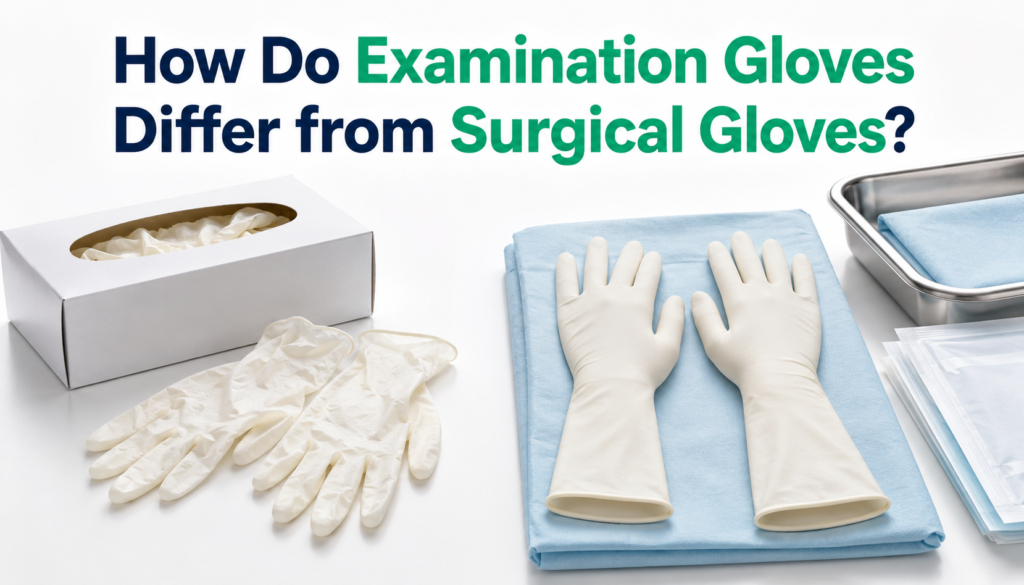
How Do Examination Gloves Differ from Surgical Gloves?
Examination Gloves differ from Surgical Gloves because they are intended mainly for routine examination and non-surgical clinical contact, while Surgical Gloves are intended for sterile operative use with more procedure-specific packaging, construction, sizing, and fit requirements. Sterility alone does not determine glove category.
This page covers routine clinical roles, Examination versus Surgical distinctions, sterile and non-sterile Examination Gloves, FDA classification and AQL, construction, sizing, fit, materials, clinical use, change-out, failure, category escalation, and final suitability verification.
This article provides educational Examination Glove guidance and does not replace product labeling, facility infection-control procedures, clinical training, occupational-health protocols, or task-specific PPE assessment. Examination Gloves do not guarantee protection from infection, needlesticks, hazardous drugs, chemicals, or glove-related skin reactions.
What are Examination Gloves, and which routine clinical tasks do they support?
Examination Gloves are disposable medical barriers intended primarily for patient examination and routine non-surgical clinical activities.
They sit within the wider category of medical gloves but retain their own intended-use boundary: routine examination and other non-operative clinical contact rather than surgical use.
What defines Examination Gloves?
Examination Gloves are disposable medical gloves intended for patient examination and other non-surgical clinical activities where contact with potentially infectious materials or contaminants may occur.
The FDA’s polymer patient Examination Glove classification describes a disposable medical barrier used against potentially infectious materials and other contaminants; exact use still depends on product labeling and facility procedure. [FDA]
Which clinical tasks commonly use Examination Gloves?
Examination Gloves commonly support routine examinations and non-surgical clinical tasks when contact precautions or exposure risks indicate glove use. Intended use matters because they are built around routine clinical contact.
Examples may include routine physical examinations, venipuncture, specimen handling, contact with mucous membranes or non-intact skin, selected diagnostic procedures, and handling contaminated equipment when the product label and facility protocol support the task.
What barrier role do Examination Gloves provide?
Examination Gloves provide a temporary barrier that can help reduce contamination transfer among patients, healthcare workers, equipment, instruments, and nearby surfaces.
The barrier is disposable and task-specific. Tears, punctures, contamination, poor fit, material degradation, or use across unrelated tasks can compromise its reliability.
What do Examination Gloves not replace?
Examination Gloves do not replace hand hygiene, aseptic technique, environmental cleaning, correct task separation, safe sharps handling, or procedure-specific PPE.
They also do not sterilize hands, equipment, or surfaces and do not guarantee prevention of infection or contamination.
Which hazards exceed standard Examination Gloves?
Standard Examination Gloves should not automatically be relied upon for surgical procedures, sharps protection, hazardous drugs, concentrated chemicals, heat, electricity, or heavy mechanical hazards.
Those exposures require a separately verified surgical or specialist glove category, engineering controls, workplace procedures, and product-specific evidence rather than assumptions based on the words medical, sterile, nitrile, thick, or long cuff.
How do Examination Gloves differ from Surgical Gloves in intended use, sterility, packaging, and fit?
Examination and Surgical Gloves differ primarily in intended use, sterility pattern, packaging, hand geometry, sizing precision, and fit priorities.
How does intended use differ?
Examination Gloves are intended mainly for patient examination, diagnostics, and routine non-surgical care, while Surgical Gloves are intended for operative procedures.
FDA classifications separate the patient Examination Glove barrier role from the Surgeon’s Glove category used in surgical settings. [FDA Exam][FDA Surgical]
How does sterility differ?
Most Examination Gloves used in routine care are non-sterile, although sterile Examination Gloves are available, while Surgical Gloves are supplied sterile for surgical use.
Sterility is one product attribute. It does not override intended use, regulatory category, packaging, construction, sizing, or procedure-specific labeling.
How does packaging differ?
Non-sterile Examination Gloves are commonly box-dispensed, while sterile Examination Gloves and Surgical Gloves use packaging intended to preserve sterility until opening.
Surgical Gloves are commonly supplied as sterile pairs. Packaging supports the intended workflow but does not independently prove that a glove belongs to a surgical category.
How does hand geometry differ?
Examination Gloves commonly use an ambidextrous form, while Surgical Gloves commonly use separate left- and right-hand anatomical shapes.
Ambidextrous construction supports rapid access and simplified inventory; hand-specific construction supports procedure-focused alignment. Neither pattern should be judged without checking the finished glove and intended task.
How does sizing differ?
Examination Gloves commonly use alpha sizes such as XS through XL, while Surgical Gloves commonly use more precise numerical sizing.
Alpha sizing simplifies broad clinical inventory. Numerical surgical sizing provides closer increments but belongs to the surgical-use system rather than this Examination Glove page.
How does fit priority differ?
Examination Gloves prioritize rapid access, practical routine fit, and inventory simplicity, while Surgical Gloves prioritize anatomical shaping and extended procedural control.
The contrast is not a universal quality ranking. Each category should be evaluated against the task it is intended to support.
Which Surgical Glove details should this page avoid duplicating?
Detailed surgical antisepsis, sterile gloving techniques, numeric sizing, double-gloving, surgical materials, and extended procedural fit belong to Surgical Glove guidance. The relevant contrast remains narrow because surgical barrier control has its own operative-use requirements.
| Comparison Attribute | Examination Gloves | Surgical Contrast | Why It Matters | Deeper Surgical Route |
|---|---|---|---|---|
| Intended use | Routine examination and non-surgical clinical contact | Operative procedures | Intended use determines category ownership | Surgical procedure guidance |
| Sterility | Commonly non-sterile; sterile products also exist | Supplied sterile for surgical use | Sterility alone does not define category | Surgical sterilization |
| Packaging | Box dispenser or sterile individual packaging | Commonly sterile paired packaging | Packaging supports workflow but does not replace labeling | Surgical sterile preparation |
| Hand geometry | Commonly ambidextrous | Commonly left/right hand-specific | Geometry changes speed, inventory, and anatomical alignment | Surgical anatomical fit |
| Sizing | Broad alpha sizes | More closely graduated numerical sizes | Sizing system reflects different fit priorities | Surgical sizing guidance |
| Fit priority | Practical routine fit and rapid replacement | Extended procedural control | The correct fit depends on the intended task | Surgical fit guidance |
| Barrier context | Temporary routine clinical barrier | Procedure-specific operative barrier | Neither category is universally protective | Surgical barrier control |
| Workflow | Change by patient, task, site, contamination, or damage | Procedure-specific sterile workflow | Workflow ownership must remain separate | Facility surgical protocol |
How do sterile and non-sterile Examination Gloves differ?
Sterile and non-sterile Examination Gloves differ in sterility status, packaging, and intended clinical use, but both remain Examination Gloves when their labeling and regulatory category identify them as patient Examination Gloves.
Sterility needs separate verification because sterile or non-sterile Examination Gloves remain part of the Examination Glove category when intended use and labeling support that classification.
What are non-sterile Examination Gloves?
Non-sterile Examination Gloves support routine clinical contact when the procedure and facility protocol do not require a sterile glove.
They are commonly supplied in dispenser boxes for rapid access. Non-sterile does not mean non-medical, but the product is unsuitable when the task requires a sterile glove.
What are sterile Examination Gloves?
Sterile Examination Gloves may support selected clinical or aseptic tasks when product labeling and facility protocol require a sterile patient Examination Glove.
FDA record K232039 provides a product-specific example of a sterile, powder-free nitrile patient Examination Glove. That record proves sterile Examination Gloves exist; it does not assign the product to every procedure. [FDA 510(k)]
Does sterility make an Examination Glove surgical?
Sterility does not make an Examination Glove surgical because glove category also depends on intended use, regulatory status, labeling, construction, sizing, and performance claims.
A sterile Examination Glove remains an Examination Glove when its official category and intended use identify it as a patient Examination Glove.
What should determine whether sterile Examination Gloves are needed?
The exact clinical procedure, product labeling, facility protocol, infection-control guidance, and required sterile-field boundary should determine whether sterile Examination Gloves are needed.
Package integrity and expiration or storage instructions should be checked where sterility is required. The page should not replace local clinical policy with a universal procedure list.
| Sterility Status | Typical Examination Role | Packaging Pattern | What It Confirms | What It Does Not Confirm |
|---|---|---|---|---|
| Non-sterile Examination Gloves | Routine clinical contact where sterility is not required | Commonly multi-glove dispenser box | Medical Examination Glove category when labeled | Surgical suitability or sterile-field use |
| Sterile Examination Gloves | Selected tasks requiring a sterile patient Examination Glove | Sterility-preserving individual or paired configuration | Sterile status for the labeled product | Surgical category or universal procedure approval |
| Sterile Surgical Gloves | Operative procedures | Sterile paired packaging | Surgical intended use and sterile supply | Chemical, hazardous-drug, or sharps protection without separate claims |
| Compromised sterile package | No acceptable sterile use | Opened, wet, torn, damaged, or otherwise compromised | Nothing about current sterility | Safe sterile use |
How should FDA classification and AQL be interpreted for Examination Gloves?
FDA classification confirms that patient Examination Gloves are regulated medical devices, while AQL provides lot-level leakage-quality evidence rather than a guarantee for each individual glove.
What does medical-device status mean for Examination Gloves?
Medical-device status means patient Examination Gloves are regulated for a defined medical barrier use rather than sold only as general-purpose disposable gloves.
The label, intended use, device classification, and applicable regulatory requirements matter; medical-device status does not approve every product for every clinical task.
Which performance areas may be evaluated?
FDA review may evaluate leak resistance, selected physical properties, biocompatibility, labeling, and intended use. Those review areas provide regulatory evidence without eliminating all defects or replacing task-specific assessment. [FDA]
What does AQL mean for Examination Gloves?
AQL is a statistical lot-sampling concept used to determine whether a glove production lot meets defined acceptance criteria for leakage defects.
A sample is tested and the lot is accepted or rejected under the applicable framework. AQL is not a fixed number of defective gloves in every retail box.
How does the Examination Glove AQL compare with Surgical Gloves?
The FDA leakage-sampling framework uses 2.5 AQL for patient Examination Gloves and 1.5 AQL for Surgeon’s Gloves.
The lower Surgeon’s Glove value represents a stricter allowable lot-quality threshold, not perfect quality or an individual-glove guarantee. [eCFR]
What does AQL not prove?
AQL does not prove that every glove is defect-free or that the product is sterile, chemical-resistant, hazardous-drug compatible, needle-protective, or suitable for a particular procedure.
Those attributes require separate labeling, product data, task assessment, and facility approval.
Can a lower-AQL Examination Glove become a Surgical Glove?
A lower AQL does not convert an Examination Glove into a Surgical Glove because intended use, sterility, regulatory category, packaging, hand geometry, and labeling still control the classification.
AQL remains relevant as lot-quality evidence, but it cannot replace the category-defining attributes.
In the United States, powdered patient Examination Gloves and powdered Surgeon’s Gloves are banned medical devices; powder-free status still does not mean allergy-free. [Federal Register]
| Term | Correct Meaning | Examination-Glove Relevance | Surgical Contrast | What It Does Not Prove |
|---|---|---|---|---|
| Patient Examination Glove | Regulated medical barrier category | Defines routine examination ownership | Different intended-use category | Universal procedure suitability |
| Medical-device labeling | Identifies medical intended use and claims | Separates medical from general-purpose gloves | Surgical labeling remains distinct | Suitability for every patient or task |
| FDA review | May include leakage, physical properties, biocompatibility, labeling, and intended use | Provides regulatory evidence | Review expectations vary by category | Zero defects |
| AQL | Statistical lot-sampling acceptance concept | Supports leakage-quality assessment | Different threshold applies | Exact box defect percentage |
| AQL 2.5 | Patient Examination Glove threshold in 21 CFR 800.20 | Lot-level examination-glove evidence | Less strict than 1.5 threshold | Sterility or procedure approval |
| AQL 1.5 | Surgeon’s Glove threshold in 21 CFR 800.20 | Controlled comparison only | Stricter lot-quality threshold | Perfect surgical glove |
| Powder-free status | No banned donning powder configuration | Required U.S. context for current patient Examination Gloves | Also applies to current Surgeon’s Gloves | Allergy-free status |
| Sterile claim | Product supplied with a sterile claim and intact package | Can apply to selected Examination Gloves | Common surgical requirement | Automatic Surgical Glove classification |
How do Examination Gloves use ambidextrous construction, alpha sizing, cuffs, and standard fit?
Examination Gloves commonly use ambidextrous construction and broad alpha sizing to support rapid routine use, but palm, finger, thumb, webbing, and cuff fit still affect control and comfort.
Why are many Examination Gloves ambidextrous?
Many Examination Gloves are ambidextrous so one glove design can fit either hand and simplify rapid access, stocking, and replacement.
The trade-off is less anatomical shaping for some hand proportions, so thumb position, webbing comfort, and palm stability still require a practical check.
Why do Examination Gloves commonly use alpha sizing?
Alpha sizes such as XS through XL simplify inventory while providing broad fit options for routine clinical teams.
Broad sizing may not accommodate every finger, palm, thumb, or wrist proportion equally, so the exact manufacturer chart and finished product remain important.
How should Examination Gloves fit across the palm?
The palm should remain stable without twisting, deep bunching, painful tension, or circulation restriction.
The wearer should open and close the hand and handle an appropriate clinical object. One wrinkle or one pressure point should not be used alone to determine size.
How should Examination Gloves fit around the fingers?
The fingers should permit controlled movement without painful compression, excessive fingertip material, large webbing gaps, or restricted flexion.
Fine manipulation should remain possible, but tactile feel cannot override the glove’s primary clinical and barrier requirements.
How should Examination Gloves fit around the thumb and webbing?
The thumb and finger webbing should move without seam strain, pulling, pinching, or restrictive tension.
Misalignment can rotate the glove, fatigue the hand, or increase stress at the thumb web even when the nominal size appears correct.
How should Examination Glove cuffs fit?
The cuff should remain secure for the intended task without rolling, gaping, excessive pressure, or unsafe interference with sleeves or other PPE.
A beaded cuff may support donning and edge stability, but cuff design does not prove surgical, chemical, or hazardous-drug suitability.
Does a longer cuff or tighter fit change the Examination Glove category?
A longer cuff, tighter fit, or thicker film does not convert Examination Gloves into Surgical, chemotherapy-tested, or chemical-resistant gloves.
Those categories require their own intended-use labeling, product evidence, and task-specific verification.
How do Examination Gloves differ by material, comfort, allergy concerns, and task limits?
Examination Glove materials differ in elasticity, tactile feel, fit stability, durability, additive profile, and task compatibility, but the finished glove must be evaluated rather than the polymer name alone.
How do latex Examination Gloves perform?
Latex Examination Gloves may provide elasticity, close fit, tactile sensitivity, and comfortable movement, but natural-rubber latex proteins can trigger reactions in sensitized people.
Latex suitability depends on the user, facility policy, powder-free status, product labeling, and the exact clinical task. Powder-free does not mean allergy-free.
How do nitrile Examination Gloves perform?
Nitrile Examination Gloves avoid natural-rubber latex proteins and may provide useful durability, fit, and puncture resistance for many routine examination tasks.
Nitrile is not automatically compatible with every disinfectant, solvent, hazardous drug, or prolonged chemical exposure; the exact product and exposure data must be checked.
How do vinyl Examination Gloves perform?
Medically labeled vinyl Examination Gloves may suit selected short-duration, lower-stress tasks, but their lower elasticity can reduce fit stability and tactile control.
Vinyl should not be treated as universally appropriate or inappropriate. Fluid exposure, movement, duration, labeling, and facility procedure determine suitability.
How do chloroprene and other synthetic Examination Gloves perform?
Chloroprene and other synthetic Examination Gloves may offer alternative balances of elasticity, comfort, fit, and latex avoidance, but performance depends on the finished product.
Latex-free does not mean accelerator-free or reaction-free, and one synthetic polymer does not establish chemical or hazardous-drug compatibility.
Can material choice change the Examination Glove category?
Material choice does not convert an Examination Glove into a Surgical, chemotherapy-tested, chemical-resistant, cut-resistant, or needlestick-resistant glove.
Category depends on intended use, labeling, tested claims, construction, and task conditions rather than polymer name alone.
| Feature or Material | Potential Benefit | Main Limitation | Practical Check | Verification Needed |
|---|---|---|---|---|
| Ambidextrous construction | Rapid access and simpler stocking | Less anatomical shaping for some hands | Check palm, thumb, and webbing stability | Exact product fit |
| Alpha sizing | Efficient broad inventory | May not suit unusual proportions | Check fingers, palm, thumb, wrist, and cuff | Manufacturer chart |
| Palm and finger fit | Control and reduced bunching | Too tight may fatigue or tear; too loose may rotate | Open, close, and manipulate safely | Task-specific fit |
| Cuff design | Wrist security and easier donning | Rolling, gaping, pressure, or PPE interference | Check movement and clothing/PPE interaction | Product instructions |
| Latex | Elasticity and close fit | Natural-rubber latex protein concern | Review user and facility restrictions | Latex and powder-free labeling |
| Nitrile | Latex-protein avoidance and useful routine durability | Chemical and drug compatibility remains product-specific | Inspect fit and task exposure | Manufacturer compatibility data |
| Vinyl | Latex-free and easy donning for selected tasks | Lower elasticity and fit stability | Limit to supported lower-stress uses | Medical labeling and task conditions |
| Chloroprene / other synthetic | Alternative comfort and elasticity profiles | Additives and performance vary | Check finished-glove behavior | Exact formulation and claims |
How should Examination Gloves be donned, changed, removed, and discarded during patient care?
Examination Gloves should be selected for one defined clinical task, donned with clean technique, changed when the patient, task, contamination zone, or glove condition changes, removed safely, and discarded after use.
What should happen before donning Examination Gloves?
Before donning Examination Gloves, confirm that gloves are indicated, perform hand hygiene as required, dry the hands sufficiently, select the correct product, and inspect it for visible damage. Gloves are not a substitute for hand hygiene. [CDC]
How should Examination Gloves be donned?
Examination Gloves should be donned without unnecessary contact with unrelated surfaces or avoidable contamination of the areas intended for patient contact.
The wearer should avoid stretching the cuff excessively, using a visibly damaged glove, or continuing when fit creates painful tension or loss of control.
When should Examination Gloves be changed?
Examination Gloves should be changed between patients, after the task, during indicated contaminated-to-clean transitions, and whenever they are damaged, soiled, contaminated, or degraded.
CDC guidance lists damage, blood or body-fluid soil, patient changes, and movement from a contaminated body site to a clean body site as change triggers. [CDC][CDC Body Site]
How should Examination Gloves be removed?
Examination Gloves should be removed using the facility-approved technique that limits contact between bare skin and the contaminated exterior.
The page should reinforce the contamination-control principle without replacing hands-on clinical training or local procedure.
What should happen after Examination Gloves are removed?
After removal, Examination Gloves should be discarded through the correct waste route, followed immediately by hand hygiene and any required exposure assessment.
Visible cleanliness of the hands does not remove the post-removal hand-hygiene requirement.
Can Examination Gloves be washed or reused?
Disposable Examination Gloves should not be washed, disinfected for reuse, shared, re-donned, or used for multiple patients.
CDC core practices call for discarding disposable gloves after the task and prohibit using the same pair for more than one patient. [CDC]
Which glove-use techniques belong to the Surgical Gloves page?
Surgical hand antisepsis, closed gloving, open sterile gloving, gown-cuff integration, and surgical double-gloving belong to Surgical Glove guidance and facility training.
This page stops at Examination Glove workflow and routing.
When should Examination Gloves be changed, and when are Surgical or specialist gloves required?
Examination Gloves should be changed immediately after contamination, damage, degradation, patient or task transition, while surgical and specialist hazards require a different glove category from the start.
What if Examination Gloves tear or puncture?
A torn or punctured Examination Glove no longer provides a reliable barrier and should be replaced immediately.
The wearer should stop safely, remove and discard the glove, perform hand hygiene, inspect the hand, replace the glove if the task continues, and follow facility exposure procedures when contact may have occurred.
What if Examination Gloves become contaminated or visibly soiled?
Contaminated or visibly soiled Examination Gloves should be changed because continued use can transfer material to another body site, instrument, surface, or patient.
The glove should not be wiped clean and reused. The next task requires a new pair after appropriate hand hygiene.
What if Examination Gloves swell, soften, become sticky, discolor, or lose strength?
Swelling, softening, stickiness, discoloration, or loss of strength may indicate material incompatibility or degradation.
Stop the exposure, remove the glove safely, follow the facility response, and verify the exact product against the exact substance, concentration, contact mode, duration, and manufacturer data.
What if a needlestick or sharps injury occurs through Examination Gloves?
A needlestick or sharps injury requires immediate facility post-exposure action because Examination Gloves are not puncture-proof and do not eliminate exposure risk.
Engineering controls, safer devices, proper handling, and sharps disposal remain primary prevention measures; an actual incident should be reported and evaluated under the facility protocol. [OSHA][OSHA Standard]
What if the wearer develops itching, redness, burning, dryness, or rash?
Recurring itching, redness, burning, dryness, or rash may relate to latex proteins, rubber accelerators, sweat, friction, cleansers, or other exposures and requires reassessment rather than continued use.
Stop using the suspected product, document timing and exposures, review materials and workplace products, and seek occupational or qualified medical evaluation when symptoms persist, worsen, or become severe.
When are Surgical Gloves required instead of Examination Gloves?
Surgical Gloves are required when the task is a surgical procedure that calls for sterile surgical-use labeling, procedure-specific barrier control, anatomical construction, and facility surgical protocol.
A sterile Examination Glove, lower AQL, longer cuff, or tighter fit does not replace the Surgical Glove category.
When are specialist gloves required instead of Examination Gloves?
Specialist gloves are required when the task involves hazardous drugs, concentrated chemicals, prolonged solvent contact, cut or sharps hazards, heat, electricity, or heavy mechanical exposure beyond standard Examination Glove claims.
The route should be based on the exact hazard and product evidence rather than a generic recommendation.
| Signal or Task | Likely Meaning | Immediate Action | Next Verification | Escalation |
|---|---|---|---|---|
| Tear or puncture | Barrier integrity lost | Stop, remove, discard, clean hands | Assess possible exposure | Facility protocol if exposure occurred |
| Visible soil or contamination | Cross-contamination risk | Change immediately | Patient, task, and body-site transition | New Examination Glove if still appropriate |
| Swelling, softening, stickiness, discoloration | Possible incompatibility or degradation | Stop contact and remove safely | Exact product and substance data | Chemical or specialist glove guidance |
| Needlestick or sharps injury | Potential occupational exposure | Initiate immediate post-exposure response | Device, incident, and exposure details | Facility exposure-control protocol |
| Recurring skin symptoms | Possible irritant or sensitization pattern | Stop suspected product | Material, accelerators, sweat, friction, cleansers | Occupational or medical evaluation |
| Surgical procedure | Wrong glove category | Do not substitute Examination Gloves | Surgical labeling and facility protocol | Surgical Gloves |
| Hazardous drugs or concentrated chemicals | Standard Examination claim insufficient | Do not proceed without evidence | Exact substance, duration, and product data | Hazard-specific specialist glove |
Which checklist verifies that Examination Gloves are suitable before clinical use?
An Examination Glove suitability checklist should confirm the clinical task, correct glove category, sterility requirement, medical labeling, AQL meaning, material, fit, change-out plan, hand hygiene, and hazard limits.
Examination Glove suitability checklist
Examination Gloves are suitable only when the task, category, sterility, labeling, quality evidence, material, fit, workflow, and hazard limits all align.
Confirm routine examination, diagnostic, specimen, venipuncture, equipment, or another non-surgical clinical task.
Use Examination Gloves only when the task does not require Surgical or specialist protection.
Use the procedure, label, and facility protocol; minor wound procedures do not all create the same requirement.
Confirm patient Examination Glove labeling rather than general-purpose disposable labeling.
Treat AQL as lot-level leakage evidence, not an individual-glove or box-percentage guarantee.
Match the finished glove to user factors, fluid contact, task stress, and product limitations.
Confirm palm stability, fingertip seating, thumb and webbing movement, cuff security, and no painful pressure.
Replace between patients, after the task, during indicated body-site transitions, and after damage, soil, contamination, or degradation.
Follow required pre-use hygiene, safe removal, correct disposal, and immediate post-removal hand hygiene.
Route hazardous drugs, concentrated chemicals, sharps, heat, electricity, and mechanical hazards elsewhere.
Use the Medical, Sterility, Routine Contact, Minor Procedure, Surgical, Hazard, Material, or Fit owner as appropriate.
Checklist limit: Completing this screen does not approve a glove for surgery, hazardous drugs, concentrated chemicals, sharps, heat, electricity, or every infection-control situation.
Conclusion
Examination Gloves are routine clinical barriers whose suitability depends on intended use, sterility, medical labeling, AQL interpretation, material, fit, change-out discipline, and facility procedure. They commonly use ambidextrous construction and alpha sizing for rapid routine care, while Surgical Gloves remain a separate operative-use category with different packaging, geometry, sizing, and fit priorities.
Sterility alone does not determine category, AQL does not guarantee every glove, material names do not establish universal protection, and gloves do not replace hand hygiene. Surgical procedures, hazardous drugs, chemicals, sharps, heat, electrical work, and other specialist tasks require separate verification.
Frequently Asked Questions
Are Examination Gloves always non-sterile?
Examination Gloves are not always non-sterile because sterile patient Examination Gloves are available for selected clinical uses, but sterility does not make them Surgical Gloves.
Can Examination Gloves be used for surgery?
Examination Gloves should not replace Surgical Gloves when the procedure requires a glove intended, labeled, and supplied for surgical use.
Does AQL 2.5 mean that 2.5 percent of Examination Gloves are defective?
AQL 2.5 does not mean exactly 2.5 percent of a retail box is defective because AQL belongs to a statistical lot-sampling acceptance framework.
Are Examination Gloves puncture-proof?
Examination Gloves are not puncture-proof and should not be relied upon to prevent needlestick or sharps injuries.
Can disposable Examination Gloves be washed and reused?
Disposable Examination Gloves should not be washed, disinfected, shared, re-donned, or reused because cleaning does not reliably restore barrier or contamination-control performance.
Does latex-free mean an Examination Glove cannot cause a skin reaction?
Latex-free does not mean reaction-free because rubber accelerators, other additives, sweat, friction, cleansers, or occlusion may still contribute to symptoms.