
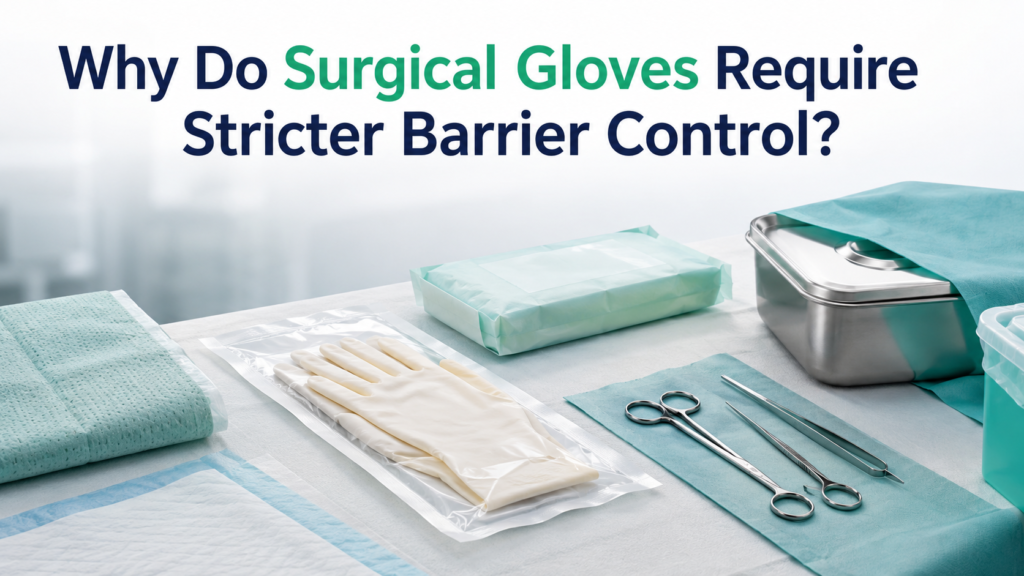
Why Do Surgical Gloves Require Stricter Barrier Control?
Surgical Gloves require stricter barrier control because invasive procedures place the glove barrier inside a higher-consequence sterile-field system. Surgical fields may involve open tissue, internal structures, sterile areas, blood, body fluids, sharp instruments, and prolonged glove wear, so Surgical Gloves help maintain a sterile barrier without creating a perfect barrier.
This page covers sterile surgical-field risk, Surgical Glove barrier role, Surgical versus Examination Glove AQL, material and fit, sterile donning, double-gloving and indicator systems, barrier failure and change-out, and a final pre-incision checklist.
This article provides educational guidance about Surgical Gloves and stricter barrier control and does not replace product labeling, facility operating-room protocol, surgical hand antisepsis procedure, sterile gloving training, infection-control policy, sharps safety systems, occupational-exposure procedures, or surgical team judgment. The exact procedure, sterile-field requirements, patient risk, glove product, and local protocol must determine the correct Surgical Glove system.
How do Surgical Gloves help protect sterile surgical fields from contamination?
Surgical Gloves help protect sterile surgical fields by forming a sterile disposable barrier between the surgical team’s hands and the operative field.
Surgical Gloves belong to the broader category because medical gloves cover clinical-contact, sterile-barrier, and precision-fit needs. Sterile packaging belongs in the wider surgical system because Surgical Glove sterilization supports sterile operative use.
Why are surgical fields higher risk than routine examination contact?
Surgical fields are higher risk than routine examination contact because invasive procedures may expose deeper tissues, internal structures, or sterile body areas.
Intact skin contact is not the same as exposed tissue, and contamination in an operative field can carry higher consequence without meaning every contamination event causes infection.
What role do Surgical Gloves play in sterile-field control?
Surgical Gloves help create a sterile barrier between the surgical team’s hands and the operative field.
They support sterile-field maintenance, reduced contamination transfer, vulnerable-tissue protection, reduced blood and body-fluid contact, and procedure-specific hand control. [FDA][FDA]
Do Surgical Gloves create a perfect zero-risk barrier?
Surgical Gloves reduce risk, but they do not create a perfect, permanent, or zero-risk barrier.
Performance depends on surgical hand antisepsis, intact sterile packaging, proper sterile gloving, correct size and material, contamination avoidance, active monitoring, and timely replacement.
Why is stricter barrier control needed?
Stricter barrier control is needed because invasive procedures combine open tissue, blood and body fluids, sharp instruments, prolonged wear, mechanical friction, sterile fields, and higher consequences if contamination occurs.
Surgical Gloves help maintain the barrier, but barrier control is a system of product selection, technique, monitoring, and change-out.
Exposed sterile tissue
Barrier RoleHelps separate hands from vulnerable tissue.
LimitDoes not eliminate contamination risk.
MonitorSterile technique and glove integrity.
Blood and body fluids
Barrier RoleHelps reduce wearer contact and transfer.
LimitDoes not replace sharps safety or exposure response.
MonitorTears, punctures, and visible contamination.
Sharp instruments
Barrier RoleProvides a disposable barrier layer.
LimitNot puncture-proof.
MonitorNeedles, blades, snags, and indicator changes.
Prolonged wear
Barrier RoleSupports ongoing hand barrier during the case.
LimitMaterial fatigue or unnoticed perforation may occur.
MonitorFacility change-out triggers.
Sterile field contact
Barrier RoleHelps maintain sterile boundary.
LimitContaminated contact can compromise control.
MonitorNon-sterile surface contact and field integrity.
These cards explain barrier-control logic only and do not replace operating-room protocol.
How do Surgical Gloves differ from Examination Gloves in AQL and barrier expectations?
Surgical Gloves differ from Examination Gloves in barrier expectations because surgeons’ gloves use a stricter FDA leakage-quality threshold and are intended for sterile surgical procedures.
Barrier expectations differ because Examination vs Surgical Gloves separate intended use, sterility, packaging, construction, sizing, and fit.
What does AQL mean for Surgical Gloves?
AQL is a statistical lot-sampling concept used to evaluate whether a Surgical Glove production lot meets required leakage-quality acceptance criteria.
AQL is not a promise that every individual glove is defect-free, sterile by itself, or protected from future intraoperative perforation.
How does Surgical Glove AQL compare with Examination Glove AQL?
Under the FDA leakage-quality framework, Surgical Gloves use the stricter 1.5 AQL threshold while patient Examination Gloves use the 2.5 AQL threshold.
Those numbers compare production-lot leakage quality; they should not be converted into a direct infection-risk figure or individual-glove probability. [eCFR][FDA]
Why is the Surgical Glove threshold stricter?
The Surgical Glove threshold is stricter because Surgical Gloves are used in operative settings where barrier failure can carry higher consequences.
Stricter lot-quality supports intended use, but it does not replace monitoring, sterile technique, correct fit, or change-out.
What does AQL not prove?
AQL does not prove every glove is flawless, sterile by itself, chemically compatible, sharps-protective, future-perforation-proof, procedure-suitable, or exempt from double-gloving and change-out protocols.
Product labeling, sterile package integrity, facility policy, procedure stress, and intraoperative monitoring still matter.
What should be checked before using Surgical Gloves?
Before using Surgical Gloves, the team should verify surgical labeling, sterile package integrity, labeled shelf-life, material, size, product documentation, and facility-approved supply status.
The practical check turns lot-level quality into a case-level readiness screen without treating AQL as full clinical approval.
Intended use
Surgical MeaningSurgical Gloves are intended for surgical procedures.
Avoid MisreadingSterile Examination Gloves are not automatically Surgical Gloves.
AQL
Surgical MeaningSurgeons’ gloves use the 1.5 AQL threshold.
Avoid MisreadingAQL does not guarantee every glove.
Examination contrast
Surgical MeaningPatient Examination Gloves use the 2.5 AQL threshold.
Avoid MisreadingExamination AQL is not a surgical-use approval.
Sterility
Surgical MeaningSurgical Gloves are supplied sterile for surgical use.
Avoid MisreadingSterility does not prevent future perforation.
Pre-use quality check
Surgical MeaningLabel, package, shelf-life, material, size, and approved supply status must align.
Avoid MisreadingA clean-looking package is not enough if compromised or out of date.
Which Surgical Glove materials support stricter barrier control?
Surgical Glove materials support stricter barrier control only when the finished glove’s material, fit, sterile labeling, package integrity, additive profile, and procedure suitability are verified.
Barrier control also depends on fit because Surgical Glove anatomical fit supports surgical control during precise hand movements.
When do latex Surgical Gloves support barrier control?
Latex Surgical Gloves may support barrier control when elasticity, close fit, tactile sensitivity, and comfortable movement are needed and latex use is permitted.
Latex is not suitable for every surgical environment or exposure type because natural-rubber latex proteins may trigger Type I latex allergy in sensitized patients or staff.
When do polyisoprene Surgical Gloves support barrier control?
Polyisoprene Surgical Gloves may support barrier control when a latex-like fit and tactile feel are needed without natural-rubber latex proteins.
Finished product performance still varies by manufacturer, and latex-free does not automatically remove every additive or dermatitis concern.
When do polychloroprene Surgical Gloves support barrier control?
Polychloroprene Surgical Gloves may support barrier control when a synthetic Surgical Glove with useful fit, barrier, and durability characteristics is needed.
Chemical compatibility, tactile feedback, fatigue, and performance depend on the finished glove and exact substance, so product labeling and manufacturer data remain necessary.
Can material alone guarantee Surgical Glove performance?
Material alone cannot guarantee Surgical Glove performance because surgical suitability depends on intended use, sterile labeling, package integrity, fit, design, additives, procedure demands, and facility-approved product status.
No material should be treated as universally best, puncture-proof, chemical-proof, or automatically safe for every case.
Latex
Potential FitFine tactile work and close hand feedback when latex is permitted.
LimitLatex proteins may trigger allergy in sensitized patients or staff.
VerifyAllergy history, facility policy, and product labeling.
Polyisoprene
Potential FitLatex-like feel in latex-sensitive environments.
LimitAdditives, thickness, texture, and sizing still vary.
VerifyProduct-specific allergen and performance information.
Polychloroprene
Potential FitSynthetic Surgical Glove option for selected cases.
LimitChemical compatibility and tactile feel are product-specific.
VerifyManufacturer data and facility supply policy.
Material alone
Potential FitNo material guarantees surgical suitability by itself.
LimitFinished glove design and procedure demands control suitability.
VerifyIntended use, sterile labeling, package, fit, and policy.
How should Surgical Gloves be donned and used with double-gloving systems?
Surgical Gloves should be donned and used according to facility-approved sterile technique, with double-gloving or indicator systems added when procedure risk, sharps exposure, duration, or policy requires them.
Breach visibility can matter because indicator undergloves can help reveal some barrier breaches, while still requiring monitoring and change-out.
What should happen before donning Surgical Gloves?
Before donning Surgical Gloves, the surgical team should perform surgical hand antisepsis, confirm gowning and gloving sequence, select the correct glove, inspect sterile packaging, and use facility-approved sterile technique.
CDC hand-hygiene guidance supports surgical hand antisepsis before sterile gloves and surgery, but local protocol controls the exact product and method. [CDC][CDC]
Which sterile gloving method should be used?
The sterile gloving method should be the facility-approved method for the case and context.
Closed gloving, open sterile gloving, and assisted gloving may each be appropriate in different contexts, but this article does not teach the step-by-step method.
When is double-gloving used with Surgical Gloves?
Double-gloving may be used when procedure risk, case duration, sharps exposure, orthopedic or trauma conditions, facility policy, team protocol, or indicator-glove availability supports an added barrier layer.
Evidence reviews support double-gloving as a way to reduce inner-glove contamination or exposure when the outer layer is perforated, but they do not make it a universal mandate. [Cochrane]
How do indicator Surgical Glove systems help?
Indicator Surgical Glove systems use contrasting glove layers so fluid between layers can make some outer-glove perforations easier to see.
Indicator systems may improve detection of some outer-glove perforations, but they do not detect every breach, prove surgical-site infection reduction, or replace monitoring. [PMC]
What should happen if the indicator system shows a breach?
If an indicator system shows a suspected or visible breach, the compromised glove layer should be replaced and the sterile field should be reassessed according to facility protocol.
Replace the outer glove, consider inner-layer replacement when inner contamination is suspected, reassess the field, and continue only when the facility protocol allows.
Surgical hand antisepsis
CheckApproved product and protocol before sterile gloves.
RiskContaminated start.
Sterile gowning and gloving
CheckFacility-approved method and intact sterile package.
RiskTechnique or package compromise.
Double-gloving decision
CheckProcedure risk, duration, sharps, trauma/orthopedic needs, or policy.
RiskAdded layer omitted when protocol requires it.
Indicator monitoring
CheckWatch for color change, tear, puncture, or contamination.
RiskUnnoticed outer-glove breach.
Replace when indicated
CheckBreach, contamination, degradation, protocol interval, or high-risk step.
RiskContinued use after compromise.
Surgical Hand Antisepsis → Sterile Gowning → Facility-Approved Gloving → Optional/Risk-Based Double-Gloving → Monitor Barrier → Replace When Indicated.
How should Surgical Gloves be managed when barrier failure is suspected?
Suspected Surgical Glove barrier failure should trigger safe pause, glove replacement, field reassessment, and exposure-response steps when needed.
What should happen if Surgical Gloves tear or puncture?
If Surgical Gloves tear, puncture, snag, split, or show visible damage, the affected glove layer should be removed and replaced as safely and promptly as the procedure allows.
If inner-layer contamination is possible, additional layers and the sterile field should be reassessed before continuing.
What should happen if Surgical Gloves are contaminated?
If Surgical Gloves touch a non-sterile surface, contaminated item, or area outside the sterile boundary, the contaminated glove should be replaced and the affected field should be reassessed.
Contaminated supplies or field elements should be replaced according to facility protocol before the team continues.
What should happen when Surgical Gloves are worn for a long time?
Longer procedures can increase the chance of unnoticed perforation or material fatigue, so Surgical Glove integrity should be monitored and changed according to facility protocol.
Use facility-defined change intervals, natural procedural breaks, high-risk step triggers, and immediate replacement when perforation is suspected or detected.
What should happen after a needlestick or sharp injury through Surgical Gloves?
A needlestick or sharp injury through Surgical Gloves should be managed through facility occupational-exposure procedures because Surgical Gloves are not puncture-proof.
Sharps safety relies on safer devices, handling, disposal, reporting, and medical evaluation when exposure may occur; glove presence does not prove no exposure happened. [OSHA][OSHA][NIOSH]
What should happen if Surgical Gloves degrade during exposure to products or chemicals?
If Surgical Gloves soften, swell, become sticky, discolor, lose strength, or feel compromised, the affected glove should be replaced and product compatibility should be checked.
Material degradation, unusual chemical contact, or substance-specific exposure should be handled through manufacturer compatibility data, facility policy, and specialist PPE when routine Surgical Gloves are not enough.
Tear, puncture, snag, or split
ActionReplace affected glove layer safely and promptly.
RecheckInner layer and sterile field if contamination is possible.
Non-sterile contact
ActionReplace contaminated glove and stop contaminated action.
RecheckAffected sterile item, field, or supply.
Long wear
ActionMonitor integrity and change per protocol or procedural break.
RecheckHigh-risk steps and suspected perforation.
Needlestick or sharp injury
ActionStop safely, remove gloves, wash or flush as appropriate.
RecheckReport and follow exposure-response protocol.
Softening, swelling, stickiness, discoloration, or weakness
ActionReplace affected glove and check compatibility.
RecheckProduct data and specialist PPE need.
Which checklist verifies Surgical Gloves before incision?
A Surgical Glove pre-incision checklist should verify procedure indication, surgical product category, sterile package integrity, material, allergy profile, fit, quality documentation, gloving method, double-gloving decision, monitoring plan, change-out plan, and exposure-response readiness.
Surgical Glove pre-incision suitability checklist
Surgical Gloves are suitable before incision only when procedure need, surgical labeling, sterile packaging, material, fit, documentation, gloving method, double-gloving decision, monitoring, change-out, and exposure-response checks align.
Confirm Surgical Gloves are required.
Verify product is labeled as Surgical Gloves.
Check package is intact, dry, sealed, and in date.
Match material to case needs.
Review latex and additive concerns.
Check fingertips, webbing, palm, cuff, and movement.
Confirm approved supply and documentation.
Use facility-approved sterile method.
Decide by risk, duration, sharps, indicator use, and policy.
Watch for tear, puncture, contamination, degradation, or indicator change.
Confirm change-out and exposure-response plan.
A completed checklist supports readiness, but product labeling, sterile technique, facility policy, and surgical team judgment still control final use.
Conclusion
Surgical Gloves require stricter barrier control because invasive procedures place the glove barrier inside a higher-consequence sterile-field system. Surgical glove suitability depends on the surgical indication, sterile packaging, intended surgical labeling, AQL context, material, fit, quality documentation, and facility-approved sterile gloving.
Surgical Gloves are not perfect barriers, and AQL is not an individual-glove guarantee. Double-gloving and indicator systems are risk- or protocol-based, indicator systems may help detect some outer-glove perforations without detecting every breach, and tears, punctures, contamination, degradation, or sharps injury require prompt change-out, field reassessment, and exposure-response protocol.
Frequently Asked Questions
Why do Surgical Gloves need stricter barrier control than Examination Gloves?
Surgical Gloves need stricter barrier control because invasive procedures may expose sterile tissue, deeper structures, blood, body fluids, sharp instruments, and sterile fields where contamination can carry higher consequences.
Does 1.5 AQL mean every Surgical Glove is defect-free?
No. AQL is a statistical lot-sampling quality measure, not a guarantee that every individual Surgical Glove is defect-free.
Do Surgical Gloves create a perfect sterile barrier?
No. Surgical Gloves help maintain a sterile barrier, but their protection still depends on surgical hand antisepsis, sterile packaging, proper gloving, correct fit, monitoring, and timely replacement.
Is double-gloving required for every surgery?
Double-gloving is not automatically required for every surgery; it should follow procedure risk, sharps exposure, expected duration, facility policy, surgeon or team protocol, and indicator-system availability.
Do indicator gloves detect every glove perforation?
No. Indicator glove systems may make some outer-glove perforations easier to see, but they do not guarantee detection of every breach or prove surgical-site infection reduction.
What should happen if a Surgical Glove tears or is punctured?
If a Surgical Glove tears or is punctured, the affected glove layer should be replaced, the sterile field should be reassessed, and exposure-response procedures should be followed if injury or contamination is possible.