
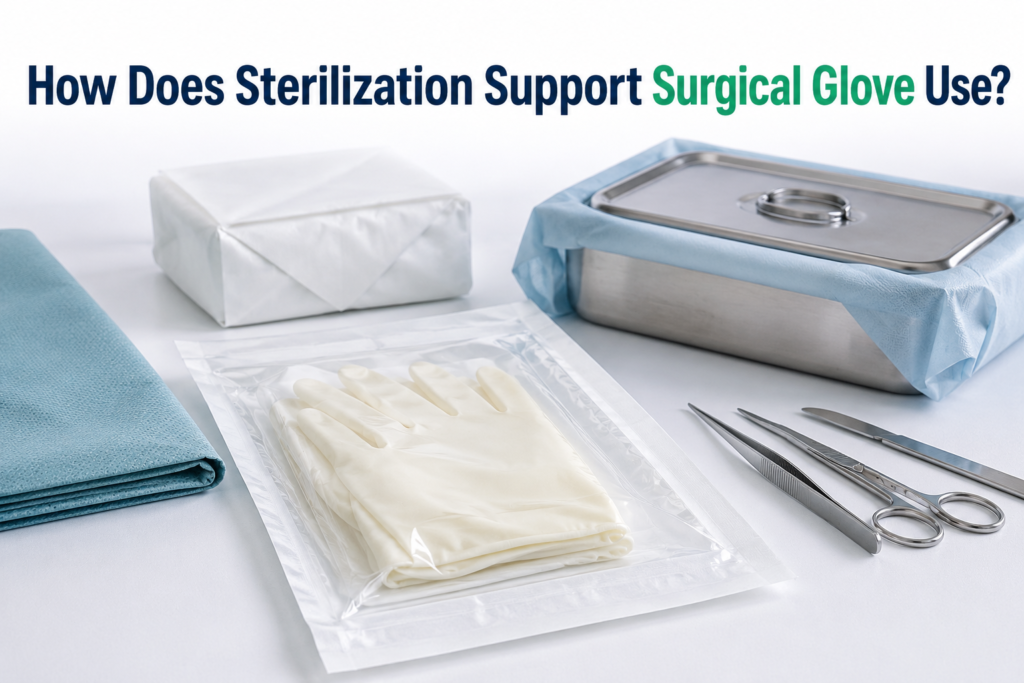
How Does Sterilization Support Surgical Glove Use?
Sterilization supports Surgical Glove use by providing a validated sterile product before opening, but sterile status still depends on intact packaging and correct point-of-use handling. Surgical Gloves require sterile labeling, validated processing, intact packaging, and sterile handling, and sterilization does not guarantee sterility after package damage, wet packaging, incorrect opening, or contaminated contact.
This page covers Surgical Glove sterilization purpose, SAL meaning, radiation, EtO, and e-beam methods, material and sterilization verification, sterile presentation and donning, packaging and sterile-field breach response, and a final sterility verification checklist.
This article provides educational guidance about Surgical Glove sterilization and sterile use and does not replace product labeling, manufacturer validation data, facility operating-room protocol, surgical hand antisepsis procedure, sterile gloving training, infection-control policy, sharps safety systems, occupational-exposure procedures, or surgical team judgment. The exact product, procedure, sterile-field requirement, packaging condition, material, and local protocol must determine whether Surgical Gloves are suitable for use.
Why do Surgical Gloves require validated sterilization before surgical use?
Surgical Gloves require validated sterilization before surgical use because invasive procedures may expose sterile tissue, deeper anatomy, blood, body fluids, or operative fields where microbial contamination can carry serious consequences.
Surgical Gloves belong to the wider category because medical gloves include products with clinical-contact, sterile-barrier, and precision-fit needs. Sterilization is only one layer because barrier control still depends on sterile-field discipline.
What problem does Surgical Glove sterilization address?
Surgical Glove sterilization addresses the microbial risk associated with the packaged glove before it is opened and introduced into a sterile surgical workflow.
Surgical procedures may expose sterile tissue, deeper anatomy, blood, body fluids, or operative fields, so sterilization supports the packaged product before use without eliminating all contamination risk. [FDA][FDA]
What does Sterility Assurance Level mean for Surgical Gloves?
Sterility Assurance Level is a validated sterilization target used by manufacturers as part of process assurance, not a promise that every glove remains sterile after damage, poor storage, incorrect opening, or contaminated handling.
SAL belongs to manufacturer validation and process documentation, and it does not override point-of-use package integrity or sterile handling. [FDA]
Why are non-sterile gloves insufficient for surgical use?
Non-sterile gloves are insufficient for surgical use because they are not intended, packaged, or labeled to maintain sterile surgical fields.
Surgical sterility depends on category control because Examination vs Surgical Gloves in intended use, sterility, packaging, construction, sizing, and fit.
What does sterilization not replace?
Sterilization does not replace surgical hand antisepsis, sterile presentation, proper sterile gloving technique, package inspection, shelf-life verification, sterile-field discipline, or glove change-out when contamination or damage occurs.
Surgical hand antisepsis and facility-approved sterile technique remain separate requirements from sterile packaging. [CDC][CDC]
Validated sterilization
SupportReduces microbial risk in the packaged glove before opening.
LimitDoes not protect after incorrect handling.
VerifySterile labeling and product documentation.
Sterility Assurance Level
SupportShows process assurance target.
LimitDoes not guarantee every glove after package compromise.
VerifyManufacturer validation and package integrity.
Sterile packaging
SupportPreserves sterile contents until opening.
LimitFails if torn, wet, unsealed, or expired.
VerifyIntact, dry, sealed, in-date package.
Aseptic presentation
SupportProtects sterile glove surfaces at point of use.
LimitCan be broken by non-sterile contact.
VerifyFacility opening and sterile-field protocol.
Surgical hand antisepsis and gloving
SupportReduces hand contamination risk before sterile gloves.
LimitDoes not replace glove sterility or package checks.
VerifyFacility-approved method.
How are Surgical Gloves sterilized before use?
Surgical Gloves are sterilized before use through manufacturer-validated processes that must be shown to work for the finished glove, packaging system, and labeled sterile product.
How does radiation sterilization support Surgical Gloves?
Radiation sterilization methods, such as gamma irradiation or electron-beam processing, use ionizing energy to inactivate microorganisms as part of a validated manufacturer process.
General medical-device radiation standards support development, validation, and routine control context, but glove-specific suitability requires finished-product and package documentation. [FDA][FDA]
How does ethylene oxide sterilization support Surgical Gloves?
Ethylene oxide sterilization uses a validated low-temperature gas process that may be selected for products or packaging systems that require that method.
EtO claims should stay product-specific because residual controls, packaging, final labeling, and validation must be confirmed through manufacturer documentation and recognized-standard context. [FDA]
How does electron-beam sterilization support Surgical Gloves?
Electron-beam sterilization uses high-energy electrons as part of a validated sterilization process for the finished glove and its packaging configuration.
It should be discussed as a radiation method without claiming that e-beam is always faster, greener, safer, or packaging-limited unless exact product documentation supports that wording.
Should clinicians choose Surgical Gloves by sterilization method alone?
Clinicians should not choose Surgical Gloves by sterilization method alone because surgical suitability depends on intended use, sterile labeling, package integrity, shelf life, material, allergy concerns, fit, facility approval, and procedure requirements.
Sterile-device submissions and recognized standards support documentation context, but they do not replace product labeling, facility supply systems, or procedure-specific approval. [FDA]
Radiation sterilization
MechanismIonizing energy helps inactivate microorganisms.
VerifyFinished glove, package, cycle, and dose validation.
Avoid ClaimingAll polymers respond the same way.
Ethylene oxide
MechanismValidated low-temperature gas process.
VerifySterilization validation, residual controls, packaging, and final label.
Avoid ClaimingUniversal safety or superiority without product data.
Electron beam
MechanismHigh-energy electrons in a validated radiation process.
VerifyFinished glove and packaging configuration.
Avoid ClaimingAlways faster, greener, or packaging-limited.
Method-alone selection
MechanismMethod is only one product attribute.
VerifyIntended use, label, package, shelf life, material, fit, and policy.
Avoid ClaimingSterilization method alone proves surgical suitability.
Which Surgical Glove materials are compatible with sterilization and surgical use?
Surgical Glove materials are compatible with sterilization and surgical use only when the finished glove, package, labeling, material performance, and manufacturer validation support that use.
Sterile use still depends on hand control because anatomical fit supports surgical control during precise sterile tasks.
How do latex Surgical Gloves fit sterilized surgical use?
Latex Surgical Gloves may fit sterilized surgical use when elasticity, tactile sensitivity, and close fit are needed and latex use is permitted by patient, staff, and facility requirements.
The finished latex glove and package must be validated for the manufacturer’s sterilization process, and latex allergy history, facility policy, and product documentation should control use.
How do polyisoprene Surgical Gloves fit sterilized surgical use?
Polyisoprene Surgical Gloves may fit sterilized surgical use when a latex-like feel is needed without natural-rubber latex proteins.
Latex-free does not mean dermatitis-free, and finished product performance varies by formulation, additives, thickness, package validation, and manufacturer design.
How do polychloroprene Surgical Gloves fit sterilized surgical use?
Polychloroprene Surgical Gloves may fit sterilized surgical use when a synthetic surgical option with useful fit, durability, and barrier characteristics is needed.
Chemical compatibility is product-specific, so protection against bone cement, antiseptics, disinfectants, adhesives, or specialized substances should not be assumed without manufacturer data.
What material claims should the article avoid?
The article should avoid material claims that use unsupported dose ranges, exact strength values, universal sterilization compatibility, universal chemical resistance, or “best” material rankings without product-specific evidence.
Material name alone never proves sterile surgical suitability.
Latex
Surgical RoleElasticity, tactile sensitivity, and close fit where latex is permitted.
Sterilization CheckFinished glove and package must be validated.
VerifyAllergy history, sterile label, facility policy, documentation.
Polyisoprene
Surgical RoleLatex-like feel without natural-rubber latex proteins.
Sterilization CheckFormulation, additives, thickness, and package validation matter.
VerifyAdditive profile, sizing, tactile needs, supply status.
Polychloroprene
Surgical RoleSynthetic option with product-specific fit and barrier characteristics.
Sterilization CheckMethod must be validated for finished glove and package.
VerifyLabeling, manufacturer data, procedure needs, policy.
Material claims
Surgical RoleMaterial name alone is not enough.
Sterilization CheckProduct-level validation controls suitability.
VerifyFinished product data and facility-approved supply list.
How should Surgical Gloves be presented and donned without compromising sterility?
Surgical Gloves should be presented and donned without compromising sterility by verifying the product, inspecting the package, opening aseptically, protecting the sterile field, and using the facility-approved gloving method.
What should be checked before opening Surgical Gloves?
Before opening Surgical Gloves, the team should confirm product category, sterile labeling, intact and dry packaging, shelf-life status, correct size, correct material, and facility-approved product status.
Any torn, wet, unsealed, expired, stained, or uncertain package should be removed from sterile workflow before opening.
How should Surgical Gloves be opened onto the sterile field?
Surgical Gloves should be opened according to product packaging instructions and facility sterile-field protocol so sterile contents, inner wrap, glove surfaces, and the sterile field are not contaminated.
This page explains the boundary without teaching step-by-step package opening.
How should Surgical Gloves be donned?
Surgical Gloves should be donned using the facility-approved sterile gloving method for the case and context.
Closed gloving, open sterile gloving, or assisted gloving may be used where appropriate, but no single method should be presented as universal.
What should happen if sterile glove contact is uncertain?
If the sterile glove exterior touches a non-sterile surface, bare skin, compromised packaging, or an uncertain field, that glove should be replaced and the sterile field should be reassessed according to facility protocol.
Do not wipe or sanitize a contaminated sterile glove exterior for continued sterile use.
Verify product
CheckSurgical category, sterile label, size, material, and approved status.
RiskWrong product or non-sterile product.
Inspect package
CheckIntact, dry, sealed, in-date package.
RiskSterile integrity uncertainty.
Open aseptically
CheckFollow package instructions and sterile-field protocol.
RiskContaminated inner wrap or glove surface.
Don by approved method
CheckClosed, open sterile, or assisted method as protocol requires.
RiskTechnique-related contamination.
Replace if compromised
CheckNon-sterile contact, package concern, tear, puncture, or uncertain field.
RiskContinued sterile-field compromise.
Verify Product → Inspect Package → Open Aseptically → Present to Sterile Field → Don by Approved Method → Monitor for Contamination → Replace if Compromised.
How should Surgical Gloves be managed after packaging or sterile-field breaches?
Surgical Gloves should not be used when packaging, sterile presentation, glove surface, or barrier integrity is damaged, wet, contaminated, punctured, or uncertain.
What should happen if Surgical Glove packaging is damaged?
If Surgical Glove packaging is torn, punctured, crushed, opened, unsealed, expired, or otherwise compromised, the gloves should not be used.
Remove the package from sterile workflow, replace it with intact sterile product, and report or quarantine according to facility supply-chain, infection-control, or manufacturer complaint procedure.
What should happen if Surgical Glove packaging is wet or stained?
Wet, stained, damp, or moisture-compromised Surgical Glove packaging should be treated as unreliable for sterile use.
Do not dry, wipe, reseal, or use the package; replace it with an intact, dry sterile product.
What should happen if a chemical indicator is missing, unclear, or abnormal?
A chemical indicator, when present, can show exposure to a sterilization process but does not independently prove sterility.
Missing, unclear, or abnormal indicators should be handled through product instructions, facility policy, and supply-chain or manufacturer escalation when needed.
What should happen if a sterile Surgical Glove is contaminated or punctured?
If a sterile Surgical Glove is contaminated, torn, punctured, or contacted by a non-sterile surface, the glove should be replaced and the sterile field reassessed.
If puncture or needlestick exposure may have occurred, the team should stop safely and follow facility exposure-response procedures.
What should happen after a needlestick or suspected exposure through Surgical Gloves?
A needlestick or suspected exposure through Surgical Gloves should be managed through facility occupational-exposure procedures because sterile gloves are not puncture-proof.
Sharps injury control depends on safer devices, handling, disposal, reporting, and medical evaluation when exposure may occur. [OSHA][OSHA][NIOSH]
Damaged package
ActionDo not use; remove from sterile workflow.
Follow-UpReplace, report, quarantine, or escalate by facility policy.
Wet or stained package
ActionTreat as compromised.
Follow-UpUse intact dry sterile product.
Unclear chemical indicator
ActionDo not treat the indicator as independent sterility proof.
Follow-UpFollow product instructions and facility policy.
Non-sterile glove contact
ActionReplace glove; do not wipe or sanitize for sterile use.
Follow-UpReassess field and supplies.
Puncture or needlestick exposure
ActionStop safely, replace glove, and follow exposure response if injury occurred.
Follow-UpReport and seek evaluation per protocol.
Which checklist verifies Surgical Glove sterility before incision?
The final Surgical Glove sterility verification checklist should confirm surgical category, sterile labeling, package integrity, shelf life, material, fit, documentation, indicator status when present, aseptic opening, gloving method, sterile-field protection, breach response, and exposure-response readiness.
Surgical Glove sterility verification checklist
Surgical Gloves are ready for use only when sterile status, package integrity, product suitability, presentation, gloving method, breach response, and exposure-response checks align.
Confirm Surgical Glove product.
Verify labeled sterile status.
Check intact, dry, sealed condition.
Confirm product is in date.
Match material to case needs.
Check approved size and control.
Use approved supply or manufacturer data.
Check process indicator if present.
Open aseptically by protocol.
Use approved sterile gloving method.
Protect sterile surfaces and contents.
Replace if contact or integrity is uncertain.
Follow occupational-exposure protocol when needed.
Final sterility verification supports readiness, but product labeling, package integrity, facility protocol, and surgical team judgment still control use.
Conclusion
Sterilization supports Surgical Glove use by providing a validated sterile product before opening, but sterile status is only reliable when the product is labeled sterile, packaged correctly, stored properly, inspected at point of use, opened aseptically, and donned through facility-approved sterile technique.
Damaged, wet, expired, unclear, contaminated, punctured, or uncertain Surgical Gloves should be replaced rather than dried, wiped, resealed, or reused. Manufacturer documentation, package integrity, facility operating-room protocol, sterile-field discipline, and exposure-response procedures remain part of safe sterile Surgical Glove use.
Frequently Asked Questions
How does sterilization support Surgical Glove use?
Sterilization supports Surgical Glove use by providing a validated sterile product before opening, but sterile status still depends on intact packaging, correct storage, aseptic opening, sterile presentation, and facility protocol.
Does Sterility Assurance Level guarantee every Surgical Glove is sterile?
No. Sterility Assurance Level is a process assurance concept, not a guarantee that every glove remains sterile after package damage, poor storage, incorrect opening, or contaminated handling.
Can non-sterile gloves be used for surgical procedures?
Non-sterile gloves are not suitable for surgical procedures that require sterile Surgical Gloves because they are not intended, packaged, or labeled to maintain sterile surgical fields.
Which sterilization method is best for Surgical Gloves?
No sterilization method is universally best for all Surgical Gloves; suitability depends on the finished glove, packaging system, manufacturer validation, sterile labeling, material, and facility-approved product status.
Can Surgical Gloves be used if the package is wet or damaged?
Surgical Gloves should not be used if the package is wet, torn, punctured, crushed, unsealed, expired, stained, or otherwise uncertain.
What should happen if a sterile Surgical Glove touches a non-sterile surface?
If a sterile Surgical Glove touches a non-sterile surface, the glove should be replaced and the sterile field should be reassessed according to facility protocol.