
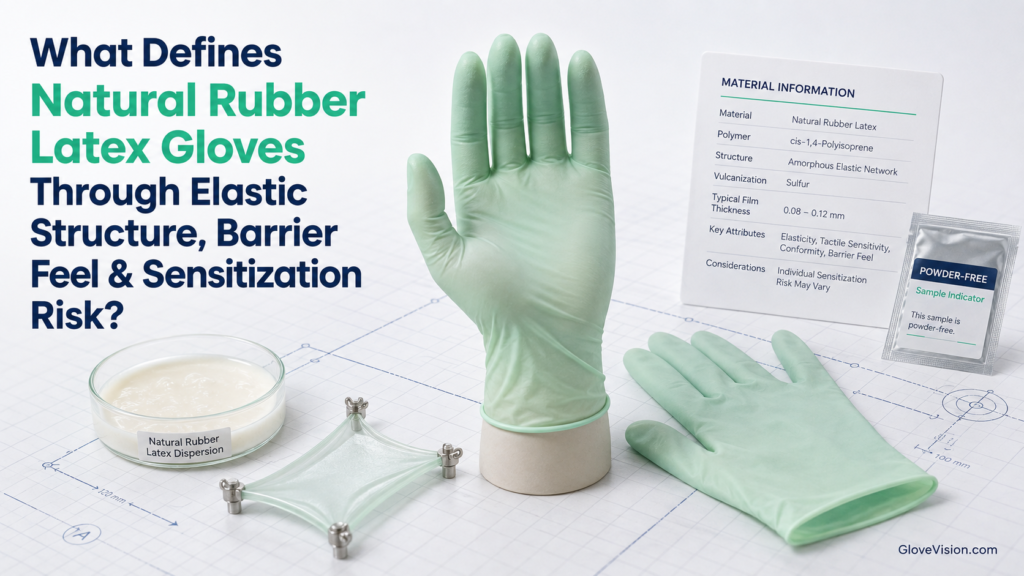
What Defines Natural Rubber Latex Gloves Through Elastic Structure, Barrier Feel & Sensitization Risk?
Natural Rubber Latex Gloves are defined by a vulcanized natural-rubber film whose elastic structure allows the glove to stretch, recover, and conform closely to the hand, supporting tactile sensitivity and a thin barrier feel.
Close fit does not prove universal protection. Chemical compatibility, mechanical durability, and reaction risk depend on the exact formulation, thickness, processing chemicals, residual proteins, surface treatment, exposure, condition, and wearer susceptibility.
What Are Natural Rubber Latex Gloves, and How Does Their Material Structure Create Elasticity?
Natural Rubber Latex Gloves are produced from compounded natural-rubber latex that is formed and vulcanized into an elastic glove film capable of stretching, recovering, and conforming to the hand.
What Is Natural Rubber Latex Made From?
Natural rubber latex is a water-based biological dispersion whose principal rubber component is cis-1,4-polyisoprene together with naturally occurring proteins and other non-rubber constituents. [Polymer]
Latex obtained primarily from Hevea brasiliensis is a colloidal biological fluid, while the finished glove is a manufactured and cured film. Raw latex, compounded latex, vulcanized film, and the complete glove therefore represent different material stages.
How Does Vulcanization Change Natural Latex Glove Behavior?
Vulcanization creates cross-links between natural-rubber polymer chains, increasing elastic recovery and structural stability in the finished glove film.
Cross-link density and performance depend on the curing system, formulation, process control, and finished-film geometry. Vulcanization does not make every latex glove equally strong, durable, or resistant.
Which Ingredients Can Be Added to Natural Rubber Latex Gloves?
Natural Rubber Latex Gloves may contain curing agents, accelerators, stabilizers, antioxidants, pigments, and surface-treatment materials whose types and residual levels vary by product.
These ingredients can influence curing, aging, donning, durability, surface feel, and residual-chemical exposure. Chlorination, polymer coatings, and other treatments modify usability without proving zero reaction risk.
Why Do Natural Latex Gloves Stretch and Recover?
Natural Latex Gloves stretch because flexible polymer chains temporarily align under force and move back toward their original configuration when that force is removed.
Overstretching, incorrect sizing, aging, heat, tears, chemical degradation, and repeated mechanical stress can reduce recovery. The dedicated guide to latex elasticity explains why stretch behavior must remain separate from puncture or tear claims.
| Structural Feature | Physical Effect | Practical Contribution | What It Does Not Guarantee |
|---|---|---|---|
| Elastic polymer network | Stretch and recovery | Close hand conformity | Puncture resistance |
| Thin glove film | Low material bulk | Tactile sensitivity | Chemical compatibility |
| Vulcanized structure | Greater structural stability | Functional elasticity | Equal durability across products |
| Surface treatment | Changes donning and surface feel | Product-specific usability | Absence of reaction risk |
| Formulation additives | Support processing and performance | Finished-glove characteristics | Identical sensitization potential |
How Do Natural Latex Gloves Create Close Barrier Feel, Grip, and Tactile Sensitivity?
Natural Latex Gloves can create close barrier feel because their elastic films conform to hand contours with relatively little material bulk, but fit, thickness, formulation, and surface treatment determine the final experience.
How Does Elastic Conformity Affect Natural Latex Glove Fit?
Elastic conformity can reduce loose material and internal movement by allowing the glove film to follow the fingers, palm, thumb, and hand creases.
Correct sizing can support finger alignment, palm conformity, stable hand-to-glove contact, and reduced bunching. Elasticity cannot correct a fundamentally unsuitable size or glove pattern; latex conformity still depends on hand shape and product geometry.
How Does Thickness Change Latex Glove Tactility?
Lower material thickness may provide more direct tactile feedback, while thicker construction may increase material separation and durability, but neither outcome is universal.
Film thickness interacts with fit, cushioning, dexterity, durability, barrier distance, and hand fatigue. The discussion of latex tactile sensitivity should never be expanded into “thinner is always better” or “thicker is always safer.”
How Do Surface Treatments Affect Natural Latex Glove Feel?
Surface treatments can alter donning, interior friction, external grip, smoothness, and wearer perception without changing every underlying protection property.
Chlorination, polymer coatings, textured zones, smooth finishes, and interior treatments can change dry, wet, or oily handling. Their effect remains product- and condition-specific rather than a universal ranking.
Why Can Poor Fit Undermine Natural Latex Glove Performance?
Poor fit can undermine Natural Latex Glove performance by causing internal movement, fingertip excess, overstretching, pressure, hand fatigue, or restricted movement.
Oversizing can create loose fingertips, palm bunching, and unstable grip. Undersizing can create excessive tension, pressure, fatigue, and restricted movement, while an unsuitable glove shape can load the thumb, finger webs, or palm unevenly.
Which Variables Make Natural Latex Gloves Feel Different?
Natural Latex Gloves can feel different because formulation, thickness, geometry, texture, surface finish, interior treatment, powder status, fit, temperature, and wear duration vary.
Subjective feel can help evaluate usability, but it is not verified evidence of chemical compatibility, microbial-barrier performance, puncture resistance, or safe exposure duration.
Where Do Latex Glove Barriers Reach Their Chemical and Mechanical Resistance Limits?
Latex Glove Barriers can separate the skin from selected substances, but resistance ends when defects, incompatible chemicals, permeation, degradation, stretching, sharp objects, heat, or wear exceed the finished glove’s verified capability.
How Can Natural Latex Glove Barriers Fail?
Natural Latex Glove Barriers can fail through visible tears, pinholes, cuff or seam defects, chemical degradation, molecular permeation, overstretching, or mechanical wear.
Penetration passes through holes or openings; degradation changes the material physically; permeation moves molecules through apparently intact film. Contamination can also reach the inside during incorrect donning, removal, or use.
Why Does Chemical Compatibility Vary Across Latex Gloves?
Chemical compatibility varies because the exact chemical, mixture, concentration, temperature, duration, thickness, formulation, and contact pattern can change degradation and permeation behavior. [OSHA]
Splash, intermittent contact, and immersion are not equivalent. Manufacturer data must match the exact glove and exposure; the page on latex chemical limits expands why material identity cannot supply a universal breakthrough time.
Which Signs Can Indicate Latex Glove Degradation?
Swelling, softening, hardening, tackiness, brittleness, cracking, discoloration, or lost elasticity can indicate that chemical or environmental exposure has degraded the glove.
Visible deterioration is a rejection signal, but the absence of visible change does not prove that molecular permeation has not occurred.
Does Latex Elasticity Prove Puncture or Tear Resistance?
No; elasticity measures deformation and recovery, while tear, puncture, needle, cut, and abrasion resistance are separate finished-glove properties.
Each mechanical hazard applies a different force and requires relevant product-level evidence. A glove can stretch closely around the hand while remaining vulnerable to a sharp edge, fine point, abrasion, or existing defect.
Which Protection Claims Require Evidence Beyond the Latex Material Name?
Chemical, microbial, chemotherapy-drug, cut, needle, heat, electrical, and reusable-protection claims require evidence for the exact finished glove rather than the latex material name.
Material identity does not establish medical approval, industrial certification, sterility, safe immersion, or a reuse period. Intended use, testing, construction, condition, and manufacturer limitations must match the claim.
| Exposure or Hazard | Possible Latex Contribution | Critical Boundary | Required Verification |
|---|---|---|---|
| Routine liquid contact | Temporary separation where documented | Defects and compatibility | Exact product purpose |
| Chemical splash | Product-dependent barrier | Chemical-specific degradation and permeation | Compatibility data |
| Prolonged chemical contact | Exposure-specific protection | Breakthrough over time | Tested breakthrough information |
| Sharp object | Flexible hand coverage | Cut, tear, or puncture failure | Relevant mechanical testing |
| Needle exposure | No automatic protection | Needle penetration | Needle-specific evidence |
| Heat or flame | No universal protection | Thermal degradation and heat transfer | Thermal testing |
| Contamination barrier | Product-dependent separation | Defects, fit, and incorrect use | Finished-glove evidence |
Why Can Natural-Rubber Glove Exposure Cause Irritation, Type IV Dermatitis, or Type I Latex Allergy?
Natural-Rubber Glove Exposure can produce nonimmune irritation, delayed Type IV allergy to residual processing chemicals, or immediate Type I allergy to residual natural-rubber proteins.
How Is Irritant Contact Dermatitis Different From Latex Allergy?
Irritant contact dermatitis is a nonimmune skin reaction and does not by itself establish allergy to natural-rubber proteins or glove-processing chemicals.
Sweating, occlusion, friction, repeated washing, incomplete drying, cleaning agents, powder, and prolonged wear may contribute to dryness, redness, cracking, burning, or soreness. Appearance alone cannot establish a diagnosis.
What Causes Type IV Reactions to Natural Latex Gloves?
Type IV reactions are delayed immune responses commonly associated with residual rubber-processing chemicals rather than the immediate protein-mediated pathway of Type I latex allergy. [FDA]
The reaction is cell-mediated, may appear hours to days after exposure, and can resemble allergic contact dermatitis. Accelerator systems and residual chemical profiles vary among products.
What Causes Type I Natural Rubber Latex Allergy?
Type I Natural Rubber Latex Allergy is an immediate immune response primarily associated with residual natural-rubber proteins and can produce local, respiratory, or systemic symptoms.
Possible manifestations include hives, swelling, nasal or eye symptoms, respiratory symptoms, and systemic reactions. The guide to latex sensitization risk provides additional mechanism context without replacing medical assessment.
How Can Glove Powder Affect Latex-Protein Exposure?
Glove powder can carry residual latex proteins and increase environmental or airborne exposure even though the powder itself is not a natural-rubber protein. [NIOSH]
Powder can distribute protein-containing particles. Powder-free does not mean protein-free, and removing powder does not establish zero Type I or Type IV reaction risk.
Do Reduced-Protein or “Hypoallergenic” Latex Gloves Remove Allergy Risk?
No; reduced-protein or reduced-sensitization products may lower selected exposures but cannot establish zero Type I or Type IV reaction risk.
A reduced chemical-sensitization claim does not automatically address protein-mediated allergy. The limits of hypoallergenic latex claims must be interpreted from the exact tested product and labeling language.
Which Symptoms Require Prompt or Urgent Escalation?
Persistent dermatitis or recurring hives require prompt assessment, while breathing difficulty, facial or throat swelling, wheezing, dizziness, or faintness require urgent medical care.
Stop exposure and follow workplace, emergency, or medical protocols. Do not continue exposure to test the reaction, diagnose from appearance alone, or delay urgent care for systemic symptoms.
| Reaction | Primary Mechanism | Common Trigger Category | Typical Timing | Critical Boundary |
|---|---|---|---|---|
| Irritant dermatitis | Nonimmune irritation | Moisture, friction, washing, occlusion, chemicals | Variable | Not automatically an allergy |
| Type IV allergy | Delayed immune response | Residual processing chemicals | Hours to days | Not primarily caused by natural-rubber proteins |
| Type I latex allergy | Immediate immune response | Natural-rubber proteins | Minutes to hours | Can become systemic and severe |
| Powder-related exposure | Carrier pathway | Powder carrying residual proteins | Exposure-dependent | Powder is not itself the latex protein |
Which Natural Rubber Latex Gloves Match the Task, Exposure, Fit, and Sensitization Profile?
Suitable Natural Rubber Latex Gloves must match the exact task, exposure, required performance evidence, hand fit, product condition, and wearer sensitization profile.
What Should Be Defined Before Selecting Latex Protective Gloves?
Selection begins by defining the task, contact material, exposure pattern, duration, required coverage, grip conditions, dexterity, and known reaction history. [OSHA]
Identify the chemical where relevant, splash versus immersion, dry, wet, or oily handling, disposable or reusable use, sterility where applicable, and any known or suspected glove-related reaction.
Which Product Evidence Should Support Latex Glove Selection?
Latex Glove selection should be supported by the exact model’s intended use, compatibility information, thickness where relevant, applicable testing, protein or accelerator information, and manufacturer limitations.
Verify the material declaration, powder status, documented protein or accelerator information, disposal or reuse instructions, and whether the test conditions actually match the task. FDA labeling guidance favors precise “not made with natural rubber latex” wording over unsupported absolute “latex-free” claims. [FDA Label]
How Should Natural Latex Glove Fit Be Evaluated?
Natural Latex Gloves should fit closely without overstretching, internal slipping, fingertip excess, palm bunching, thumb pressure, or restricted hand movement.
Check finger alignment, fingertip space, palm conformity, thumb position, finger-web comfort, hand opening and closure, cuff coverage, internal movement, pressure points, and excessive film tension.
When Should an Alternative to Natural Rubber Latex Gloves Be Considered?
An alternative should be considered when latex is incompatible with the exposure, required performance lacks evidence, symptoms recur, policy requires another material, or the wearer has known or suspected latex sensitivity.
No single replacement material is correct for every situation. The latex allergy trade-off must be resolved against both the hazard and the wearer profile.
Which Latex Glove Selection Mistakes Should Be Avoided?
The main selection mistakes are choosing by elasticity, thickness, close fit, powder status, or the latex name without verifying compatibility, reaction history, and finished-glove evidence.
Do not treat all formulations as equivalent, powder-free as allergy-free, close fit as proof of protection, or a disposable glove as reusable chemical protection. Degradation and unexplained symptoms are reasons to stop and reassess.
How Should Natural Latex Hand Protection Be Used, Inspected, and Finally Evaluated?
Natural Latex Hand Protection remains suitable only while the exact glove is correctly fitted, intact, compatible with the exposure, used within documented conditions, and tolerated by the wearer.
What Should Be Checked Before Using Natural Latex Gloves?
Before use, verify the glove’s identity, intended purpose, size, packaging where relevant, expiration information, material condition, and compatibility with the planned exposure.
Inspect for holes, tears, brittleness, tackiness, discoloration, lost elasticity, cuff damage, or compromised packaging where packaging integrity matters.
How Should Natural Latex Gloves Be Used During the Task?
Natural Latex Gloves should be donned, worn, changed, removed, discarded, or reused only according to the exact product, workplace, contamination-control, and exposure instructions.
Follow applicable guidance for cuff placement, contact duration, double-gloving where required, changing, cross-contamination control, removal, disposal, and reuse where expressly permitted. No universal change schedule applies to every glove and task.
When Should Natural Latex Gloves Be Removed or Replaced?
Natural Latex Gloves should be removed or replaced when they tear, puncture, degrade, become contaminated, lose fit or function, exceed documented exposure conditions, or cause suspected reaction symptoms.
A task or hazard change, unstable grip, inadequate dexterity, damaged cuff, or manufacturer replacement instruction also requires removal, replacement, or reassessment.
How Should Symptoms During Latex Glove Use Be Handled?
When symptoms appear, stop exposure, remove the glove safely, follow workplace or medical protocols, and obtain appropriate assessment before further latex exposure.
Use the sequence: symptom → stop exposure → remove safely → follow emergency or medical protocol → reassess before reuse. Do not self-diagnose or perform unsupervised re-exposure.
What Final Questions Determine Latex Glove Suitability?
Final suitability depends on whether the glove matches the exposure, has relevant product evidence, fits correctly, remains intact, preserves required function, and is appropriate for the wearer’s reaction history.
Confirm compatibility, evidence, coverage, fit, dexterity, condition, intended-use limits, sensitization history, replacement procedures, and emergency arrangements before approval.
- Exact task is identified.
- Contact material is known.
- Contact duration is estimated.
- Splash versus immersion is defined.
- Mechanical and thermal hazards are identified.
- Exact glove model is known.
- Intended use matches the task.
- Compatibility information is available.
- Relevant performance testing is documented.
- Product limitations are understood.
- Size is correct.
- Fingers align naturally.
- Palm material does not bunch.
- Full hand movement is possible.
- Grip remains stable.
- The cuff provides required coverage.
- Known latex allergy is considered.
- Previous glove-related reactions are considered.
- Powder status is verified where relevant.
- Accelerator information is reviewed where necessary.
- Symptoms are not ignored or self-diagnosed.
- No holes are present.
- No tears are present.
- No brittleness is present.
- No tackiness or swelling is present.
- Elastic recovery remains functional.
- No unresolved contamination is present.
- Use — evidence, compatibility, fit, tolerance, and condition pass.
- Replace — damage, contamination, or loss of function is present.
- Reassess — compatibility or reaction risk remains unclear.
- Select another material — latex does not match the hazard or wearer profile.
- Do not use — suitability cannot be verified.
Conclusion
Natural Rubber Latex Gloves are valued for elastic conformity, tactile sensitivity, and thin barrier feel, but those benefits do not establish universal chemical, mechanical, biological, or allergy protection. Their natural-rubber composition, vulcanized network, finished-film design, exposure limits, and reaction pathways must be evaluated separately.
Final suitability depends on the exact finished glove, exposure, compatibility evidence, fit, condition, and wearer sensitization profile—not the latex material name alone.
Frequently Asked Questions
Are Natural Rubber Latex Gloves Allergy-Proof When They Are Powder-Free?
No. Powder-free construction can reduce one exposure pathway but does not guarantee the absence of natural-rubber proteins, processing chemicals, or allergic-reaction risk.
Are All Reactions to Natural Rubber Latex Gloves Type I Latex Allergy?
No. Glove-related reactions may involve nonimmune irritation, delayed Type IV allergy to processing chemicals, or immediate Type I allergy to natural-rubber proteins.
Do Thicker Latex Gloves Always Provide Better Protection?
No. Thickness can influence durability, tactile feel, and permeation behavior, but suitability still depends on the hazard, formulation, construction, exposure, and product testing.
Can Natural Rubber Latex Gloves Protect Against Every Chemical?
No. Chemical resistance depends on the exact substance, mixture, concentration, temperature, duration, glove thickness, formulation, and finished-product evidence.
When Should Natural Rubber Latex Gloves Be Replaced With Another Material?
Another material should be selected when latex is incompatible with the exposure, required performance is unsupported, necessary function cannot be maintained, or the wearer has known or suspected latex-related sensitivity.