
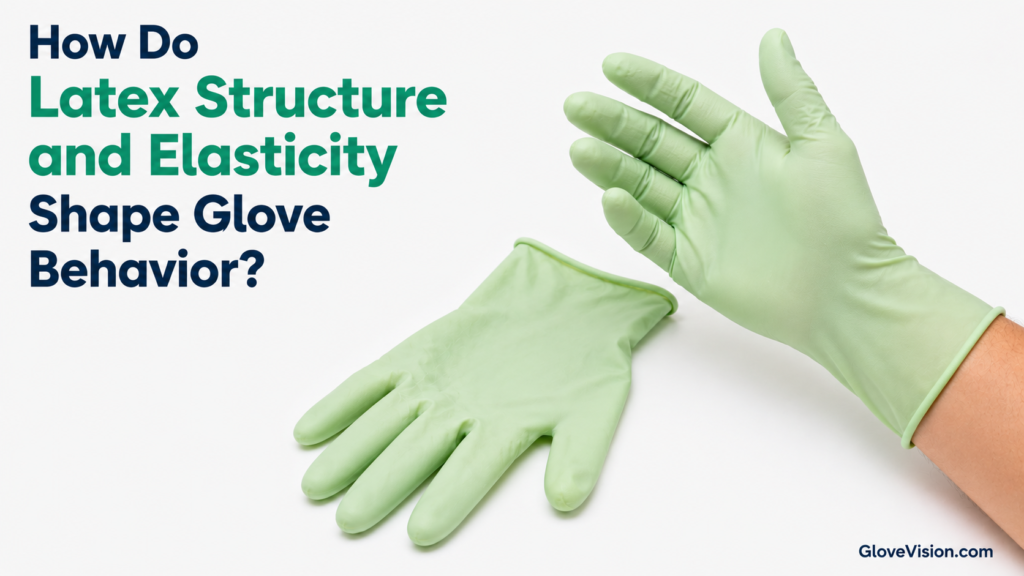
How Do Latex Structure and Elasticity Shape Glove Behavior?
Latex Gloves translate natural rubber latex, flexible cis-1,4-polyisoprene chains, and vulcanized crosslinks into reversible stretching, close hand conformity, mobility, and tactile response.
Their actual behavior depends on formulation, crosslink density, thickness, geometry, size, temperature, chemical exposure, repeated strain, aging, manufacturing quality, and condition; elasticity alone does not establish barrier integrity, chemical resistance, puncture protection, or allergy safety.
What Material Structure Gives Latex Gloves Their Elastic Behavior?
Latex Gloves derive their elastic foundation primarily from cis-1,4-polyisoprene chains that are compounded, formed into thin glove films, and vulcanized into connected rubber networks.
What Is Natural Rubber Latex Before It Becomes a Glove?
Natural rubber latex is an aqueous biological dispersion containing suspended rubber particles in a water-based serum with proteins, lipids, carbohydrates, minerals, and other non-rubber constituents. Collection, stabilization, concentration, compounding, forming, leaching, curing, and surface treatment separate raw latex from a finished glove.
How Does Cis-1,4-Polyisoprene Shape Latex Gloves?
Long cis-1,4-polyisoprene chains have a flexible carbon-based backbone. In a relaxed film, chain segments occupy many disordered configurations; force extends and increasingly orients them. This creates elastic potential, while the finished compounded glove—not the polymer name—owns protective performance.
Why Must Natural Latex Be Compounded?
Compounding supports dispersion stability, controlled curing, strength, flexibility, aging resistance, color, surface behavior, and manufacturing consistency. Formulations may include curing agents, accelerators, activators, antioxidants, stabilizers, fillers, pigments, and processing aids. Natural-rubber technical literature treats processing and formulation as part of the material system. IRRDB
How Does Vulcanization Transform Latex Into Glove Film?
Compounded latex is deposited as a glove-shaped film and cured so crosslinks connect polymer chains. Crosslinks restrict unrestricted chain sliding and influence recovery, strength, stiffness, elongation, and durability. Too few may weaken recovery; a balanced network can support useful stretch; too many may raise stiffness and reduce elongation.
Why Are Latex Gloves Not Pure Natural Rubber?
Finished Latex Gloves contain compounded ingredients and retain formulation-dependent residues. Leaching can reduce selected water-soluble constituents, and chlorination or polymer coatings can alter donning and friction. Powder-free does not mean protein-free, accelerator-free, additive-free, or allergy-safe.
| Component | Material role | Behavior influenced | Critical qualification |
|---|---|---|---|
| Cis-1,4-polyisoprene | Elastic polymer | Stretch and conformity | Does not establish protection |
| Crosslinks | Restrict chain sliding | Recovery and stability | Density changes stiffness and elongation |
| Natural proteins | Biological constituent | Allergy relevance | Residual content varies |
| Accelerators | Support vulcanization | Film formation | Some may contribute to dermatitis |
| Antioxidants | Slow oxidation | Storage durability | Cannot prevent all aging |
| Fillers and pigments | Modify formulation | Strength, stiffness, color | Effects are formulation-specific |
| Surface treatments | Alter interface | Donning and friction | Do not prove barrier integrity |
How Does Elastic Recovery Allow Latex Gloves to Stretch and Recoil?
Latex Gloves stretch when force extends and orients flexible polymer chains, then recoil because crosslinks restrict permanent sliding and help the network return toward a lower-strain configuration.
What Happens Inside Latex Gloves During Stretching?
Applied force extends chain segments from disordered configurations and increases their orientation. The film becomes thinner locally while crosslinks maintain network connectivity. Rising strain demands more structural reorganization, and excessive strain can concentrate stress around defects.
Why Do Latex Gloves Recoil After Force Is Removed?
Extended chains have fewer available configurations. When force is removed, the network tends toward a more disordered, lower-strain state; crosslinks preserve connectivity and stored elastic energy contributes to recoil. Recovery may be substantial without being complete.
How Does Crosslink Density Change Latex Gloves?
Insufficient crosslinking may permit more chain sliding and weak recovery. Balanced crosslinking can support useful stretch, recovery, and strength. Excessive crosslinking can increase stiffness and restrict elongation. The appropriate balance depends on formulation and intended use—not a universal maximum.
When Does Stretching Permanently Deform Latex Gloves?
Undersizing, aggressive cuff pulling, fingernails, jewelry, repeated stretching, heat, chemical degradation, aging, or defects can push the film from recoverable strain toward fatigue, permanent set, thinning, tear propagation, or rupture. Strain-induced crystallization can strengthen natural rubber locally under some conditions, but it is not a finished-glove rating.
How Do Stress Relaxation and Creep Affect Latex Gloves?
Stress relaxation is declining force while the glove remains held at a fixed dimension. Creep is continued deformation under sustained load. Permanent set remains after unloading. Together they may produce cuff slippage, finger elongation, bunching, reduced tension, and unstable fit.
How Do Latex Gloves Convert Elasticity Into Fit, Sensitivity, and Barrier Behavior?
Latex Gloves use elastic conformity to follow fingers, palms, and moving joints, supporting tactile feedback and stable handling, but fit and barrier performance still depend on size, thickness, geometry, film quality, exposure, and verified product evidence.
How Does Elasticity Help Latex Gloves Conform to the Hand?
Stretch allows the film to follow hand contours; inward recovery tension reduces excess material and helps the surface remain positioned across moving joints. Elasticity cannot correct the wrong size: excessive tension can cause fatigue and localized thinning, while loose material can bunch or slip.
How Does Thickness Affect Latex Gloves’ Tactile Sensitivity?
A thinner film may transmit surface detail with less bulk, while greater thickness may require more deformation force and may improve durability in some tasks. Fit, formulation, fingertip geometry, texture, and object shape can matter as much as thickness. Thinner is not automatically superior.
How Does Elastic Modulus Affect Latex Gloves’ Feel?
Lower modulus generally means less force is needed for a given stretch; higher modulus can feel firmer. Modulus changes with strain, temperature, formulation, and aging. Size and geometry affect perceived tightness, so a material value alone does not predict comfort.
Does Elasticity Improve Latex Gloves’ Barrier Integrity?
Only indirectly. Conformity may reduce folds, recovery may maintain position, and intact film may cover moving joints. Stretch cannot repair pinholes, tears, weak seams, or manufacturing defects; excessive strain can thin the film or enlarge existing damage. Visual appearance alone cannot verify barrier integrity.
How Does Elasticity Affect Latex Gloves’ Grip?
Close fit can improve force transmission, reduce bunching, and support precision. Surface texture and treatment control interface friction, while sweat, water, oil, chemicals, and contamination can reduce control. Elasticity does not guarantee non-slip performance.
Supports stable contact, but excessive inward tension harms comfort.
May support tactile detail, but can reduce damage tolerance.
Maintains shape only while the network remains healthy.
Can be disrupted by sweat, oil, contamination, or wrong size.
Does not establish puncture or sharp-object protection.
Finished-glove testing, task assessment, and the exact model’s instructions remain necessary. General protective-glove requirements do not replace hazard-specific evidence. ISO
Which Conditions Change Latex Gloves’ Elasticity and Recovery?
Latex Gloves may lose elasticity, strength, fit, or surface integrity when heat, oxygen, ozone, ultraviolet light, incompatible chemicals, sustained loading, repeated strain, poor storage, or prolonged use changes the rubber network.
How Do Heat and Cold Change Latex Gloves?
Heat increases chain mobility and can accelerate oxidation or aging, contributing to tackiness, hardening, softening, distortion, or strength loss. Cold may temporarily increase stiffness and, depending on formulation and condition, reduce flexibility. There is no universal safe temperature for every Latex Glove.
How Do Oxygen, Ozone, and UV Age Latex Gloves?
Oxidation, chain scission, unwanted additional crosslinking, surface cracking, hardening, discoloration, reduced elongation, and strength loss may occur. Color change can be a warning but cannot quantify retained performance.
How Do Oils, Solvents, and Other Chemicals Affect Latex Gloves?
Incompatible exposures may cause swelling, softening, extraction, tackiness, distortion, permeation, strength loss, or accelerated tearing. Use the sequence: exact chemical → concentration → temperature → contact duration → compatibility data for the exact glove. When the hazard requires it, select documented chemical-resistant gloves. OSHA requires selection based on the task, exposure conditions, duration, and identified hazards. OSHA
How Does Repeated Stretching Affect Latex Gloves?
Repeated strain can contribute to stress relaxation, fatigue, local thinning, cuff distortion, finger elongation, microdamage, tear initiation, and reduced fit stability. Visible recovery does not prove that barrier performance remains unchanged.
How Do Moisture, Sweat, and Skin Oils Affect Latex Gloves?
Moisture and skin oils may promote internal slipping, movement, maceration, donning difficulty, contaminant accumulation, irritation, or forceful removal. These effects should not automatically be labeled lost elasticity or latex allergy.
Which Visible Changes Suggest Degradation in Latex Gloves?
Brittleness, hardening, softness, tackiness, cracking, crazing, swelling, discoloration, thinning, distorted fingers, loose cuffs, permanent stretching, tears, punctures, or lost texture require removal or product-specific assessment.
| Exposure | Possible change | Observable sign | Required decision |
|---|---|---|---|
| Excess heat | Accelerated aging | Tackiness, hardening, distortion | Replace |
| Cold | Temporary stiffness or damage risk | Reduced flexibility | Follow product guidance |
| Oxygen, ozone, or UV | Oxidation and cracking | Crazing or discoloration | Remove if integrity is uncertain |
| Oil or solvent | Swelling or extraction | Softness, tackiness, growth | Follow compatibility data |
| Repeated strain | Fatigue and permanent set | Loose fit or stretched fingers | Replace when function changes |
| Sharp contact | Local rupture | Cut, tear, or puncture | Replace immediately |
| Poor storage | Accelerated aging | Brittleness or distortion | Reject if uncertain |
| Extended wear | Relaxation and contamination | Looseness or surface change | Change according to procedure |
How Should Latex Gloves Be Selected, Used, and Checked for Elastic Failure?
Latex Gloves should be selected by matching the task and hazards to the finished glove’s documented barrier, chemical, mechanical, fit, sterility, reuse, and allergy-related information, then checking conformity and integrity before and during use.
What Must Be Defined Before Selecting Latex Gloves?
Identify the exact task, required barrier, contact duration, biological and chemical exposure, sharp-object hazards, tactile and grip needs, wear duration, sterility, single-use or reusable design, and natural rubber latex allergy concerns. The broad Natural Rubber Latex Gloves guide covers the parent material context.
Which Product Information Should Be Verified?
Verify manufacturer and model, intended use, size, thickness or construction, powder status, sterility, chemical compatibility, relevant test evidence, allergy labeling, storage, shelf life, and reuse restrictions. Medical-device claims require jurisdiction-specific finished-product evidence; the FDA prohibited powdered surgeon’s and patient-examination gloves in the United States. FDA
How Should Latex Gloves Fit and Function?
Confirm correct finger length, stable palm material, minimal bunching, a secure cuff, unrestricted circulation, full hand closure, controlled fine manipulation, suitable grip, and no painful pressure. Too small creates excessive strain and thinning; too large encourages slipping and unstable control.
How Should Latex Gloves Be Donned and Removed?
Follow workplace and manufacturer procedure while avoiding jewelry, sharp fingernails, excessive cuff pulling, unnecessary stretching, and contact with contaminated exterior surfaces. Never recommend reuse of a single-use glove, and remove it without spreading contamination.
What Should Be Inspected While Latex Gloves Are Worn?
Look for tears, punctures, splits, cuff damage, excessive stretching, looseness, swelling, softening, tackiness, hardening, discoloration, chemical contact, grip loss, or suspected contamination. Change the glove whenever the task, exposure, procedure, or uncertain integrity requires it.
How Should Latex Gloves Be Stored?
Follow exact instructions for temperature, humidity, light, ozone sources, chemicals, original packaging, stock rotation, expiration, and—only for reusable models—cleaning, drying, and inspection. Do not store near motors or other potential ozone sources unless the manufacturer permits it.
How Should Allergy and Dermatitis Risks Be Separated?
Immediate reactions may involve natural-rubber proteins; delayed allergic contact dermatitis may involve accelerators or other chemicals; irritant dermatitis can arise from moisture, friction, frequent washing, or occlusion. Not every skin reaction is latex allergy. NIOSH advises reducing exposure and using appropriate alternatives for workers with latex allergy. NIOSH
When Should Latex Gloves Be Changed or Replaced?
Change, remove, isolate, or reject them when expired, when packaging integrity is lost, recovery declines, fit becomes unstable, damage or swelling appears, degradation is suspected, contamination requires removal, the task changes, skin symptoms develop, or continued barrier performance cannot be verified.
Task and hazard
- Task and hazards are defined
- Required barrier performance is known
- Chemical compatibility is documented
- Mechanical hazards are assessed separately
- Allergy and dermatitis risks are considered
- Single-use or reusable status is confirmed
Product and fit
- Exact model and intended use are verified
- Correct size is selected
- Fingers align properly
- Palm material remains stable
- Cuff remains secure
- Circulation is unrestricted
- Dexterity and grip match the task
Condition
- No tears, punctures, cracks, or splits are present
- Material is not tacky, brittle, swollen, or distorted
- No permanent stretching is visible
- Cuff recovery remains functional
- No chemical damage is suspected
- Packaging and expiration remain acceptable
Task and hazard → finished Latex Gloves construction → required barrier → chemical compatibility → size and fit → tactile and grip needs → allergy considerations → exposure and wear time → current condition → use, change, remove, replace, or reject.
What Should Readers Remember About Latex Gloves?
Latex Gloves gain their characteristic stretch, recovery, conformity, and tactile response from flexible cis-1,4-polyisoprene chains organized within a compounded and vulcanized crosslink network.
Barrier protection, chemical compatibility, durability, allergy suitability, and continued use still depend on the exact glove, size and fit, task exposure, finished-product documentation, storage history, and current physical condition.
Which Questions Clarify Latex Gloves’ Structure and Elasticity?
What makes Latex Gloves elastic?
Latex Gloves are elastic primarily because flexible cis-1,4-polyisoprene chains can extend under force and recoil within a vulcanized crosslink network. Formulation, curing, thickness, temperature, and condition determine the resulting behavior.
Do Latex Gloves return completely to their original shape?
Not always. Ordinary stretching may be substantially reversible, but excessive strain, sustained loading, repeated use, heat, chemicals, and aging can produce stress relaxation, permanent set, or physical damage.
Does greater stretch make Latex Gloves more protective?
No. Stretch can support conformity and movement but does not establish barrier integrity, tear resistance, puncture resistance, chemical compatibility, or allergy safety. Excessive stretching may thin and damage the glove.
Why do Latex Gloves become loose, brittle, or tacky?
Possible causes include heat, oxidation, ozone, ultraviolet light, incompatible chemicals, repeated strain, poor storage, aging, or formulation-specific deterioration. Unexplained material changes require glove removal or product-specific assessment.
When should Latex Gloves be replaced?
Replace Latex Gloves when tears, punctures, cracks, swelling, tackiness, brittleness, permanent stretching, cuff failure, chemical degradation, contamination, expiration, or uncertain barrier integrity prevents reliable use.