
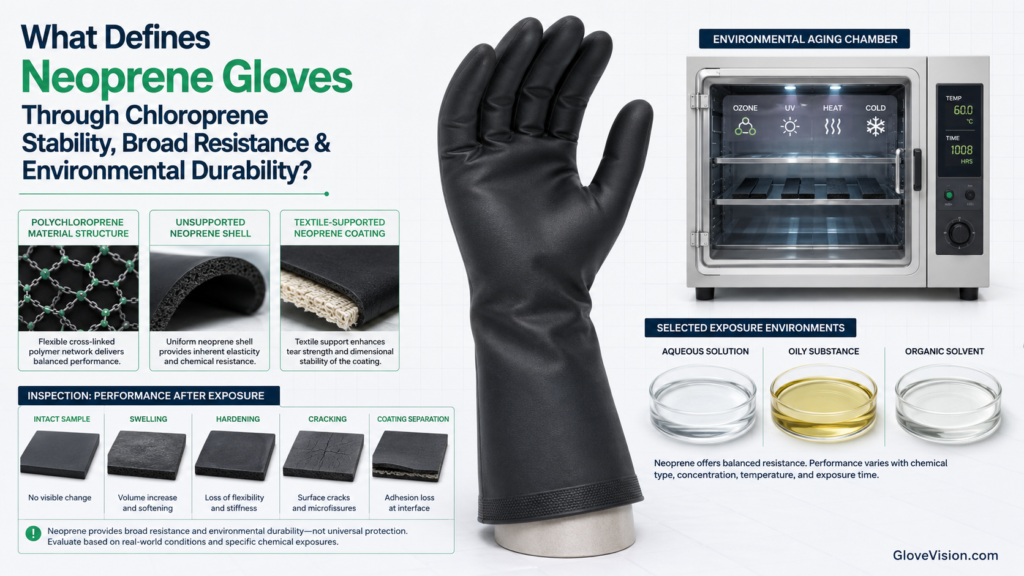
What Defines Neoprene Gloves Through Chloroprene Stability, Broad Resistance & Environmental Durability?
Neoprene Gloves are defined by a polychloroprene-based synthetic-rubber structure that can provide a balanced combination of flexibility, physical durability, weathering stability, and resistance across selected chemical exposures.
Their resistance is broad only in a relative and exposure-specific sense; performance depends on formulation, cure system, thickness, lining, coating, chemical identity, concentration, temperature, contact duration, environmental exposure, testing, and current condition.
What Are Neoprene Gloves, and How Does Chloroprene Stability Shape Their Behavior?
Neoprene Gloves are made wholly or partly from polychloroprene, a synthetic elastomer whose formulation can balance flexibility, strength, aging stability, and resistance to selected environmental and chemical exposures.
What Is the Material Inside Neoprene Gloves?
The primary material in Neoprene Gloves is polychloroprene, a synthetic rubber produced by polymerizing chloroprene and then compounding and curing the polymer into a functional glove material.
Chloroprene is the monomer; polychloroprene is the polymer; a latex dispersion is a processing form; and the finished glove is a cured construction. Identifying the polymer does not reveal the complete formulation or protection level.
How Does Polychloroprene Structure Affect Neoprene Gloves?
Polychloroprene structure can support elastic deformation, recovery, environmental stability, and resistance across selected exposures, but complete performance remains formulation-dependent.
The relationship between polychloroprene structure and balanced physical performance is developed further in the guide to neoprene broad resistance. Polymer-family behavior cannot substitute for finished-product testing.
Why Must Neoprene Gloves Be Compounded and Cross-Linked?
Neoprene Gloves require compounding and cross-linking to convert the base polymer into a stable rubber network with usable strength, flexibility, recovery, and manufacturing properties.
Cure systems, fillers, plasticizers, stabilizers, pigments, processing aids, and surface treatments may change modulus, softness, aging, chemical interaction, and skin compatibility.
How Do Neoprene Gloves Differ From Natural Rubber Latex Gloves?
Neoprene Gloves use synthetic polychloroprene, whereas natural rubber latex gloves use natural rubber containing natural-rubber proteins.
They may differ in elastic feel, formulation, chemical behavior, aging, and sensitization pathways. “Neoprene latex” means an aqueous polychloroprene dispersion; it is not natural rubber latex.
Why Does “Neoprene” Not Describe One Identical Glove Material?
The neoprene label covers products with different polymer grades, blends, cure systems, additives, thicknesses, supports, linings, surfaces, and manufacturing processes.
Chemical compatibility, dexterity, grip, strength, and environmental service life therefore require evidence for the exact finished product.
| Material Factor | Possible Physical Effect | Practical Contribution | Necessary Qualification |
|---|---|---|---|
| Polychloroprene base | Elastic rubber behavior | Flexible hand coverage | Formulation-dependent |
| Cross-linking | Controls strength and recovery | Structural stability | Cure systems vary |
| Fillers and additives | Modify stiffness and aging | Task-specific behavior | May change comfort or resistance |
| Material thickness | Changes barrier and flexibility | Protection–dexterity balance | Does not establish compatibility |
| Surface treatment | Changes grip and donning | Task interaction | May wear or become contaminated |
| Liner or support | Adds structure and comfort | Mechanical support | May add bulk or retain contamination |
How Do Neoprene Gloves Construction Choices Change Flexibility, Grip, and Durability?
Neoprene Gloves can behave very differently because disposable films, unsupported shells, textile-supported coatings, blends, liners, grip finishes, and cuff designs produce different balances of dexterity, durability, coverage, and comfort.
How Do Disposable Neoprene Gloves Behave?
Disposable Neoprene Gloves generally prioritize low bulk, conformity, and dexterity, but their chemical and mechanical limits depend on the exact film, thickness, cuff, and product testing.
Data from thicker industrial gloves must not be transferred to a thin disposable film. Single-use or limited-use labeling and the specified change schedule control use.
How Do Unsupported Neoprene Gloves Behave?
Unsupported Neoprene Gloves use a continuous rubber shell that may provide broad liquid coverage while balancing thickness, flexibility, durability, and dexterity.
Interior flocking and extended cuffs may improve donning or coverage, but no unsupported glove should be assumed suitable for immersion without matching evidence.
How Do Supported or Neoprene-Coated Gloves Behave?
Supported and coated Neoprene Gloves combine a textile substrate with neoprene coverage, which may improve structure and handling durability while introducing coating gaps and liner-contamination risks.
Partial coating, fabric exposure, seams, and liquid entry can interrupt the barrier. A coated glove is not automatically a continuous chemical barrier.
How Do Neoprene Glove Blends Change Performance?
Neoprene blends can alter stretch, grip, durability, chemical behavior, aging, and skin-reaction considerations, so the complete composition must be verified.
Products may combine polychloroprene with natural rubber, nitrile, other elastomers, or textile structures; pure-polychloroprene behavior cannot be inferred from a blend.
How Do Grip Finish, Cuff Length, and Lining Affect Neoprene Gloves?
Grip finish, cuff length, and lining change handling, coverage, comfort, sweat management, donning, contamination retention, and dexterity.
Smooth, textured, roughened, flocked, fabric-lined, short-cuff, and gauntlet constructions solve different interface problems. Grip performance remains separate from chemical compatibility.
Where Do Neoprene Gloves Provide Broad Resistance, and Where Does Their Barrier End?
Neoprene Gloves may resist selected acids, bases, oils, alcohols, salts, and other substances, but compatibility varies sharply between chemicals and cannot be inferred from the phrase “broad resistance.”
Which Chemical Categories May Be Compatible With Neoprene Gloves?
Product-tested Neoprene Gloves may provide useful resistance to selected dilute acids, alkalis, salts, oils, alcohols, oxidizers, and processing solutions.
Product-level compatibility remains essential even where neoprene acid exposure data suggest useful resistance. OSHA likewise bases selection on the substance, concentration, temperature, contact, task, and required coverage. [OSHA]
Which Chemical Exposures Can Exceed Neoprene Gloves Resistance?
Selected ketones, aromatic hydrocarbons, chlorinated solvents, concentrated corrosives, mixed solvents, fuels, and heated chemicals may exceed or sharply reduce neoprene compatibility.
Aromatic, chlorinated, ketone, and mixed-solvent exposures require the narrower analysis provided in the guide to neoprene solvent limits. Individual chemicals in one family can behave differently.
How Do Degradation, Penetration, and Permeation Differ in Neoprene Gloves?
Degradation changes the material physically, penetration passes through openings or defects, and permeation moves through apparently intact neoprene at the molecular level.
ISO treats penetration and degradation as separate test properties, reinforcing why one result cannot prove the others. [ISO 374-2] [ISO 374-4] Neoprene may permit permeation without visible damage.
How Should Breakthrough Time Be Interpreted for Neoprene Gloves?
Breakthrough time applies only to the tested glove, chemical, concentration, thickness, temperature, method, and permeation threshold.
It is not a universal change interval or guaranteed safe-wear duration. Manufacturer and laboratory results require cautious interpretation because real conditions can shorten protection. [OSHA OTM]
Why Can Chemical Mixtures Defeat Simple Neoprene Gloves Predictions?
Chemical mixtures can alter swelling, degradation, and permeation in ways that cannot be predicted by averaging the compatibility of their individual ingredients.
Carrier-solvent effects, changed concentration, heat, and missing mixture data require mixture-specific evidence. The exposure-specific limits behind the material’s broad reputation are examined in the guide to neoprene resistance limits.
How Can Flexing, Grip Pressure, and Reuse Change Neoprene Gloves Resistance?
Flexing, grip pressure, abrasion, previous exposure, and reuse can thin or damage the material and reduce its real-world barrier reliability.
Pressure points, microdamage, retained chemicals, and incomplete decontamination can change performance even when the surface still appears usable.
| Exposure Factor | Possible Neoprene Contribution | Boundary or Failure Risk | Required Evidence |
|---|---|---|---|
| Selected dilute acids or bases | Potential chemical barrier | Concentration and temperature sensitivity | Exact compatibility data |
| Selected oils and greases | Potential material stability | Swelling varies by formulation | Product-specific testing |
| Selected alcohols | Possible resistance | Alcohol and duration differences | Breakthrough data |
| Aromatic or chlorinated solvents | Often limited or variable | Rapid permeation or degradation | Exact-model approval |
| Chemical mixtures | Unpredictable interaction | One component may accelerate passage | Mixture-specific data |
| Splash exposure | Short contact opportunity | Contamination may remain on glove | Change and removal procedure |
| Immersion | Continuous challenge | Greater permeation burden | Tested immersion suitability |
| Elevated temperature | Faster molecular movement | Reduced breakthrough time | Matching test conditions |
| Repeated flexing | Realistic task movement | Thinning and microdamage | In-use assessment |
Why Can Neoprene Gloves Remain Environmentally Durable Yet Still Age or Fail?
Neoprene Gloves can offer useful resistance to ozone, oxidation, weathering, and moderate environmental stress, but the finished glove can still deteriorate through heat, sunlight, flexing, contamination, poor storage, or component failure.
How Does Ozone Resistance Support Neoprene Gloves Durability?
Polychloroprene generally offers useful ozone-aging stability, but formulation, ozone concentration, strain, exposure duration, and glove condition still influence cracking and service life.
The material-family relationship between polychloroprene and environmental stability is examined in the guide to neoprene ozone aging. Comparative stability does not mean ozone-proof or unlimited storage life.
How Do Sunlight and Weather Affect Neoprene Gloves?
Sunlight, ultraviolet exposure, heat, oxidation, moisture cycling, and outdoor storage can still change neoprene surfaces and mechanical behavior.
Fading alone does not measure barrier loss, but cracking, hardening, tackiness, or delamination requires rejection or formal reassessment.
How Do Heat and Cold Change Neoprene Gloves Behavior?
Heat can accelerate aging and permeation, while cold can increase stiffness and reduce dexterity or sealing performance.
Low-temperature flexibility and cold-related stiffness are examined further in the guide to neoprene cold performance. Neither material identity nor cold flexibility establishes thermal or flame protection.
How Can Repeated Mechanical Stress Age Neoprene Gloves?
Repeated flexing, compression, abrasion, stretching, and creasing can fatigue the material, coatings, seams, and support layers.
Finger flexing, palm pressure, cuff stretching, coating fatigue, and liner movement can create localized weakness before broad surface failure appears.
Which Components Can Fail Before the Neoprene Material?
Seams, liners, adhesives, coating interfaces, cuffs, grip finishes, reinforcements, and closures may fail before the main neoprene layer visibly deteriorates.
ISO 21420 addresses the complete glove through design, construction, comfort, efficiency, marking, and manufacturer information—not the polymer alone. [ISO 21420]
Which Signs Show That Neoprene Gloves Have Lost Reliable Condition?
Swelling, shrinkage, hardening, softening, tackiness, cracking, brittleness, thinning, punctures, tears, discoloration, delamination, seam failure, or persistent contamination indicate lost reliability.
The absence of visible damage does not prove continued chemical-barrier performance.
Which Neoprene Gloves Match the Chemical Exposure, Environment, and Task?
The correct Neoprene Gloves are selected by matching the exact finished product to the chemical exposure, contact pattern, environmental conditions, physical hazards, dexterity needs, coverage requirements, and replacement plan.
Which Exposure Questions Should Be Answered Before Selecting Neoprene Gloves?
Before selecting Neoprene Gloves, identify the exact substance or mixture, concentration, temperature, contact type, duration, frequency, and required coverage.
Where available, record the chemical name and CAS number, mixture composition, splash or immersion pattern, hand or forearm exposure, and contamination-control procedure. OSHA requires selection against task, conditions, duration, and identified hazards. [OSHA 1910.138]
Which Neoprene Gloves Suit Disposable Precision Tasks?
Thin disposable Neoprene Gloves may suit precision tasks only when their exact product data support the exposure, contact duration, cuff coverage, grip, and required change schedule.
Thin films improve tactile feedback but may have limited mechanical durability and coverage. NIOSH explicitly warns that its listed recommendations do not automatically apply to neoprene films 0.3 mm or thinner. [NIOSH]
Which Neoprene Gloves Suit Reusable Chemical Handling?
Reusable chemical handling may require thicker unsupported or fully coated Neoprene Gloves with verified compatibility, suitable cuffs, inspection criteria, and authorized decontamination procedures.
Continuous coverage, thickness, linings, extended cuffs, chemical data, and reuse limits must all match. Reusable construction does not mean universal immersion approval.
Which Neoprene Gloves Suit Wet, Oily, or Outdoor Tasks?
Neoprene Gloves for wet, oily, or outdoor tasks must combine verified substance compatibility with stable grip, adequate coating coverage, suitable drying, and environmental durability.
Grip, abrasion, liner drying, cuff security, and weather exposure require separate checks. A strong grip finish does not establish a chemical barrier.
How Should Mechanical and Thermal Hazards Affect Neoprene Gloves Selection?
Mechanical, thermal, flame, and electrical hazards require independent performance evidence because the neoprene material name does not establish those protections.
Abrasion, cuts, punctures, needles, impact, contact heat, cold, flame, and electrical exposure each need relevant complete-glove testing. ISO 374-1 addresses chemical-risk terminology and performance requirements, not automatic approval for unrelated hazards. [ISO 374-1]
Which Evidence Should Support a Neoprene Gloves Decision?
A Neoprene Gloves decision should be supported by exact-model documentation, composition, construction, thickness, compatibility, testing, limitations, care instructions, and replacement criteria.
Confirm whether the product is pure or blended, then check permeation, degradation, penetration, intended use, applicable certification, authorized decontamination, and retirement criteria.
| Task Profile | Construction to Evaluate | Primary Contribution | Main Limitation to Check |
|---|---|---|---|
| Short precision task | Thin disposable neoprene | Dexterity and conformity | Thickness and cuff coverage |
| Reusable liquid handling | Unsupported neoprene shell | Continuous material coverage | Reduced tactile feedback |
| Mechanically demanding handling | Supported or coated neoprene | Structural durability | Coating gaps and liner contamination |
| Wet handling | Textured neoprene surface | Grip support | Chemical compatibility remains separate |
| Forearm splash exposure | Extended cuff or gauntlet | Greater coverage | Cuff fit and liquid entry |
| Outdoor task | Weather-stable construction | Environmental durability | Sunlight, heat, and storage still matter |
| Mixed hazard | Tested multi-property glove | Documented combined performance | No protection should be inferred |
How Should Neoprene Gloves Be Used, Inspected, and Finally Evaluated?
Neoprene Gloves should be used only after the exact product, exposure compatibility, fit, condition, donning method, change schedule, decontamination rules, and replacement criteria have been verified.
What Should Be Verified Before Using Neoprene Gloves?
Before use, confirm the exact product, composition, construction, thickness, cuff, size, compatibility, expected exposure duration, and manufacturer instructions.
A usable plan identifies the model, blend status, supported or unsupported build, temperature, intended use, change point, and replacement route.
How Should Neoprene Gloves Be Inspected Before Use?
Inspect the complete Neoprene Gloves construction for damage, contamination, deformation, coating failure, liner failure, and loss of product identity.
Check fingers, fingertips, thumb crotch, palm, cuff, seams, coating, liner, grip finish, previous contamination, deformation, unauthorized repairs, and markings. Use only manufacturer-authorized leak testing.
How Should Neoprene Gloves Be Worn During Chemical Tasks?
Neoprene Gloves should be worn according to the workplace procedure for sizing, cuff placement, sleeve interface, contact-time control, glove changing, and contamination prevention.
Replace them when contact exceeds approved conditions, damage occurs, liquid enters through the cuff, grip becomes unreliable, fit changes, or the approved schedule requires it.
How Should Neoprene Gloves Be Removed Without Spreading Contamination?
Remove Neoprene Gloves without touching contaminated exterior surfaces with bare skin or allowing liquid to run from the cuff onto the hand or clothing.
Use controlled cuff handling, contain removed gloves, follow disposal and hand-hygiene procedures, and report exposure. Removal cannot reverse permeation that has already occurred.
How Should Reusable Neoprene Gloves Be Decontaminated and Stored?
Reusable Neoprene Gloves should be decontaminated and stored only through the exact manufacturer-approved or workplace-validated procedure.
Verify cleaning agents, water temperature, interior treatment, drying, ventilation, storage temperature, light exposure, shape preservation, and separation from chemicals. Cleaning does not automatically restore original barrier performance.
When Should Neoprene Gloves Be Replaced?
Replace Neoprene Gloves when the approved change interval is reached, compatibility is uncertain, contamination remains, exposure history is unknown, or construction and barrier reliability have deteriorated.
Swelling, softening, hardening, tackiness, cracking, thinning, tears, coating separation, liner contamination, seam failure, or lost fit and grip are rejection signals.
How Should the Final Neoprene Gloves Decision Be Made?
Final suitability requires the exact hazard, exposure profile, verified glove model, product-level test data, construction, fit, condition, and change or decontamination plan to align.
Use this sequence: exact hazard → contact type → concentration and temperature → duration → verified model → construction and thickness → evidence → fit and task function → inspection → change or decontamination plan → final decision. The balance between versatility, bulk, dexterity, and specialist protection is explained through the neoprene specialization trade-off.
- Exact chemical or mixture, concentration, temperature, contact type, duration, and coverage are known.
- Exact model, composition, construction, thickness, compatibility data, tests, and limitations are confirmed.
- Size, finger alignment, movement, grip, cuff coverage, and internal stability match the task.
- No swelling, hardening, softening, cracking, puncture, tear, separation, or unresolved contamination is present.
- Change, removal, approved decontamination, drying, storage, and replacement procedures are defined.
- Use only when every check passes; otherwise change, decontaminate where authorized, reassess, replace, or do not use.
Conclusion
Neoprene Gloves provide a balanced combination of chloroprene-based flexibility, physical stability, selected chemical resistance, and environmental aging durability, but none of these characteristics creates universal protection.
Final suitability depends on the exact chemical and task, finished-glove construction, product-level testing, fit, current condition, exposure duration, and a defined inspection and replacement process.
Frequently Asked Questions
Are Neoprene Gloves Resistant to Every Chemical?
No. Compatibility depends on the exact substance or mixture, concentration, temperature, duration, thickness, construction, and product-level test data. Broad resistance alone cannot approve a glove.
Are Neoprene Gloves the Same as Natural Rubber Latex Gloves?
No. Neoprene Gloves use synthetic polychloroprene, while natural rubber latex gloves contain natural rubber proteins. Blends and other product components still require verification.
Can Neoprene Gloves Protect Against Solvents?
Sometimes, but not universally. Performance varies across solvent families, individual substances, mixtures, concentrations, temperatures, and exposure durations. Exact permeation and compatibility data are required.
Can Neoprene Gloves Be Reused After Chemical Exposure?
Only when the exact product is reusable, exposure stays within documented limits, decontamination is permitted, and inspection confirms continued suitability. Cleaning does not automatically restore the barrier.
When Should Neoprene Gloves Be Replaced?
Replace them when the approved interval is reached, compatibility is uncertain, contamination remains, exposure history is unknown, or the material, coating, liner, seams, fit, grip, or barrier condition has deteriorated.