
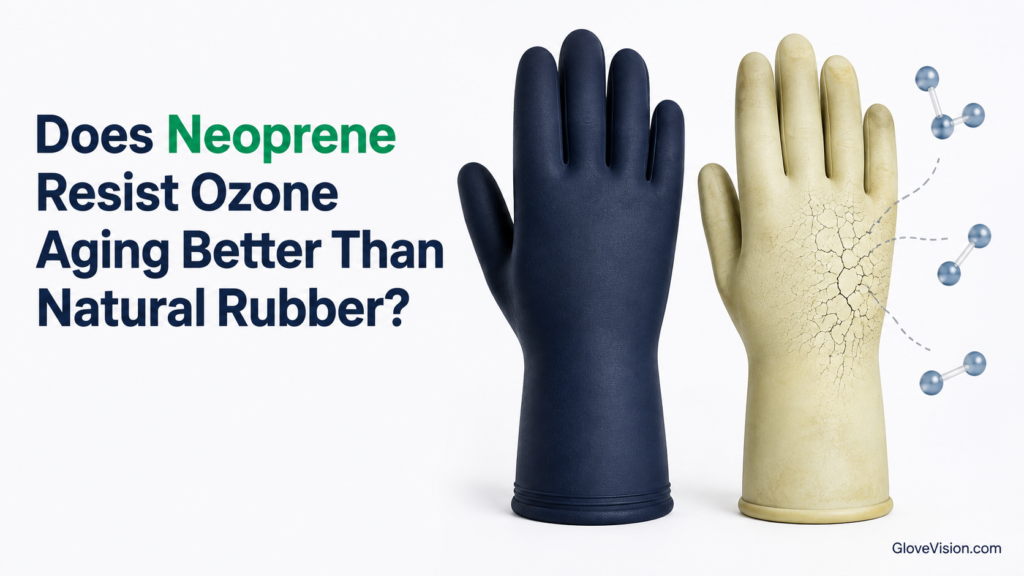
Does Neoprene Resist Ozone Aging Better Than Natural Rubber?
Generally, yes. Polychloroprene used in Neoprene Gloves normally provides better inherent resistance to ozone-induced cracking than conventional unprotected natural rubber under comparable exposure and strain conditions.
This is a material tendency, not a product guarantee. Formulation, additives, thickness, strain, temperature, ozone concentration, storage, flexing, construction and existing damage can change the finished glove’s response.
What Makes Polychloroprene-Based Neoprene Gloves More Ozone-Resistant Than Natural Rubber?
Polychloroprene-based Neoprene Gloves generally resist ozone aging better because chlorine substitution changes the polymer’s electronic and intermolecular behavior, reducing rapid ozone attack relative to conventional natural-rubber polyisoprene.
The advantage belongs to a complete compound under defined conditions—not to the name “neoprene” alone.
What Polymer Forms Neoprene Gloves?
Polychloroprene is produced from chloroprene and cured into a crosslinked elastomeric network. It retains molecular unsaturation, so it is resistant rather than inert. Finished gloves also contain curing agents, fillers, stabilizers, pigments and processing ingredients. See the neoprene resistance guide for the wider formulation boundary.
Why Is Natural Rubber More Vulnerable to Ozone?
Natural rubber is primarily cis-1,4-polyisoprene. Ozone can react with susceptible backbone double bonds, damage chains and create weak surface zones that open into cracks when strained. Natural-rubber elastic structure should not be confused with ozone durability.
How Does Chlorine Substitution Change Polychloroprene?
Chlorine substitution changes electron distribution, intermolecular attraction and chemical reactivity. These effects generally improve environmental-aging behavior relative to conventional natural rubber, but chlorine alone does not determine finished performance.
How Do Crosslinking and Additives Affect Both Materials?
Crosslinking influences shape retention, recovery, hardness, flexibility and crack propagation. Antiozonants and protective waxes may delay surface attack; fillers, plasticizers, blends and curing quality can improve or weaken other properties. More crosslinking is not universally better.
| Factor | Neoprene Gloves | Natural-rubber gloves | Evidence boundary |
|---|---|---|---|
| Primary polymer | Polychloroprene | Cis-1,4-polyisoprene | Finished compounds contain other ingredients |
| Inherent response | Generally more resistant | Generally more susceptible | Compare equivalent conditions |
| Under strain | Cracking remains possible | Cracking often develops sooner | Strain must be reported |
| Protective additives | May improve performance | Can substantially improve performance | Formulations may be proprietary |
| Aging expectation | Usually delayed | Often earlier under comparable exposure | No universal lifespan |
| Suitability | Product verification required | Product verification required | Polymer identity is insufficient |
How Does Ozone Damage Natural Rubber Differently From Neoprene Gloves?
Ozone reacts readily with susceptible sites in natural rubber, producing chain damage and strain-related surface cracking, while the polychloroprene structure of Neoprene Gloves generally slows—but does not prevent—the same failure pathway.
Where Does Ozone Attack Begin?
Ozone reaches the exposed surface, reacts at susceptible molecular sites, damages polymer chains and forms weak zones. Applied strain then promotes crack initiation.
Why Does Tensile Strain Promote Cracking?
Surface stretch concentrates stress where molecular damage has accumulated. Knuckles, finger joints, thumb webs, palm creases, tight fingertips, cuff edges and areas stretched over tools are especially vulnerable.
How Do Static and Dynamic Strain Differ?
Static strain holds the material continuously stretched. Dynamic strain repeatedly opens and closes weakened regions and can propagate damage during use. Unstrained storage reduces crack-opening force but does not stop chemical aging.
Which Changes Warn That Neoprene Gloves Are Aging?
Look for fine cracks, hardening, chalkiness, tackiness, discoloration, texture change, reduced elasticity, lower tear tolerance and cuff, seam or coating deterioration. OSHA identifies ozone checking and texture changes as reject conditions for electrical rubber equipment; this is inspection evidence, not proof that ordinary Neoprene Gloves provide electrical protection. [OSHA]
Ozone reaches surface → susceptible sites react → molecular damage accumulates → strained zones crack → flexing enlarges defects → elasticity and barrier reliability decline → replace the glove.
Which Conditions Accelerate Ozone Aging in Neoprene Gloves?
Ozone deterioration can accelerate as ozone concentration, exposure duration, temperature, tensile strain, repeated flexing and prior damage increase, or when formulation and storage controls are inadequate.
How Do Concentration and Duration Affect Neoprene Gloves?
Higher concentration increases available oxidant, while continuous, repeated or long-term exposure increases cumulative opportunity for reaction. Accelerated laboratory hours must not be translated directly into service-life hours. EPA guidance also separates ambient ground-level ozone from controlled industrial sources. [EPA]
Why Do Temperature, UV and Weather Need Separate Treatment?
Heat may accelerate ozone and oxygen aging; UV is a separate degradation mechanism; weathering may combine UV, oxygen, ozone, heat and humidity. Resistance to one stress does not prove resistance to another.
Which Equipment May Create Local Ozone Exposure?
Electrical arcing, high-voltage equipment, ozone generators, certain UV systems, welding and some sterilization processes can create local exposure. A NIOSH workplace evaluation documents ozone generation during gas-metal-arc welding, but workplace source assessment must not rely on odor. [NIOSH]
How Do Contamination and Previous Aging Reduce the Advantage?
Oils, solvents, cleaners, disinfectants, abrasion, heat, repeated washing, improper drying and poor storage may weaken the compound before ozone-related damage becomes obvious. The separation between environmental aging and chemical-resistance limits must remain explicit.
| Factor | Why risk increases | Higher-risk area | Required control |
|---|---|---|---|
| Elevated ozone | Increases oxidant exposure | Entire exposed surface | Identify and control source |
| Static stretching | Encourages crack opening | Tight fingers and cuffs | Correct sizing and storage |
| Repeated flexing | Propagates defects | Knuckles and thumb web | Inspect during use cycles |
| Elevated temperature | Accelerates aging processes | Warm work areas | Follow product limits |
| UV and weather | Add independent stresses | Exposed surfaces | Protect from direct light |
| Ozone-producing equipment | Creates localized exposure | Stored inventory | Relocate storage |
| Contamination | May weaken compound | Contact surfaces | Follow contamination procedure |
| Folded storage | Concentrates strain | Fold and cuff lines | Store as instructed |
How Should Ozone Resistance Be Verified for Neoprene Gloves?
Verification requires evidence identifying the exact Neoprene Gloves product or compound, test method, ozone concentration, temperature, strain, duration, humidity where applicable and defined failure endpoint.
What Does ISO 1431-1 Evaluate?
ISO 1431-1:2024 estimates cracking resistance of vulcanized or thermoplastic rubber under static or dynamic tensile strain in air containing a definite ozone concentration at a definite temperature, optionally at defined humidity, while excluding direct light. [ISO]
What Does ASTM D1149 Evaluate?
ASTM D1149-18(2025) evaluates ozone deterioration under controlled static or dynamic surface strain and specified ozone levels. ISO and ASTM results are not automatically interchangeable. [ASTM]
Which Variables and Endpoints Must Match?
Compare ozone concentration, temperature, time, strain mode and percentage, specimen thickness, conditioning, crack assessment and failure endpoint. Time to first crack, crack severity, hardness change and tensile or elongation loss are different measures—not one universal rating.
Can Rubber Sheets or Seals Prove Glove Performance?
No. Bulk specimens may help explain mechanisms, but thin film, curved hand geometry, localized stretching, seams, cuffs, coatings, linings, texture and manufacturing defects limit transfer to finished gloves. A recent synthetic-rubber lifespan study is informative for controlled specimens, not a universal glove-life claim. [Study]
What Documentation Should Buyers Reject?
Reject unmatched conditions, undisclosed ozone concentration, unspecified strain, thick parts compared with thin gloves, protected natural rubber compared with unspecified neoprene, uncontrolled demonstrations and “passed” claims without endpoints. Finished-product evidence outranks color, material name or a generalized polymer-composition assumption.
How Should Neoprene Gloves Be Selected, Stored, Inspected and Replaced?
Select Neoprene Gloves using product-relevant ozone evidence and complete task requirements, then store them away from ozone sources, direct light, excessive heat, incompatible chemicals and unnecessary strain.
When Should Ozone Resistance Influence Selection?
Prioritize it around ozone-generating processes, electrical equipment, outdoor exposure, long inventory periods, permitted reuse and repeated flexing. Do not let it displace chemical, biological, cut, needle, puncture, heat, flame, impact, electrical or medical verification.
How Should Neoprene Gloves Be Stored?
Follow the manufacturer’s packaging, temperature, humidity, light, chemical-separation, shelf-life and stock-rotation instructions. Do not store gloves stretched around containers or sharply folded. Skin-risk questions belong to the separate sensitization guide, not to ozone evidence.
What Must Be Inspected Before Use?
Check knuckles, thumb web, finger bases, palm creases, fingertips, cuffs, seams and coating boundaries for cracks, hardening, tackiness, brittleness, chalkiness, discoloration, lost stretch, holes and delamination. Confirm normal movement, recovery, fit, grip, cuff integrity and any approved leak test.
Can Ozone Damage Be Repaired?
Generally, no. A surface treatment cannot reverse molecular aging. Do not patch protective gloves for hazardous service unless the manufacturer supplies a validated repair procedure for that exact product and use.
When Must Neoprene Gloves Be Replaced?
Replace after visible cracking, lost recovery, hardening, tackiness, brittleness, distortion, seam or coating separation, failed leak integrity, unknown history, exceeded shelf life, exposure beyond verified conditions or inability to demonstrate complete protection.
Exposure
- Ozone sources identified.
- Concentration, time and temperature assessed.
- Static and dynamic strain considered.
- UV, heat, chemicals and weather separated.
Product evidence
- Exact model identified.
- Test conditions and endpoints reported.
- Complete task protection documented.
- Storage and shelf life known.
Storage and condition
- Approved packaging maintained.
- Heat, light and ozone sources controlled.
- No stretching or sharp folds.
- No cracks, tackiness or chalkiness.
Decision
Conclusion
Neoprene Gloves generally resist ozone aging better than conventional unprotected natural-rubber gloves. Natural rubber’s polyisoprene structure is comparatively vulnerable to ozone attack under tensile strain, while polychloroprene usually delays surface cracking and functional deterioration.
The advantage is conditional, not absolute. Formulation, antiozonants, waxes, thickness, strain, ozone concentration, temperature, flexing, storage and damage determine finished-glove performance. Product evidence and current condition—not the material name alone—must control selection.
Frequently Asked Questions
Do Neoprene Gloves Resist Ozone Better Than Natural-Rubber Gloves?
Generally, yes, when conventional polychloroprene and unprotected natural rubber are compared under equivalent conditions. Formulation, additives, strain and construction can change the outcome.
Are Neoprene Gloves Completely Ozone-Proof?
No. Severe or prolonged exposure can still cause cracking, hardening, reduced elasticity and other deterioration.
Why Does Stretching Increase Ozone Cracking?
Ozone weakens susceptible surface polymer chains. Tensile strain concentrates stress in those damaged areas, allowing cracks to open and grow.
Can Natural-Rubber Gloves Be Protected Against Ozone?
Yes. Antiozonants, protective waxes, coatings, blends and controlled storage can improve performance, but the exact finished glove must be verified.
When Should Ozone-Exposed Neoprene Gloves Be Replaced?
Replace them after cracking, hardening, tackiness, brittleness, elasticity loss, seam failure, coating separation, failed leak integrity or exposure beyond documented limits.