
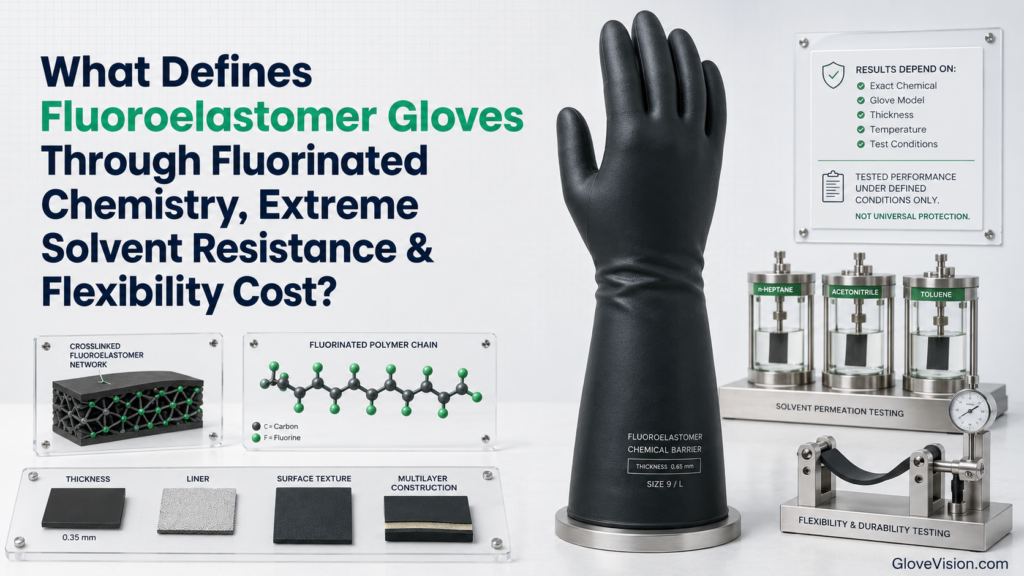
What Defines Fluoroelastomer Gloves Through Fluorinated Chemistry, Extreme Solvent Resistance & Flexibility Cost?
Fluoroelastomer Gloves use fluorine-containing elastomer chemistry to provide strong resistance against selected hydrocarbons, aromatic solvents, chlorinated solvents, fuels, oils, and other aggressive chemicals.
Their resistance is not universal: performance depends on the exact chemical or mixture, concentration, temperature, duration, polymer family and grade, monomer composition, cure system, thickness, construction, fit, condition, and product-specific testing.
What Are Fluoroelastomer Gloves, and How Does Fluorinated Chemistry Shape Their Behavior?
Fluoroelastomer Gloves are made wholly or partly from fluorine-containing elastomers whose polymer composition can limit interaction with selected aggressive solvents while retaining rubber-like elasticity.
What Does “Fluoroelastomer” Mean?
A fluoroelastomer is a member of an elastic fluorinated-polymer family rather than one identical glove compound. FKM identifies standardized rubber classes, while base polymer, compounding, curing, thickness, and finished construction define the actual glove. ASTM nomenclature keeps FKM, FFKM, and FEPM distinct. [ASTM]
Which Monomers Can Shape FKM Gloves?
FKM formulations may contain different combinations of fluorinated monomers, so the FKM name alone does not reveal the exact polymer structure. Documented formulations can use vinylidene fluoride, hexafluoropropylene, tetrafluoroethylene, and other comonomers in grade-specific combinations.
How Do Carbon–Fluorine Bonds Support Solvent Resistance?
Carbon–fluorine bonding contributes to stable fluorinated polymer structures, but finished resistance still depends on the complete polymer and exposure. Chain composition, cure, cross-linking, additives, and temperature shape swelling and diffusion. Explore the fluorinated chemistry behind fluoroelastomer behavior without treating one bond type as universal proof.
Why Does Fluorine Content Not Determine Performance Alone?
Fluorine content cannot determine glove performance by itself because monomer sequence, cure chemistry, cross-link density, additives, thickness, and construction also alter behavior. Higher fluorine content is not automatically superior for every chemical, temperature, or handling task.
How Are FKM, FFKM, FEPM, and Fluoroplastics Different?
FKM, FFKM, and FEPM are distinct elastomer classifications, while PTFE, PFA, and FEP are fluoroplastic families rather than interchangeable FKM materials. A family name sets a boundary; it does not establish finished-glove performance.
Why Is Viton™ Not Every Fluoroelastomer Glove?
Viton™ is one fluoroelastomer brand containing multiple families and grades, not the generic name for every Fluoroelastomer Gloves product. Its selection guide demonstrates grade variation, but brand and seal data cannot validate an unspecified glove. [Viton]
| Material Factor | Possible Physical Effect | Practical Contribution | What It Does Not Guarantee |
|---|---|---|---|
| Fluorinated polymer chain | Reduced interaction with selected fluids | Aggressive-solvent resistance | Universal chemical resistance |
| Carbon–fluorine bonding | Supports structural stability | Property retention in selected exposures | Resistance to every ketone, ester, acid, or base |
| Polymer grade | Changes chemical and temperature behavior | Exposure-specific performance | Equal behavior across FKM families |
| Cross-linking | Creates an elastic network | Recovery and material stability | Identical flexibility across products |
| Greater thickness | Extends some diffusion paths | Product-specific barrier contribution | Automatic chemical suitability |
| Additives and fillers | Modify handling and durability | Task-specific characteristics | Unchanged chemical resistance |
How Do Fluoroelastomer Gloves Balance Solvent Protection Against Flexibility and Cost?
Fluoroelastomer Gloves balance solvent protection against flexibility and cost through polymer formulation, thickness, supported or unsupported construction, liners, multilayer systems, grip finishes, and cuff design.
How Does Thickness Affect Fluoroelastomer Gloves?
Thickness can lengthen a chemical’s diffusion path and add physical robustness, but it can also reduce finger movement, tactile feedback, and comfort. It may increase material cost and fatigue, and it cannot correct chemical incompatibility.
How Do Unsupported Fluoroelastomer Gloves Behave?
Unsupported Fluoroelastomer Gloves rely mainly on a continuous elastomer shell, creating a thickness-dependent balance between barrier coverage and flexibility. Grip finish, cuff geometry, internal moisture, and product-specific durability still require inspection.
How Do Supported and Multilayer Builds Behave?
Supported and multilayer Fluoroelastomer Gloves combine chemical-contact, structural, comfort, or grip layers that must be tested as one finished system. Liners may aid donning and structure but add bulk, contamination retention, drying needs, and delamination points.
How Do Grip Finish and Cuff Design Affect Performance?
Grip finishes and cuffs alter handling and coverage but do not establish solvent compatibility. Surface texture can support control while complicating cleaning; extended cuffs increase coverage while creating sleeve and suit-interface constraints.
Why Do Fluoroelastomer Gloves Cost More?
Fluoroelastomer Gloves may cost more because specialty polymers, complex formulation, multilayer production, testing, lower manufacturing volume, and limited distribution increase expense. These practical limits on fluoroelastomer adoption matter operationally, but price never proves compatibility.
When Does Flexibility Become Insufficient?
Flexibility becomes insufficient when the glove prevents reliable opening, closure, grip, tool control, or coordination with adjacent PPE. Pressure points, fatigue, tactile loss, and cuff interference are functional failures, not minor comfort issues. Review the flexibility limitations of fluoroelastomer gloves before accepting the specialist material.
| Construction Factor | Possible Protection Contribution | Flexibility or Handling Cost | Financial or Operational Cost |
|---|---|---|---|
| Thicker fluoroelastomer | Longer diffusion path | More bulk and stiffness | More specialty material |
| Thinner fluoroelastomer | Lower bulk | Less physical margin | Requires exact exposure evidence |
| Textile-supported build | Structural stability | Reduced tactility | Complex decontamination |
| Multilayer construction | Combines barrier and support | Bulk or delamination risk | Higher manufacturing cost |
| Textured palm | Handling support | Harder cleaning | Surface-wear monitoring |
| Extended cuff | Forearm coverage | Interface restriction | Larger specialist product |
Where Do Fluoroelastomer Gloves Provide Strong Solvent Resistance, and Where Does It End?
Fluoroelastomer Gloves may provide strong resistance to selected hydrocarbons, fuels, oils, aromatic solvents, and chlorinated solvents, but performance can decline sharply against particular oxygenated solvents, reactive chemicals, bases, amines, or mixtures.
Which Hydrocarbons May Suit Fluoroelastomer Gloves?
Selected aliphatic and aromatic hydrocarbons, petroleum-derived fluids, fuels, oils, and lubricants may suit tested Fluoroelastomer Gloves. The category is not approval: additives, temperature, duration, grade, and exact model matter. OSHA’s broad material guidance supports hazard-led selection rather than blanket approval. [OSHA] For deeper context, see aromatic-solvent resistance of fluoroelastomers.
How Can Fluoroelastomer Gloves Perform Against Chlorinated Solvents?
Some Fluoroelastomer Gloves provide strong documented resistance to selected chlorinated solvents, but results cannot be transferred across the category. Verify the exact solvent, concentration, temperature, model, thickness, permeation result, and degradation result through the chlorinated-solvent compatibility boundaries.
Why Are Ketones an Important Resistance Boundary?
Selected ketones can cause rapid permeation or degradation in some Fluoroelastomer Gloves despite strong performance against other aggressive solvents. MAPA’s FluoTech 344 data provide one product-specific example of chemical-to-chemical variation and poor acetone performance; the result cannot be generalized to every FKM glove. [MAPA]
Why Do Esters, Acetates, Organic Acids, Bases, and Amines Require Caution?
These chemical families require exact product evidence because fluoroelastomer grades can respond differently. Grade, cure, concentration, temperature, mixture composition, and duration prevent a broad compatible-or-incompatible verdict.
How Do Chemical Mixtures Change Resistance?
Chemical mixtures may interact with Fluoroelastomer Gloves differently from their separate ingredients because one component can alter polymer swelling or transport of another. NIOSH mixture-permeation research supports mixture-specific caution rather than averaging single-chemical results. [NIOSH] Even toluene and xylene resistance considerations must remain product- and condition-specific.
How Do Degradation, Penetration, and Permeation Differ?
Degradation is damaging material change, penetration is passage through physical defects, and permeation is molecular movement through apparently intact material. ISO 374-2 treats penetration as a distinct property [ISO 374-2], while ISO 374-4 separately addresses degradation. [ISO 374-4] Molecular permeation may occur without visible damage.
How Should Breakthrough Time Be Interpreted?
Breakthrough time belongs to an exact chemical, glove, thickness, concentration, test temperature, method, and detection threshold. It is not a guaranteed wear time, universal replacement interval, cross-product rating, or whole-shift approval.
| Exposure Category | Possible Contribution | Important Boundary | Required Verification |
|---|---|---|---|
| Selected aliphatic hydrocarbons | Strong barrier potential | Individual-fluid variation | Exact permeation data |
| Selected aromatic solvents | Specialty resistance potential | Temperature and grade matter | Product-specific testing |
| Selected chlorinated solvents | Potentially long breakthrough | Not universal across solvents | Permeation and degradation data |
| Fuels and oils | Potential material stability | Blended formulations vary | Exact fluid data |
| Ketones | Important potential weakness | Rapid permeation or degradation | Substance-specific testing |
| Esters and acetates | Product-dependent resistance | Some grades may be poorly matched | Exact glove model |
| Bases and amines | Grade-dependent behavior | Broad charts may conflict | Exact product data |
| Chemical mixtures | Unpredictable combined behavior | Individual data may mislead | Mixture-specific testing |
Which Fluoroelastomer Gloves Match the Exact Solvent Exposure and Task?
Fluoroelastomer Gloves should be selected when exact product data support the exposure and when flexibility, grip, mechanical strength, coverage, availability, and cost remain practical.
Which Exposure Details Must Be Defined First?
Selection cannot begin until the exact chemical, contact conditions, required coverage, and simultaneous hazards have been defined. Record the chemical name and CAS number, mixture composition, concentration, temperature, pressure where relevant, splash or immersion, duration, frequency, mechanical stress, and routine or emergency use.
When Are Fluoroelastomer Gloves Justified?
Fluoroelastomer Gloves may be justified when a general-purpose product lacks suitable resistance and exact testing supports the specialist glove. The tested construction must also preserve dexterity, supply continuity, change scheduling, and manageable cost. Use the exposure conditions that justify fluoroelastomer use to keep the decision hazard-led.
When Are Fluoroelastomer Gloves Poorly Matched?
Fluoroelastomer Gloves are poorly matched when chemical compatibility, mechanical function, fit, evidence, or operational feasibility fails. Reconsider them when resistance is inadequate, proof is missing, puncture or cut risk dominates, dexterity or PPE integration fails, or a less costly tested glove fully meets the task.
How Should Thickness and Construction Be Chosen?
Thickness and construction should balance documented barrier needs with coverage, grip, finger movement, mechanical support, and wear duration. Splash versus immersion, liner, reinforcement, cuff length, grip surface, and multilayer design must be evaluated together.
How Should Fit and Dexterity Be Function-Checked?
Suitable Fluoroelastomer Gloves must preserve the hand movement and control required by the task without unstable internal movement. Verify finger alignment, thumb position, palm stability, full opening and closure, tool control, cuff position, adjacent PPE, and absence of pain or numbness.
Which Product Evidence Should Support Selection?
Selection should be supported by documentation for the exact finished Fluoroelastomer Gloves model. Confirm manufacturer, model, material family, layers, thickness, length, intended use, permeation, degradation, test temperature, applicable certification, change guidance, decontamination, and retirement criteria. ISO 374-1 provides terminology and requirements but does not prove an unspecified glove complies. [ISO 374-1]
How Should Cost Be Evaluated?
Cost should be evaluated against verified protection and operational feasibility rather than reputation or purchase price alone. Acquisition, replacement, permitted reuse, decontamination, availability, downtime, training, disposal, and exposure-failure consequences belong in the decision.
How Should Fluoroelastomer Gloves Be Used, Inspected, and Retired?
Fluoroelastomer Gloves should remain in service only while their chemical compatibility, physical integrity, fit, grip, PPE interfaces, exposure history, change schedule, and manufacturer-defined condition remain acceptable.
What Should Be Verified Before Use?
Pre-use verification must confirm the exact product, construction, exposure, compatibility evidence, change schedule, and supporting procedures. Confirm model, material family, layers, thickness, cuff, liner, grip, breakthrough data, reuse permission, decontamination method, and additional PPE.
How Should Fluoroelastomer Gloves Be Inspected?
Inspection should cover every layer, seam, cuff, liner, and grip area that could compromise barrier performance or task control. Check fingertips, thumb crotch, finger sides, palm, backhand, cuffs, interfaces, adhesion, repairs, swelling, softening, hardening, tackiness, cracks, punctures, tears, thinning, discoloration, delamination, contamination, and elasticity.
How Should Fluoroelastomer Gloves Be Used During Exposure?
During exposure, Fluoroelastomer Gloves must remain within approved contact conditions, cuff configuration, task procedure, and change schedule. Stop if exposure changes, unexpected immersion occurs, damage appears, movement or grip becomes unreliable, or the approved interval is reached.
How Should Fluoroelastomer Gloves Be Removed?
Doffing must prevent contact between bare skin and the contaminated exterior while controlling cuff runoff and secondary contamination. Follow the approved sequence, contain removed gloves, perform hand hygiene, report exposure, and use the required disposal route.
How Should Reusable Fluoroelastomer Gloves Be Decontaminated and Stored?
Reusable Fluoroelastomer Gloves should be decontaminated only when the exact product permits reuse and an approved procedure exists. Approved cleaning does not guarantee removal of absorbed chemical. Store clean and dry, protected from light, heat, chemicals, compression, sharp folds, and loss of product or exposure-history records.
When Should Fluoroelastomer Gloves Be Retired?
Fluoroelastomer Gloves must be retired whenever compatibility, traceability, structural integrity, or barrier reliability can no longer be verified. Retirement triggers include the approved interval, unknown exposure, suspected permeation, unresolved contamination, swelling, deformation, hardness, softness, tackiness, cracking, tearing, thinning, separated layers, contaminated liners, or deteriorated fit and grip.
What Final Decision Determines Suitability?
Final suitability requires every chemical, product, construction, function, maintenance, cost, and condition check to pass. Exact chemical or mixture → concentration and temperature → contact pattern → duration → exact model → polymer and layers → product evidence → fit and handling → mechanical suitability → change and decontamination plan → cost feasibility → current condition → final decision.
- Exact chemical, CAS number, mixture, concentration, temperature, contact, duration, coverage, and mechanical hazards are defined.
- Exact model, family, layers, thickness, cuff, permeation, degradation, test conditions, change rules, and retirement criteria are confirmed.
- Finger alignment, palm stability, closure, grip, tactility, cuff position, PPE integration, and fatigue remain acceptable.
- No swelling, softening, hardening, tackiness, cracks, punctures, tears, delamination, contamination, or lost traceability exists.
- Supply, change intervals, authorized reuse, decontamination, storage, disposal, and cost remain workable.
- Use only when every check passes; otherwise change, reassess, retire, or do not use.
Conclusion
Fluoroelastomer Gloves provide specialized resistance to selected aggressive solvents because of fluorinated elastomer chemistry, but protection remains chemical-, grade-, product-, and exposure-specific. FKM is a family, Viton™ is one brand, and strong hydrocarbon or chlorinated-solvent performance does not establish ketone, ester, acid, base, amine, or mixture compatibility.
Select by the exact exposure and finished-glove evidence, then verify construction, fit, grip, flexibility, mechanical hazards, change procedures, permitted decontamination, retirement rules, supply, and cost. The correct choice is the best verified overall match, not the strongest material reputation.
Frequently Asked Questions
Are Fluoroelastomer Gloves Resistant to Every Solvent?
No. They may resist selected hydrocarbons, aromatic and chlorinated solvents, oils, and fuels, but ketones, esters, organic acids, bases, amines, and mixtures require exact product evidence.
Are All Fluoroelastomer Gloves Made From Viton™?
No. Viton™ is one fluoroelastomer brand, while gloves may use other brands, grades, formulations, or multilayer constructions.
Are Fluoroelastomer Gloves Suitable for Acetone?
Not automatically. Some finished products show poor acetone resistance, so exact model-level permeation and degradation data are required.
Why Are Fluoroelastomer Gloves Expensive?
Cost can reflect specialty polymers, formulation, curing, multilayer construction, testing, limited volume, and specialist distribution. Higher price does not prove compatibility.
When Should Fluoroelastomer Gloves Be Replaced?
Replace them when the approved change interval is reached or when compatibility, contamination, exposure history, fit, flexibility, layers, grip, or structural condition can no longer be verified.