
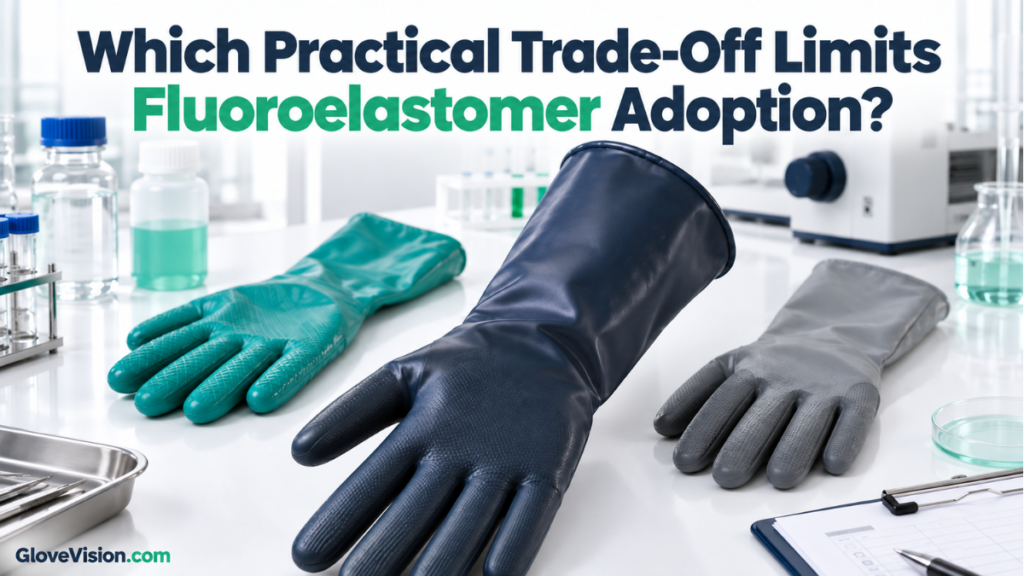
Which Practical Trade-Off Limits Fluoroelastomer Adoption?
Fluoroelastomer Gloves adoption is mainly limited by the trade-off between specialist chemical protection and complete-task efficiency. These gloves can provide valuable resistance in selected demanding solvent exposures, but that specialization is worthwhile only when it solves a protection problem that other verified products do not adequately solve.
The trade-off is product-specific rather than an unavoidable property of every Fluoroelastomer Glove. Physical performance, dexterity, construction, chemical breadth, workflow, and actual product cost vary, so generic material-level limitations cannot automatically describe every finished product.
What Practical Trade-Off Most Limits Fluoroelastomer Gloves Adoption?
Fluoroelastomer Gloves adoption is most limited by the need to justify specialist chemical resistance against the complete requirements of the task. Their protection advantage matters only when the actual chemical hazard requires it and the finished glove remains practical enough to use safely.
What Do Fluoroelastomer Gloves Gain Through Specialization?
OSHA’s current chemical-resistant glove chart identifies Fluoro-elastomer (Viton) as an organic-solvent material and lists chlorinated solvents, aliphatics, and alcohols among its generic use areas. These categories are useful for initial screening, but they do not establish suitability of every Fluoroelastomer Glove for every chemical within those families. [OSHA]
What Can Fluoroelastomer Gloves Give Up Through Specialization?
The same OSHA chart lists poor physical properties and poor resistance to some ketones, esters, and amines as generic Fluoroelastomer disadvantages. These are material-level screening limitations rather than finished-product ratings. [OSHA]
Why Is Cost Only Part of the Adoption Problem?
OSHA’s glove-selection guidance states that, where performance characteristics remain acceptable, regularly replacing cheaper gloves can in some circumstances be more cost-effective than reusing more expensive types. That is general glove-selection guidance; it does not establish that Fluoroelastomer Gloves themselves are inherently expensive. [OSHA]
Why Is Maximum Chemical Resistance Not Automatically the Best Choice?
A chemically capable glove must also satisfy dexterity, grip, mechanical integrity, coverage, exposure duration, removal, and other task requirements. The broader glove materials explained framework helps separate broad material characteristics from complete-glove selection.
What Question Defines the Adoption Decision?
Does this exact Fluoroelastomer Glove provide a necessary verified protection advantage while also satisfying the physical and operational requirements of the complete task?
Fluoroelastomer Gloves Adoption Trade-Off Table
| Decision Dimension | Potential Fluoroelastomer Advantage | Potential Adoption Constraint |
|---|---|---|
| Selected demanding solvents | Specialist barrier value | Exact chemical and product evidence required |
| Chlorinated solvent tasks | Generic candidate use area | Named solvents remain product-specific |
| Chemical breadth | Useful within verified zones | Some ketones, esters, and amines are generic limitation zones |
| Physical performance | Finished products require individual assessment | Generic OSHA guidance identifies physical-property limitations |
| Dexterity | Depends on the finished glove | Cannot be inferred from polymer name alone |
| Workflow | Specialist barrier can solve a difficult stage | May be unnecessary for tasks already covered by another verified product |
| Cost | Can be justified when specialist protection is necessary | Compare actual adequate systems only after protection requirements are met |
Why Does Specialist Chemical Resistance Increase the Value of Fluoroelastomer Gloves?
Specialist chemical resistance increases Fluoroelastomer Gloves value when the controlling exposure is difficult enough that an exact Fluoroelastomer product provides a necessary barrier advantage over other adequately assessed options.
When Do Difficult Organic Solvents Strengthen the Case?
OSHA categorizes Fluoro-elastomer (Viton) as an organic-solvent glove material and lists chlorinated solvents, aliphatics, and alcohols among generic use areas. That makes Fluoroelastomer a reasonable material family to investigate for selected difficult organic-solvent tasks, while exact-product evidence remains necessary. [OSHA]
When Do Chlorinated Solvents Increase Specialist Value?
Chlorinated solvents are specifically included in OSHA’s generic Fluoroelastomer use column. This supports candidate screening, but it does not replace verification of the exact solvent, concentration, temperature, contact pattern, glove construction, and applicable finished-product data.
Why Can High-Consequence Exposure Increase Specialist Value?
Where barrier failure would have serious consequences, stronger product-specific evidence becomes more important. Specialist chemistry is valuable when it closes a documented protection gap, not merely because the material has a strong general reputation.
Why Can Repeated Chemical Handling Strengthen the Case?
Repeated contact makes permeation, degradation, physical condition, contamination history, inspection, and replacement criteria increasingly important. Evidence from one exposure pattern should not automatically be transferred to a substantially different contact duration or use pattern.
When Does Specialist Value Disappear?
The practical advantage becomes weak when another exact product already provides adequate chemical protection, required task performance and coverage, and a manageable use system under the same exposure conditions.
How Do Physical Performance, Dexterity, and Workflow Affect Fluoroelastomer Gloves?
Chemical resistance alone cannot justify Fluoroelastomer Gloves adoption if the exact product cannot withstand the physical task, provide sufficient hand control, or be managed reliably within the workplace workflow.
Why Do Physical Properties Matter?
OSHA’s glove-selection guidance directs users to consider the dexterity required, duration and frequency of exposure, degree of exposure, and physical stresses applied during the work activity. These factors can make a chemically promising glove unsuitable for the complete task. [OSHA]
Why Must Generic OSHA Physical-Property Guidance Be Qualified?
OSHA’s chemical-resistant glove chart lists poor physical properties as a generic Fluoroelastomer disadvantage. That statement should be used as a screening caution rather than converted into a dexterity, puncture, abrasion, or durability rating for every finished Fluoroelastomer Glove. [OSHA]
Can Construction Change the Trade-Off?
Yes. Thickness, layering, liners, surface treatment, cuff design, and other construction details can change the practical behavior of a finished glove. Material-family guidance therefore cannot substitute for whole-product evaluation.
Why Must Grip and Dexterity Be Evaluated Separately?
A glove can be chemically adequate yet difficult to manipulate in the actual task. Grip, tactile control, flexibility, fit, and dexterity should therefore be assessed against the specific work activity rather than inferred from the polymer name.
When Does Workflow Become an Adoption Constraint?
Inspection, contamination history, replacement criteria, storage, task switching, training, safe removal, and any supported reuse or decontamination procedure can affect practical adoption. A glove that is difficult to manage reliably may be a poor operational choice even when its chemistry is promising.
Why Can Multi-Chemical Workflows Reduce Practical Value?
A process involving several chemically different substances can cross compatibility boundaries. OSHA’s selection guidance specifically warns that formulated products and mixtures require attention to the limiting component unless specific mixture data are available. [OSHA]
How Should Cost Be Included?
Use the sequence chemical adequacy → task suitability → replacement or supported reuse strategy → operational burden → actual cost. Purchase price should not move a chemically inadequate glove ahead of a protective one.
Fluoroelastomer Gloves Practical-Limit Matrix
| Practical Factor | Possible Task Effect | Required Evaluation | Adoption Implication |
|---|---|---|---|
| Puncture or tear exposure | Possible barrier breach | Exact-product physical performance | May require another construction or protection system |
| Abrasion | Wear and integrity loss | Task-specific durability | Can affect replacement strategy |
| Grip | Reduced object control | Actual handling conditions | Product-specific assessment |
| Dexterity | Fine manipulation may become difficult | Exact glove and task assessment | Do not infer from polymer name |
| Construction | Can change complete performance | Whole-product data | Evaluate the finished glove |
| Repeated use | Accumulated condition and exposure history | Inspection and supported procedures | Lifecycle decision |
| Chemical switching | One specialist may not cover every stage | Full-process chemical map | May require planned glove changes |
| Lifecycle cost | Operational burden | Compare only adequate systems | Cost follows protection requirements |
Which Chemical Boundaries Most Limit Fluoroelastomer Gloves Adoption?
Fluoroelastomer Gloves adoption is chemically limited when the task includes substances or formulations outside the exact product’s verified resistance range, especially where conventional Fluoroelastomer limitations or unresolved mixtures remove the specialist advantage.
Why Do Some Ketones Limit Use?
OSHA’s current glove chart lists poor resistance to some ketones as a generic Fluoroelastomer disadvantage. Strong performance against other solvent families therefore should not be transferred automatically to ketone exposure. [OSHA]
Why Can Esters Limit Wider Adoption?
The same OSHA source lists some esters within the generic Fluoroelastomer limitation zone. This is a screening warning rather than proof that every ester is incompatible; exact chemical and product data remain necessary. [OSHA]
Why Do Amines Require Separate Verification?
OSHA also identifies some amines as a generic limitation. Performance against chlorinated solvents, aliphatics, or alcohols therefore should not be transferred automatically to amine handling. [OSHA]
Why Must Specialty Fluoroelastomers Be Treated Separately?
Fluoroelastomer chemistry is not uniform. The official Viton Extreme ETP-600S product information reports resistance beyond conventional fluoroelastomers for low-molecular-weight esters, ketones, aldehydes, high-pH/base materials, highly caustic solutions, and amines. This demonstrates formulation-specific differences, but polymer-level data do not by themselves establish that a particular finished glove is suitable for those exposures. [Viton]
How Can Mixtures Eliminate a Specialist Advantage?
For mixtures and formulated products without specific test data, OSHA’s glove-selection guidance warns that the component with the shortest breakthrough time can control selection because solvents may carry other ingredients through polymeric materials. Individual-component reputation therefore should not be treated as proof of complete-mixture suitability. [OSHA]
When Should Fluoroelastomer Gloves Be Rejected Chemically?
Reject or escalate the proposed glove when exact chemical identity is unknown, important mixture information is unresolved, applicable exact-product data are absent, barrier performance is inadequate, degradation is unacceptable, exposure conditions materially exceed the evidence available, or generic material reputation is the principal justification.
How Should Fluoroelastomer Gloves Be Compared and Verified Before Adoption?
Fluoroelastomer Gloves should be adopted only after their exact chemical advantage is compared with other adequately protective finished products under the same exposure and task requirements.
When Can Nitrile Be More Practical?
Nitrile can remain in the comparison when an exact product provides adequate chemical protection and its physical properties, grip, dexterity, or workflow better fit the task. Generic material reputation should not override exact chemical evidence.
When Can Neoprene Be More Practical?
Consider an exact neoprene glove when its chemical data are adequate, its physical performance suits the task, and Fluoroelastomer specialization is unnecessary. See Neoprene specialization trade-offs.
When Can Butyl Rubber Be a Better Specialist?
Butyl Rubber can deserve comparison where the exact chemical and product data support it, particularly where the exposure falls outside the strongest practical case for conventional Fluoroelastomer. Compare finished products rather than ranking the materials universally. See Butyl selection trade-offs.
When Can PVA Be Relevant?
PVA can enter the shortlist for selected organic-solvent tasks, but its own exposure boundaries must be respected. Exact chemical, moisture conditions, physical task, and finished-product evidence remain necessary. See PVA selection trade-offs.
When Can a Multilayer Barrier Be More Appropriate?
A verified multilayer product may deserve comparison when one specialist polymer does not adequately cover the complete formulation or another finished barrier provides stronger applicable evidence. Multilayer construction itself does not establish universal superiority.
How Should Alternatives Be Compared Fairly?
Hold constant the exact chemical or mixture, concentration, temperature, contact mode, duration, test method and endpoint, required coverage, and physical task. Only products that pass the required chemical-protection gate should remain for practical comparison.
Fluoroelastomer Gloves Specialist-or-Alternative Decision Matrix
| Controlling Task | Fluoroelastomer Direction | Alternative Direction | Decision Requirement |
|---|---|---|---|
| Verified difficult organic-solvent task | Reason to evaluate | Compare other exact solvent barriers | Chemical-specific product data |
| Selected chlorinated solvent | Generic candidate use area | Compare other verified products | Named-solvent evidence |
| Ketone-dominant exposure | Conventional Fluoroelastomer requires caution | Evaluate another verified material or specialty formulation | Exact chemical and finished-product evidence |
| Ester or amine exposure | Conventional Fluoroelastomer requires caution | Compare another verified barrier or applicable specialty formulation | Product-specific evidence |
| High physical stress | Chemistry alone is insufficient | Compare suitable finished constructions | Chemical + physical evidence |
| High dexterity requirement | Exact product must be assessed | Compare other chemically adequate products | Protection gate first |
| Complex mixture | Generic material guidance may be insufficient | Seek mixture-specific or limiting-component evidence | Complete formulation assessment |
| Routine task already covered by another glove | Specialist advantage may add little | Use an adequately verified practical option | Complete-task adequacy |
What Chemical Gate Must Be Passed?
Confirm the exact chemical identity, CAS number where useful, complete formulation where available, concentration, temperature, contact pattern, duration and frequency, relevant permeation and degradation evidence, and the glove construction represented by those data.
Which Product Details Must Match?
Verify manufacturer, exact model, known material or formulation, homogeneous or composite construction, thickness, liner, grip, cuff, seams or interfaces, coverage, and applicable test documentation.
How Should Breakthrough Data Be Interpreted?
ASTM F739-20 identifies breakthrough detection time, standardized breakthrough time, permeation rate, and cumulative permeation as key barrier-performance measures. ASTM also states that data from the method cannot be used to infer safe exposure levels because quantitative information about acceptable dermal contact is limited for most chemicals. A laboratory breakthrough value therefore should not automatically be treated as a safe glove-wear time. [ASTM]
What Physical and Workflow Gates Must Be Passed?
Evaluate grip, dexterity, physical integrity, fit, coverage, repeated flexing, safe removal, inspection, replacement, supported reuse or decontamination where applicable, storage, contamination history, and chemical or task switching.
How Should Cost Be Compared?
Use chemical protection → physical and task adequacy → replacement or supported reuse plan → lifecycle burden → actual cost. Cost comparison should occur among products that already satisfy the required protection criteria.
Fluoroelastomer Gloves Adoption Verification Checklist
Chemical Necessity
- Exact chemical is identified.
- CAS number or formulation is confirmed where useful.
- Complete mixture information is reviewed where available.
- Specialist Fluoroelastomer resistance is actually relevant.
- Exact-product evidence supports the exposure.
- Test conditions sufficiently represent the intended use.
Physical Task
- Grip is adequate for the actual handling task.
- Dexterity is adequate.
- Flexibility and fit are adequate.
- Required physical integrity is adequate.
- Coverage is adequate.
- The glove can remain serviceable for the intended task.
Workflow
- Inspection requirements are defined.
- Replacement criteria are established.
- Reuse or decontamination is used only where supported.
- Storage requirements are manageable.
- Chemical and task switching has been assessed.
- A safe removal procedure is available.
Alternative Comparison
- Only chemically adequate alternatives remain.
- Alternatives are compared under equivalent exposure conditions.
- Physical-task performance is compared.
- Lifecycle requirements are compared.
- Actual product cost is considered only after protection requirements are met.
Final Decision
What Should Readers Remember About the Trade-Off Limiting Fluoroelastomer Gloves Adoption?
Fluoroelastomer Gloves are most valuable when their verified resistance to a demanding chemical exposure solves a protection problem that other candidate products do not adequately solve. Their specialist value is real, but generic material guidance also identifies chemical and physical limitations that prevent them from functioning as universal chemical gloves.
Wider adoption is therefore limited by specialization versus complete-task efficiency—not by cost alone. Use an exact Fluoroelastomer Glove when its verified specialist advantage is necessary and the finished product also meets the task; compare other verified products when that specialist advantage is unnecessary, unsupported, or offset by another required performance boundary.
Which Questions Clarify the Practical Limits of Fluoroelastomer Gloves Adoption?
Why Aren’t Fluoroelastomer Gloves Used for Every Chemical Task?
Because Fluoroelastomer Gloves are specialist barriers, not universal chemical gloves. Their strongest practical case exists when an exact product has applicable evidence for the controlling exposure. Conventional Fluoroelastomer guidance also identifies limitations against some ketones, esters, and amines, while physical performance, construction, dexterity, and workflow can independently affect suitability. A strong result for one chemical family should therefore not be transferred automatically to another exposure.
Is Cost the Main Reason Fluoroelastomer Gloves Have Limited Adoption?
No. Cost is a downstream comparison factor rather than the primary protection gate. First determine whether the exact glove provides adequate chemical resistance, whether it can perform the physical task, and whether its fit, dexterity, coverage, inspection, replacement, and handling requirements are workable. Only then should its actual lifecycle cost be compared with other products that also provide adequate protection.
Do Fluoroelastomer Gloves Always Have Poor Dexterity?
No. Generic material guidance cannot determine the dexterity of every finished Fluoroelastomer Glove. Thickness, construction, layering, fit, flexibility, surface design, and the precision required by the task can all change hand control. Treat generic physical-property cautions as reasons to evaluate the exact product rather than as automatic proof that every Fluoroelastomer glove is difficult to use.
When Are Fluoroelastomer Gloves Worth the Practical Trade-Off?
They are most worth considering when specialist chemistry closes a real protection gap. The exact Fluoroelastomer Glove should have applicable evidence for the chemical, concentration, temperature, contact pattern, and intended exposure conditions, while also meeting the task’s physical, dexterity, coverage, and workflow requirements. A specialist material adds less practical value when another verified glove already satisfies those same requirements.
When Should Another Glove Be Chosen Instead of Fluoroelastomer Gloves?
Compare another glove when the Fluoroelastomer product does not clearly pass the complete selection process. That includes situations where applicable chemical data are missing, the exposure falls within an important compatibility limitation, physical or ergonomic requirements are not met, the formulation is unresolved, or another exact product already provides adequate protection with a more suitable complete-task profile. The alternative must still be verified for the actual exposure rather than chosen from material reputation alone.