
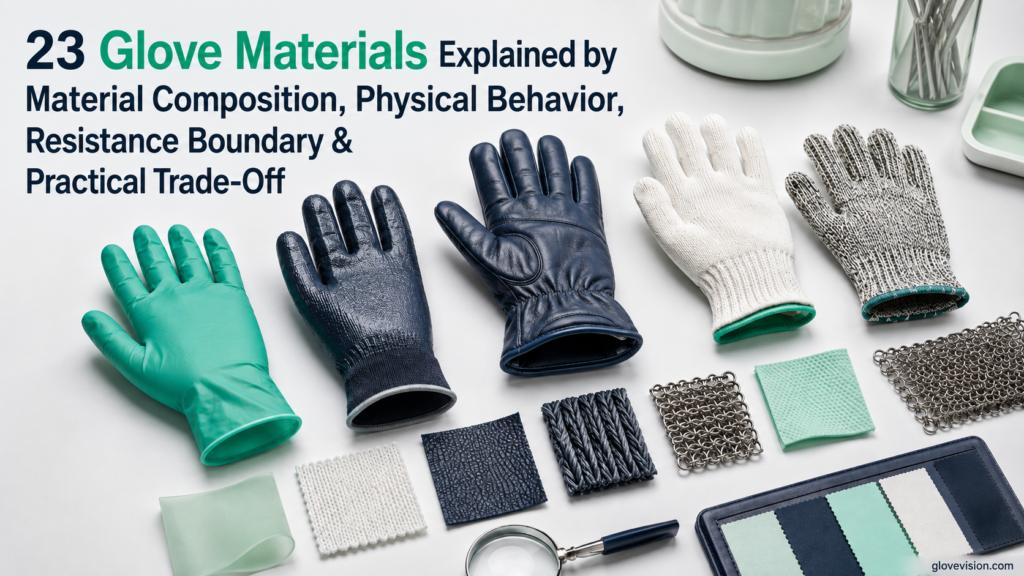
23 Glove Materials Explained by Material Composition, Physical Behavior, Resistance Boundary & Practical Trade-Off
Glove Materials include natural rubber, synthetic elastomers, thermoplastic films, animal hides, textile fibers, high-strength yarns, metallic mesh, and specialty polymers whose structures influence glove flexibility, grip, tactility, durability, moisture response, and resistance behavior.
No material simultaneously maximizes protection, dexterity, comfort, durability, grip, breathability, and affordability. Material identity alone cannot establish performance because the finished glove also depends on formulation, thickness, coatings, liners, seams, reinforcement, exposure conditions, testing, fit, wear, and current condition.
What Are Glove Materials, and Why Does Their Composition Shape Finished-Glove Performance?
Glove Materials are the natural, synthetic, fibrous, polymeric, or metallic substances that provide the structural and contact layers of finished gloves.
Which Structural Forms Can Glove Materials Take?
Glove Materials may be formed as continuous films, natural hides, woven or knitted textiles, high-strength yarns, metallic rings, coatings, laminates, or solid and foamed polymers. Structural form can be as important as the underlying chemical or fiber name because openings, layers, density and continuity change how the finished glove behaves.
How Does Composition Affect Glove Material Behavior?
Composition affects how a glove material stretches, recovers, absorbs moisture, bends, grips, wears, transfers heat, and interacts with chemicals. Elasticity, surface friction, tactility, abrasion, tearing and temperature response remain construction-specific rather than universal material scores.
Why Does a Glove Material Name Not Prove Finished-Glove Performance?
A material name does not prove finished-glove performance because formulation, thickness, construction, reinforcement, coverage, fit, and condition can change how that material behaves. Polymer formulation, leather processing, fiber orientation, knit gauge, coatings, liners, seams, closures, wear and damage must be considered together. [ISO 21420]
| Material family | Included entries | Shared evaluation lens |
|---|---|---|
| Elastomeric barriers | Latex, nitrile, neoprene, butyl rubber, fluoroelastomer | Elasticity, permeability and compatibility |
| Thermoplastics and specialty films | Vinyl/PVC, PVA, PE, TPE | Film integrity, fit and moisture sensitivity |
| Natural hides | Leather, cowhide, goatskin, pigskin, deerskin | Fibrous structure, abrasion and flexibility |
| Natural textiles | Cotton and wool | Absorption, comfort and insulation |
| Synthetic support fibers | Nylon, polyester and spandex/elastane | Strength, shape retention and stretch |
| High-strength fibers | Aramid and HPPE/UHMWPE | Cut behavior, flexibility and temperature limits |
| Metallic structures | Metal mesh | Edge resistance, openings and weight |
| Specialty polymers | Silicone | Grip, temperature behavior, bulk and tear limits |
Which 23 Glove Materials Define the Main Composition, Behavior, Resistance, and Trade-Off Categories?
The following 23 Glove Materials represent the principal elastomeric, thermoplastic, hide, textile, high-strength, metallic, and specialty constructions used across finished gloves.
- Natural Rubber Latex Gloves
Composition: vulcanized natural-rubber latex. Physical behavior: highly elastic with close hand conformity and strong stretch recovery. Resistance boundary: elasticity does not prove chemical, puncture, or tear resistance, and residual proteins or processing chemicals may cause reactions. Practical trade-off: tactile conformity is balanced against sensitization risk and exposure-specific compatibility.
- Nitrile Gloves
Composition: synthetic nitrile-butadiene rubber with product-specific formulations. Physical behavior: flexible with variable stiffness, durability, and hand conformity. Resistance boundary: nitrile does not resist every chemical, and cut, puncture, heat, and accelerator-related claims require separate evidence. Practical trade-off: selected barrier performance and latex avoidance are balanced against formulation-dependent tactility, stiffness, and reaction potential.
- Neoprene / Chloroprene Gloves
Composition: polychloroprene or a related chloroprene-rubber formulation. Physical behavior: flexible with product-dependent weathering and environmental stability. Resistance boundary: broad-sounding resistance does not replace exact chemical-compatibility or mechanical testing. Practical trade-off: versatility is balanced against thickness, cost, and potentially reduced fine feedback.
- Butyl Rubber Gloves
Composition: synthetic butyl elastomer with relatively low gas permeability. Physical behavior: flexible but commonly used in substantial glove constructions. Resistance boundary: specialized barrier strengths do not create universal resistance across all solvents, chemicals, cuts, or heat. Practical trade-off: selected vapor and chemical-barrier performance is balanced against bulk, cost, and dexterity loss.
- Fluoroelastomer Gloves
Composition: fluorinated synthetic elastomer. Physical behavior: dense, durable, and product-dependently flexible. Resistance boundary: resistance remains chemical-, formulation-, thickness-, temperature-, and duration-specific. Practical trade-off: specialist chemical performance is balanced against cost, reduced availability, bulk, and flexibility limitations.
- Vinyl / PVC Gloves
Composition: plasticized polyvinyl chloride film. Physical behavior: limited elastic recovery with generally looser hand conformity than highly elastic glove films. Resistance boundary: thin constructions may stretch, tear, or lose integrity, and PVC identity does not prove chemical compatibility. Practical trade-off: low cost and simple short-task use are balanced against fit, tactility, durability, and barrier limitations.
- Polyvinyl Alcohol / PVA Gloves
Composition: polyvinyl-alcohol film or coating. Physical behavior: comparatively stiff with specialized barrier behavior. Resistance boundary: water, humidity, and perspiration can critically degrade performance. Practical trade-off: selected solvent resistance is balanced against narrow usable conditions and moisture sensitivity.
- Polyethylene / PE Gloves
Composition: lightweight conventional polyethylene film. Physical behavior: low stretch, loose fit, and limited hand conformity. Resistance boundary: seams, tearing, slippage, and thin-film integrity can limit protection and task control. Practical trade-off: low cost and short-task convenience are balanced against weak dexterity, stability, and durability.
- TPE / Thermoplastic Elastomer Gloves
Composition: product-specific thermoplastic-elastomer blend. Physical behavior: lightweight, soft, and stretchable to a formulation-dependent degree. Resistance boundary: the TPE label does not establish one barrier, durability, or chemical-resistance profile. Practical trade-off: improved conformity over basic films may be balanced against variable evidence, wear tolerance, and barrier performance.
- Leather Gloves
Composition: processed animal hide forming the parent natural-hide category. Physical behavior: fibrous, flexible, porous, and strongly affected by hide source and processing. Resistance boundary: leather is not a universal liquid, chemical, cut, puncture, or thermal barrier. Practical trade-off: abrasion durability and comfort are balanced against bulk, moisture sensitivity, variable tactility, and product inconsistency.
- Cowhide Gloves
Composition: processed bovine hide and a subtype of the parent leather category. Physical behavior: typically substantial, fibrous, and product-dependently durable. Resistance boundary: thickness and toughness do not prove liquid, chemical, needle, cut, or heat protection. Practical trade-off: wear tolerance is balanced against bulk, break-in requirements, and reduced fine feedback.
- Goatskin Gloves
Composition: processed goat hide with a comparatively fine grain and a subtype of leather. Physical behavior: supple with good hand conformity in suitable constructions. Resistance boundary: softness and tactility do not establish chemical, puncture, cut, or thermal protection. Practical trade-off: dexterity and flexibility are balanced against thickness-dependent durability and protection limits.
- Pigskin Gloves
Composition: processed porcine hide with a visibly porous structure and a subtype of leather. Physical behavior: flexible, breathable, and responsive to moisture. Resistance boundary: porosity and complete construction limit liquid and chemical-barrier claims. Practical trade-off: comfort and flexibility are balanced against barrier limitations and variable moisture behavior.
- Deerskin Gloves
Composition: processed deer hide and a subtype of the parent leather category. Physical behavior: soft, supple, and capable of close movement. Resistance boundary: softness does not prove abrasion life, cut resistance, puncture resistance, or chemical compatibility. Practical trade-off: comfort and flexibility are balanced against limited verified protection and potentially higher cost.
- Cotton Gloves
Composition: woven or knitted natural cellulose fibers. Physical behavior: soft, breathable, absorbent, and flexible. Resistance boundary: cotton is porous, may retain contaminants, and provides minimal standalone resistance to liquids, chemicals, cuts, punctures, or heat. Practical trade-off: comfort and affordability are balanced against moisture retention and limited primary protection.
- Wool Gloves
Composition: crimped natural keratin fibers. Physical behavior: insulating, absorbent, and capable of retaining warmth when suitably constructed. Resistance boundary: wool does not automatically provide wind, liquid, chemical, flame, or defined temperature protection. Practical trade-off: warmth is balanced against bulk, permeability, moisture retention, and reduced dexterity.
- Nylon Gloves
Composition: synthetic polyamide fibers. Physical behavior: flexible, smooth, and mechanically supportive in woven or knitted constructions. Resistance boundary: ordinary nylon does not prove chemical, cut, puncture, impact, or thermal protection. Practical trade-off: low bulk and structural support are balanced against limited standalone hazard resistance.
- Polyester Gloves
Composition: synthetic polyester fibers. Physical behavior: dimensionally stable with relatively low moisture absorption. Resistance boundary: conventional polyester has heat, melting, chemical, and barrier limitations that depend on construction. Practical trade-off: affordability and shape retention are balanced against limited primary protection and high-temperature constraints.
- Spandex / Elastane Gloves
Composition: segmented polyurethane elastic fibers generally used in blends or panels. Physical behavior: highly extensible with strong recovery. Resistance boundary: spandex provides little standalone chemical, cut, puncture, impact, or thermal protection. Practical trade-off: improved fit and mobility are balanced against heat sensitivity, elastic fatigue, and dependence on other protective components.
- Aramid Fiber Gloves
Composition: aromatic polyamide fibers used alone or in engineered blends. Physical behavior: high tensile strength with comparatively stable behavior under selected heat exposures. Resistance boundary: aramid identity does not prove a specific cut level, puncture protection, chemical resistance, impact protection, or unlimited heat protection. Practical trade-off: lightweight mechanical and thermal potential is balanced against grip needs, wear, UV sensitivity, and cost.
- HPPE / UHMWPE Gloves
Composition: highly oriented ultra-high-molecular-weight polyethylene fibers, often used in engineered yarn blends. Physical behavior: lightweight, flexible, and strong relative to mass. Resistance boundary: cut resistance does not prove needle or impact protection, and thermoplastic fibers have important high-temperature limitations. Practical trade-off: dexterity and cut-performance potential are balanced against heat sensitivity, coating dependence, and puncture boundaries.
- Metal Mesh Gloves
Composition: interlinked metallic rings or comparable engineered mesh structures. Physical behavior: articulated, open, comparatively heavy, and resistant to selected blade-cutting actions. Resistance boundary: open mesh does not provide liquid or chemical containment and does not automatically resist needles, crushing, powered blades, or impact. Practical trade-off: selected edge resistance is balanced against weight, openings, fit sensitivity, reduced tactility, and hazard-specific limits.
- Silicone Gloves
Composition: siloxane-based elastomeric polymer. Physical behavior: flexible, grippy, low-absorbency, and product-dependently stable across selected temperature conditions. Resistance boundary: silicone is not universally chemical-, cut-, puncture-, tear-, flame-, or heat-proof. Practical trade-off: grip and selected temperature utility are balanced against bulk, tear behavior, dexterity reduction, and product-specific thermal limits.
How Do Protective Glove Materials Shape Elasticity, Grip, Dexterity, Moisture, and Wear?
Protective Glove Materials behave differently because elastic films, hides, textiles, high-strength yarns, metallic mesh, and specialty polymers deform, recover, absorb moisture, and transfer force differently.
How Do Elasticity and Recovery Differ Across Glove Materials?
Elasticity and recovery are generally most pronounced in elastomeric films and stretch fibers, while thermoplastic films, hides, textiles, and metallic mesh accommodate movement through deformation, flexion, knit expansion or ring articulation. Detailed evaluation of Natural Rubber Latex Gloves must separate elastic conformity from chemical, mechanical, and sensitization performance.
Elastic recovery is not evidence of chemical, cut, puncture, or heat protection.
How Do Glove Materials Affect Grip and Tactile Feedback?
Grip and tactile feedback depend on material thickness, surface texture, coating, fit, moisture, stiffness, and internal movement rather than material identity alone. Nitrile Gloves demonstrate why one material-family name can include products with different thicknesses, textures, stiffness levels, and grip behavior.
How Do Glove Materials Affect Breathability and Moisture?
Moisture behavior differs because continuous films tend to restrict vapor movement, textiles may absorb or transport moisture, hides remain porous, and open mesh provides little environmental separation. Leather Gloves require hide-, finish-, lining-, construction-, and condition-specific evaluation rather than one universal leather rating.
How Do Glove Materials Affect Durability and Wear?
Glove durability depends on the specific failure mechanism, including film tearing, polymer cracking, coating loss, fiber abrasion, UV deterioration, leather hardening, mesh-ring damage, chemical degradation, or elastic fatigue. A material that resists one failure mode can remain vulnerable to another.
Why Must Comfort Be Balanced Against Protection?
Comfort supports sustained glove use and task control, but it cannot replace verified protection against the identified hazard. Thickness can reduce tactility, close films may retain heat, mesh may add weight, insulation may reduce finger control, and loose or restrictive constructions may undermine safe handling.
Where Do Hand-Protection Material Resistance Boundaries Differ Across Chemical, Mechanical, and Thermal Hazards?
Hand-Protection Materials must be evaluated against individual hazards because chemical, abrasion, cut, puncture, needle, impact, and thermal resistance are separate performance categories.
How Can Chemical Glove Materials Fail?
Chemical glove materials can fail through penetration, degradation, permeation, construction defects, or damage created during use. Penetration occurs through holes, seams or openings; degradation is physical material deterioration; permeation is molecular movement through apparently intact material. [OSHA OTM] [NIOSH] Neoprene Gloves must be checked against the exact chemical and contact conditions instead of being treated as universally resistant.
Why Does Chemical Compatibility Require Exact Exposure Data?
Chemical compatibility cannot be selected from the polymer name alone because performance changes with the substance, mixture, concentration, temperature, duration, thickness, glove condition, and splash or immersion contact. Exact manufacturer data must match the product and exposure; universal breakthrough times should not be inferred. [OSHA OTM]
Why Are Cut, Puncture, Needle, and Impact Resistance Different?
Cut, puncture, needle, and impact hazards apply different forces and therefore require separate construction features and test evidence. Strong fibers do not automatically resist fine needles or absorb impact, and open mesh does not prevent crushing. [ISO 23388] Aramid Fiber Gloves require finished-product evidence before any cut, puncture, or thermal level is assigned.
HPPE/UHMWPE Gloves combine high-strength fibers with product-specific yarns, coatings, and reinforcement systems that alter complete-glove performance.
Why Does Heat Stability Not Prove Thermal Protection?
A material can remain structurally stable at an elevated temperature without preventing dangerous heat transfer to the hand. Contact heat, radiant heat, convective heat, flame, molten splash, insulation and exposure duration require separate finished-glove evidence.
How Can Water and Moisture Change Glove Material Performance?
Water and moisture can alter grip, insulation, flexibility, dimensional stability, contaminant retention, drying behavior, and chemical-barrier performance. Absorbent textiles, natural hides, water-sensitive films, occlusive films and open structures respond differently to wet exposure.
| Hazard | Material-level clue | Critical failure boundary | Required evidence |
|---|---|---|---|
| Chemical contact | Polymer family and thickness | Permeation, degradation and penetration | Exact compatibility data |
| Blade cut | High-strength yarn or metallic structure | Cut-through, seams and coverage gaps | Relevant cut testing |
| Puncture | Dense or reinforced construction | Point penetration | Relevant puncture testing |
| Needle | Specialized layered construction | Fine-point penetration | Needle-specific evidence |
| Impact or crush | Padding or rigid reinforcement | Force transmission | Impact-specific testing |
| Heat | Heat-stable or insulating construction | Heat transfer and material degradation | Thermal-performance testing |
| Cold | Insulating layers | Moisture, compression and heat loss | Cold-use performance data |
| Wet exposure | Film, coating or membrane | Material and construction penetration | Complete-glove evidence |
How Should Glove Materials Be Compared and Chosen for a Finished-Glove Requirement?
Glove Material Selection should begin with the exact hazard and required protective function, not with a preferred material name.
Which Questions Should Be Answered Before Comparing Glove Materials?
Before comparing Glove Materials, define what will contact the glove, how contact will occur, how long exposure may last, which areas require coverage, what grip and dexterity are required, whether multiple hazards are present, and whether the glove is intended to be disposable or reusable. [OSHA]
How Should Unsuitable Glove Material Families Be Eliminated?
Eliminate any material family whose documented resistance boundary conflicts with the identified exposure. Water-sensitive barriers should not be retained for wet exposure; ordinary cut evidence should not be accepted for needles; generic splash claims should not be transferred to immersion; and open mesh should not be treated as liquid containment.
Which Finished-Glove Details Must Be Verified?
After screening the material family, verify the exact glove model, declared materials, thickness, coatings, liners, blends, reinforcement, seams, cuffs, closures, mesh arrangement, product testing, manufacturer limitations and current condition. [ISO 21420] Metal Mesh Gloves require verification of the exact blade hazard, coverage, ring condition, fit, and intended task.
How Should Fit and Dexterity Be Evaluated?
A suitable glove should maintain required coverage and protection without slipping, bunching, restricting essential movement, or undermining task control. Check finger alignment, fingertip space, palm bunching, internal slipping, thumb movement, grip stability, cuff coverage and pressure points. [ISO 21420]
How Should Competing Material Trade-Offs Be Resolved?
Resolve material trade-offs by prioritizing verified protection and safe task control before coverage, wear duration, comfort, maintenance and cost. Comfort cannot replace necessary protection, but protection that prevents safe task performance is also unsuitable.
How Can Glove Material Selection Mistakes Be Corrected Before the Final Decision?
Glove Material Selection errors occur when broad material reputations replace exact hazard analysis and finished-product evidence.
Which Glove Material Assumptions Should Be Rejected?
Reject assumptions that transfer one property into an unrelated guarantee: thicker does not always mean safer; cut resistance does not prove puncture or needle resistance; heat resistance does not prove insulation; water resistance does not prove chemical resistance; and a material name does not prove certification.
How Should Conflicting Glove Material Claims Be Checked?
Conflicting claims should be checked against the exact product, performance category, test method, test conditions, reported result, intended use, manufacturer documentation, stated limitations and current glove condition. Marketing language without identifiable test conditions should not become a universal performance claim.
When Should a Glove Material Candidate Be Rejected?
Reject a candidate when it conflicts with the exposure, lacks relevant evidence, fails to provide coverage or control, creates unstable grip or inadequate dexterity, is incorrectly fitted or damaged, shows degradation, or leaves a simultaneous hazard unresolved. [OSHA PPE]
What Final Glove Material Rule Should Readers Retain?
Begin with the exact hazard, eliminate materials whose documented boundaries conflict with the exposure, compare the remaining trade-offs, and approve only a finished glove whose tested construction, coverage, fit, dexterity, and condition match the task.
- Exact hazard is identified.
- Exposure route is known.
- Contact duration is estimated.
- Temperature and concentration are considered.
- Splash versus immersion is defined.
- Simultaneous hazards are identified.
- Material family is confirmed.
- Material form is identified.
- Physical behavior suits the task.
- Resistance boundaries are documented.
- Trade-offs remain acceptable.
- Exact model is identified.
- Thickness is considered.
- Coatings and liners are considered.
- Blends and reinforcements are assessed.
- Seams, cuffs, and closures are assessed.
- Product-level test data are available.
- Manufacturer limitations are understood.
- Fit is correct.
- Grip remains stable.
- Required dexterity is preserved.
- Coverage is sufficient.
- Condition is acceptable.
- Select — evidence, protection, fit, and function match the task.
- Compare — multiple verified products remain suitable.
- Reassess — hazard or product information is incomplete.
- Reject — a resistance boundary conflicts with the exposure.
- Do not use — suitability cannot be verified.
Conclusion
The 23 Glove Materials provide different combinations of flexibility, grip, durability, moisture behavior, barrier performance, thermal response, and mechanical resistance, but none provides universal protection.
Final suitability belongs to the complete tested glove—not the material name alone—and must be verified against the exact hazard, exposure conditions, fit, task function, coverage, and current glove condition.
Frequently Asked Questions
Is There One Best Glove Material?
No. Each material balances protection, flexibility, grip, durability, comfort, moisture behavior, availability, and cost differently. Suitability depends on the exact hazard, exposure conditions, finished-glove construction, test evidence, fit, and condition.
Which Glove Material Provides the Best Chemical Protection?
No material provides universally superior chemical protection. Compatibility depends on the exact chemical or mixture, concentration, temperature, contact duration, splash or immersion conditions, material thickness, complete construction, and product-level test data.
Are Natural Glove Materials Better Than Synthetic Materials?
Not universally. Natural and synthetic materials provide different behaviors and resistance boundaries, but neither category proves suitability by itself. Compare the finished glove against the task rather than selecting from the natural-or-synthetic label.
Can a Glove Material Name Prove Cut, Heat, Puncture, or Impact Protection?
No. Those protection levels belong to the exact tested glove construction. Fibers, coatings, thickness, reinforcement, seams, coverage, mesh structure, wear, and condition can all change performance.
Why Do Composite, Blended, or Coated Gloves Perform Differently?
Composite gloves combine components that perform different functions, so their behavior cannot be predicted from one named material alone. Liners, coatings, reinforcing yarns, elastic fibers, mesh layers, and insulation can each contribute a separate function; the finished glove must be evaluated as one protective system.