
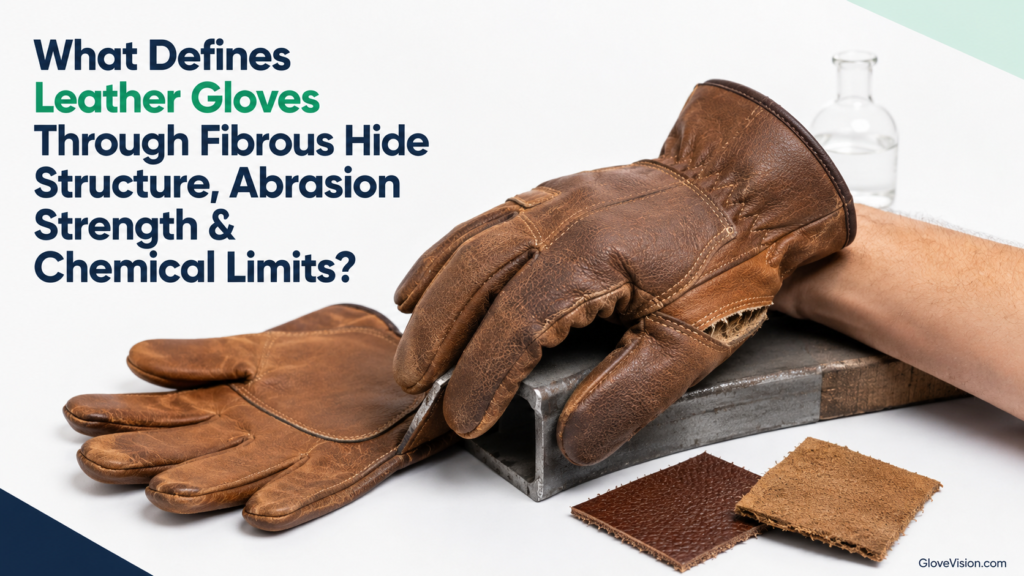
What Defines Leather Gloves Through Fibrous Hide Structure, Abrasion Strength & Chemical Limits?
Leather Gloves use processed hide’s interwoven collagen-fiber structure to provide flexible, product-dependent resistance to abrasion, rough surfaces, chips, sparks and selected mechanical wear. That fibrous structure can support durable contact surfaces and controlled handling without proving a universal protection level.
Leather is not one standardized glove material. Animal source, body area, hide layer, fiber density, tanning, finishing, thickness, seams, reinforcement, lining, fit, moisture, damage and finished-glove testing can all change performance; cuts, punctures, needles, heat, liquids, chemicals and electricity therefore require separate evidence.
What Are Leather Gloves, and How Does Their Fibrous Hide Structure Shape Performance?
Leather Gloves are constructed from processed animal hide whose interwoven collagen fibers can provide flexibility, surface durability and resistance to selected mechanical wear, with performance varying across hides and finished products. Material identity starts the evaluation; the exact construction and evidence finish it.
What Creates the Fibrous Structure of Leather Gloves?
Collagen fibers and fiber bundles form an interlaced structure whose orientation and density vary through the hide. Body location, natural growth, fiber looseness, scars and processing can create local differences in flexibility, thickness and surface-wear behavior.
Tanning stabilizes that biological structure, while cutting and glove manufacture decide which zones reach the palm, fingers, thumb and cuff. No two hides should be assumed to have identical fiber organization.
How Do Grain and Split Leather Gloves Differ?
Grain leather retains the outer grain surface to a product-dependent degree, while split leather is separated from beneath the grain portion and exposes a more fibrous structure. Grain surfaces may be smoother; split or suede-like surfaces may offer different handling friction, flexibility or selected heat-use characteristics.
Neither layer is universally superior. Tanning, finishing, thickness, fiber density, reinforcement, moisture and the complete glove can outweigh a simple grain-versus-split label.
What Do Full-Grain and Top-Grain Mean in Leather Gloves?
Full-grain generally describes leather whose grain surface has not been completely removed through corrective processing, while top-grain describes material from the upper hide region that may receive correction or finishing. Commercial usage and grading can vary.
These terms describe processing and appearance—not abrasion, cut, puncture, heat or chemical ratings. A premium-sounding label cannot replace finished-glove test data.
How Does Tanning Affect Leather Gloves?
Tanning stabilizes hide and can change flexibility, aging, moisture response, surface feel, color and heat behavior. Finishing may add surface character, repellency or friction changes, but results remain recipe- and product-specific.
No tanning method is universally safer or stronger. Residues, coatings, dyes and later treatments must be understood through the exact finished glove and its instructions.
Why Does Natural Hide Variation Matter in Leather Gloves?
Scars, loose fiber zones, body-area differences, uneven thickness and surface defects can produce local performance variation. Careful hide selection, cutting layout and manufacturing quality control are therefore protection variables, not cosmetic details.
Visible smoothness also cannot prove hidden fiber density or structural consistency. Inspect the finished glove rather than inferring quality from color or surface polish.
| Leather Variable | Possible Physical Effect | Practical Contribution | What It Does Not Prove |
|---|---|---|---|
| Dense fiber organization | May improve wear behavior | Rough-surface handling | Abrasion rating |
| Grain layer | May provide a smoother contact surface | Product-dependent grip and wear | Chemical resistance |
| Split layer | May provide a fibrous surface | Product-dependent handling | Inferior construction |
| Tanning | Changes stability, feel and moisture response | Flexibility and aging behavior | Universal heat performance |
| Thickness | Adds material depth | Wear material and cushioning | Cut or puncture rating |
| Natural variation | Creates local differences | Makes quality control important | Uniform performance |
How Do Leather Gloves Construction and Hide Selection Affect Abrasion Strength and Handling?
Leather Gloves derive usable abrasion durability from the interaction of hide structure, thickness, palm design, seams, reinforcement, lining and fit—not from species, appearance or thickness alone. Each construction choice changes both protection potential and hand control.
How Does Hide Layer Affect Leather Gloves Abrasion Behavior?
Grain-side and split or suede surfaces place different fiber structures against the work object. Fiber density, finishing, coatings, moisture, contact pressure and the abrasive material can all change surface wear.
ISO 23388:2018 treats abrasion separately from blade cut, tear, puncture and applicable impact. [ISO 23388]
The current published edition is being revised, but ISO/CD 23388 remains under development and must not be treated as the published replacement. [ISO Draft]
How Does Thickness Affect Leather Gloves?
Additional thickness can add material depth, cushioning and separation from rough objects, but it can also add bulk and stiffness. Reduced tactile feedback, restricted finger closure and higher hand fatigue may follow when thickness exceeds the task’s handling needs.
Thickness is a construction variable—not an abrasion, cut, puncture, needlestick or heat rating. The finished glove must still be tested for the relevant property.
How Do Seams and Thread Affect Leather Gloves?
Seam placement, stitch density, thread material, thumb construction and finger junctions determine whether cut-and-sewn panels remain connected under work stress. External seams may face wear; internal seams can create pressure or handling interference.
Strong leather cannot compensate for failed stitching. The broader Glove Basics of construction, coverage and fit should therefore be checked alongside the hide.
How Do Palm Reinforcements Affect Leather Gloves?
Palm patches can protect high-wear zones, add cushioning and support product-dependent grip. Their benefit depends on placement, attachment, material continuity and whether the task loads the reinforced area.
Extra layers may also add bulk, create pressure points, reduce tactile feedback or retain moisture. Reinforcement is useful only where its coverage and trade-offs match the work.
How Do Linings Change Leather Gloves Performance?
Linings may add comfort, insulation, moisture management or separately tested cut resistance, but they can also add bulk and retain contamination. Lining movement can disturb fit, and incomplete coverage can leave unprotected zones.
A lining’s protection belongs only to the complete tested glove and the areas where it is present. Fiber identity alone cannot be transferred to the shell, seams or cuff.
How Does Fit Affect Leather Gloves Handling?
Functional fit keeps fingers aligned, the palm stable, the thumb mobile and the cuff secure during representative work. Fingertip excess, internal slipping, palm bunching, seam pressure or restricted closure can reduce grip and increase fatigue.
Fit must be checked with the actual object and adjacent PPE. A glove that feels comfortable at rest may still snag, twist or load seams during gripping.
| Component | Possible Contribution | Handling Trade-Off | Required Verification |
|---|---|---|---|
| Grain-leather palm | Surface durability and handling | Finish- and moisture-dependent grip | Abrasion evidence |
| Split-leather panel | Fibrous contact surface | Product-dependent flexibility | Finished construction |
| Additional thickness | Wear material and cushioning | Bulk and reduced dexterity | Task function-check |
| Reinforced palm | Supports high-wear zones | Reduced tactile feedback | Protected-zone coverage |
| Seams and thread | Maintain glove structure | Pressure and failure points | Inspection and task suitability |
| Lining | Adds comfort or specialist protection | Bulk and moisture retention | Complete-glove testing |
| Extended cuff | Adds wrist or forearm coverage | Possible PPE interference | Exposure-path assessment |
Where Do Leather Gloves Provide Protection, and Where Do Their Chemical and Hazard Limits Begin?
Leather Gloves may protect against rough surfaces, chips, sparks, moderate heat and selected mechanical wear, but every hazard requires product-level evidence that matches the exposure. Material tendency is not a rating, and one mechanical result cannot be transferred to another hazard.
How Do Leather Gloves Resist Abrasion?
Interwoven fibers, material depth, surface finish and reinforcement can slow surface wear under suitable conditions. Contact pressure, abrasive geometry, moisture, palm construction and existing damage determine how that potential appears in work.
ANSI/ISEA 105-2024 classifies separate performance properties and clarifies leather abrasion testing; an abrasion result still does not establish cut, puncture, chemical or thermal protection. [ANSI/ISEA]
Do Leather Gloves Provide Cut or Puncture Protection?
Not automatically: abrasion, blade cut, ordinary puncture and hypodermic-needle puncture are separate properties. Leather thickness alone cannot establish any of them, and a reinforced palm may leave the back of the hand, fingers or seams differently protected.
When sharp edges or points are present, verify the exact tested construction and the relevant coverage. Separately tested Cut-Resistant Glove Linings may add edge protection, but do not automatically provide needle or impact resistance.
How Much Heat Can Leather Gloves Withstand?
No universal temperature applies to Leather Gloves. Sparks, conductive contact, radiant heat, flame, hot surfaces and molten splash create different exposures, and duration can matter as much as peak temperature.
OSHA describes leather gloves as generally useful against sparks, moderate heat, blows, chips and rough objects; that is a general tendency, not a finished-product thermal rating. [OSHA PPE]
Are Leather Gloves Flame-Resistant?
Not automatically: sufficient heat can char, shrink, harden, crack or weaken leather. Linings, coatings, closures, reinforcements and thread may fail separately even when the hide does not melt like some thermoplastics.
Welding or flame-exposed use requires complete-product evidence for the process and exposure. Evaluate Heat-Resistant Stitching when seams face thermal stress; thread choice alone still cannot approve the glove.
Are Leather Gloves Waterproof?
Not automatically: untreated leather may absorb water, and seams or openings may permit entry. Water-repellent finishes reduce wetting under specified conditions but do not create a continuous waterproof membrane or chemical barrier.
Moisture can change dimensions, flexibility, surface friction, grip, lining behavior and drying. Only documented complete-glove construction supports a waterproof claim.
Why Are Leather Gloves Poorly Matched to Unverified Chemical Exposure?
Porous leather may absorb and retain hazardous liquids, hold contamination against skin and become difficult to decontaminate. It may also harden, shrink, lose flexibility or conceal contamination after exposure.
OSHA’s acrylonitrile guidance specifically warns that leather can absorb liquid acrylonitrile and retain it against the skin. That example establishes a chemical-specific boundary—not universal breakthrough data for every substance. [OSHA AN]
Do Leather Gloves Provide Electrical Protection?
No—ordinary Leather Gloves are not electrical insulators and do not carry a voltage class. Rated rubber insulating gloves provide the electrical barrier; leather protector gloves may guard that rubber from physical damage inside an approved system.
OSHA requires protector gloves over insulating gloves except under defined limited-use conditions. The protector role does not create or inherit electrical insulation. [OSHA Electrical]
Which Leather Gloves Match Different Mechanical and Work Tasks?
Leather Gloves should be selected by the exact task, mechanical hazard, heat exposure, coverage requirement, handling demands and finished-glove ratings—not by leather appearance, species or thickness alone. Begin with the hazard, then verify construction, fit and condition.
Which Leather Gloves Suit General Material Handling?
General handling candidates should match the object’s weight, roughness, edge condition, grip demand and required dexterity. Palm construction, seam placement, reinforcement and cuff coverage must remain functional through representative lifting and repositioning.
OSHA requires selection to consider performance characteristics relative to the task, conditions, duration and identified hazards. A generic “work glove” label is insufficient. [OSHA Hand]
Which Leather Gloves Suit Repeated Abrasion?
Repeated-abrasion work needs documented abrasion performance, suitable palm coverage, protected wear zones, stable seams and functional fit. Inspect often enough to detect thinning before a hole interrupts coverage.
Do not select by thickness alone. Contact pressure, surface geometry, moisture and reinforcement placement can change where wear accumulates.
Which Leather Gloves Suit Heat or Spark Exposure?
Only a complete glove supported for the exact heat source, contact pattern and duration should be considered. Check cuff length, lining, seam and thread suitability, shrinkage risk, flame contact, conductive and radiant heat, and adjacent PPE.
Detailed welding selection remains outside this page. Ordinary leather construction must not inherit welding or foundry suitability from the material name.
Which Leather Gloves Suit Dexterity-Dependent Tasks?
Dexterity-dependent work needs finger shaping, thumb mobility, suitable palm thickness, controlled seam placement and stable grip. Flexible leather may improve hand conformity, but loose lining or fingertip excess can cancel that benefit.
The thinnest glove is not automatically safest. It must preserve both the required protection and reliable control of the actual object.
Which Leather Gloves Require Cut- or Puncture-Resistant Layers?
Sharp sheet material, glass, wire, blades, metal edges, needles, pointed debris and thorn-like objects may require separately tested layers or systems. Select the evidence for the exact sharp hazard and the zones exposed.
One liner does not prove abrasion, blade cut, ordinary puncture, needlestick and impact performance at once. Coverage gaps and seams remain part of the decision.
When Should Another Glove Replace Leather Gloves?
Select another documented glove when the task requires chemical permeation resistance, waterproof construction, electrical insulation, high cut or needlestick protection, extreme heat resistance, sterility, biological-fluid protection or very high tactile sensitivity. Leather should not be forced into a role its evidence does not support.
The parent 23 Glove Materials Explained guide can frame alternative material families, but final approval still belongs to the complete tested glove.
| Task Context | Possible Leather Contribution | Additional Requirement | Main Boundary |
|---|---|---|---|
| General material handling | Rough-surface and abrasion support | Fit, grip and seam integrity | Leather name is insufficient |
| Repeated abrasion | Wear-resistant palm construction | Documented abrasion result | Thickness is not a rating |
| Spark or moderate-heat work | Limited thermal and spark support | Heat-rated complete glove | Not automatically welding-safe |
| Sharp-edge handling | Base mechanical coverage | Tested cut-resistant system | Abrasion does not equal cut resistance |
| Puncture exposure | Material separation | Puncture-specific testing | Leather can still be penetrated |
| Needlestick exposure | Minimal base coverage | Needle-specific protection | Ordinary puncture data are insufficient |
| Wet work | Physical hand coverage | Waterproof membrane or alternative | Leather may absorb water |
| Chemical handling | Minimal incidental separation | Chemical-specific barrier glove | Leather may absorb contaminants |
| Electrical work | Possible protector role | Rated rubber insulating system | Leather provides no voltage protection |
How Should Leather Gloves Be Selected, Inspected, Maintained, and Retired?
Leather Gloves should be selected from the hazard backward, function-checked before use, inspected for material and construction damage, maintained according to exact product instructions and retired whenever protection or handling can no longer be verified. The sequence is hazard → evidence → fit → inspect → use → maintain → reassess → retire.
What Should Be Verified Before Selecting Leather Gloves?
Confirm the task, primary and secondary hazards, exact model, intended use, applicable ratings, leather and hide layer, palm construction, seams, reinforcement, lining, cuff, size and manufacturer instructions. Grip and dexterity must be checked under representative conditions.
Do not fill missing product information with assumptions about species, color, thickness, softness or price. Unverified protection is not protection evidence.
How Should Leather Gloves Fit?
Fingers should align naturally, fingertip excess should not disrupt control, the palm should remain stable and the thumb should move comfortably. Verify full hand opening, functional closure, secure cuff position and compatibility with adjacent PPE.
Reject or resize when internal slipping, pressure points, bunching, seam tension or restricted closure prevents safe handling.
What Should Be Inspected Before Wearing Leather Gloves?
Inspect for abrasion, thin spots, holes, cuts, punctures, tears, cracks, hardening, shrinkage, burns, charring, failed seams, loose thread, detached reinforcement and lining displacement. Also check moisture damage, chemical contamination, oil or fuel saturation and previous repairs.
Flex the glove and inspect high-load zones around fingertips, thumb junction, palm, seams and cuff. Static appearance alone may miss stiffness or structural separation.
How Should Leather Gloves Be Cleaned and Dried?
Follow the exact manufacturer’s instructions for surface cleaning, washing permission, cleaning agents, water exposure, reshaping, liner care and drying method. Multi-material gloves may contain membranes, adhesives, elastic, coatings or specialist thread with different limits.
Do not universally prescribe soaking, machine washing, hand washing, detergent, solvent cleaning or heat drying. An incorrect care method can change fit, grip, stiffness or protective construction.
Should Leather Gloves Be Conditioned?
Condition only when the exact manufacturer permits a compatible product and method. Oils and treatments can alter grip, breathability, flexibility, coatings, adhesives, thread or thermal behavior.
Conditioning cannot replace missing leather, close a hole, restore a failed seam or recover a rating after unassessed damage.
Which Repairs Are Appropriate for Leather Gloves?
Use only approved methods, compatible materials and authorized services where the product allows repair. The repair must preserve the specified construction and be reassessed for the intended task.
Avoid household adhesives, unapproved patches, ordinary thread and repairs that conceal heat or chemical damage. Repair does not automatically restore original tested or certified performance.
When Should Leather Gloves Be Retired?
Retire or formally reassess Leather Gloves when holes, severe thinning, cuts, punctures, failed seams, detached reinforcement, hardening, shrinkage, heat damage or unresolved contamination interrupts confidence in protection. Unstable fit, unreliable grip, displaced lining or unknown history also requires removal from service.
Do not use a universal age or wash count. Retirement follows the exact hazard, glove instructions, damage, contamination history and current functional condition.
- Exact model and intended use match the task.
- Required mechanical or thermal ratings are verified.
- Chemical, biological and electrical hazards are addressed separately.
- Manufacturer care instructions are available.
- Fingers, palm and thumb align naturally.
- Full functional hand movement is possible.
- Grip and cuff coverage match the task.
- Adjacent PPE interfaces correctly.
- No holes, severe thinning, cuts or punctures are present.
- Leather remains sufficiently flexible.
- No unresolved shrinkage or hardening is present.
- No significant moisture or heat damage is present.
- Seams and thread remain secure.
- Reinforcements and lining remain positioned.
- Closures remain functional.
- No unauthorized repair changed the construction.
- No unresolved chemical, oil or fuel contamination remains.
- Cleaning and drying followed exact instructions.
- No unapproved conditioner was applied.
- Previous repairs are authorized.
- Use: hazard match, ratings, fit and condition are verified.
- Maintain: approved care is required.
- Reassess: moisture, wear, heat or contamination creates uncertainty.
- Repair: an authorized process can restore specified construction.
- Replace: protection or handling cannot be restored.
- Do not use: suitability, history or condition cannot be verified.
Conclusion
Leather Gloves use a variable natural hide structure whose layer, tanning, finish and thickness influence flexibility and wear behavior, but none of those terms is a standalone protection rating. Full-grain is not universally best, split leather is not universally inferior, and seams, reinforcement, lining, cuff, fit and finished-glove testing remain decisive.
Abrasion does not establish cut, puncture or needlestick resistance; leather is not a universal heat, flame, liquid, chemical or electrical barrier. Final suitability depends on the exact hazard, complete product evidence, coverage, functional handling, approved care, contamination history and current condition.
Frequently Asked Questions
Are Leather Gloves Abrasion-Resistant?
They can provide strong abrasion resistance, but performance depends on the hide, construction, reinforcement, moisture, wear and applicable finished-glove test results.
Are Thicker Leather Gloves More Protective?
Not automatically. Additional thickness may increase material depth or cushioning, but it can also reduce flexibility, grip, dexterity and natural hand closure.
Do Leather Gloves Protect Against Cuts and Punctures?
Not automatically. Cut, ordinary puncture and needlestick resistance are separate properties requiring appropriate finished-glove testing and, where necessary, added protective layers.
Are Leather Gloves Safe for Chemical Handling?
Ordinary Leather Gloves should not be treated as chemical-resistant gloves. Leather may absorb and retain hazardous liquids, so chemical-specific barrier protection is required.
Can Leather Gloves Be Washed and Reused?
Many Leather Gloves are reusable, but cleaning, drying, conditioning, inspection and continued use must follow the instructions for the exact finished product.