
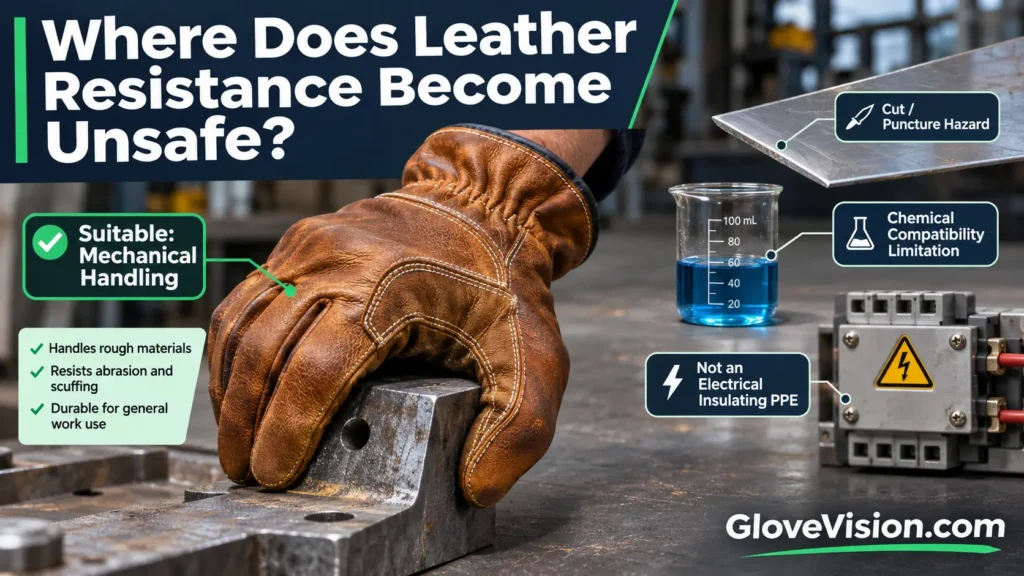
Leather glove resistance becomes unsafe when workplace hazards exceed the verified protective capability of the finished glove, when damage or contamination compromises its function, or when glove use creates an additional risk around moving machinery. General leather toughness does not establish sufficient mechanical, chemical, thermal or electrical protection for every task.
This guide explains the limits of leather protection against sharp objects, hazardous liquids, heat and electricity; how environmental damage affects glove condition; why machine entanglement requires separate controls; how to interpret EN 388 ratings; and when another protective solution or replacement glove is necessary.
What Defines the Safe Resistance Limits of Leather Work Gloves?
A leather glove’s safe resistance limit is determined by its documented protective performance relative to a specific hazard, the conditions of exposure and the glove’s current condition. A glove suitable for rough handling may be unsafe for sharp, chemical, thermal or electrical exposure if those protections are unverified.
What Does Leather Glove Resistance Mean?
Leather glove resistance means the performance of a specific finished glove against a defined hazard under relevant conditions. It is not an unlimited property of the leather from which the glove is made.
The main guide to leather glove material and protection characteristics explains the general material and construction factors.
Why Does Leather Have Different Protection Limits?
Different hazards act on a glove in different ways. Repeated friction produces surface wear; sharp blades can cut; pointed objects can penetrate; hazardous liquids may create dermal exposure; heat transfers thermal energy; and electrical contact can cause shock.
Protection demonstrated against one hazard does not automatically establish protection against another.
How Do Exposure Severity and Duration Matter?
The force, frequency, duration and environment of exposure affect the required protection. Chemical selection also depends on substance identity, concentration, temperature and the nature of contact, such as splashing or immersion.
OSHA explicitly identifies these chemical-selection factors and warns that laboratory breakthrough information must be applied cautiously.
OSHA — Dermal Exposure GuidanceDoes Thick or Heavy-Duty Leather Guarantee Safe Use?
No. A thick glove may offer more material depth, but thickness and marketing labels cannot replace the required performance tests. The same leather construction may be appropriate for one handling task and inadequate for another.
What Establishes the Safe-Use Boundary?
Safe use requires a task-specific hazard assessment, effective workplace controls, product identification, relevant test evidence, suitable coverage, fit and an acceptable glove condition.
Where required protection is unverified or inadequate, the glove should not be approved for that exposure.
OSHA’s 29 CFR 1910.138 requires hand-protection selection based on the task, conditions, duration and identified hazards. Its nonmandatory Appendix B also explains that PPE should work alongside engineering and other controls.
OSHA — Hand Protection OSHA — PPE Hazard Assessment| Hazard | Leather Consideration | Unsafe Condition | Required Evidence | Safety Action |
|---|---|---|---|---|
| Abrasion | Possible rough-contact durability. | Wear exposure exceeds performance. | Relevant abrasion testing. | Use appropriately rated glove. |
| Blade cutting | Material toughness is insufficient proof. | Cut protection unknown or inadequate. | Applicable cut test. | Select verified cut protection. |
| Puncture | Depends on point and construction. | Inadequate penetration resistance. | Appropriate puncture testing. | Control exposure and verify glove. |
| Needlestick | Standard puncture data cannot establish needle resistance. | Needle-specific protection unverified. | Relevant needle-specific evidence. | Use appropriate sharps controls. |
| Chemicals | No universal liquid barrier. | Compatibility or duration unsupported. | Substance-specific documentation. | Use suitable chemical protection. |
| Heat | Some products protect against specific heat hazards. | Required thermal performance unknown. | Relevant thermal test results. | Select tested thermal PPE. |
| Electricity | Ordinary leather is not insulating PPE. | Electrical shock protection absent. | Applicable insulating equipment. | Use authorized electrical controls. |
| Glove damage | Integrity may deteriorate. | Holes, cracks or failed seams. | Inspection and manufacturer criteria. | Remove unsuitable glove. |
| Moving machinery | Gloves may snag on exposed parts. | Entanglement hazard. | Equipment risk assessment. | Guard, isolate or revise work process. |
Mobile users: swipe within the table to read additional columns.
When Does Leather Glove Mechanical Resistance Become Unsafe Against Sharp Hazards?
Leather gloves become unsuitable for sharp hazards when the blade or point exposure requires resistance the particular glove cannot demonstrate. Abrasion, tear, cutting and puncture are distinct mechanical categories and cannot be substituted for each other.
Why Does Abrasion Resistance Not Prove Cut Resistance?
Abrasion involves repeated surface friction, while cutting involves blade interaction and material separation. A glove may withstand rough rubbing but still lack appropriate cut resistance.
The detailed guide to leather abrasion resistance explains surface-wear behavior without treating it as cut protection.
Which Sharp Objects Require Separate Assessment?
Sharp metal edges, utility blades, nails, wire ends and similar objects present different cutting or penetration mechanisms. Point shape, edge sharpness, pressure and motion affect the required protection.
Does Tear Resistance Establish Puncture Protection?
No. Tear testing measures resistance to propagation of a tear, while puncture testing uses localized penetration. A high tear result does not supply a puncture rating.
For the underlying material-strength mechanisms, see leather mechanical durability .
Does EN 388 Puncture Resistance Prove Needlestick Protection?
No. The EN 388 puncture method uses a defined test stylus. A hypodermic needle behaves differently, so standard puncture results cannot establish needle-specific protection.
Where needles are a foreseeable hazard, use suitable sharps controls and appropriate needle-specific evidence.
When Should Specialized Mechanical Protection Be Considered?
Use a specialized, appropriately tested protective solution when the ordinary leather glove cannot meet required cut or puncture performance. Engineering or procedural controls may also be necessary.
SATRA describes separate EN 388 abrasion, cutting, tearing and puncture test methods. Its technical guidance does not certify any unspecified leather glove.
SATRA — EN 388 Mechanical Tests| Sharp Hazard | Relevant Performance | Leather Limitation | Evidence Needed | Decision |
|---|---|---|---|---|
| Sharp sheet metal | Cut resistance. | No universal blade rating. | Relevant cut-test data. | Verify suitable cut protection. |
| Utility blade | Blade-specific cut protection. | Thickness cannot prove safety. | Applicable test and task assessment. | Reduce exposure and select suitable PPE. |
| Pointed nail | Puncture resistance. | Possible local penetration. | Appropriate point-related evidence. | Control point hazard. |
| Wire end | Cut or puncture performance. | Geometry determines exposure. | Correct test and coverage. | Reassess glove choice. |
| Hypodermic needle | Needle-specific protection. | Standard stylus data insufficient. | Needle-specific performance evidence. | Apply appropriate sharps controls. |
| Rough and sharp load | Abrasion plus cutting. | One rating cannot replace another. | Both relevant properties. | Verify both requirements. |
Why Can Leather Glove Resistance Be Unsafe Against Chemicals, Heat, and Electricity?
Ordinary leather can become unsuitable when the work requires chemical barrier performance, specialized heat protection or electrical insulation that the glove does not demonstrate. Some specialized leather gloves may protect against specified thermal exposures, but ordinary leather toughness cannot establish a universal safe limit.
Why Is Ordinary Leather Not a Reliable Universal Chemical Barrier?
Leather construction does not by itself establish resistance to solvents, acids or other hazardous liquids. A chemical may penetrate, contaminate or deteriorate an unsuitable glove.
Selection depends on the specific chemical, concentration, temperature, contact duration and the manufacturer’s compatibility documentation.
The dedicated guide on leather glove liquid chemical exposure limits examines this boundary in more detail.
Can Chemicals Cause Exposure Without Obvious Glove Damage?
Yes. Some chemical-protective materials can permit permeation without an immediately visible hole. Molecular movement through a material is different from a visible tear.
OSHA cautions that published laboratory breakthrough information may not predict workplace breakthrough precisely. Do not equate laboratory breakthrough time with guaranteed safe wearing time.
OSHA — Chemical Compatibility and Contact ConditionsCan Ordinary Leather Protect Against Every Heat Hazard?
No. OSHA’s PPE guidance notes that some leather gloves can offer protection against sparks and moderate heat, but this general observation does not establish protection for every temperature, contact period, flame or molten-metal exposure.
Use task-specific testing and the exact product’s intended-use limits for thermal hazards.
OSHA PPE Guide — Hand and Arm ProtectionAre Leather Gloves Electrically Insulating?
Ordinary leather work gloves are not approved electrical insulating PPE. They must not replace appropriately rated insulating equipment in tasks requiring electrical protection.
What Is the Role of Leather Protectors in Electrical PPE?
Compatible leather protector gloves may be used over rated rubber insulating gloves to help protect the insulating equipment from mechanical damage.
The leather protector does not provide the electrical insulation. OSHA 1910.137 includes specific protector-use rules and limited exceptions that must be followed within the applicable protective system. This is not an instruction to assemble an unverified system.
OSHA — Electrical Protective EquipmentWhen Is a Specialized Protection System Required?
Use an appropriately approved system whenever ordinary leather cannot demonstrate the required chemical, thermal or electrical protection. Engineering controls and authorized safe-work procedures remain essential.
| Hazard | Leather Limitation | Required Protection | Evidence | Decision |
|---|---|---|---|---|
| Solvents | Compatibility not established by leather identity. | Appropriate chemical barrier. | Substance-specific manufacturer data. | Use verified chemical PPE. |
| Acids or hazardous liquids | Possible unsuitable material response. | Hazard-specific chemical resistance. | Concentration and exposure data. | Apply appropriate protective controls. |
| Chemical splashes | Durability does not prove liquid protection. | Documented splash protection. | Product tests and coverage. | Reduce exposure and select PPE. |
| Hot surfaces | No universal contact-heat limit. | Appropriate thermal resistance. | Relevant thermal ratings. | Verify actual conditions. |
| Welding exposure | Ordinary leather is not automatically suitable. | Hazard-specific thermal and welding PPE. | Applicable performance documentation. | Select tested equipment. |
| Electrical shock | Ordinary leather is not insulating PPE. | Rated insulating protective system. | Applicable electrical PPE compliance. | Do not substitute ordinary leather. |
How Can Environmental Damage Reduce Leather Glove Resistance to Unsafe Levels?
Environmental deterioration can make a previously suitable leather glove unsafe when repeated moisture changes, abrasive wear, contamination, cracks or construction damage reduce the protection or handling function required by the task.
How Can Repeated Wetting and Drying Affect Leather?
Repeated moisture changes may affect leather flexibility, stiffness and fit. The effect varies by processing, treatment and exposure. A wet glove is not automatically damaged, but changes that impair safe use require inspection and reassessment.
Why Can Contamination Reduce Protection?
A harmful chemical or other contaminant may affect material condition, grip, cleanliness or protective suitability. Visible appearance alone cannot establish whether the glove remains suitable.
Follow substance-specific workplace procedures and manufacturer instructions; do not improvise decontamination.
How Does Abrasion Create Unsafe Wear?
Repeated rubbing can progressively thin leather palms, fingers and other high-contact areas. Serious material loss or wear-through may compromise protective coverage.
How Can Cracking and Hardening Affect Performance?
Deep cracks or excessive stiffness may signal structural deterioration or interfere with hand movement. Ordinary cosmetic changes do not prove a particular remaining protection level.
Conditioning should never be treated as automatic restoration of tested PPE performance.
Why Must Seams and Reinforcements Be Inspected?
The protective function of a glove depends on secure stitching and panel attachment as well as leather. Open seams and detached reinforcement may leave hazards inadequately covered.
When Must a Damaged Glove Be Removed From Service?
Remove a glove when damage, contamination or loss of function compromises required protection, or when that suitability cannot be established.
Use the exact manufacturer’s inspection and replacement criteria rather than unauthorized repair.
| Warning Sign | Possible Cause | Concern | Action |
|---|---|---|---|
| Deep cracks | Repeated stress or material deterioration. | Possible loss of integrity. | Assess replacement. |
| Material thinning | Progressive abrasion. | Reduced protective coverage. | Inspect and remove if compromised. |
| Holes or cuts | Penetration or wear. | Exposed hand area. | Remove unsuitable glove. |
| Hardening | Condition changes. | Restricted movement. | Check manufacturer criteria. |
| Open seams | Damaged stitching. | Panel separation. | Remove compromised glove. |
| Loose reinforcement | Patch-attachment failure. | Reduced local coverage. | Reassess product suitability. |
| Chemical contamination | Substance exposure. | Possible hidden degradation or dermal exposure. | Use authorized procedure. |
| Reduced grip | Fit, wear or contamination. | Unstable object handling. | Reassess or replace. |
OSHA’s PPE guidance emphasizes choosing gloves specifically designed for the workplace hazards; products that appear suitable for one task may not provide protection for another.
OSHA — PPE Selection GuideWhen Can Leather Work Glove Resistance Become Unsafe Around Moving Machinery?
Glove use can become unsafe near moving machinery when leather or loose material can snag or be drawn into exposed rotating parts, rollers or ingoing nip points. Greater abrasion or tear resistance does not eliminate entanglement hazards.
Why Can Leather Gloves Become Caught in Machinery?
Contact with exposed rotating shafts, rollers or other moving components may catch the glove and draw material toward hazardous parts. The exact mechanism depends on the equipment and the work operation.
Does Higher Mechanical Resistance Reduce Entanglement Risk?
No. Resistance to material wear or tearing is not evidence of safe contact with moving machinery. Protective glove strength cannot replace machine guarding.
Are Loose or Thick Leather Gloves More Concerning?
Loose material may create additional snagging opportunities in certain machine interactions. But neither tight-fitting gloves nor bare hands make unguarded moving parts safe to contact.
What Controls Must Come Before Glove Selection?
Required guarding and safe machine procedures come before glove selection. Where applicable, covered servicing and maintenance must also follow appropriate hazardous-energy control processes.
OSHA 1910.212 addresses hazards including rotating parts and ingoing nip points. OSHA 1910.147 addresses hazardous-energy control for work within its defined scope; it does not apply identically to every sector or operation.
When Should Gloves Not Be Worn?
Do not wear gloves for an operation when the machine-specific risk assessment or authorized procedure determines that glove use creates an unacceptable entanglement hazard.
This does not authorize direct contact with exposed moving machinery without gloves.
Why Is Removing Gloves Alone Not Sufficient?
The underlying rotating or drawing-in hazard remains regardless of what is worn on the hands. Guarding, isolation where applicable and safe task design are still necessary.
How Can Leather Glove Resistance Ratings Reveal Unsafe Protection Gaps?
EN 388 can reveal mechanical protection gaps because abrasion, blade cutting, tearing, puncture and applicable impact performance are assessed separately. A strong result for one test does not compensate for inadequate performance against another identified hazard.
What Does EN 388 Evaluate?
EN 388:2016+A1:2018 covers defined mechanical tests for abrasion, circular-blade cutting, tearing, standard puncture, straight-blade cutting and qualifying impact performance where applicable.
How Are the Mechanical Results Reported?
The standard uses defined positions for abrasion (0–4), circular-blade cutting (0–5), tearing (0–4), puncture (0–4), straight-blade cutting (A–F) and an optional P marking for qualifying impact performance. X may appear where relevant.
What Does X Indicate?
X is not a demonstrated positive performance level and should not be confused with a tested zero. Its interpretation depends on the relevant test and marking rules. Missing necessary results cannot establish adequate protection.
Can One High Rating Compensate for Another Weak Rating?
No. High abrasion performance cannot compensate for inadequate blade-cut resistance. Likewise, tear performance does not prove the puncture protection needed for a pointed-object task.
Does EN 388 Prove Needle, Heat or Chemical Protection?
No. EN 388 mechanical results do not independently demonstrate needlestick resistance, chemical compatibility, thermal suitability or electrical insulation. Each requires appropriate additional evidence.
How Should Buyers Evaluate the Exact Glove?
Identify the manufacturer and model, confirm the intended use and tested construction, review relevant performance positions, assess protective coverage and check instructions.
Do not approve a glove when mandatory protective performance cannot be verified.
| Category | Format | Evaluates | Does Not Prove | Decision |
|---|---|---|---|---|
| Abrasion | 0–4 or X. | Specified surface wear resistance. | Blade or needle protection. | Check other hazards. |
| Circular-blade cut | 0–5 or X. | Method-specific blade cutting. | All blade conditions. | Verify cut suitability. |
| Tear | 0–4 or X. | Tear resistance. | Puncture protection. | Evaluate point hazards separately. |
| Standard puncture | 0–4 or X. | Defined stylus penetration. | Needlestick resistance. | Require relevant needle evidence. |
| EN ISO 13997 cut | A–F or X. | Straight-blade cutting. | Safety against every sharp object. | Match actual cutting hazard. |
| Impact | P where qualifying. | Impact attenuation at tested regions. | Universal crush prevention. | Keep additional controls. |
SATRA explains these separate test categories and their limitations. The standard does not assign one universal safety score to leather.
SATRA — EN 388 StandardWhich Protective Alternatives Are Needed When Leather Glove Resistance Is Insufficient?
When an ordinary leather glove cannot demonstrate the required protection, the preferred response is to reduce or control the hazard first, then select appropriately documented PPE for any remaining exposure. A change of glove material alone is not a complete safety solution.
Why Must Hazard Controls Be Considered First?
Hazards should be eliminated, substituted, isolated or otherwise reduced where feasible before relying solely on gloves. Engineering controls and safe processes remain important even when suitable PPE is available.
When Are Cut-Resistant Gloves Needed?
Use suitably tested cut protection when cutting exposure requires performance the selected leather glove cannot demonstrate. Confirm the relevant test and protected hand regions.
When Is Specialized Puncture Protection Needed?
Specialized puncture protection is appropriate when the shape and severity of the penetrating object require a result the chosen glove lacks. Needlestick hazards need needle-specific consideration.
When Should Chemical-Resistant Gloves Replace Leather?
Choose a suitably documented chemical-protective glove when the identified substance, concentration, contact conditions or duration exceeds the verified capability of the leather glove.
When Is Thermal-Protective PPE Necessary?
Use appropriate thermal PPE when the work involves contact, radiant, flame or other heat conditions that the selected glove is not documented to withstand.
What Is Required for Electrical Hand Protection?
Use the applicable electrical protective system and authorized work controls. Ordinary leather gloves cannot replace rated insulating equipment. Any mechanical protectors must follow the approved system’s requirements and instructions.
When Is a Different Glove Not the Solution?
Changing gloves will not solve unguarded rotating parts, draw-in points or uncontrolled hazardous energy. The underlying machine hazard must be controlled.
Can Unverified Glove Layering Create Adequate Protection?
No. Combining unrelated glove products does not automatically produce a tested or approved protective system. Use only compatible, documented combinations where the task requires them.
| Unmet Hazard | Primary Control | PPE Consideration | Required Evidence | Decision |
|---|---|---|---|---|
| Sharp blades | Reduce blade exposure. | Tested cut protection. | Relevant cut data. | Use suitable controls and PPE. |
| Needles | Reduce point contact. | Needle-specific protection as appropriate. | Needle-specific evidence. | Do not rely on ordinary puncture score. |
| Hazardous liquids | Substitute, enclose or reduce splash. | Compatible chemical gloves. | Substance-specific product data. | Reject unsupported exposure. |
| Contact heat | Reduce temperature contact. | Suitable thermal PPE. | Applicable thermal testing. | Verify task suitability. |
| Electrical hazard | Apply authorized electrical controls. | Approved insulating system. | Electrical PPE compliance. | Do not substitute leather alone. |
| Moving machinery | Guard or isolate where applicable. | Machine-specific glove decision. | Equipment safety assessment. | Do not rely on material strength. |
| Damaged glove | Remove unsuitable equipment. | Appropriate replacement. | Manufacturer and task requirements. | Replace or reassess. |
What Leather Glove Resistance Checks Identify When Protection Is No Longer Safe?
A final safety decision must confirm that the exact glove matches the workplace hazards, required test evidence is available, machinery risks are controlled and the glove remains suitable in condition, fit and grip.
Does the Glove Match the Identified Hazards?
Confirm the exact task, anticipated exposure and manufacturer’s intended use. Reject protection inferred only from the leather material.
Are the Relevant Test Results Available?
Review all required mechanical, chemical, thermal or electrical evidence as applicable. Missing necessary protection data must not be treated as sufficient performance.
Are Nonmechanical Exposures Appropriately Controlled?
Chemical, thermal and electrical risks require separate controls and suitable documented PPE.
Is Glove Use Appropriate Around the Equipment?
Follow the machine’s risk assessment, guards, applicable isolation rules and authorized work procedures.
Is the Glove Structurally Intact?
Inspect palms, fingertips, seams, reinforcement and other protective areas for relevant damage.
Have Moisture or Contaminants Changed Suitability?
Reassess the glove when environmental exposure may affect grip, material condition or required protective use.
Is Fit and Grip Still Acceptable?
Confirm that the glove permits safe hand movement and stable object control in appropriate representative conditions.
Should Work Proceed, Pause or Require a Different Control?
Work should proceed only when the required controls and protective measures are established.
If essential protection is uncertain, pause the affected activity and obtain an appropriate assessment or safer solution before proceeding.
- Actual task hazards identified.
- Exact manufacturer and glove model confirmed.
- Product intended use checked.
- Required protective ratings available.
- Chemical hazards evaluated separately.
- Thermal and electrical risks assessed.
- Machine guarding and entanglement controls checked.
- Leather panels structurally intact.
- Stitching and reinforcement secure.
- No unacceptable holes, cuts or thinning.
- Contamination and moisture assessed.
- Fit and grip suitable.
- Manufacturer care instructions followed.
- Unsafe gloves removed from service.
- Reassessment completed when conditions change.
Final safety boundary: Leather glove resistance is insufficient when the required protection is not verified, the glove condition no longer supports its intended use, or equipment interaction introduces an unacceptable hazard.
What Ultimately Determines When Leather Glove Resistance Is Unsafe?
Leather may provide useful toughness during selected handling tasks, but that material property does not guarantee adequate cut, puncture, chemical, thermal or electrical protection. The safe-use boundary depends on the actual hazard and the tested finished glove.
Reliable decisions require appropriate workplace controls, product-specific performance evidence, the glove’s current condition, machinery safety procedures and verified protective alternatives when necessary. Do not use a glove for an exposure its required protection cannot support.
Frequently Asked Questions
Are Leather Work Gloves Safe Against Sharp Metal Edges?
Only when the exact glove provides adequate documented cut performance and protective coverage for the assessed sharp-metal hazard. Ordinary leather toughness alone is insufficient evidence.
Can Ordinary Leather Gloves Protect Against Chemicals?
They must not be assumed suitable without product-specific, substance-specific chemical compatibility evidence. The type of chemical, concentration and exposure conditions matter.
Are Leather Gloves Electrically Insulating?
Ordinary leather work gloves are not electrical insulating PPE. Compatible leather protectors may have a mechanical role over rated rubber insulating gloves within an authorized protective system.
Should Leather Gloves Be Worn Around Rotating Machinery?
Follow the machine-specific risk assessment and authorized procedure. Exposed rotating components create entanglement hazards. Neither strong gloves nor removing gloves alone makes unguarded machinery safe.
When Must Damaged Leather Work Gloves Be Replaced?
Remove or replace gloves when wear, holes, cuts, failed seams, contamination or loss of function compromises required protection or safe handling. Follow manufacturer and workplace replacement criteria.

One Response