
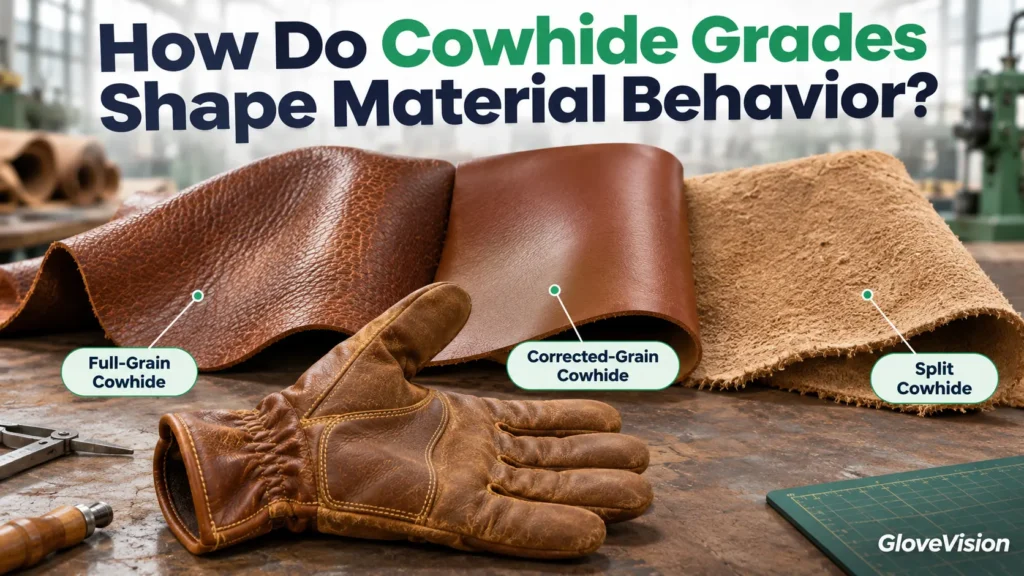
Cowhide leather grades describe differences in retained hide layers, grain-surface treatment and supplier-defined material quality. Full-grain, corrected-grain and split cowhide may differ in texture, flexibility and mechanical response, but these classifications do not independently rank finished work gloves by strength or protective performance.
This guide explains cowhide grade terminology, grain and corium structure, flexibility, abrasion and tear behavior, tanning, surface finishing, material defects and supplier verification. It also shows how to compare actual glove construction and documented protective performance before choosing a cowhide work glove.
What Do Cowhide Leather Grades Actually Describe?
Cowhide grades describe different classification dimensions: the hide layer retained, the treatment of the grain surface or the supplier’s quality criteria. These systems must not be combined into a universal ladder of mechanical or protective performance.
What Are Cowhide Leather Grades?
They are classification terms applied to processed cattle hide. Some describe material structure, others surface finishing, while commercial grades may reflect appearance, defects or supplier-specific acceptance rules.
For broader material context, see the guide to cowhide gloves.
What Is Full-Grain Cowhide?
Full-grain cowhide retains the original grain surface without corrective mechanical removal. Natural surface variation may remain visible, but the label does not certify superior abrasion, tear or cut performance.
What Is Corrected-Grain Cowhide?
Corrected-grain cowhide has undergone mechanical correction of its grain surface, commonly followed by finishing. This changes the appearance and possibly contact behavior, but it does not automatically mean the underlying leather is defective or weak.
What Is Split Cowhide?
Split cowhide comes from a lower hide layer separated from the grain-bearing portion. Its surface is commonly fibrous, and its properties depend on the layer, thickness and processing.
Is Top-Grain the Same as Corrected-Grain?
Not necessarily. Top-grain may refer to the upper grain-bearing hide layer, while some commercial uses describe particular finished surfaces. Buyers should request the supplier’s exact definition rather than assuming top-grain always means corrected-grain.
What Do Grade A, B and C Mean?
They have no single universal protective-glove meaning. A supplier may use these labels for appearance, defect tolerance or consistency, so the documented grading specification is necessary before comparison.
Does Genuine or Premium Leather Prove Strength?
No. Genuine and premium are not substitutes for standardized mechanical performance data. A glove’s protective capability must be supported by relevant product evidence.
The guide to leather gloves explains how material classification differs from finished-glove construction.
| Term | Classification Basis | Material Meaning | Common Misinterpretation | Verification Needed |
|---|---|---|---|---|
| Full-grain | Grain retention. | Original grain surface remains. | Always strongest. | Product testing. |
| Corrected-grain | Surface treatment. | Grain mechanically corrected. | Automatically defective. | Correction and finish. |
| Top-grain | Supplier terminology. | Often upper grain-bearing portion. | Always corrected-grain. | Supplier definition. |
| Grain split | Hide separation. | Upper separated layer with grain. | PPE rating. | Layer description. |
| Flesh split | Lower hide layer. | Flesh-side separated material. | Always weak. | Thickness and testing. |
| Middle split | Intermediate layer. | Possible split from thick hides. | Always identical to flesh split. | Exact retained layer. |
| Genuine leather | Commercial term. | Not an independent premium rank. | Certified protection. | Specifications. |
| Supplier A/B/C | Quality specification. | Supplier-defined criteria. | Universal strength ranking. | Written grading criteria. |
How Does the Grain-to-Split Structure of Cowhide Grades Influence Material Properties?
Grain-to-split structure influences material behavior because cowhide contains collagen fibers whose organization varies with depth. Separating or modifying layers changes which structure and surface remain, but does not assign a protective rating to the resulting material.
How Is Collagen Organized Through Cowhide?
Cowhide contains interconnected collagen fibrils, fibers and bundles. Their arrangement, orientation and packing vary through the hide and contribute to its mechanical response.
What Defines the Grain Region?
The grain is the outer hide region, typically with relatively fine surface structure and its own fiber organization. Appearance and behavior vary with finishing and natural material differences.
What Defines the Corium?
The corium is a deeper hide region containing collagen-fiber bundles arranged differently from the near-surface grain. It is not a perfectly uniform layer with one fixed strength.
What Happens When a Cowhide Is Split?
Horizontal separation can produce a grain-bearing layer and one or more lower splits. The retained depth and exposed surface affect material characteristics, depending on further processing.
How Does Surface Correction Change the Grain?
Surface correction removes or modifies part of the grain surface and is often followed by finishing. Corrected-grain remains conceptually different from leather produced solely from a lower split layer.
How Can Structural Differences Affect Material Properties?
Differences in fiber continuity, orientation and surface structure can influence flexibility, tear behavior and contact response. The relationship is conditional and cannot be converted directly into an EN 388 glove score.
The dedicated guide to leather mechanical durability explores these structural mechanisms.
Why Does Hide Location Matter?
Thickness and collagen organization can vary within one hide as well as between hides. Buyers should evaluate actual consistency rather than assuming one anatomical region is universally strongest.
| Hide Region | Retained Structure | Surface Characteristics | Potential Physical Effect | Limitation |
|---|---|---|---|---|
| Original grain | Outer grain-bearing region. | Natural grain. | Contact and wear response. | No universal rating. |
| Corium | Deeper collagen bundles. | Fibrous internal structure. | Tear and bending response. | Organization varies. |
| Grain split | Separated upper portion. | Grain on one face. | Thickness-dependent behavior. | Processing matters. |
| Middle split | Intermediate material. | Fibrous faces. | Depends on layer and finish. | Not in every hide. |
| Flesh split | Lower portion. | Fibrous surface. | Task-specific performance. | Needs testing. |
| Corrected grain | Modified grain-bearing layer. | Corrected and finished. | Surface interaction changes. | Not automatically inferior. |
How Do Different Cowhide Glove Grades Affect Flexibility and Handling Comfort?
Cowhide grade may help describe structural or surface differences, but flexibility and handling comfort depend on thickness, tanning, moisture condition, finishing and the complete glove design. No grade can be assigned a universal comfort ranking.
What Is Cowhide Suppleness?
Suppleness is the ease with which leather bends or flexes under relevant conditions. It is different from elasticity, tactile sensitivity or certified protective performance.
How Does Thickness Affect Bending?
Thickness can strongly influence bending stiffness under otherwise comparable conditions. Added bulk may restrict finger closure, but no single thickness threshold describes every cowhide glove.
Is Full-Grain Cowhide Always More Flexible?
No. Full-grain leather can be supple or comparatively stiff depending on processing, thickness and condition. Its grain label does not determine finished-glove dexterity.
Can Split Cowhide Also Be Flexible?
Yes. Appropriately processed split cowhide can provide functional flexibility. The result depends on material depth, condition, finish and glove construction.
How Do Moisture and Processing Affect Suppleness?
Moisture and collagen packing can influence leather stiffness under particular conditions. Such material behavior does not create a universal glove-care method or prove improved protective performance.
Why Does Finished-Glove Design Matter?
Finger patterns, seams, linings, reinforcement and sizing affect how the material moves on the hand. A supple leather sample does not guarantee a dexterous finished glove.
How Should Flexibility Be Evaluated?
Check the exact glove’s finger movement, hand closure, grip and fit through safe representative handling exercises. Verify mandatory protection independently before final selection.
| Material Characteristic | Flexibility Consideration | Potential Handling Effect | Product Variable | Verification |
|---|---|---|---|---|
| Thickness | May increase stiffness. | Restricted closure. | Thickness and pattern. | Specification and fit. |
| Full-grain | No automatic suppleness ranking. | Handling varies. | Finish and tanning. | Actual glove check. |
| Split cowhide | May be supple or stiff. | Movement varies. | Depth and finish. | Model-specific assessment. |
| Fatliquoring | May aid fiber movement. | Influences suppleness. | Processing formulation. | Supplier documentation. |
| Moisture | May change stiffness. | Handling may change. | Condition. | Manufacturer instructions. |
| Finger pattern | Defines movement geometry. | Dexterity changes. | Glove design. | Safe functional test. |
| Reinforcement | Adds local material. | May reduce tactile control. | Placement. | Protection and movement. |
Why Do Cowhide Leather Grades Differ in Abrasion, Tear, and Wear Behavior?
Cowhide grades can involve different surface structures, fiber arrangements and manufacturing histories, which may affect mechanical behavior. No grade is universally strongest, and abrasion, tear, cut and puncture performance must be evaluated as separate properties.
How Can Grain Retention Affect Surface Wear?
Retaining the natural grain may influence surface continuity and contact response under certain conditions. It does not establish a universally higher abrasion rating than other leather constructions.
How Can Split Cowhide Behave Under Friction?
The exposed fibrous surface of split cowhide may interact differently with rough materials. Frictional feel and standardized abrasion resistance are distinct properties.
The dedicated article on leather abrasion resistance explains the wear mechanisms.
How Does Fiber Organization Affect Tear Resistance?
Collagen orientation and arrangement can influence measured tear strength. Bovine-hide research supports structural variation, but experimental tear results cannot establish the cut or abrasion rating of an untested glove.
How Do Material Defects Affect Mechanical Behavior?
Deep cuts, weak regions or discontinuities may influence local material response. Minor cosmetic marks do not automatically represent serious structural defects.
Does Greater Thickness Guarantee Greater Protection?
No. Thickness may affect material response but cannot independently establish an EN 388 abrasion, tear, cut or puncture rating.
Why Must Mechanical Properties Be Tested Separately?
Abrasion involves progressive surface wear, tear involves crack extension, cut involves a blade and puncture involves penetration by a defined point. ISO 23388 and EN 388 distinguish these mechanical risks through specified tests.
How Does Complete-Glove Construction Change Performance?
Seams, reinforcement, coatings and panel placement can influence the protective function of the finished glove. Exact-model results and relevant protected zones matter more than a general material label.
| Category or Feature | Mechanical Property | Influencing Factors | Required Test Evidence | Selection Boundary |
|---|---|---|---|---|
| Full-grain | Surface wear. | Grain and finish. | Abrasion test. | Not universally superior. |
| Corrected-grain | Contact and wear. | Correction and coating. | Comparable product data. | Not automatically weak. |
| Split cowhide | Friction and wear. | Fiber exposure. | Relevant abrasion data. | Friction differs from wear rating. |
| Collagen orientation | Tear response. | Arrangement and direction. | Tear test. | Not a cut score. |
| Thickness | Bending and durability. | Material depth. | Specification and testing. | Not certification. |
| Reinforcement | Local wear support. | Coverage and attachment. | Finished-glove results. | Check actual zones. |
| Complete glove | Abrasion, cut, tear, puncture. | All construction variables. | Relevant ISO/EN results. | Match exact hazards. |
How Do Tanning and Finishing Change the Behavior of Cowhide Leather Grades?
Tanning, fatliquoring and surface finishing affect cowhide behavior independently of a grade label. They can influence stability, suppleness and surface response, but the result varies with processing conditions and finished-glove construction.
How Does Tanning Change Raw Cowhide?
Tanning stabilizes the collagen-based hide and transforms it into usable leather. The treatment influences the resulting material’s stability and properties.
Can Different Tanning Methods Produce Different Properties?
Yes. Different tanning formulations and process conditions may produce different material behavior, but no universal ranking of all tanning systems should be assumed.
What Is Fatliquoring?
Fatliquoring introduces lubricating substances that can influence movement between leather fibers and contribute to suppleness. Results depend on the formulation and process.
How Does Surface Finishing Affect Cowhide?
Finishing may alter color, texture, contact friction and moisture response. A finish is a processing characteristic, not a separate anatomical hide layer or automatic protective certification.
Is Corrected-Grain Cowhide Automatically Less Durable?
No. Surface correction changes the appearance and condition of the grain surface, but underlying material quality and actual mechanical performance require independent evaluation.
How Can Moisture and Drying Change Flexibility?
Moisture conditions can change the flexibility and stiffness of leather. These effects are material- and process-dependent and do not justify universal soaking, drying or conditioning instructions for protective gloves.
Why Can Similar Grade Labels Perform Differently?
Two leather samples carrying the same commercial grade may differ in thickness, tanning, fatliquoring, surface finish and quality. Buyers should compare documented specifications instead of assuming equivalent behavior.
How Can Cowhide Grade Defects Affect Durability and Material Consistency?
Cowhide defects can influence material consistency and localized mechanical behavior, depending on their type, severity and location. Visible markings alone do not always mean the leather is unsafe; rejection should follow documented specifications and protective requirements.
Why Does Cowhide Quality Vary Naturally?
Cowhide is a naturally heterogeneous material. Surface appearance, thickness and fiber organization may vary between animals and across individual hides.
Which Surface Defects Should Buyers Identify?
Scars, scratches, cuts, loose grain and visibly damaged surfaces should be examined. Cosmetic variations and structural damage must be distinguished rather than treated as equivalent.
How Can Inconsistent Thickness Matter?
Uneven thickness may affect flexibility and local material response. Buyers should check whether high-stress glove regions meet documented tolerances.
Can Surface Correction Conceal Material Problems?
Surface correction may change visible appearance without demonstrating improved underlying integrity. It does not mean every corrected-grain product conceals harmful defects.
Why Does Defect Location Matter?
A serious defect in a highly loaded palm, finger or reinforcement zone may be more concerning than a cosmetic mark elsewhere. Actual risk requires evaluation of the intended glove function.
Can Construction Fail Even With Good Leather?
Yes. Poor stitching, unsuitable panel placement or failed reinforcement may compromise glove integrity even when the underlying leather is acceptable.
When Should Material Be Rejected?
Reject or investigate leather that fails documented quality tolerances or the necessary protective requirements. Avoid rejecting material solely because of harmless natural surface variation.
| Defect or Variation | Possible Material Effect | Inspection Priority | Evidence Needed | Corrective Decision |
|---|---|---|---|---|
| Scars | Appearance or local change. | Check depth and zone. | Supplier criteria. | Accept or investigate. |
| Deep cuts | Interrupted continuity. | High. | Inspection and tolerance. | Reject if unsuitable. |
| Loose grain | Possible surface issue. | Check protective areas. | Quality specification. | Investigate. |
| Uneven thickness | Variable bending. | Check loaded zones. | Thickness tolerance. | Apply specifications. |
| Surface correction | Altered appearance. | Review process. | Finish and test data. | No automatic rejection. |
| Weak panels | Local failure concern. | High. | Material and glove tests. | Reject failures. |
| Stitching defects | Panel separation risk. | High. | Construction inspection. | Remove unsuitable gloves. |
| Failed reinforcement | Local durability loss. | High. | Attachment and ratings. | Reject if needed. |
How Can Buyers Verify Cowhide Leather Grade Claims and Mechanical Performance?
Buyers should first obtain written definitions of the supplier’s grade system, then examine material specifications, construction details and test evidence for the exact glove. Marketing labels are supporting descriptions, not substitutes for protective-performance documentation.
How Should the Supplier’s Grade Be Defined?
Ask whether each grade describes hide layer, surface correction or supplier quality. Request the written criteria, especially for top-grain and A/B/C categories.
Which Material Specifications Should Be Requested?
Request the retained hide layer, thickness and tolerances, surface finish, tanning details where relevant and documented quality acceptance criteria.
How Should Cowhide Surface Quality Be Inspected?
Examine uniformity, serious defects and conformity with the supplied specification. Visual inspection cannot replace mechanical testing.
How Can Buyers Verify the Actual Glove Construction?
Confirm which leather is used in palms, fingers and other protective zones. Inspect seams, reinforcements, linings and the exact finished design.
What Do ISO 23388 and EN 388 Establish?
ISO 23388 and EN 388 specify mechanical-risk performance requirements and testing. They are not cowhide grade standards. ISO 21420 addresses general protective-glove requirements; applicable editions must be checked.
Why Must the Exact Product Be Tested?
A mechanical rating applies to the tested glove and relevant test conditions, not every item made from similarly described cowhide. Match the exact model, construction and protection area.
How Should Fit and Dexterity Be Assessed?
Evaluate the actual glove’s comfort and handling through safe, representative movements. These functional checks supplement but do not replace protective testing.
What Evidence Confirms Acceptance?
Acceptance requires clear grade definitions, adequate material specifications, sound construction and relevant finished-product results. Missing mandatory evidence should trigger clarification or rejection.
- Written supplier grade definition obtained.
- Grain/split classification confirmed.
- Surface correction identified.
- Thickness tolerance reviewed.
- Tanning and finish documented where relevant.
- Defect acceptance criteria checked.
- Protective panel material verified.
- Relevant mechanical results reviewed.
- Exact manufacturer and model confirmed.
- Fit and handling assessed.
- Procurement decision documented.
Which Cowhide Leather Grades Best Match Different Work Glove Requirements?
No single cowhide grade is best for every work-glove requirement. Full-grain, corrected-grain and split cowhide are candidates to evaluate according to the task’s necessary protection, handling demands and actual finished-glove construction.
When Might Full-Grain Cowhide Be Considered?
Full-grain cowhide may be considered when its natural grain surface and the finished glove’s documented characteristics meet the task. The grade alone is not evidence of superior mechanical protection.
When Might Corrected-Grain Cowhide Be Suitable?
Corrected-grain cowhide may be suitable when the processed surface, material quality and finished-glove performance satisfy the intended work. Surface correction is not an automatic rejection criterion.
When Might Split Cowhide Be Appropriate?
Split cowhide may suit selected demanding handling tasks if its thickness, processing, glove construction and verified protection meet the requirements. It must not be universally described as inferior.
How Should Dexterity Influence the Choice?
The glove should allow necessary finger bending, hand closure and task control after the required protection has been established. Comfort cannot be inferred from grade alone.
How Should Abrasion and Tear Requirements Influence the Choice?
Use relevant test results for each property rather than substituting a general material label. Abrasion and tear resistance are separate mechanical characteristics.
What Role Do Reinforcement and Seams Play?
Reinforcements and seam placement affect local durability, handling and glove coverage independently of the cowhide category. Verify the finished construction.
How Should Cost and Service Life Be Compared?
Compare purchase and replacement costs using actual records from suitable products. Never prioritize a lower price ahead of mandatory protection or invent a standard lifespan.
When Is Cowhide Not the Appropriate Solution?
Cowhide is unsuitable when the selected glove cannot demonstrate required protection against a specific hazard. Chemical, electrical, needle-related or thermal risks may require different verified PPE.
| Work Requirement | Potential Cowhide Characteristic | Handling Trade-Off | Required Test Evidence | Selection Decision |
|---|---|---|---|---|
| Rough surfaces | Suitable contact zones. | Possible bulk. | Abrasion results. | Compare models. |
| Frequent grip | Suitable finish. | Surface-dependent grip. | Task evidence. | Assess control. |
| Precision work | Supple material. | Reduced tactile feedback. | Protection and fit. | Check movement. |
| High-wear palm | Reinforcement. | Added bulk. | Wear and coverage data. | Check palm zone. |
| Sharp edges | Leather alone insufficient to infer protection. | Handling demands. | Cut results. | Reject missing rating. |
| Moisture exposure | Relevant finish. | Grip/stiffness changes. | Wet-use documentation. | Verify conditions. |
| Repeated handling | Appropriate seams and flexibility. | Wear accumulation. | Protection and service checks. | Review real records. |
What Cowhide Leather Grade Checks Confirm Suitable Material Behavior?
Suitable cowhide glove selection requires a clearly defined grade, acceptable material quality, appropriate handling and verified protective performance. Grade terminology supports the decision but cannot replace the complete product assessment.
Is the Cowhide Classification Clearly Defined?
Confirm whether the supplier describes hide layer, surface correction or a commercial quality category, and record the relevant definition.
Are Surface and Processing Details Available?
Review correction, finish, tanning and relevant thickness information rather than assuming all gloves with the same grade are equivalent.
Is Material Quality Acceptable?
Check significant defects, thickness variation and conformity with documented quality tolerances.
Does Flexibility Suit the Work?
Assess practical bending and grasping in the finished glove under safe representative conditions.
Are Mechanical Protection Claims Supported?
Confirm that exact-product testing establishes each mechanical property required by the task.
Does Construction Match the Task?
Review palm coverage, finger geometry, seams, reinforcement, fit and grip rather than material labels alone.
Is the Selection Supported by Practical Value?
Compare suitable products using actual purchase and replacement information after safety requirements are satisfied.
When Must the Choice Be Reassessed?
Reassess when supplier definitions, material specifications, glove design, workplace conditions or hazard requirements change.
- Grade terminology defined.
- Hide-layer origin identified.
- Surface correction confirmed.
- Thickness and finishing reviewed.
- Material defects assessed.
- Flexibility evaluated.
- Mechanical test results reviewed.
- Exact model and task confirmed.
- Construction and reinforcement suitable.
- Fit and grip acceptable.
- Cost evaluated after safety.
- Reassessment conditions set.
What Ultimately Determines How Cowhide Grades Affect Work Glove Behavior?
Cowhide grade classifications describe differences in retained layers, surface correction and supplier-defined quality. Full-grain retains the original grain surface, corrected-grain has undergone surface modification, and split cowhide comes from separated lower layers. Their physical behavior can vary with collagen organization, thickness and processing.
Actual work-glove suitability depends on material consistency, tanning and finishing, complete construction, handling requirements and relevant finished-product testing. No commercial cowhide grade alone establishes the protection, flexibility or service life required for a particular task.
Frequently Asked Questions
What Is the Difference Between Full-Grain and Split Cowhide?
Full-grain cowhide retains the original grain surface. Split cowhide comes from lower separated hide layers without that original surface. Performance depends on processing, construction and testing.
Is Corrected-Grain Cowhide Lower Quality Than Full-Grain?
Not necessarily. Surface correction does not independently prove inferior durability or overall quality. The actual material and finished-glove test evidence must be considered.
Does Top-Grain Always Mean Corrected-Grain?
No. Technical and commercial uses differ, so the supplier’s exact classification should be confirmed.
Which Cowhide Grade Offers the Best Abrasion Resistance?
No grade is universally best. Compare appropriate abrasion results from relevant finished glove products rather than grade names.
How Can Buyers Verify Cowhide Grade and Protective Performance?
Review supplier grade definitions, leather specifications, quality inspection results and relevant mechanical test evidence for the exact finished glove.