
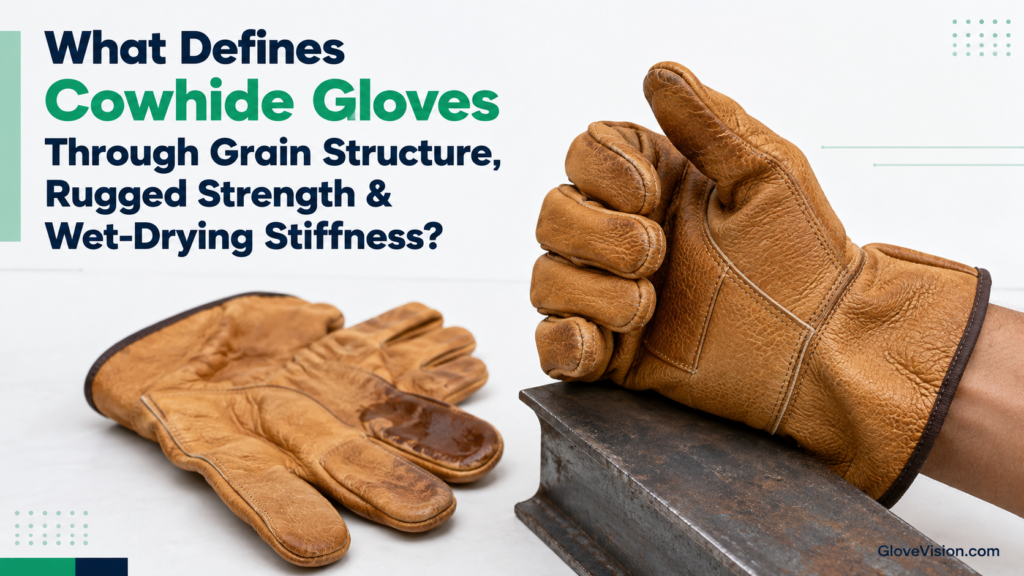
What Defines Cowhide Gloves Through Grain Structure, Rugged Strength & Wet-Drying Stiffness?
Cowhide Gloves are rugged hand-protection products whose behavior depends on bovine-hide structure, grain or split selection, fiber density, thickness, tanning, finishing and complete-glove construction. Those variables can support product-dependent abrasion durability, grip and handling performance.
The practical trade-offs include flexibility, dexterity, moisture response, drying behavior and hazard boundaries. Cowhide alone does not establish protection against cuts, punctures, heat, chemicals, liquids or electricity; suitability belongs to the exact finished glove.
What Are Cowhide Gloves, and How Does Their Grain Structure Affect Physical Behavior?
Cowhide Gloves are made from processed bovine hide whose collagen-fiber arrangement, selected surface layer, tanning, thickness and finishing influence strength, flexibility, surface durability and moisture response. The material is naturally variable rather than a perfectly uniform manufactured sheet.
What Is the Structural Composition of Cowhide Glove Leather?
Bovine hide is structured primarily through interwoven collagen-fiber bundles. The outer grain layer, deeper corium and flesh-side region differ in fiber organization, density and surface character, while anatomical location introduces natural variation in thickness, stretch and defects.
The parent Leather Gloves guide explains broader leather categories; this page remains focused on bovine-hide behavior.
How Does Tanning Stabilize Cowhide Used in Gloves?
Raw hide is biologically unstable. Tanning stabilizes its collagen structure, while retanning, fatliquoring, dyeing, finishing and drying can alter flexibility, surface feel, friction, moisture response, appearance and aging behavior.
No tanning system is universally superior. The result must be judged in the exact glove construction and intended task.
What Is the Difference Between Grain and Split Cowhide Gloves?
Grain cowhide retains the outer surface and may provide a smoother contact face with product-dependent wear behavior. Split cowhide comes from a lower layer and often presents a fibrous, suede-like surface that may support friction in selected handling conditions.
Neither grain nor split cowhide is universally superior. Grade, density, thickness, processing, panel placement and finished-glove testing control the practical result.
Why Does the Hide Location Affect Cowhide Gloves?
Different areas of a bovine hide may vary in fiber density, thickness, stretch, firmness, surface consistency and natural defects. Those differences can influence processing and panel behavior, but unsupported claims about one anatomical location remain weaker than finished-product evidence.
Cowhide Fiber-Layer Observatory
Structure-to-Behavior Table
| Cowhide Feature | Possible Physical Effect | Practical Contribution | What It Does Not Prove |
|---|---|---|---|
| Grain surface | Smooth contact face | Product-dependent surface durability | Universal abrasion rating |
| Split surface | Fibrous texture | Friction in selected handling conditions | Superior grip everywhere |
| Dense fiber network | Substantial structural behavior | Rugged handling potential | Cut or puncture protection |
| Greater thickness | More material depth | Wear material and cushioning | Complete protection |
| Tanning and fatliquoring | Influence stability and flexibility | Product-specific feel and aging | Equal wet-drying behavior |
| Surface finish | Changes friction and moisture interaction | Handling and appearance | Waterproof or chemical protection |
How Do Cowhide Gloves Convert Hide Construction Into Rugged Strength and Usable Handling?
Cowhide Gloves achieve rugged performance through the combined effects of fiber structure, leather thickness, panel placement, seams, reinforcement, lining and fit—not through the cowhide name alone. Every added layer or construction feature can change both wear management and hand control.
How Does Thickness Affect Cowhide Gloves Strength and Dexterity?
Greater thickness can add material depth, cushioning and wear material, but it can also increase bulk, slow hand closure and reduce tactile feedback. A thinner panel may flex more readily in one design yet perform poorly if its leather quality, placement or seams are unsuitable.
Thickness is therefore one variable—not a protection rating.
How Do Cowhide Gloves Palms and Reinforcements Manage Wear?
Single-layer palms, double palms, patches, thumb-crotch reinforcement and fingertip reinforcement redistribute wear across selected zones. Added material may improve local durability while creating bulk, pressure points, altered grip, reduced flexibility or additional seams.
How Do Seams Affect Cowhide Gloves Strength?
Seam placement, thread, stitch density, thumb construction and protection from direct abrasion determine whether cut-and-sewn panels remain connected through repeated flexing and contact. Strong cowhide cannot compensate for unsuitable, damaged or failed seams.
The Glove Basics guide provides the wider construction context for panels, coverage and fit.
How Do Linings and Cuffs Change Cowhide Gloves Performance?
Linings may add comfort or thermal buffering, but also add bulk, retain moisture and lengthen drying. Cuffs influence entry, wrist or lower-arm coverage, debris exclusion, removal and compatibility with adjacent clothing or PPE.
How Does Cowhide Gloves Fit Affect Rugged Handling?
Palm bunching, excess finger length, internal slipping or restricted closure can reduce grip and control while increasing seam stress and wear. Functional fit requires stable palm contact, suitable finger length, full hand closure, usable wrist movement and task-appropriate dexterity.
Cowhide Construction Load Ledger
Construction-and-Performance Matrix
| Construction Feature | Intended Contribution | Possible Trade-Off | Verification |
|---|---|---|---|
| Thicker palm | Greater material depth | Reduced feedback or flexibility | Product specification and task trial |
| Palm reinforcement | Wear-zone management | Bulk or altered grip | Reinforcement placement |
| Protected seams | Reduced direct seam abrasion | Construction complexity | Finished-glove inspection |
| Lining | Comfort or thermal support | Bulk and longer drying | Exact lining documentation |
| Extended cuff | Wrist or lower-arm coverage | Reduced access or ventilation | PPE-interface check |
| Anatomical fit | Stable hand-to-glove contact | Pressure when incorrectly sized | Functional fit assessment |
Why Can Cowhide Gloves Become Stiff After Wetting and Drying?
Cowhide Gloves can feel stiffer after wetting and drying because moisture changes spacing and movement within leather’s collagen structure, while drying conditions can affect flexibility, dimensions, finishes and complete-glove construction. The outcome is product-dependent and cannot be predicted from cowhide alone.
How Does Water Enter Cowhide Gloves?
Untreated or incompletely protected cowhide may absorb liquid water, retain moisture within its fibers, gain weight, soften or stretch temporarily, change surface friction and transfer moisture to a lining. Water resistance and waterproofing are finished-product claims—not automatic cowhide properties.
What Happens Inside Wet Cowhide as It Dries?
Moisture loss changes collagen spacing and fiber movement. Tanning chemistry, lubricating components, finishes and drying uniformity can influence the resulting flexibility or distortion. A laboratory study found that collagen packing and controlled moisture content affected leather stiffness and flexibility, but it did not test every finished Cowhide Gloves product or workplace drying event. [Stiffness]
Why Can Excessive Drying Heat Damage Cowhide Gloves?
Unapproved direct heat may accelerate moisture loss and contribute to hardening, shrinkage, distortion, surface cracking, finish damage, seam damage or changes in linings and adhesives. No universal safe drying temperature applies to every construction.
Can Stiff Cowhide Gloves Be Restored?
Flexibility may sometimes improve through manufacturer-approved care or controlled use, but restoration of original fit, structure or protection cannot be guaranteed. Do not assume oils, waxes, soaking, heat or forceful stretching are suitable.
When Does Wet-Drying Stiffness Make Cowhide Gloves Unsuitable?
Reassess or remove the glove when stiffness causes restricted closure, reduced grip, painful pressure, unstable fit, seam stress, cracking, distortion, lost task control or unverifiable protection.
Cowhide Moisture-State Balance
Cowhide Gloves Wetting-and-Drying Response Checklist
After Moisture Exposure
- Identify the liquid and distinguish clean water from hazardous contamination.
- Check exact product-care instructions.
- Remove the gloves from service if hazardous contamination is suspected.
During Drying
- Follow the approved drying method and avoid unapproved direct heat.
- Preserve intended shape where instructed.
- Allow shell, lining, seams and reinforcement to dry as specified.
After Drying
- Check flexibility, shrinkage, distortion, palm texture, cracks and hard areas.
- Check seams, reinforcement, lining position and cuff condition.
- Confirm fit, full hand closure, grip and task control.
Final Decision
- Return to use only when condition and function remain acceptable.
- Reassess when stiffness or dimensional change affects performance.
- Follow additional care only when exact instructions permit it.
- Replace or reject when damage, contamination or protection cannot be resolved or verified.
Which Tasks and Protection Boundaries Apply to Cowhide Gloves?
Cowhide Gloves can suit selected rugged material-handling tasks, but every application must be matched to the exact mechanical, thermal, chemical, electrical and environmental hazards involved. Job title, leather appearance and “rugged” feel cannot approve the glove.
Which Mechanical Tasks May Suit Cowhide Gloves?
Suitable finished products may be candidates for rough-material handling, general construction, rigging, rope or cable handling, landscaping, warehousing, equipment handling and selected fabrication work. The task still controls palm design, seams, reinforcement, fit, grip, duration and coverage.
OSHA states that no material—including leather—protects against every hazard and directs users toward hazard-specific properties and manufacturer data. [OSHA PPE]
How Much Abrasion Protection Do Cowhide Gloves Provide?
Cowhide can provide useful surface-wear resistance, but the result varies with layer, thickness, treatment, seams, reinforcement and test performance. ISO 23388:2018 addresses abrasion separately from blade cut, tear, puncture and applicable impact. [ISO 23388]
The revision project ISO/CD 23388 remains under development and is not the current published replacement. [ISO Draft]
Do Cowhide Gloves Automatically Resist Cuts, Punctures or Needles?
No. Abrasion, blade cut, ordinary puncture and needlestick penetration are separate properties. Sharp edges and points may penetrate cowhide, and thickness alone cannot establish protection.
Where sharp hazards exist, inspect the exact rating and coverage; separately tested Cut-Resistant Glove Linings may add a documented layer without automatically proving needle or whole-glove protection.
Can Cowhide Gloves Be Used for Heat or Welding?
Only when the exact finished product is documented for the specific contact heat, sparks, flame, radiant heat or molten-material exposure. Cuff coverage, seams, thread, lining and complete-product requirements matter; ordinary cowhide work gloves are not automatically welding gloves.
Can Cowhide Gloves Protect Against Chemicals?
Not as a general rule. Cowhide may absorb and retain liquids, while seams and openings create additional entry routes. A separately tested continuous barrier layer can change a finished product’s role, but chemical suitability still depends on the exact substance, concentration, temperature, contact and product data.
Can Cowhide Gloves Be Used for Electrical Work?
Do not infer electrical insulation from cowhide. Rated and maintained insulating equipment supplies the electrical barrier; leather protectors may serve a physical-protection role within an approved system. OSHA requires protector gloves over insulating gloves except under defined limited-use conditions. [OSHA Electrical]
Cowhide Suitability Compass
Task-and-Protection Boundary Matrix
| Task or Hazard | Possible Cowhide Contribution | Required Verification | Main Boundary |
|---|---|---|---|
| Rough-material handling | Abrasion and friction management | Complete construction and rating | Sharp hazards may penetrate |
| Rope or cable handling | Grip and surface-wear support | Palm, seams, fit and reinforcement | Broken wire may create puncture hazards |
| General construction | Product-dependent rugged handling | Exact task and finished-glove evidence | No universal cut or impact rating |
| Welding or hot work | Possible role in suitable rated designs | Thermal or welding documentation | Ordinary work gloves may be inadequate |
| Wet work | No assumed wet-use protection | Waterproof or wet-use documentation | Cowhide may absorb water and stiffen |
| Chemical handling | No verified barrier role without a tested layer | Exact chemical and finished-glove data | Cowhide may absorb and retain chemicals |
| Electrical work | Possible protector role in an approved system | Electrical PPE system requirements | Cowhide provides no voltage insulation |
| Needlestick exposure | No verified needle-protection role by itself | Needle-specific tested glove system | Standard puncture data are insufficient |
How Should Cowhide Gloves Be Selected, Inspected, Maintained, and Retired?
Cowhide Gloves should be selected by exact task and hazard, verified through complete-product information, fitted for functional movement, inspected before use, maintained according to product instructions and retired when protection or task control can no longer be verified.
What Should Be Defined Before Selecting Cowhide Gloves?
Identify the contact surface, abrasion exposure, sharp edges, puncture points, needles, impact, heat, flame or sparks, chemicals, water, cold, electrical exposure, dexterity, grip, coverage, duration and frequency. OSHA requires hand protection to be selected by performance relative to the task, conditions, duration and identified hazards. [OSHA Hand]
Which Cowhide Gloves Construction Should Be Evaluated?
Check the grain or split layer, leather grade, thickness, palm design, reinforcement, thumb construction, seams, thread, back material, lining, cuff, closure, applicable ratings and documented intended use. The name “cowhide” is not a shortcut around those variables.
How Should Cowhide Gloves Fit Be Checked?
Verify finger alignment, appropriate fingertip space, stable palm position, full opening and closure, thumb and wrist movement, absence of disruptive seam pressure, limited internal slipping and compatibility with adjacent PPE.
What Should Be Inspected Before Using Cowhide Gloves?
Inspect for holes, cuts, punctures, excessive abrasion, thin spots, cracks, hard or brittle areas, stretching, shrinkage, distortion, failed seams, detached reinforcement, lining displacement, cuff damage, contamination, previous repairs and missing product identity.
How Should Cowhide Gloves Be Cleaned and Maintained?
Follow the exact finished product’s instructions for surface cleaning, washing restrictions, drying, conditioning, water-repellent treatments, storage, decontamination and authorized repair. One care method cannot safely be transferred to every cowhide construction.
When Should Cowhide Gloves Be Retired?
Remove or reassess gloves when leather wears through, deep cuts or punctures appear, seams open, reinforcement detaches, stiffness blocks movement, shrinkage alters fit, cracking affects integrity, contamination remains, heat damage appears, identity is lost or an unauthorized repair changes the construction.
The 23 Glove Materials Explained guide can frame alternative material families when cowhide no longer fits the hazard.
Final Cowhide Gloves Decision Pathway
Conclusion
Cowhide Gloves can provide rugged, durable hand protection because processed bovine hide contains an interwoven collagen-fiber structure, but performance still depends on hide layer, tanning, thickness, seams, reinforcement, lining and the complete glove. Grain and split constructions should not be universally ranked, and rugged strength is not a standardized rating.
Abrasion does not establish cut, puncture or needle protection; cowhide is not a universal liquid, chemical, welding or electrical solution. Final suitability depends on hazard-specific evidence, fit, grip, moisture and care history, contamination history and current condition.
Frequently Asked Questions
Are Grain Cowhide Gloves Stronger Than Split Cowhide Gloves?
Not universally. Grain and split cowhide differ in surface structure, fiber organization, texture, thickness, processing and intended use. The complete glove and relevant testing determine suitability.
Why Do Cowhide Gloves Become Stiff After Getting Wet?
Water changes moisture distribution and movement within leather’s collagen structure. Drying conditions, tanning, lubricating components, finishes, thickness and construction influence whether stiffness is mild, temporary, severe or service-affecting.
Can Stiff Cowhide Gloves Be Made Flexible Again?
Possibly, but recovery is not guaranteed. Follow the exact manufacturer instructions and do not apply unapproved oils, heat, soaking, stretching or conditioning products.
Are Cowhide Gloves Cut- and Puncture-Resistant?
Only to the level demonstrated by the exact finished product. Abrasion, blade cut, puncture and needlestick penetration are separate properties requiring relevant evidence.
When Should Wet Cowhide Gloves Be Replaced?
Replace or reassess them when wetting, contamination or drying causes persistent stiffness, shrinkage, distortion, cracking, seam damage, unstable fit, restricted movement, unreliable grip or unverifiable protection.