
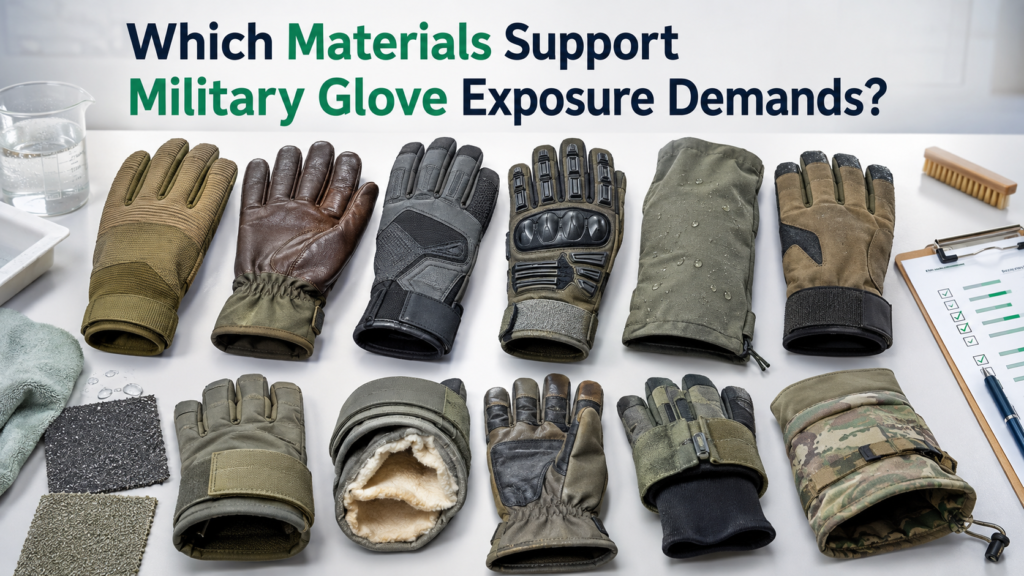
Which Materials Support Military Glove Exposure Demands?
Military glove materials may include flame-resistant aramids, leather, synthetic reinforcement materials, barrier polymers, membranes, insulation systems, impact-protective components, and specialized thread. Their value depends on how those materials are integrated into a complete glove system and what that complete product has actually been documented to do.
No material is automatically best for military use. The exact role, identified hazards, applicable specification or test requirement, glove construction, environmental conditions, required grip and dexterity, interfaces, previous exposure, and current condition should determine whether a glove system is appropriate.
This article provides material-selection education, not mission-specific tactical instruction. Follow applicable service specifications, issuing-authority requirements, technical manuals, manufacturer guidance, and unit safety procedures for glove selection, issue, use, decontamination, maintenance, inspection, and replacement.
Why Must Military glove materials Be Matched to Operational Exposure Demands?
Military glove materials should be selected only after the exact role, hazards, required performance criteria, functional demands, and applicable specifications are defined.
DoD standardization documents include defense specifications, standards, adopted non-government standards, and other approved documents; a marketing phrase such as “military-grade” is not an independent protective-performance rating. [DSP]
Which hazard classes should be identified?
Separate flame and thermal exposure from abrasion, cut, puncture, impact, fuel or chemical contact, cold and wet conditions, and functional requirements such as grip and dexterity. One material property should not be used as evidence for another hazard domain.
Why is material name insufficient?
Two gloves using similar material families can differ in thickness, weave, formulation, finish, reinforcement, seams, thread, coverage, interfaces, and complete-glove test performance. Material reputation therefore cannot substitute for product documentation.
Why does complete-glove evidence matter?
A protective material contributes only where and how it is incorporated. Verify the complete product, applicable specification or test method, coverage, interfaces, and current condition.
Why must protection and function be considered together?
Additional reinforcement, insulation, impact elements, or thickness can affect articulation, tactility, grip, and control. A deeper assessment of military glove protection and dexterity should therefore treat function as a required performance domain.
Table 1. Start with the hazard, then define the evidence required.
| Hazard | Required Performance Question | Material / Construction Factors | Required Evidence | Decision |
|---|---|---|---|---|
| Flame / flash | What defined thermal performance is required? | Shell, palm, thread, seams, cuff, interfaces | Applicable specification or thermal test | Issue only when complete-glove performance matches |
| Abrasion | What surface-wear demand is expected? | Palm, reinforcement, finger zones, seams | Applicable mechanical data | Select construction matched to wear zones |
| Cut | What cut performance is required? | Textile system, reinforcement, complete finger/palm build | Relevant cut test result | Do not infer from fiber name |
| Puncture | What puncture hazard and location exist? | Complete material stack and coverage | Relevant puncture test | Do not transfer cut rating |
| Impact | Where is blunt-impact protection required? | Back-of-hand elements, coverage, articulation | Applicable impact evidence | No fragmentation inference |
| Chemical / fuel | Which substance and contact pattern apply? | Barrier materials, seams, contamination history | Exact compatibility and guidance | Do not approve from material name |
| Cold / wet | What environmental and functional requirements apply? | Membrane, insulation, shell, cuff, wet grip | Exact product/specification data | Verify warmth and moisture separately |
| High dexterity | What tactility and articulation are required? | Fit, pattern, finger build, reinforcement, thickness | Task-specific functional verification | Select another system if control is inadequate |
How Do Military glove materials Differ in Thermal, Mechanical, Environmental, and Chemical Performance?
Military glove materials can contribute to several protective functions, but thermal, mechanical, chemical, environmental, and functional performance must be evaluated separately through the relevant glove system and evidence.
How can aramid Military glove materials contribute?
Depending on the exact construction, aramid textiles may contribute to flame-resistant systems, cut-supporting systems, reinforcement, or structural textile layers. Fiber identity alone does not establish a complete-glove flame, cut, abrasion, or puncture rating. ISO 23407:2021 separates defined thermal risks such as flame, contact heat, convective heat, and radiant heat, illustrating why “flame-resistant” is not the same as unlimited heat protection. [ISO 23407]
How can leather Military glove materials contribute?
Leather may contribute to palm durability, friction management, grip, abrasion performance, and dexterity, but results vary by hide, treatment, thickness, reinforcement, seams, and complete construction. No hide type should be ranked universally.
How can polymer Military glove materials contribute?
Polymers may appear as barrier layers, grip surfaces, coatings, impact elements, or weather-related components. Their value is formulation- and product-specific, and impact padding does not establish ballistic or fragmentation protection.
How can membrane and insulation Military glove materials contribute?
Membranes may support moisture or wind management, while insulation may support thermal retention. Neither component alone proves complete cold-weather suitability, and shell wetting alone does not prove membrane failure.
Why are mechanical properties separate?
ISO 23388:2018 treats abrasion, blade cut, tear, puncture, and impact where applicable as separate mechanical-risk areas. A result in one category should not be transferred to another. [ISO 23388]
How Should Military glove materials Be Selected for Different Operational Hazards?
Military glove materials should be selected by moving from the role and hazard to the applicable requirement, exact glove system, documented test performance, functional demands, and current condition.
The Defense Standardization Program identifies ASSIST as the DoD official source for current DSP documents, so document revision and issuing-authority requirements should be checked rather than relying on retailer summaries. [ASSIST]
What should be checked for thermal/flame hazards?
Verify the exact thermal hazard, applicable requirement, complete-glove flame or heat performance, shell, palm, thread, seams, cuff, interfaces, and documented exposure boundaries. MIL-DTL-2874 covers flame-resistant anti-flash gloves and demonstrates why a defined product specification matters more than an aramid name alone. [MIL-DTL-2874]
Roles involving defined thermal hazards require a deeper assessment of military gloves for flame exposure.
What should be checked for abrasion/cut hazards?
Define the exact mechanical hazard and required test result, then inspect the palm, reinforcement, finger construction, seams, and the dexterity needed for the task. Cut and abrasion are separate properties.
What should be checked for puncture or impact hazards?
Verify the hazard type, location, protective element, coverage, applicable performance evidence, and any effect on articulation. Molded back-of-hand protection should not be described as fragmentation or shrapnel protection without separate evidence.
What should be checked for cold/wet environments?
Verify temperature, wind, moisture, insulation, membrane construction, wet grip, dexterity, drying requirements, and the exact product’s environmental documentation. MIL-DTL-32709 covers an Intermediate Cold Weather Glove and illustrates complete-product requirements. [MIL-DTL-32709]
Selection of military gloves for cold and wet environments should verify environmental protection, moisture management, grip, dexterity, and care separately.
What should be checked for fuel or chemical contact?
Identify the exact substance, concentration where relevant, contact pattern, duration, exact glove, compatibility evidence, contamination procedure, decontamination limits, and replacement criteria. ISO 374-1:2024 treats dangerous-chemical protection as its own performance domain. [ISO 374-1]
How should applicable standards and specifications be verified?
Use the exact issuing-authority requirement, defense specification, adopted standard, test method, and current document revision. Understanding military glove standards and specifications separates material reputation from documented requirements.
Table 2. Record the requirement before approving the construction.
| Field | Verification Needed | Decision Use |
|---|---|---|
| Role / task | Exact intended use and issuing context | Defines the performance problem |
| Primary hazard | Thermal, mechanical, chemical, environmental, other | Sets the main requirement |
| Secondary hazards | Additional exposures | Prevents one-dimensional selection |
| Required specification | Exact defense/service/adopted document | Sets approval criteria |
| Test method | Applicable performance method | Defines what the rating means |
| Exact glove | Manufacturer and model | Connects evidence to product |
| Construction | Shell, palm, reinforcement, seams, lining, cuff | Shows where protection is incorporated |
| Function | Dexterity, tactility, grip, device interaction | Confirms usable performance |
| Environment | Cold, wet, heat, humidity, contamination | Defines conditions of use |
| Final decision | Issue / reassess / another system / replace / do not issue | Closes the decision |
How Do Construction and Protective Layers Affect Military glove materials?
Military glove materials should be evaluated within the complete protective system because shell, palm, fingers, reinforcements, thread, seams, impact elements, membranes, linings, cuffs, and closures can influence different aspects of performance.
ISO 21420:2020 covers general glove design and construction, comfort, efficiency, marking, and manufacturer information, but hazard-specific protective properties require the appropriate specific standards. [ISO 21420]
Why do palms and fingers matter?
Assess material, thickness, reinforcement, flex zones, high-wear areas, grip surfaces, and articulation. A durable palm that reduces required tactility can still be a poor match for a role requiring fine control.
Why do thread and seams matter?
Seam opening, stitch damage, thread damage, reinforcement separation, or loss of coverage can change the performance of the assembly. Shell material should not be judged independently from the structure that joins it.
Why do back-of-hand protectors matter?
They may contribute to documented blunt-impact performance where tested. They do not establish ballistic, fragmentation, or shrapnel resistance without separate evidence.
Why do membranes and insulation matter?
Assess environmental purpose, moisture control, thermal insulation, dexterity, drying, and complete-product documentation. Membrane and insulation functions remain separate.
Why do cuffs and interfaces matter?
Verify intended coverage, fit, sleeve interface, closure, mobility, and required overlap with other PPE.
Table 3. Each element supports a function but has an evidence boundary.
| Glove Element | Possible Function | Key Limitation | Verification |
|---|---|---|---|
| Aramid shell | May support flame-resistant or reinforcement systems | Fiber name is not a complete-glove rating | Applicable thermal/mechanical evidence |
| Leather palm | May support durability, friction control, grip | Hide type alone does not rank performance | Exact construction and test data |
| Synthetic palm | May support grip, wear and tactility | Not universally inferior or superior to leather | Exact product documentation |
| FR thread | May support seam integrity in thermal systems | Thread alone does not establish glove flame performance | Complete-glove thermal requirement |
| Reinforcement | May support high-wear or cut/abrasion zones | Coverage and attachment matter | Location-specific evidence |
| Impact pad | May support blunt-impact performance | Not fragmentation or ballistic proof | Exact impact test and coverage |
| Membrane | May support moisture/wind management | Not automatic insulation | Environmental product data |
| Insulation | May support thermal retention | Does not guarantee prevention of cold injury | Complete-product cold performance |
| Cuff / closure | May support coverage and interface stability | Fit and overlap vary | PPE interface and movement check |
How Should Damage and Degradation in Military glove materials Be Recognized?
Damage in Military glove materials should be assessed against exact technical criteria because scorching, fraying, thinning, contamination, seam failure, deformation, or grip loss can affect different protective and functional properties.
What does scorching mean for Military glove materials?
Scorching or thermal discoloration shows that thermal exposure occurred and requires evaluation against applicable rejection criteria. Appearance alone cannot establish remaining flame performance or a safe future exposure time.
What does fraying mean for Military glove materials?
Assess location, depth, exposed lower layers, seam involvement, reinforcement involvement, and exact acceptance criteria. Do not invent an acceptable damage size.
What do tackiness or swelling mean for Military glove materials?
Tackiness, swelling, permanent softening, hardening, or distortion can indicate a material-condition problem. ISO 374-4:2019 addresses degradation of protective glove materials by dangerous chemicals, but appearance alone does not identify the exact mechanism.
What does shell wetting mean for Military glove materials?
Shell wetting can involve surface-treatment condition, contamination, seam damage, membrane damage, or exposure beyond intended conditions. Do not diagnose membrane failure solely from a wet outer shell.
How should complete-glove damage be inspected?
Inspect the palm, fingers, thumb, reinforcement, shell, thread, seams, impact elements, membrane or lining where inspectable, cuff, closure, fit, and grip. A dedicated military glove pre-use inspection should also review previous exposure history.
Table 4. Separate the observation from the diagnosis.
| Finding | Possible Concern | What Not to Assume | Required Response |
|---|---|---|---|
| Scorch / discoloration | Thermal exposure | Exact remaining flame performance | Reassess against thermal criteria |
| Melted / deformed component | Heat damage | Unaffected-looking areas remain fully protective | Remove pending criteria |
| Frayed textile | Mechanical wear | Universal acceptable fray size | Assess location, depth and criteria |
| Thinned palm | Loss of material and grip/wear function | Remaining protection from appearance | Compare with rejection criteria |
| Seam opening | Loss of structural continuity | Shell material compensates | Remove/reassess |
| Tackiness | Contamination or material change | Exact chemical mechanism | Segregate and review exposure guidance |
| Swelling | Possible chemical degradation | Drying restores original performance | Remove/reassess |
| Hardening | Material change affecting flex/integrity | One universal cause | Review exposure and criteria |
| Shell wetting | Surface, seam, membrane or exposure issue | Proven membrane failure | Approved inspection |
| Grip loss | Wear, contamination, surface change or fit shift | Intact appearance means safe function | Stop if control is inadequate |
How Should Military glove materials Be Cleaned, Decontaminated, Dried, and Maintained?
Military glove materials should be cleaned, decontaminated, dried, treated, and stored only through procedures approved for the exact glove system and previous exposure.
Should Military glove materials always be dry-brushed?
No. Use the exact approved debris-removal method for the product and contamination involved.
Should Military glove materials always be hand-washed?
No. Follow the technical manual, manufacturer, issuing authority, and applicable specification. One universal detergent, temperature, or washing method can conflict with a specific construction.
Should leather Military glove materials always be conditioned?
No. Conditioning can change surface behavior, grip, existing treatments, or compatibility with other requirements. Apply treatment only when exact guidance permits it.
Can Military glove materials be decontaminated after fuel or chemical exposure?
Only through approved guidance for the contaminant, exact glove system, exposure, decontamination method, and post-treatment inspection. If adequate recovery and required protection cannot be verified, remove the glove from service.
How should Military glove materials be dried and stored?
Follow exact guidance for drying, heat exposure, shape, membrane, leather, lining, storage, and contamination segregation. Detailed military glove cleaning and maintenance should not be replaced by generic field recipes.
Proof Asset 5. Maintenance is controlled recovery, not proof that original performance has been restored.
- Exact model and manufacturer known
- Issuing authority and specification known
- Intended role known
- Technical care instructions available
- Previous task known
- Thermal/mechanical exposure recorded
- Fuel/chemical contact recorded
- Wet/cold exposure recorded
- Approved cleaning/decontamination known
- Approved drying known
- Leather/membrane treatment known where relevant
- No generic treatment substituted
- Contamination segregated
- Approved agents used
- No unapproved solvent/conditioner
- Seams, cuff and closure protected
- Approved drying followed
- Unapproved direct heat avoided
- No hole, tear or seam opening
- No swelling, tackiness or delamination
- Grip and dexterity acceptable
- Technical storage guidance followed
- Damaging heat/chemicals avoided
- Contaminated gloves segregated
- Exposure history retained
When Should Damage to Military glove materials Trigger Glove Replacement?
Military glove materials should trigger glove replacement when applicable structural, thermal, chemical, environmental, or functional criteria can no longer be met or verified.
Which structural failures require replacement?
Use applicable rejection criteria for holes, tears, seam opening, worn-through areas, detached reinforcement, or failed closures that affect coverage. Do not invent a universal damage-size threshold.
Which thermal findings require replacement?
Remove or reassess after scorching, charring, melting or deformation, thermal holes, or heat-damaged seams. Remaining thermal performance should not be estimated from appearance.
Which chemical findings require replacement?
Remove or reassess after swelling, tackiness, permanent softening or hardening, persistent contamination, significant unknown chemical exposure, or decontamination whose effectiveness cannot be verified.
Which functional failures require replacement?
Replace or select another system when grip fails, dexterity is inadequate, fit becomes unsafe, articulation is restricted, cuff or closure function is lost, or required device interaction fails. The broader military glove replacement decision should remain tied to exact rejection criteria.
Proof Asset 6. Replace when required protection or function fails—not according to invented mission counts.
- No unacceptable hole, tear or open seam
- No worn-through area
- Reinforcement attached
- Cuff/closure functional
- No unresolved scorch/charring
- No melted/deformed component
- Thread/seams acceptable
- No invented damage rule used
- No swelling/tackiness
- No unresolved contamination
- Decontamination status verified
- Exposure history known
- No severe thinning/fraying
- Reinforcement functional
- Fit, grip and dexterity adequate
- Device interaction works where required
- Applicable specification known
- Exact rejection criteria reviewed
- No invented service-life count
- No unsupported exposure-time threshold
- Continue use: criteria pass.
- Clean/decontaminate: approved recovery remains appropriate.
- Dry further: maintenance incomplete.
- Reassess: technical review required.
- Select another glove: performance mismatch.
- Replace: protective or functional criteria fail.
- Do not issue: suitability cannot be verified.
Which Mistakes Reduce the Performance of Military glove materials?
Performance problems arise when Military glove materials are selected from reputation, marketing terminology, or appearance instead of the exact operational requirement, complete construction, documented test performance, maintenance history, and current condition.
Which selection mistakes affect Military glove materials?
Avoid selecting by material name, assuming aramid equals complete flame protection, assuming leather provides maximum abrasion performance, assuming para-aramid guarantees a cut level, assuming impact padding provides fragmentation protection, selecting by thickness alone, or ignoring specifications and dexterity.
Which environmental mistakes affect Military glove materials?
Avoid treating waterproof as cold-proof, insulation as prevention of cold injury, or shell appearance as proof of membrane condition. Wet grip, drying, environmental test conditions, and dexterity remain separate.
Which chemical mistakes affect Military glove materials?
Avoid diagnosing a chemical mechanism from appearance, reusing after unresolved fuel contamination, generic decontamination, assuming drying restores chemical performance, or using a barrier-material name as compatibility evidence.
Which maintenance and inspection mistakes affect Military glove materials?
Avoid universal detergents or conditioners, generic waterproofing sprays, unapproved heat, improvised seam-pull tests, invented damage thresholds, palm-only inspection, ignoring seams or cuffs, overlooking prior exposure, or approving a glove because it merely looks serviceable.
What Should Personnel Verify Before Using Military glove materials in an Operational Glove?
Before Military glove materials are relied upon in an operational glove system, personnel should verify the exact role, hazards, applicable requirement, exact glove, complete construction, test documentation, exposure history, current condition, fit, grip, and required dexterity.
Proof Asset 7. This is a material-and-condition verification screen, not tactical instruction.
- Exact role/task identified
- Primary and secondary hazards identified
- Thermal/mechanical/chemical/environmental needs known
- Dexterity and grip needs known
- Manufacturer/model known
- Issuing authority known
- Applicable specification known
- Required test documentation available
- Shell, palm, fingers and thumb checked
- Reinforcement, thread and seams checked
- Impact/membrane/lining/insulation considered
- Cuff and closure checked
- No unresolved thermal damage
- No unacceptable holes, thinning or fraying
- No unresolved fuel/solvent contamination
- No swelling or tackiness
- Correct size
- Required articulation
- Grip, dexterity and tactility adequate
- Cuff/closure and device interaction work where required
- Cleaning/decontamination approved
- Drying approved
- No unapproved treatment
- Storage history acceptable
- Issue/use: requirements, documentation, condition and function pass.
- Clean/decontaminate: approved recovery required.
- Dry further: otherwise serviceable.
- Reassess: technical review needed.
- Select another glove: performance mismatch.
- Replace: protective or functional criteria fail.
- Do not issue: required protection cannot be verified.
Sources & Evidence Boundaries
This page uses official defense-standardization and ISO sources. Exact glove approval still requires current issuing-authority and product-specific documentation.
- DSP — defense specifications and standards context.
- ASSIST — official DoD source for current DSP documents.
- MIL-DTL-2874 — anti-flash, flame-resistant glove specification example only.
- MIL-DTL-32709 — Intermediate Cold Weather Glove specification example only.
- ISO 21420 — general glove design, construction and manufacturer-information context.
- ISO 23388 — separate mechanical-risk categories.
- ISO 23407 — defined thermal-risk categories.
- ISO 374-1 / 374-4 — chemical-risk requirements and degradation testing.
Conclusion
Military glove materials should be selected as parts of a complete documented glove system whose performance matches the exact operational hazards, applicable specifications, environmental conditions, and functional requirements.
No material protects against every hazard, and material names are not performance ratings. Aramids, leather, synthetic constructions, impact polymers, membranes, insulation, thread, seams, cuffs, and closures must be interpreted through the complete glove, applicable test or specification, current condition, grip and dexterity requirements, maintenance history, and exposure record. When required protection or function cannot be verified, reassessment, another glove system, replacement, or a decision not to issue is the safer outcome.
Frequently Asked Questions
Are aramid Military glove materials completely fireproof?
No. Aramid materials may contribute to flame-resistant glove systems, but material identity alone does not establish unlimited thermal protection or complete-glove performance.
Does Kevlar automatically make Military glove materials cut-resistant?
No. Para-aramid materials may contribute to cut-resistant constructions, but the applicable complete-glove test performance determines suitability.
Is leather always the best palm material for Military glove materials?
No. Leather types, treatments, thicknesses, reinforcements, seams, fit, and complete-glove designs vary. Compare exact products and documented performance.
Do impact protectors make Military glove materials resistant to shrapnel?
Not automatically. Molded impact protectors may provide documented blunt-impact protection, but ballistic or fragmentation claims require separate specific evidence.
Do waterproof Military glove materials automatically protect against extreme cold?
No. Moisture management and thermal protection are separate performance requirements. Verify complete-product environmental performance.
When should Military glove materials trigger glove replacement?
Replacement is appropriate when applicable inspection or rejection criteria fail because of structural damage, unacceptable thermal exposure, significant degradation, unresolved contamination, grip loss, fit change, dexterity loss, or another condition that makes required protection unverifiable.