
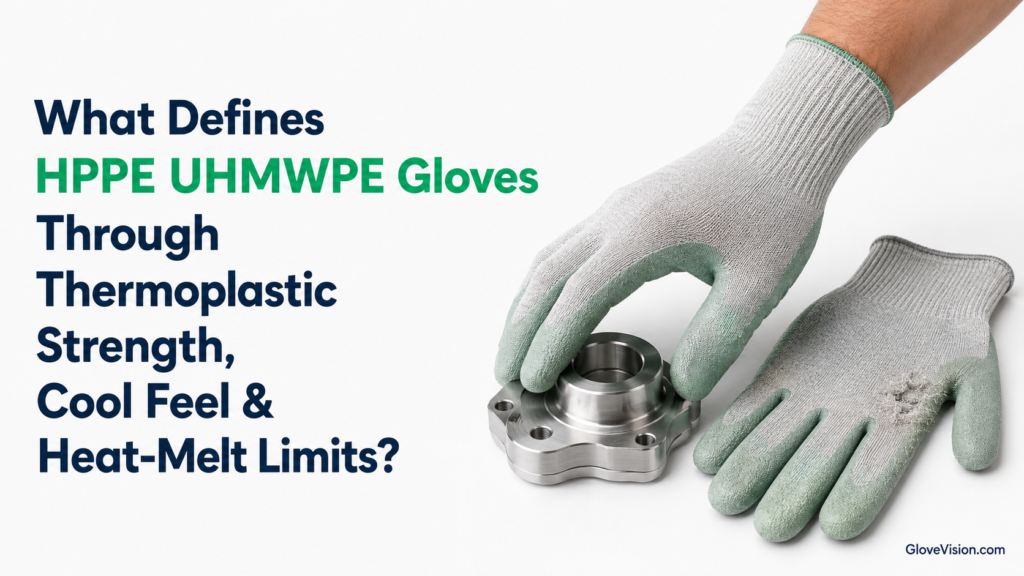
What Defines HPPE UHMWPE Gloves Through Thermoplastic Strength, Cool Feel & Heat-Melt Limits?
HPPE UHMWPE Gloves use highly oriented, ultra-high-molecular-weight polyethylene fibers or engineered HPPE yarn systems to provide high strength at low weight. Fine-gauge knits, composite reinforcements, elastic fibers, and palm coatings can turn that fiber potential into close-fitting mechanical-protection platforms.
Performance still depends on the exact yarn blend, knit, coating, reinforcement, coverage, ratings, fit, wear, contamination, and temperature exposure. A cool initial touch is not active cooling, and high cut strength does not make UHMWPE heat-resistant, cut-proof, chemical-proof, or suitable for hot objects.
What Are HPPE UHMWPE Gloves, and How Does Their Thermoplastic Structure Create Strength?
HPPE UHMWPE Gloves derive lightweight strength potential from extremely long polyethylene chains that are highly oriented along the fiber axis, while complete-glove performance depends on how those fibers are spun, blended, knitted, coated, and tested. Chem
What Is the Difference Between HPPE and UHMWPE?
UHMWPE identifies the primary ultra-high-molecular-weight polyethylene fiber chemistry. HPPE is a broader glove-industry label that may describe UHMWPE-based protective yarn blended with nylon, polyester, elastane, glass, steel, basalt, mineral filaments, or other reinforcement. The exact composition must be verified.
How Does Molecular Orientation Strengthen UHMWPE Fibers?
Long chains, reduced entanglement, high axial alignment, and strong load transfer can support high tensile strength and modulus at low density. Strength is directional and fiber-level; it does not establish the glove’s cut, puncture, or abrasion rating.
How Does Gel-Spun Production Affect the Fiber?
Gel spinning can disentangle very long polyethylene chains before drawing aligns them strongly along the fiber axis. Production method supports material potential, but yarn damage, knit geometry, reinforcement, coating, and condition control what the glove delivers. Spin
Why Can the Gloves Feel Lightweight and Flexible?
Low fiber density, fine filaments, thin shells, seamless knitting, and elastic recovery can reduce bulk and support dexterity. Low mass does not mean low hazard, and a thin shell may provide little heat separation.
How Do Composite Yarns Change Performance?
Glass or steel may disrupt blade travel; polyester can support dimensional stability; and elastane can improve fit recovery. Each component introduces its own stiffness, fatigue, comfort, breakage, and heat limits.
| Feature | Physical effect | Possible contribution | Qualification |
|---|---|---|---|
| Long PE chains | Efficient load transfer | Fiber-strength potential | Not a glove rating |
| High orientation | Axial strength | Light cut-resistant yarn | Direction matters |
| Low density | Lower shell mass | Less bulk | Weight ≠ protection |
| Fine-gauge knit | Close fit | Tactile control | Little thermal separation |
| Elastic blend | Stretch recovery | Stable fit | Separate heat limit |
| Hard reinforcement | Disrupts blade action | Cut potential | Comfort may change |
| Palm coating | Changes friction | Grip and wear | Not automatically a barrier |
How Do HPPE UHMWPE Gloves Create a Cool Initial Contact Sensation?
HPPE UHMWPE Gloves may feel cool when first worn because heat moves from warmer skin into a cooler fiber-and-knit structure, but the sensation fades as temperatures approach equilibrium. Contact cooling depends on thermal effusivity and the complete textile surface rather than conductivity alone. Cool
Why Can UHMWPE Feel Cool Against Skin?
Initial cool touch depends on the starting temperature difference, thermal effusivity, fabric mass, contact area, pressure, thickness, and moisture—not on active refrigeration.
How Does Construction Change Cool Feel?
Fine yarns, thin knits, open structures, liners, coatings, tight fit, and compression alter contact and airflow. A dense coating may reduce evaporation even when the shell initially feels cool.
Does Moisture Transport Make It a Cooling Glove?
No. Moisture may spread through a blend and evaporation may remove heat, but humidity, airflow, activity, coating coverage, and fit control the result. UHMWPE itself does not guarantee wicking or dryness.
When Can the Glove Feel Warm or Clammy?
High activity, restricted airflow, full coatings, tight fit, soaked liners, humid conditions, and long wear can trap heat or moisture. Cool touch cannot establish thermal protection or long-duration comfort.
How Do HPPE UHMWPE Gloves Convert Fiber Strength Into Mechanical Protection?
HPPE UHMWPE Gloves become mechanically protective only when fiber strength is organized through suitable yarns, knit density, reinforcements, coatings, coverage, and complete-glove testing. Mech
How Can HPPE Yarn Resist Cutting?
Strong, high-modulus fibers can engage an edge across multiple yarn pathways. Yarn orientation, density, fineness, hard reinforcement, knit geometry, coating, and condition determine how effectively the load is distributed.
Why Are Mechanical Ratings Separate?
Cut, abrasion, tear, puncture, needle, and impact tests load the glove differently. A strong cut result does not prove point penetration, impact absorption, or unlimited wear.
How Do Glass or Steel Reinforcements Change the Glove?
Hard filaments may improve blade disruption but can add stiffness, pressure points, fatigue, broken-filament discomfort, conductivity, and heat-transfer pathways.
How Do Coatings Change Grip and Durability?
Nitrile, polyurethane, latex, foam, or textured coatings can alter grip, abrasion, breathability, flexibility, liquid contact, and heat response. Partial coverage is not a dependable chemical barrier.
Which Tasks May Suit a Rated Construction?
Sheet handling, assembly, glass work, maintenance, warehousing, and component handling may suit an exact rated glove after the edge, grip, dexterity, temperature, contamination, and entanglement risks are assessed. Use a complete cut-resistant glove assessment rather than the fiber name alone.
| Hazard | Possible role | Not established | Verify |
|---|---|---|---|
| Sharp sheet edge | Cut-resistant platform | Cut prevention | Cut rating |
| Surface rubbing | Light work shell | Abrasion life | Abrasion rating |
| Pointed part | Construction-dependent | Puncture protection | Puncture rating |
| Needle | No assumed role | Needle resistance | Needle test |
| Falling object | Possible liner | Impact protection | Impact construction |
| Oily part | Coating may add grip | Chemical barrier | Grip + chemical data |
| Hot sharp part | Mechanical role only | Heat protection | Cut + thermal data |
| Electrical work | No automatic role | Electrical insulation | Voltage-rated system |
| Rotating machinery | Possible entanglement risk | Safe machine interaction | Machine assessment |
| Hazardous liquid | Knitted shell is not a barrier | Permeation resistance | Chemical-specific data |
Why Do HPPE UHMWPE Gloves Have Heat-Softening and Melt Limits?
HPPE UHMWPE Gloves are thermoplastic: elevated heat can soften, shrink, distort, melt, or weaken polyethylene fibers, so high mechanical strength must never be interpreted as heat resistance.
How Does Heat Affect Fiber Strength and Shape?
As thermal energy increases, molecular mobility rises and orientation can be lost. The fiber may relax, shrink, soften, fuse, glaze, or melt; exact thresholds vary by fiber, blend, tension, coating, pressure, and exposure time. Heat
Why Can Strong Gloves Perform Poorly on Hot Objects?
Mechanical strength and thermal stability are different properties. Thin shells transfer heat quickly, pressure increases contact, and melting polymer can worsen contact with skin. Compare this boundary with heat-stable aramid fiber gloves without assuming either material is universally superior.
Which Sources Can Cause Damage?
Hot metal, ovens, steam lines, friction-heated parts, sparks, radiant sources, heated tools, vehicle surfaces, dryers, and open flame may exceed the glove’s documented limits. Do not assign one universal safe temperature.
How Do Duration and Pressure Change Risk?
Higher temperature, longer contact, and greater pressure generally increase heat transfer and material-damage risk. Coatings and blend fibers may fail before or after UHMWPE, so the weakest relevant component controls the decision.
Which Signs Require Removal?
Shrinkage, hardening, glazing, fusion, holes, distortion, discoloration, coating bubbles, delamination, broken yarn, lost flexibility, altered fit, or unknown heat history require isolation and manufacturer/workplace review. Replace unless retained suitability is confirmed.
How Should HPPE UHMWPE Gloves Be Selected, Inspected, and Maintained?
HPPE UHMWPE Gloves should be chosen by matching the exact hazard and required ratings to the complete yarn, knit, coating, reinforcement, fit, grip, temperature boundary, contamination status, and current condition. OSHA Gen
What Must Be Defined Before Selection?
Identify edge type, abrasion, puncture or needle exposure, impact, grip condition, temperature, chemicals, electrical energy, machine motion, required dexterity, cuff coverage, wear duration, and reuse expectations.
What Product Information Must Be Verified?
Confirm whether “HPPE” means UHMWPE alone or a composite; verify fiber blend, gauge, coating chemistry and coverage, reinforcement, seams, cuff, mechanical ratings, heat limits, care instructions, and traceable product identity.
How Should Fit and Function Be Checked?
Check finger length, palm stability, bunching, full hand closure, thumb motion, circulation, cuff security, grip, object pickup, control operation, tool handling, and emergency release under safe conditions.
What Should Be Inspected?
Look for cuts, holes, open seams, broken or exposed filaments, abrasion thinning, fuzzing, coating wear, cracks, peeling, delamination, heat glazing, fusion, shrinkage, contamination, lost grip, and distorted fit.
How Should Cleaning, Drying, and Storage Be Managed?
Follow the exact manufacturer instructions for wash method, detergent, bleach, water and drying temperature, cycles, direct heat, sunlight, and decontamination. Store clean, dry, identified gloves away from heat, chemicals, sunlight, sharp objects, compression, and contaminated PPE.
Hazard match
- Cut hazard identified
- Abrasion and tear identified separately
- Puncture and needle exposure separated
- Impact exposure assessed
- Heat source, intensity, pressure, and duration defined
- Chemical and electrical hazards assessed
- Machine-entanglement risk assessed
- Grip condition and coverage defined
Construction match
- UHMWPE fiber identity verified
- Meaning of HPPE confirmed
- Blend and composite components known
- Knit gauge and thickness verified
- Coating chemistry and coverage known
- Reinforcement and cuff verified
- Every required rating confirmed
- No missing result inferred
Fit and function
- Finger length is correct
- Palm fabric remains stable
- No bunching at grasp points
- Thumb and finger motion remain complete
- Grip matches the working surface
- Cuff coverage is sufficient
- Tool and control operation remain accurate
- Emergency release remains possible
Condition and care
- No holes, cuts, or open seams
- No exposed or broken reinforcement
- No abrasion thinning or excessive fuzzing
- Coating has required coverage and adhesion
- No shrinkage, fusion, glazing, or distortion
- No unknown contamination remains
- Approved reusable gloves are clean and dry
- Product identity and ratings remain traceable
Task and hazard → exposure mechanism → required rating → exact HPPE/UHMWPE construction → coating and reinforcement → heat and chemical boundaries → fit, grip, and dexterity → contamination and condition → use, trial, clean, isolate, replace, or reject.
Conclusion
HPPE UHMWPE Gloves use highly oriented thermoplastic polyethylene fibers or composite protective yarns to support high strength at low weight, close fit, and an initially cool touch. Those traits create useful potential, but they do not establish a finished glove’s cut, puncture, impact, chemical, electrical, or thermal performance.
Choose HPPE UHMWPE Gloves only when the exact yarn system, complete construction, tested ratings, coating, grip, fit, temperature limits, contamination status, and current condition match the task—and select another verified glove whenever heat or another hazard exceeds their documented boundary.
Frequently Asked Questions
Are HPPE and UHMWPE Gloves the same?
Not always. UHMWPE identifies the polyethylene fiber class, while HPPE may describe a broader engineered yarn system containing UHMWPE plus elastic or reinforcing materials.
Are HPPE UHMWPE Gloves cut-proof?
No. They may achieve tested cut resistance, but protection depends on the complete yarn, knit, reinforcement, coating, coverage, rating, and condition.
Why do UHMWPE Gloves feel cool?
Heat initially moves from warmer skin into the cooler fiber-and-knit structure. The sensation usually decreases as temperatures equalize and does not prove active cooling.
Can HPPE Gloves be used to handle hot objects?
Only when the exact complete glove has suitable documented thermal performance. UHMWPE is thermoplastic and may soften, shrink, fuse, or melt under excessive heat.
When should HPPE UHMWPE Gloves be replaced?
Replace them when holes, broken filaments, abrasion thinning, open seams, coating failure, heat distortion, contamination, lost grip, altered fit, missing identity, or uncertain ratings prevent reliable use.