
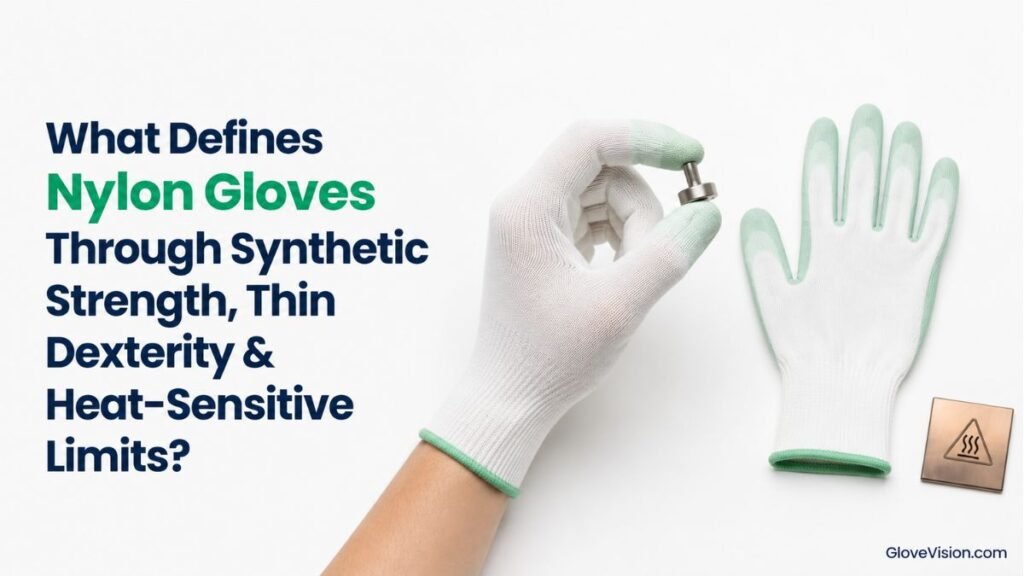
What Defines Nylon Gloves Through Synthetic Strength, Thin Dexterity & Heat-Sensitive Limits?
Nylon Gloves are synthetic-polyamide handwear built from strong fine fibers, lightweight yarns, flexible knitted structures, close-fitting forms, and sometimes surface coatings. Together, these features may support dexterity, tactile control, light mechanical handling, and controlled grip.
Actual performance varies with nylon formulation, filament and yarn design, knit gauge, thickness, coating type and coverage, reinforcement, fit, heat, moisture, contamination, and product test ratings. Nylon Gloves are not automatically cut-resistant, chemical-resistant, waterproof, ESD-safe, or suitable for heat exposure.
What Are Nylon Gloves, and How Does Their Synthetic Polyamide Structure Affect Performance?
Nylon Gloves use manufactured polyamide fibers whose molecular structure can support strong, flexible, abrasion-tolerant yarns suitable for lightweight textile constructions. That contribution must be separated from the protection of the complete tested glove.
What Is Nylon Made From?
Nylon is a family of synthetic polymers with repeating polyamide linkages. Long chains, hydrogen bonding between portions of neighboring chains, and semi-crystalline plus less-ordered regions influence fiber behavior. Nylon 6 and nylon 6,6 are common, non-identical examples; “nylon” is not one universal formulation or performance level.
How Does Polyamide Structure Contribute to Nylon Fiber Strength?
Intermolecular attraction, chain alignment, and filament formation can distribute loads along fibers while supporting recovery and repeated flexing. Useful fiber strength and abrasion behavior do not establish a finished glove’s cut, puncture, tear, impact, or abrasion rating. UGA
How Are Nylon Fibers Converted Into Glove Fabric?
Continuous-filament or staple-spun yarns are knitted, woven, blended, heat-set, or finished into fabric. Yarn thickness, filament count, loop geometry, density, seamless-liner construction, and sewn components all shape the finished glove—not the fiber name alone. General glove requirements and test methods apply to the finished design, not merely its named fiber. ISO 21420
How Do Nylon Blends Change Nylon Gloves?
Blends may add stretch, shape retention, comfort, or another protective component. Polyester gloves help distinguish polyester-specific stability and moisture behavior from nylon’s role.
Spandex/elastane glove constructions explain how elastic fibers can influence recovery and conformity. Cotton, engineered cut-resistant fibers, glass, or steel may also change fit, heat response, care, and tested mechanical performance; those results belong to the composite glove.
| Structural feature | Possible behavior | Practical contribution | Critical qualification |
|---|---|---|---|
| Polyamide chains | Support strong textile fibers | Lightweight yarn strength | Not a glove rating |
| Fine filaments | Form low-bulk yarns | Close conformity | May snag or wear |
| Elastic recovery | Supports flexing | Flexible movement | Can decline with heat or wear |
| Dense knit | Closer textile structure | Stability | May reduce ventilation |
| Open knit | Airflow and flexibility | Light-work comfort | Limited exclusion |
| Reinforced yarn | Adds another component | May improve tested mechanics | Judge as a composite |
| Surface coating | Changes friction | May improve grip or wear | Not automatically a chemical barrier |
How Do Nylon Gloves Combine Thin Construction With Dexterity and Handling Control?
Nylon Gloves can support dexterity through fine yarns, flexible knitted structures, low bulk, and close hand conformity, but real control depends on fit, fabric stability, coating flexibility, grip, seam placement, and task requirements.
Why Can Fine-Gauge Nylon Gloves Feel Less Bulky?
Finer yarns and smaller loops can reduce material volume and excess fabric between the hand and an object. Knit gauge is only one variable: a high number does not by itself prove thinness, strength, dexterity, abrasion protection, or safety.
How Do Stretch, Seams, and Fit Affect Control?
Correct recovery may reduce bunching and stabilize the palm, while too much tension can restrict movement or pressure the finger webs. Seamless liners can remove sewn pressure points, but finger length, thumb freedom, cuff tension, internal slip, and circulation still require a fit check.
How Do Coatings Change Nylon Gloves Grip and Tactile Feedback?
Fingertip, palm, three-quarter, and full coatings change coverage, friction, flexibility, airflow, and liquid-entry routes. Smooth, foam, and textured finishes behave differently. Polyurethane-coated gloves require coating-specific evaluation; polyurethane does not universally prove wet, oil, or chemical protection.
When Can Thin Nylon Gloves Reduce Control?
Control may fall when fingers are long, fabric bunches or twists, a tight glove limits movement, sweat causes internal slip, coating turns smooth or delaminates, knit snags, or the task needs more protection than the construction supplies.
| Construction variable | Potential effect | Trade-off | Functional check |
|---|---|---|---|
| Fine yarn | Reduces bulk | Limited ruggedness | Pick up a small object |
| Close fit | Improves alignment | Tightness may restrict | Open and close the hand |
| Flexible coating | Supports grip | May reduce ventilation | Handle the expected surface |
| Fingertip coat | Preserves back airflow | Limited coverage | Match coating to contact |
| Full coating | More surface coverage | Stiffness and heat buildup | Repeat finger flexion |
| Seamless liner | Removes sewn seams | Fit can still fail | Check fingertips and webs |
Why Do Nylon Gloves Have Heat-Sensitive Performance Limits?
Nylon Gloves are heat-sensitive because nylon is thermoplastic: sufficient heat can cause dimensional change, softening, shrinkage, fusion, melting, and loss of useful glove structure.
How Can Heat Change Nylon Gloves Fibers?
Heat damage may appear as shrinkage, shape loss, reduced elasticity, gloss, softening, fused loops, melting, hardening after cooling, rupture, or coating separation. There is no single universal failure temperature for all nylon formulations and glove constructions.
Why Does Nylon Melting Create a Skin-Injury Concern?
Thin fabric is not automatic insulation. Softened polymer may lose separation, adhere to surfaces, remain against skin, transfer heat, and make glove removal harder. OSHA’s hot-work guidance establishes why ordinary nylon must not be presumed flame-safe, but it does not define every glove exposure. OSHA Heat
Which Heat Sources Can Exceed Nylon Gloves Limits?
Flame, sparks, welding spatter, hot tools or metal, ovens, steam, hot liquids, friction heat, molten material, and flash exposure can exceed a glove’s role. Risk changes with intensity, distance, pressure, duration, and the complete construction.
Can a Coating Make Nylon Gloves Heat-Resistant?
Not automatically. Coatings have separate thermal limits and may soften, char, blister, crack, ignite, or delaminate; exposed nylon can remain vulnerable. Only whole-glove testing supports a thermal claim.
What Should Be Done After Suspected Heat Damage?
Stop the task → move away safely → remove the glove only when removal will not worsen injury → assess the hand → isolate the glove → replace it → investigate the mismatch
Do not keep using a distorted glove, trim melted material, assume washing repairs it, or test it against another hot surface.
Recognition signs: shrinkage, stiff or glossy areas, hardened fibers, distorted fingers, fused loops, melt holes, coating bubbles, separation, lost stretch, or unusual texture.Which Tasks and Protection Boundaries Apply to Nylon Gloves?
Nylon Gloves may suit clean, dry, precision-oriented, or light mechanical tasks where fit, dexterity, cleanliness, and controlled grip matter, but suitability depends on coating, reinforcement, ratings, exposure, and the complete hazard assessment.
Which Light-Duty Tasks May Suit Uncoated Nylon Gloves?
Subject to assessment, clean handling, inspection, packing, sorting, parts presentation, fingerprint reduction, light assembly, or use as an inner textile layer may fit. Uncoated knit provides limited grip on smooth, wet, or oily objects and no dependable liquid barrier.
When May Palm-Coated Nylon Gloves Be More Appropriate?
Assembly, warehousing, maintenance, and dry material handling may benefit from added surface friction. Check coating material, texture, coverage, grip condition, abrasion rating, flexibility, and ventilation. Nitrile-coated gloves require their own product data; oil-grip language is not chemical-resistance evidence.
When Must Cut-Resistant Nylon-Blend Gloves Be Evaluated Separately?
Nylon may be a carrier or comfort fiber while engineered fibers, reinforcement, and coatings create tested cut performance. Verify the standard, level, coverage, and current documentation; a cut rating does not prove puncture or needle resistance. ISO 23388 Aramid glove systems likewise require complete-product ratings.
Why Are Ordinary Nylon Gloves Not Dependable Chemical or Biological Barriers?
Porous knit, seams, cuffs, coating gaps, retained liquid, and unknown permeation or leakage performance prevent dependable barrier claims. A coated palm is not a fully enclosed chemical glove, and ordinary textile handwear has no automatic medical certification. OSHA directs selection toward the particular hazard and relevant manufacturer documentation. OSHA PPE
When Do Nylon Gloves Need Verified Electrostatic-Control Performance?
Sensitive electronics, controlled production, and ignition-sensitive environments require exact resistance data, conductive-yarn placement, grounding compatibility, cuff interaction, and workplace-system verification. Ordinary nylon is neither automatically ESD-safe nor electrically insulating.
Which Hazards Require Protection Beyond Ordinary Nylon Gloves?
Blades, needles, severe puncture or abrasion, impact, crush and entanglement, immersion, electricity, flame, sparks, contact heat, molten material, severe cold, and prolonged wet exposure require hazard-specific decisions. Use 23 Glove Materials Explained for broader material orientation—not as a substitute for product testing.
| Task or hazard | Possible contribution | Not established by nylon | Required verification |
|---|---|---|---|
| Clean inspection | Fit and cleanliness | Barrier certification | Workplace requirements |
| Precision assembly | Low bulk | Universal tactility | Fit and function test |
| Dry handling | Flexible layer | Heavy mechanics | Finished-glove rating |
| Wet or oily surface | Coating may aid grip | Liquid or chemical barrier | Coating data |
| Sharp edge | Carrier for reinforcement | Cut or puncture protection | Exact rating |
| Chemical liquid | No dependable knit role | Permeation resistance | Chemical-specific data |
| Electronics | Thin interface | ESD control | Verified system |
| Hot surface or flame | Ordinary nylon may be unsuitable | Thermal protection | Tested heat glove |
| Electrical exposure | No ordinary role | Insulation | Voltage-rated system |
| Biological material | No automatic role | Infection barrier | Approved barrier glove |
How Should Nylon Gloves Be Selected, Used, Inspected, and Maintained?
Nylon Gloves should be selected only after the task, hazards, contact conditions, and required ratings are defined, then verified for construction, coating, fit, grip, dexterity, heat limits, care instructions, and current condition.
What Should Be Defined Before Selecting Nylon Gloves?
Define the object, surface, wet or oily contact, chemicals, sharp edges, puncture, heat, electricity, ESD, dexterity, grip, duration, contamination, reuse, and snag or entanglement risks before choosing a glove. Workplace selection must match the glove to identified hand hazards. OSHA Hand
Which Product Details and Fit Should Be Verified?
Check disclosed nylon type, blend, gauge, thickness, coating and coverage, reinforcement, ratings, approvals, size, care, and replacement guidance. Confirm finger length, palm stability, comfortable webs, thumb freedom, full movement, safe cuff tension, circulation, and tool control.
How Should Dexterity and Grip Be Function-Checked?
In a controlled setting, pick up and position a representative small object, operate required controls, hold the actual tool, test the expected surface, repeat hand opening and closure, and confirm that the glove does not twist or slip. Never expose the wearer to a live hazard for the check.
How Can Common Problems Be Corrected?
Slipping grip: verify coating and surface → change suitable texture or coverage. Clumsy fingers: check excess length and bulk → resize or change construction. Overheating: verify density and coverage → assess a breathable compatible option. Snagging, peeling, uncertain ESD, heat distortion, or internal slip: stop, identify the cause, and replace or select a documented alternative.
How Should Nylon Gloves Be Cleaned, Dried, and Inspected?
Follow the exact maker and workplace method for laundering, detergent, temperature, agitation, rinsing, drying, cycles, and contamination handling. Cleaning cannot be presumed to remove hazards, repair heat damage, restore yarn or coating, or recover an ESD rating. Moisture experience also varies with yarn geometry, filament count, porosity, coating, airflow, activity, fit, and time. Moisture
Before reuse, inspect holes, seams, yarns, snags, thinning, stretch, shrinkage, hardened or glossy fibers, coating cracks or peeling, debris, dampness, residue, grip, fit, and product identification.
When Should Nylon Gloves Be Removed From Service?
Remove, isolate, or replace them after suspected heat damage, fusion, shrinkage, holes, seam opening, severe thinning, coating loss, unreliable grip or fit, uncertain hazardous contamination, lost identity, unverifiable ratings, or failure of the assigned function.
Task and Hazard
- Task and surface defined
- Heat assessed
- Chemical, cut, puncture, electrical, and ESD needs identified
- Snag risks considered
- Approvals known
Construction
- Fiber and blend known
- Gauge treated as construction, not a rating
- Coating type and coverage fit the task
- Technical ratings verified
- Protection attributed to the full glove
Fit and Function
- Finger length and palm stability correct
- Full movement and safe cuff tension
- Grip matches the surface
- Control remains reliable
- No twisting or internal slip
Heat and Condition
- No shrinkage, gloss, fusion, or hardening
- No holes, tears, or broken yarns
- Coating intact
- No unknown contamination
- Dry, identified, and ratings traceable
Task and hazard → contact conditions → exact nylon construction → coating and reinforcement → verified ratings → fit and dexterity → grip → heat boundary → contamination and care → current condition → use, clean, isolate, replace, or reject
Conclusion
Nylon Gloves can provide lightweight strength, flexibility, and thin hand conformity, but their practical grip, protection, comfort, and durability depend on the complete glove construction and the conditions in which it is used.
Choose Nylon Gloves only when documented ratings, coating coverage, fit, grip, dexterity, heat limits, care history, and current condition match the task; use another tested glove system whenever the hazard exceeds nylon’s verified role.
Frequently Asked Questions
Are Nylon Gloves Cut-Resistant?
Not automatically. Nylon may contribute strength and durability, but cut resistance must be established through the complete glove’s tested yarn system, reinforcement, coating, construction, coverage, and documented rating.
Why Are Many Nylon Gloves Thin and Dexterous?
Nylon can be formed into fine, flexible yarns and close-fitting knitted structures with relatively low bulk. Actual dexterity still depends on sizing, finger geometry, fabric stability, seam placement, coating stiffness, grip, and the task.
Are Coated Nylon Gloves Waterproof or Chemical-Resistant?
Not automatically. A palm or fingertip coating may change grip and local liquid contact, but exposed fabric, gaps, seams, cuffs, degradation, and unknown permeation performance prevent unsupported barrier claims.
Can Nylon Gloves Be Used for Hot Objects?
Only when the exact finished glove has documented thermal performance appropriate for the exposure. Ordinary Nylon Gloves can shrink, soften, fuse, or melt and must not be treated as contact-heat or flame-resistant gloves.
When Should Nylon Gloves Be Replaced?
Replace Nylon Gloves when holes, broken yarns, fabric thinning, unstable fit, lost grip, coating failure, contamination, shrinkage, hardening, fusion, melting, or other deterioration prevents reliable use.