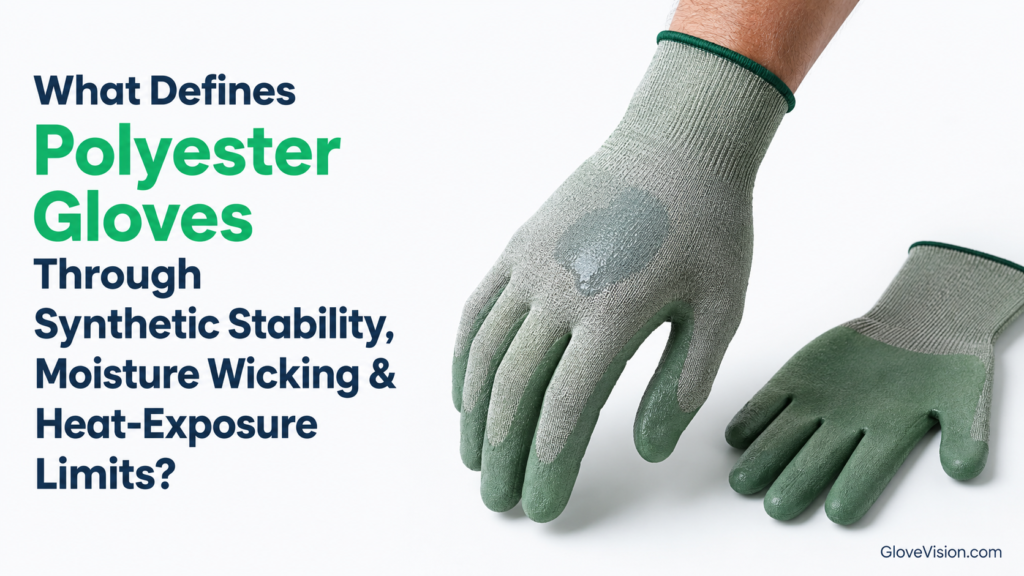
What Defines Polyester Gloves Through Synthetic Stability, Moisture Wicking & Heat-Exposure Limits?
Polyester Gloves use synthetic filaments or spun yarn, stable textile construction, fine-gauge knitting, low-absorbency fibers, engineered capillary pathways, and optional coatings. These variables may support shape retention, dexterity, grip, and construction-dependent moisture transport.
Actual performance varies with polyester type, fiber geometry, yarn and knit structure, thickness, coating and coverage, fit, airflow, humidity, sweat rate, heat, care history, and product ratings. Polyester Gloves are not automatically waterproof, breathable, cut-resistant, chemical-resistant, ESD-safe, flame-resistant, or suitable for hot contact.
What Are Polyester Gloves, and How Does Their Synthetic Structure Support Stability?
Polyester Gloves use synthetic fibers—commonly PET—whose molecular orientation and partly crystalline structure can support resilient, dimensionally stable yarns for lightweight glove construction.
What Is the Material Composition of Polyester Handwear?
Polyester is a polymer family containing ester linkages; PET is the dominant textile example, but it is not the only possible formulation. Long chains, orientation, and crystalline plus less-ordered regions influence fiber behavior. This differs from the polyamide chemistry discussed for Nylon Gloves.
Polyester is also distinct from cellulose-based Cotton Gloves, particularly in how water interacts with the fiber. A family name never proves one glove thickness or protection level.
How Does Polyester Fiber Processing Affect Glove Stability?
Melt spinning, filament drawing, molecular alignment, heat setting, yarn texturing, and knit stabilization can change shape retention, wrinkle behavior, stretch, recovery, shrinkage, and abrasion behavior. Polyester is associated with useful resilience and stability, but manufacturing and finished construction control the outcome. Fiber
How Do Polyester Yarns Form Glove Fabric?
Continuous multifilament, staple-spun, textured, microfiber, fine, or coarse yarn can be knitted loosely or densely and formed as seamless or sewn gloves. Each choice changes bulk, surface feel, pilling, snagging, ventilation, dexterity, and durability.
How Do Polyester Blends Change Polyester Gloves?
Elastane, nylon, cotton, acrylic, engineered cut-resistant fibers, glass, steel, or conductive yarn can change recovery, moisture behavior, strength, cut performance, static behavior, heat response, and care. Spandex/Elastane Gloves explain the elastic component; blend performance belongs to the complete construction.
Does Recycled Polyester Perform Exactly Like Virgin Polyester?
Not automatically. Feedstock, polymer quality, processing history, additives, filament formation, yarn engineering, fabric construction, and finished-glove testing matter more than an unsupported assumption based on the recycled label.
| Structural feature | Possible behavior | Contribution | Qualification |
|---|---|---|---|
| Oriented chains | Stable fiber structure | Shape retention | Processing changes results |
| Partly crystalline regions | Restrict movement | Dimensional stability | Heat can still distort |
| Continuous filaments | Smooth yarn | Low bulk | May snag |
| Textured yarn | More interfiber space | Comfort and channels | May retain surface liquid |
| Dense knit | Stable fabric | Controlled fit | May reduce ventilation |
| Blend or coating | Changes performance | Task-specific role | Judge the complete glove |
How Do Polyester Gloves Wick Moisture Despite Low Fiber Absorbency?
Polyester Gloves may wick sweat by moving liquid through small channels along and between fibers, even though polyester absorbs relatively little moisture into the fiber itself.
What Is the Difference Between Moisture Absorption and Wicking?
Absorption brings water into a fiber; surface wetting holds or spreads it on the surface; wicking moves liquid through capillary spaces; spreading enlarges the wet area; vapor transfer, evaporation, and drying are separate later processes. Polyester generally takes less water into the fiber than natural textile fibers. RSC
Wool Gloves involve different vapor and insulation behavior; those properties cannot be transferred to polyester.
How Do Capillary Spaces Move Sweat?
Narrow gaps between fibers, filament channels, textured-yarn spaces, knitted-loop pores, surface tension, and hand pressure may move liquid from wetter toward less-wet regions—not necessarily straight away from skin. Hydrophobic polyester assemblies show that fiber geometry and interfiber spaces can affect capillary flow, but one assembly does not prove every glove. Capillary
How Do Fiber Geometry, Yarn, and Knit Affect Wicking?
Round, trilobal, multilobal, channeled, grooved, hollow, or microfiber geometries change surface area and channel formation. Filament count, fineness, twist, texture, gauge, loop size, thickness, porosity, skin pressure, and seams can make the same polyester fiber behave differently in two gloves.
How Do Wicking Finishes Change Polyester Gloves?
Finishes may increase wettability, spreading, or drying opportunity, but laundering, detergent, oil, contamination, and wear can change them. Durability across wash cycles needs product-level support.
When Does Wicking Fail to Keep Hands Dry or Cool?
Wicking may be overwhelmed by sweat, humidity, poor airflow, saturation, tight fit, residue, outer layers, or coating coverage. Cooling requires evaporation; spreading without evaporation can create a larger clammy area. Low fiber absorbency is not waterproofing.
Sweat reaches fabric → wetting → capillary movement → spreading → airflow and humidity govern evaporation → retained liquid falls, or clamminess and slipping increase
| Claim | What it actually establishes |
|---|---|
| Low absorbency | Limited uptake into the fiber |
| Wicking | Capillary liquid movement |
| Breathability | Air or vapor passage through the complete glove |
| Quick drying | Favorable evaporation and limited retained liquid |
| Waterproofing | Continuous resistance to liquid entry |
| Dry hands | Removal exceeding moisture production |
Why Do Polyester Gloves Have Heat-Exposure Limits?
Polyester Gloves have heat-exposure limits because polyester is thermoplastic: sufficient heat can cause shrinkage, softening, fusion, melting, and loss of the glove’s functional structure.
How Can Heat Change Polyester Gloves?
Possible signs include tightening, distortion, gloss, softening, fused fibers, hardening after cooling, melt holes, lost elasticity, and coating damage. No universal failure temperature applies to every polymer, weight, blend, finish, coating, intensity, or duration.
Why Can Melted Polyester Increase Burn Severity?
Melted polymer may adhere to skin, thin fabric may provide little separation, shrinkage may tighten the glove, and removal may become harder. OSHA treats meltable fabrics such as polyester as a hazard boundary in flame or arc contexts; this is not a glove test result. OSHA Heat
Which Heat Sources Can Exceed Polyester Gloves Limits?
Flame, sparks, arcs, welding spatter, hot tools or metal, ovens, steam, hot liquid, friction heat, molten material, heated machinery, and uncontrolled dryers may exceed the glove’s role. Ordinary dimensional stability is not contact-heat, flame, or arc performance.
Can a Coating or Hot Care Process Change the Boundary?
A coating has separate thermal limits and may soften, char, bubble, crack, ignite, or delaminate; partial coverage leaves fabric exposed. Excessive washing or drying heat may shrink fabric, deform coating, change fit or grip, and damage a wicking finish. Follow exact care instructions.
What Should Be Done After Suspected Heat Damage?
Stop exposure → leave safely → remove only when removal will not worsen injury → assess the hand → isolate the glove → investigate → replace with task-appropriate protection
Reject gloves with shrinkage, distorted fingers, gloss, stiff or fused areas, melt holes, bubbles, delamination, lost stretch, a tightened cuff, or changed texture.
Which Tasks and Protection Boundaries Apply to Polyester Gloves?
Polyester Gloves may suit clean, dry, precision-oriented, moisture-variable, or light mechanical tasks when their fit, coating, grip, and ratings match the work, but polyester fiber alone establishes no dependable protection against serious hazards.
Which Light-Duty Tasks May Suit Uncoated Polyester Gloves?
After assessment, inspection, packing, sorting, parts presentation, fingerprint reduction, light assembly, clean handling, or use as an inner liner may fit. Uncoated knit can lack grip on smooth, wet, or oily objects and is not a continuous liquid barrier.
When May Coated Polyester Gloves Be More Appropriate?
Assembly, warehousing, maintenance, component handling, and dry materials may need added friction. Polyurethane, nitrile, foam, latex, or PVC patterns affect thickness, coverage, flexibility, wet or oil grip, abrasion, and ventilation differently; the coating name alone proves nothing.
When Must Cut-Resistant Polyester Blends Be Evaluated Separately?
Polyester may be a carrier while engineered fibers, glass, steel, and coatings create tested behavior. Verify the standard, level, coverage, task, and current documentation. Aramid Gloves likewise require complete-product evaluation; cut ratings do not prove needle or puncture resistance.
Why Are Ordinary Polyester Gloves Not Chemical or Biological Barriers?
Knit openings, seams, cuffs, coating gaps, liquid spreading, unknown permeation, and contaminant retention defeat unsupported barrier claims. Wicking may spread a hazardous liquid rather than protect the hand. OSHA advises selection for the specific hazard using relevant product data. OSHA PPE
When Do Polyester Gloves Need Verified ESD Performance?
Sensitive electronics, controlled production, ignition-sensitive areas, and ESD programs require conductive-yarn verification, resistance data, skin contact, grounding compatibility, cuff interaction, humidity control, and workplace testing. Ordinary polyester is not automatically antistatic or electrically insulating.
Which Hazards Require Protection Beyond Ordinary Polyester Gloves?
Blades, needles, severe puncture or abrasion, impact, crush or entanglement, splash or immersion, biological material, electrical contact, flame, sparks, hot contact, molten material, severe cold, and prolonged wetness need hazard-specific protection. Use 23 Glove Materials Explained for broader orientation.
| Task or hazard | Possible contribution | Not established | Verification |
|---|---|---|---|
| Clean inspection | Light separation | Barrier certification | Cleanliness rules |
| Precision assembly | Low bulk, stable fit | Universal dexterity | Function test |
| Sweat-variable work | Possible wicking | Dry hands | Fabric and coating |
| Wet or oily surface | Coating may aid grip | Chemical resistance | Product data |
| Sharp component | Carrier for reinforcement | Cut or puncture protection | Exact rating |
| Chemical liquid | No dependable knit role | Permeation resistance | Chemical-specific glove |
| Electronics | Thin interface | ESD control | Verified system |
| Hot surface or flame | May be unsuitable | Thermal protection | Rated thermal glove |
| Electrical or biological | No ordinary role | Insulation or infection barrier | Approved system |
How Should Polyester Gloves Be Selected, Used, Inspected, and Maintained?
Polyester Gloves should be selected only after the task, hazards, moisture conditions, heat exposure, and required ratings are defined, then verified for construction, coating, fit, grip, dexterity, care requirements, and current condition.
What Should Be Defined and Verified?
Define the object, surface, sweat, humidity, airflow, chemicals, sharp edges, puncture, heat, electricity, ESD, dexterity, grip, duration, contamination, reuse, and snag risks. Verify composition, blend, yarn, gauge, thickness, wicking treatment, coating and coverage, reinforcement, ratings, approvals, size, care, and replacement guidance. General glove requirements apply to the complete design. ISO 21420
How Should Fit and Function Be Checked?
Confirm finger length, stable palm, minimal bunching, comfortable webs, thumb freedom, full movement, cuff safety, circulation, and tool control. In a controlled trial, pick and position a small object, operate controls, test expected grip, repeat movements, check twisting, and observe whether moisture accumulates, spreads, or evaporates.
How Can Common Problems Be Corrected?
Sweat or clamminess: check coating, knit, fit, humidity, workload, and saturation → change construction, schedule, or dry pair. Slip, clumsiness, or twisting: verify texture, coverage, length, bulk, palm stability, and recovery → resize or replace. Uncertain ESD, peeling, or heat distortion: stop the task → verify documentation or choose another rated glove.
How Should Wet Polyester Gloves Be Managed?
Leave exposure → remove safely → identify perspiration, water, oil, chemical, biological, or unknown moisture → assess contamination → follow care instructions → dry completely → inspect → reuse only if acceptable
How Should Polyester Gloves Be Cleaned and Inspected?
Follow exact instructions for whether laundering is permitted, method, water and drying temperature, detergent, bleach, agitation, rinse, tumble drying, direct heat, cycle limits, and contamination handling. Cleaning does not prove decontamination or restore coating, heat damage, ratings, ESD behavior, stretched yarn, or a depleted finish.
Inspect holes, seams, yarn breaks, snags, pilling, thinning, stretch, shrinkage, distorted fingers, hard or glossy fibers, coating cracks or peeling, debris, dampness, residue, lost grip, unstable fit, suspicious odor, and missing identification.
When Should Polyester Gloves Be Removed From Service?
Remove, isolate, or replace after suspected heat damage, fusion, melting, hardening, shrinkage, holes, seam opening, thinning, coating loss, unreliable grip or fit, failed moisture control, uncertain contamination, lost product identity, unverifiable ratings, or loss of assigned function.
Task and Hazard
- Task and surface defined
- Sweat, humidity, airflow assessed
- Heat and serious hazards identified
- Snag risks considered
- Approvals known
Construction
- Fiber, blend, yarn, knit known
- Coating and coverage verified
- Ratings documented
- Wicking applies to this product
- No fiber-name inference
Fit and Function
- Finger and palm alignment correct
- Full movement and safe cuff
- Grip matches surface
- Moisture does not cause slip
- Control remains reliable
Heat and Condition
- No shrinkage, gloss, fusion, or hardening
- No holes or broken yarns
- Coating intact
- No unexplained contamination
- Dry, identified, and traceable
Task and hazard → polyester construction → moisture and evaporation → coating and reinforcement → ratings → fit and dexterity → grip → heat boundary → contamination and care → condition → use, change, dry, clean, isolate, replace, or reject
Conclusion
Polyester Gloves can provide lightweight stability, shape retention, and construction-dependent moisture transport, but their practical comfort, grip, protection, and durability depend on the complete glove and its actual use conditions.
Choose Polyester Gloves only when their construction, moisture behavior, coating, verified ratings, fit, grip, heat limits, care history, and current condition match the task—and select another tested glove system whenever the hazard exceeds polyester’s documented role.
Frequently Asked Questions
Do Polyester Gloves Absorb Sweat?
They absorb relatively little moisture into the polyester fiber itself. However, an engineered polyester fabric may wet, spread, and transport sweat through surface and capillary pathways.
Do Polyester Gloves Keep Hands Dry?
Not automatically. Hand dryness depends on sweat rate, fabric construction, coating coverage, airflow, humidity, evaporation, fit, and wear duration. Wicking can redistribute moisture without fully removing it.
Are Polyester Gloves Waterproof or Chemical-Resistant?
Not unless the complete finished glove has separately documented resistance. Ordinary polyester fabric contains openings through which liquid can pass, while partial coatings leave exposed areas and do not establish chemical-specific permeation protection.
Can Polyester Gloves Be Used for Hot Objects?
Only when the exact finished glove has appropriate documented thermal performance for that exposure. Ordinary Polyester Gloves can shrink, soften, fuse, or melt and should not be treated as flame-resistant or contact-heat gloves.
When Should Polyester Gloves Be Replaced?
Replace Polyester Gloves when holes, broken yarns, fabric thinning, unstable fit, lost grip, inadequate moisture performance, coating deterioration, contamination, shrinkage, hardening, fusion, melting, or other damage prevents reliable use.