
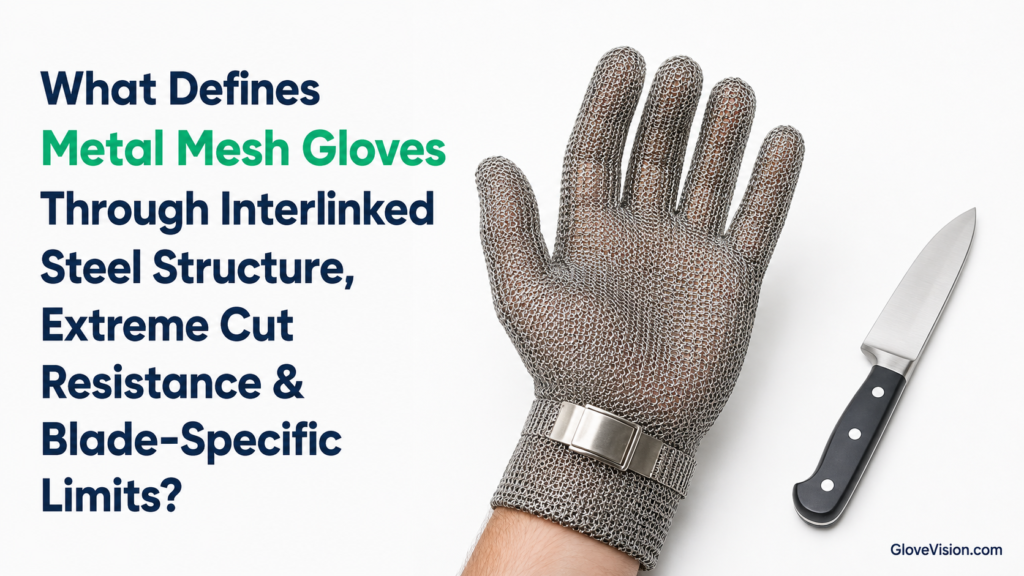
What Defines Metal Mesh Gloves Through Interlinked Steel Structure, Extreme Cut Resistance & Blade-Specific Limits?
Metal Mesh Gloves are protective gloves formed from interlinked metal rings—usually stainless steel—with secure joints, shaped finger sections, closures, and optional cuffs. When the complete model is tested for its intended manual-knife hazard, the flexible mesh can deflect a blade and distribute force across neighboring rings.
Their protection is blade-, task-, coverage-, fit-, and condition-specific. Metal mesh is not cut-proof, stab-proof, needle-proof, powered-blade-safe, impact-resistant, chemically impermeable, thermally insulating, electrically insulating, or automatically approved for food contact.
What Are Metal Mesh Gloves, and How Does Their Interlinked Steel Structure Work?
Metal Mesh Gloves use connected metal rings to create a flexible protective surface whose continuity, joint strength, ring geometry, shaped pattern, closure, and coverage determine how the complete glove responds to a specified manual knife. ISO
Which Components Form Metal Mesh Gloves?
The system may include interlinked rings, welded or otherwise secured joints, shaped fingers and thumb, palm and back-of-hand mesh, wrist strap, buckle or clasp, identification tags, and short or extended cuffs. It is not the same as a knitted glove containing steel fibers, aramid yarn, or HPPE/UHMWPE yarn.
How Do Interlinked Rings Preserve Flexibility?
Each ring moves relative to adjacent rings, allowing the mesh to bend around fingers and the palm. Ring overlap preserves continuity while movement supports grasping; excessive looseness, bunching, or a poor pattern can reduce control and expose transitions.
Why Are Secure Ring Joints Important?
A knife load can pull, rotate, and separate rings. A sound joint helps keep a ring closed so neighboring rings share force. One opened ring or failed joint creates a local weakness that visual inspection cannot treat as certified protection.
How Do Ring Diameter and Wire Thickness Affect the Glove?
Smaller openings may restrict some broad points, while thicker wire may resist deformation. Both can add mass, stiffness, pressure, and cleaning complexity. Fine needles, hooks, wires, and spikes behave differently from a broad knife point.
Why Is Stainless Steel Common?
Suitable stainless-steel constructions can combine strength, corrosion resistance, cleanability, and durability. “Stainless” does not mean corrosion-proof under every chemical, salt, cleaning, or storage condition, and steel alone does not establish certification.
| Feature | Structural role | Possible contribution | Important limit |
|---|---|---|---|
| Interlinked rings | Flexible continuity | Distribute some blade force | Openings remain |
| Secure joints | Resist ring opening | Maintain mesh integrity | One failure weakens locally |
| Smaller openings | Restrict broad points | Local coverage potential | Fine points differ |
| Thicker wire | Resists deformation | Durability potential | More weight and stiffness |
| Shaped pattern | Follows movement | Supports control | Poor size causes bunching |
| Wrist closure | Retains position | Reduces shifting | Loose closure undermines fit |
| Extended cuff | Covers wrist/forearm | Expands protected area | Transition gaps may remain |
How Do Metal Mesh Gloves Resist Hand-Knife Cutting and Stabbing?
Metal Mesh Gloves resist documented hand-knife actions by interrupting blade travel, deflecting some contact, and spreading load through interlinked rings, but performance belongs only to the tested glove, configuration, coverage, and standard scope.
How Do They Respond to Slicing?
A smooth manual blade may contact several rings instead of passing directly through textile yarn. Ring hardness, opening size, joint integrity, blade angle, force, movement, surface support, and glove fit all influence the interaction.
How Do They Respond to Hand-Knife Stabbing?
A broad knife point may be deflected or stopped by ring geometry within a documented test scope. A more acute point can seek an opening, and repeated or off-axis loading can stress rings and closures differently.
Why Does Blade Angle Matter?
Shallow slicing, direct stabbing, oblique contact, hooking, and twisting place different loads on the mesh. Evidence for one action cannot be generalized to every blade geometry or motion.
How Does Force Transfer Through the Mesh?
The contacted ring loads its joint and neighboring rings, spreading force across a wider zone. Bunching, unsupported edges, damaged rings, loose closures, or coverage transitions can disrupt that pathway.
Which Evidence Confirms Protection?
Verify the exact model, current applicable standard and edition, manufacturer declaration, tested area, size/configuration, closure, exclusions, and jurisdiction. EU PPE rules require model-level conformity evidence rather than informal demonstrations. PPE
Which Blade-Specific Limits Apply to Metal Mesh Gloves?
Metal Mesh Gloves must not be assumed suitable for powered blades, serrated teeth, fine points, needles, hooks, chopping, crushing, or moving machinery merely because they have hand-knife evidence.
Why Is Hand-Knife Resistance Different From Powered-Blade Protection?
Band saws, rotary cutters, and reciprocating blades add continuous energy, speed, repeated engagement, snagging, and machine forces beyond a manual-knife test. Do not infer suitability.
Why Can Moving Machinery Make the Gloves Dangerous?
Rigid rings or closures can snag and pull the hand toward a moving component. If entanglement is possible, stop and follow guarding, lockout, machine-specific assessment, workplace procedure, and any glove prohibition. Mach
Do They Resist Serrated Blades?
Teeth can hook rings and create repeated localized loads. Smooth-blade evidence does not automatically transfer to serrated geometry.
Can Fine Points Pass Through?
Hypodermic needles, wires, awls, spikes, hooks, and fish spines may enter ring openings or load one joint. Require point-specific evidence.
Do They Protect Against Chopping or Crushing?
A cleaver or heavy object adds impact and crush mechanisms. Edge resistance does not prove bone, joint, or soft-tissue protection.
| Blade or point | Primary mechanism | Can hand-knife evidence transfer? | Required decision |
|---|---|---|---|
| Smooth hand knife | Manual slicing/stabbing | Only within scope | Verify model evidence |
| Serrated hand knife | Toothed cutting/hooking | No automatic transfer | Obtain relevant evidence |
| Cleaver | Cutting plus impact | No | Assess cut and impact |
| Band saw | Powered continuous cutting | No | Machine controls |
| Rotary cutter | Rotation and entanglement | No | Do not infer suitability |
| Reciprocating blade | Rapid repeated movement | No | Machine controls |
| Needle | Fine-point penetration | No | Needle-specific protection |
| Awl or spike | Concentrated puncture | No | Puncture evidence |
| Fish spine or hook | Irregular fine point | No | Exact geometry assessment |
How Should Metal Mesh Gloves Be Matched to Tasks and Secondary Hazards?
Metal Mesh Gloves should be matched to the exact manual-knife action, exposed hand, tested model, required coverage, secure fit, secondary hazards, hygiene controls, and workplace procedure.
Which Manual-Knife Tasks May Suit Them?
Some meat, fish, poultry, deboning, trimming, or food-processing tasks may fit a documented glove used on the exposed non-knife hand. Task name alone is insufficient; exact motion and workplace procedure control selection.
Which Hand Should Wear the Glove?
Do not assume. Check worker handedness, glove design, reversibility, task, manufacturer instructions, and procedure. A model may be left-, right-, or ambidextrous only if its documentation says so.
Which Coverage Is Required?
Verify fingers, thumb, palm, back of hand, wrist, cuff, forearm, and transitions. Protection ends where verified coverage ends.
Why Is Mesh Not a Chemical or Biological Barrier?
Open rings allow liquids and biological material to contact skin. Stainless steel does not create permeation protection; use an approved compatible chemical-resistant glove system when required.
Why Is It Not Electrical or Thermal Protection?
Metal conducts electricity and heat. The mesh provides little insulating air space and does not establish voltage, heat, cold, flame, or molten-material protection.
When Does Hygiene Determine Suitability?
Food-processing use requires product approval and a validated workflow. Cleaning removes soil, sanitizing reduces microorganisms under validated conditions, and sterilizing is a separate process; these terms are not interchangeable. FDA
| Task or hazard | Possible role | Not established | Verify |
|---|---|---|---|
| Manual meat cutting | Non-knife-hand protection | Complete injury prevention | Hand-knife certification |
| Deboning | Specified knife resistance | Fine-point protection | Knife and point assessment |
| Fish processing | Manual-blade role | Spine/hook resistance | Point evaluation |
| Powered cutting | No automatic role | Powered-blade safety | Machine assessment |
| Rotating machinery | Entanglement hazard | Safe interaction | Workplace procedure |
| Heavy chopping | Possible edge resistance | Impact/crush protection | Combined evidence |
| Chemical contact | No barrier role | Permeation resistance | Chemical glove |
| Biological material | Open contact | Infection barrier | Approved barrier |
| Hot/frozen object | Limited separation | Thermal insulation | Thermal assessment |
| Electrical exposure | Conductive material | Insulation | Voltage-rated system |
| Food processing | Potentially cleanable | Food-contact approval | Product documentation |
How Should Metal Mesh Gloves Be Selected, Fitted, Inspected, and Sanitized?
Metal Mesh Gloves require model-level verification, correct sizing and closure, systematic ring inspection, validated cleaning and sanitizing, traceability, and removal whenever protection or hygiene cannot be confirmed. OSHA
What Should Be Verified Before Selection?
Confirm exact blade and motion, manual versus powered operation, entanglement, standard and edition, model declaration, covered area, hand orientation, size, closure, cuff, exclusions, secondary hazards, cleaning instructions, repair authorization, and traceable identity.
How Should the Glove Fit and Be Secured?
Correct finger length, stable palm, full thumb motion, minimal bunching, secure wrist closure, adequate cuff overlap, and safe release are required. Too loose increases shifting and snagging; too tight restricts motion and stresses closures.
How Should It Be Inspected?
Follow a repeatable path: identification → fingers → thumb → palm → back of hand → wrist → cuff → closure → function check. Look for opened, missing, cracked, distorted, corroded, or sharp rings; failed joints; torn straps; damaged buckles; contamination; and lost traceability.
How Should It Be Cleaned and Sanitized?
Follow the exact manufacturer and workplace method for equipment, detergent, sanitizer, concentration, contact time, temperature, rinsing, drying, storage, and verification. Do not prescribe one universal process or assume cleaning equals sanitizing.
When Should It Be Removed?
Isolate or replace a glove with ring or weld failure, corrosion, sharp projections, damaged closures, unreliable fit, unresolved contamination, incomplete sanitation, missing identification, expired workplace status, unapproved repair, or uncertain certification. Never self-repair unless an authorized process and required recertification preserve traceability.
Hazard match
- Exact blade and point identified
- Slice, stab, chop, impact, and puncture separated
- Manual or powered action confirmed
- Entanglement risk assessed
- Secondary hazards identified
- Applicable model evidence verified
Fit and coverage
- Correct hand orientation confirmed
- Finger and thumb length correct
- Palm remains stable
- Closure remains secure
- Required wrist/cuff coverage verified
- No transition gap is ignored
Ring and component condition
- No opened or missing rings
- No cracked or failed joints
- No distortion, corrosion, or sharp projection
- Straps and buckles intact
- Identification remains readable
- No unapproved repair present
Hygiene
- Soil removal completed
- Validated sanitizing completed when required
- Rinsing and drying completed
- No residue or unresolved contamination
- Storage prevents recontamination
- Cleaning history remains traceable
Task → blade and motion → manual or powered → entanglement check → certification → coverage → fit and closure → secondary hazards → hygiene → ring and joint condition → use, adjust, clean, isolate, authorized repair, replace, or reject.
Conclusion
Metal Mesh Gloves use interlinked metal rings, secure joints, fitted patterns, closures, and defined coverage to provide strong resistance against specified manual-knife hazards. That performance belongs to the complete tested model—not to stainless steel alone—and it does not make the glove cut-proof, stab-proof, puncture-proof, or indestructible.
Choose Metal Mesh Gloves only when the exact blade action, manual task, model evidence, covered area, fit, closure, secondary hazards, hygiene workflow, traceability, and current ring condition all match—and reject the glove whenever powered machinery, fine points, impact, contamination, or damage exceeds its documented boundary.
Frequently Asked Questions
Are Metal Mesh Gloves cut-proof?
No. They may provide strong tested resistance to specified manual-knife hazards, but no glove prevents every cut, blade action, force, or misuse.
Can a knife stab through Metal Mesh Gloves?
Performance depends on the exact knife point, angle, force, ring opening, joint integrity, tested model, and documented standard scope. Fine points require separate evidence.
Can Metal Mesh Gloves be used with powered blades?
Hand-knife evidence does not establish powered-blade safety. Powered and moving equipment require machine-specific guarding, assessment, procedure, and any applicable glove prohibition.
Which hand should wear Metal Mesh Gloves?
Follow the task assessment, worker handedness, glove design, manufacturer instructions, and workplace procedure. Do not assume every model is reversible or ambidextrous.
When should Metal Mesh Gloves be replaced?
Replace or isolate them when rings, joints, straps, closures, fit, hygiene, traceability, or certification status can no longer be confirmed as acceptable.