
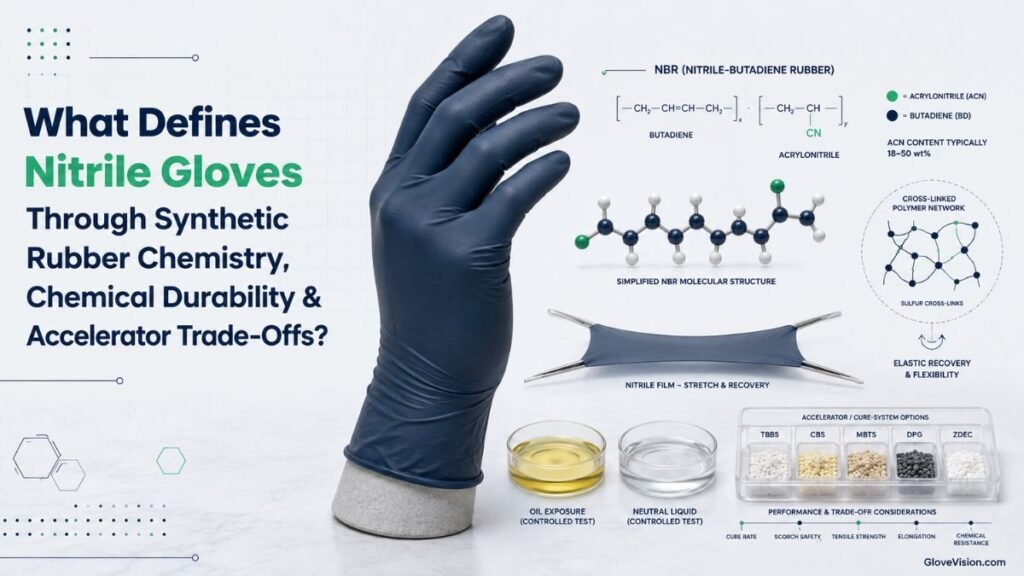
What Defines Nitrile Gloves Through Synthetic Rubber Chemistry, Chemical Durability & Accelerator Trade-Offs?
Nitrile Gloves are defined by a cross-linked nitrile-butadiene rubber structure that can combine hand conformity, product-dependent mechanical durability, and resistance to selected oils, chemicals, and contaminants.
Nitrile is not universally chemical-resistant, and performance varies with formulation, thickness, cross-linking, complete construction, exposure, testing, fit, condition, and accelerator system; susceptible users may also react to processing chemicals.
What Are Nitrile Gloves, and How Does NBR Chemistry Shape Their Behavior?
Nitrile Gloves are made primarily from nitrile-butadiene rubber, a synthetic copolymer whose formulation and cross-linked structure influence flexibility, durability, and chemical interaction.
What Is Nitrile-Butadiene Rubber Made From?
Nitrile-butadiene rubber is a synthetic copolymer produced from acrylonitrile and butadiene components and commonly processed as an aqueous synthetic-rubber dispersion for dipped gloves.
In glove manufacturing, “nitrile latex” describes the physical dispersion of synthetic NBR; it is not natural rubber latex and NBR itself does not contain natural-rubber proteins. The relationship between formulation and physical performance is examined further in the guide to nitrile resistance and stiffness.
How Do Acrylonitrile and Butadiene Influence Nitrile Behavior?
Acrylonitrile contributes polarity and can influence resistance to selected oils and chemicals, while butadiene contributes rubber-like flexibility; the final balance remains formulation-specific.
Changing the component balance may alter stiffness, selected solvent interaction, and low-temperature behavior, but the chemistry relationship cannot establish an exact glove’s performance without formulation and product testing. The polarity relationship is expanded in acrylonitrile and solvent resistance.
How Does Cross-Linking Change Nitrile Glove Performance?
Cross-linking connects polymer chains into a rubber network that supports elastic recovery, structural stability, and resistance to permanent deformation.
Cross-link density, vulcanization, and cure chemistry vary by product. More cross-linking cannot be assumed to improve flexibility, tear behavior, chemical durability, and comfort simultaneously.
Why Do Finished Nitrile Gloves Perform Differently?
Finished Nitrile Gloves perform differently because the polymer grade is only one part of a construction that also includes thickness, curing, texture, coatings, liners, quality control, aging, and condition.
Surface treatment, manufacturing consistency, storage, overstretching, and current damage can change performance after the underlying NBR formulation is selected.
| Chemistry or Construction Factor | Possible Physical Effect | Practical Contribution | What It Does Not Guarantee |
|---|---|---|---|
| Acrylonitrile contribution | Changes polarity and stiffness | Selected oil or chemical durability | Universal solvent resistance |
| Butadiene contribution | Supports rubber-like flexibility | Hand conformity and movement | Tear, puncture, or needle protection |
| Cross-linked network | Supports recovery and stability | Functional elastomeric film | Equal performance across products |
| Increased thickness | Adds material between hand and exposure | Product-dependent durability | Chemical compatibility |
| Surface texture | Changes contact friction | Documented dry, wet, or oily grip | Complete-glove protection |
How Do Nitrile Glove Formulation and Construction Change Flexibility, Grip, and Durability?
Nitrile Gloves can range from thin, close-fitting disposable films to thicker supported chemical gloves, so the material name alone cannot predict flexibility, grip, tactility, or durability.
How Does Thickness Affect Nitrile Glove Behavior?
Thickness can change tactile feedback, flexibility, durability, hand fatigue, and permeation behavior, but it cannot establish chemical compatibility by itself.
Thin disposable, thicker unsupported, and supported constructions serve different tasks. Thinner does not always mean better control, and thicker cannot make an incompatible formulation suitable. Increasing polarity can also introduce a flexibility cost, explored through the acrylonitrile stiffness trade-off.
How Do Liners and Supports Change Nitrile Gloves?
Liners and textile supports may improve mechanical stability, moisture management, comfort, and durability while adding bulk and reducing direct tactile feedback.
Flock linings, knit supports, and coated textile constructions must be assessed as complete systems. Supported nitrile is not universally more protective than unsupported nitrile.
How Do Surface Treatments Affect Nitrile Grip?
Surface treatments change the hand-to-object interface, but grip depends on the exact texture, coating, contaminant, pressure, and condition.
Smooth films, textured fingertips, textured palms, and microsurface finishes can behave differently in dry, wet, or oily contact. Maximum friction is not automatically safest if it impedes release or movement.
Does Nitrile Puncture Resistance Prove Needle Protection?
No. Ordinary puncture resistance and fine-needle penetration are different hazards and require different test evidence.
Point geometry, needle diameter, thickness, formulation, and film tension affect failure. Puncture-resistant and needle-resistant must not be used interchangeably.
Which Factors Can Reduce Nitrile Glove Durability?
Nitrile durability can decline through overstretching, abrasion, repeated flexing, chemical degradation, unsuitable temperature, aging, poor storage, or reuse beyond product instructions.
Incorrect sizing, unsupported reuse, and coating or liner separation can also undermine fit, grip, and barrier integrity before severe damage becomes obvious.
Where Does Nitrile Glove Chemical Durability Reach Its Resistance Limits?
A Nitrile Chemical Barrier may resist selected oils, greases, fuels, bases, and other substances, but suitability remains specific to the exact chemical, glove, and contact conditions.
What Does Chemical Durability Mean for Nitrile Gloves?
Chemical durability describes how well a nitrile glove retains its structure and useful properties during a defined exposure; it does not mean unlimited impermeability.
Resistance to swelling, softening, hardening, and loss of strength must be considered alongside molecular permeation. The broader compatibility boundary is developed in the guide to nitrile resistance limits.
How Can a Nitrile Chemical Barrier Fail?
A Nitrile Chemical Barrier can fail through holes, tears, penetration, degradation, molecular permeation, or contamination entering through the cuff.
Penetration uses a physical opening; degradation changes the material; permeation moves molecules through apparently intact material; breakthrough time marks a test-defined detection threshold rather than a universal safe-wear duration.
Why Does Nitrile Chemical Compatibility Vary?
Nitrile compatibility varies because chemical identity, mixture composition, concentration, temperature, contact duration, thickness, formulation, movement, and glove condition all affect performance. [OSHA]
Splash, intermittent contact, and immersion are not equivalent. Reusable chemical-glove data must not be transferred to very thin disposable nitrile films without evidence for the exact product and conditions.
Which Signs Can Indicate Nitrile Degradation?
Swelling, softening, hardening, tackiness, brittleness, cracking, discoloration, loss of elasticity, or surface separation may indicate degradation.
Visible change is a rejection signal, but appearance alone cannot verify continued protection because permeation may occur without obvious degradation.
Which Nitrile Protection Claims Require Separate Evidence?
Any claim involving a specific chemical, biological agent, drug, needle, cut, heat, flame, or electrical hazard requires evidence for the exact finished glove. [NIOSH]
NIOSH’s archived recommendations explicitly exclude very thin nitrile films of 0.3 mm or less from those barrier-duration tables. Product-specific evidence is required for disposable films, mixtures, and combined hazards.
| Exposure or Hazard | Possible Nitrile Contribution | Critical Boundary | Required Verification |
|---|---|---|---|
| Oils and greases | Product-dependent resistance | Formulation, concentration, and duration | Exact product data |
| Chemical splash | Temporary barrier where documented | Degradation and permeation | Chemical-specific compatibility |
| Chemical immersion | Exposure-specific protection | Breakthrough over time | Tested breakthrough data |
| Solvent mixture | Potentially unpredictable interaction | Changed or accelerated permeation | Mixture-specific evidence |
| Sharp object | Flexible hand coverage | Tear or puncture | Mechanical testing |
| Fine needle | No automatic protection | Fine-point penetration | Needle-specific evidence |
| Heat or flame | No universal protection | Heat transfer and material degradation | Thermal testing |
Why Do Nitrile Glove Accelerators Create Curing-Performance and Dermatitis Trade-Offs?
Nitrile Glove Accelerators can support efficient cross-linking and finished-rubber performance, but residual accelerator chemicals may trigger delayed allergic contact dermatitis in susceptible users.
Why Are Accelerators Used in Nitrile Glove Manufacturing?
Accelerators are used to promote efficient cross-link formation during curing and help develop the elastic and mechanical properties of finished nitrile rubber.
They can influence cure speed and manufacturing efficiency, but cure systems are not technically identical across manufacturers or products.
Which Accelerator Families May Be Relevant?
Depending on the exact formulation, nitrile gloves may involve dithiocarbamates, thiurams, thiazole-related chemicals, guanidines, or other curing agents. [Accelerators]
A NIOSH-supported glove survey demonstrates product-level variation in sulfur-containing accelerators. No family should be declared present in an exact glove without manufacturer documentation or testing.
How Is Type IV Allergic Contact Dermatitis Different From Irritation?
Irritant dermatitis is a nonimmune reaction, whereas Type IV allergic contact dermatitis is a delayed immune reaction to a sensitizing substance. [CDC]
Sweating, friction, handwashing, occlusion, detergents, and chemical exposure can contribute to irritation. Fit, wear duration, and exposure are considered together in nitrile wearability and sensitivity; symptoms alone cannot diagnose the pathway.
Are Nitrile Gloves Associated With Type I Natural-Latex Allergy?
NBR itself does not contain the natural-rubber proteins responsible for Type I latex allergy. [FDA]
Nitrile and natural rubber are different polymers, but accelerators may still cause Type IV reactions and other components may irritate. The main nitrile latex-avoidance advantage applies only when the complete product and labeling confirm natural rubber is not used.
What Does “Accelerator-Free” Mean for Nitrile Gloves?
Accelerator-free generally means that specified conventional rubber accelerators were omitted, but the exact claim depends on the manufacturer’s formulation and evidence.
It does not mean chemical-free, sensitizer-free, friction-free, sweat-free, or reaction-free. Product claims must identify what was omitted, as explained in the guide to accelerator-free nitrile gloves.
Which Accelerator and Skin-Suitability Claims Require Product Evidence?
Claims concerning accelerator content, dermatitis potential, sensitive-skin suitability, powder status, or natural-rubber use must be verified for the exact product.
Accelerator-free, reduced-sensitization, powder-free, sensitive-skin, and natural-rubber statements describe different questions and cannot substitute for one another.
| Issue | Primary Mechanism | Possible Contributor | Typical Timing | Critical Qualification |
|---|---|---|---|---|
| Irritant dermatitis | Nonimmune irritation | Sweating, friction, washing, occlusion, or chemicals | Variable | Not automatically an allergy |
| Type IV dermatitis | Delayed immune response | Accelerator or processing chemicals | Hours to days | Requires clinical differentiation |
| Type I natural-latex allergy | Immediate protein-specific response | Natural-rubber proteins | Usually rapid | Not caused by NBR itself |
| Accelerator-free claim | Product formulation choice | Omission of specified accelerators | Not applicable | Does not mean reaction-free |
Which Nitrile Protective Gloves Match the Task, Exposure, Fit, and Skin Profile?
Suitable Nitrile Protective Gloves must match the exact task, exposure conditions, finished-glove evidence, fit, required dexterity, and user reaction history.
What Should Be Defined Before Selecting Nitrile Gloves?
Before selecting Nitrile Gloves, identify the task, substance, concentration, contact method, temperature, duration, coverage, grip, and simultaneous hazards. [OSHA]
Selection must consider splash versus immersion, dry, wet, or oily handling, disposable or reusable use, dexterity, mechanical hazards, and previous glove-related reactions.
Which Nitrile Glove Construction Fits the Exposure?
The appropriate construction may be thin disposable, thicker unsupported, supported, lined, textured, or coated nitrile depending on the exposure and task requirements.
Construction must follow the identified hazard rather than assumptions based on the nitrile name. No construction is universally superior across chemical, mechanical, and dexterity tasks.
Which Product Evidence Should Support Nitrile Glove Selection?
Selection should be supported by exact-model documentation showing intended use, relevant testing, material construction, compatibility, and limitations.
Verify thickness where relevant, chemical data, applicable tests, accelerator information, liner and coating materials, disposal instructions, authorized reuse, and manufacturer limits.
How Should Nitrile Glove Fit Be Evaluated?
Nitrile Gloves should fit without loose fingertips, palm bunching, internal slipping, excessive stretching, restricted thumb movement, or inadequate cuff coverage.
Check finger alignment, fingertip space, palm conformity, thumb position, full hand opening and closure, pressure points, internal stability, and task-specific grip.
When Should Another Glove Material Be Considered?
Consider another material when nitrile is incompatible with the exposure, lacks required test evidence, cannot provide sufficient coverage or control, or causes unresolved reactions.
Unsupported heat, cut, puncture, needle, or chemical claims are reasons to choose a verified alternative rather than stretching nitrile beyond its documented role.
Which Nitrile Glove Selection Mistakes Should Be Avoided?
Avoid choosing Nitrile Gloves from material reputation, thickness, appearance, or marketing terminology alone.
Do not treat every NBR formulation as equivalent, visible durability as evidence against permeation, powder-free as accelerator-free, accelerator-free as reaction-free, or disposable construction as reusable chemical protection.
How Should Synthetic Nitrile Hand Protection Be Used, Inspected, and Finally Evaluated?
Synthetic Nitrile Hand Protection remains suitable only while the exact glove is compatible with the exposure, correctly fitted, intact, functional, and tolerated by the wearer.
What Should Be Checked Before Using Nitrile Gloves?
Before use, confirm the product identity, intended task, size, packaging, condition, and applicable compatibility information.
Inspect for holes, tears, brittleness, tackiness, swelling, discoloration, cuff damage, liner separation, coating separation, or compromised packaging.
How Should Nitrile Gloves Be Used During the Task?
Use Nitrile Gloves only within the exact product and workplace instructions for contact conditions, donning, glove changing, removal, disposal, and authorized reuse.
No single donning, change, double-gloving, or reuse schedule applies to every construction and exposure.
When Should Nitrile Gloves Be Removed or Replaced?
Remove or replace Nitrile Gloves when they are torn, punctured, degraded, heavily contaminated, unstable, unsuitable for a changed task, or associated with new skin symptoms.
Loss of grip, dexterity, fit, cuff coverage, or documented exposure time also requires replacement or reassessment.
How Should Symptoms During Nitrile Glove Use Be Handled?
Stop exposure, remove the glove safely, follow the applicable workplace or medical protocol, and reassess the product before any further use.
Use the sequence: symptom → stop exposure → remove safely → follow workplace or medical protocol → reassess. Recurrent symptoms require appropriate assessment; do not diagnose from appearance alone.
What Final Questions Determine Nitrile Glove Suitability?
Final suitability depends on whether the exact glove passes compatibility, construction, fit, function, condition, and skin-tolerance checks.
Verify product evidence, coverage, grip, dexterity, accelerator concerns, condition, and exposure limits before choosing use, replacement, reassessment, an alternative, or rejection.
- Exact task is identified.
- Contact substance and concentration are known.
- Duration and contact type are defined.
- Mechanical and thermal hazards are identified.
- Exact model is known.
- Intended use matches the task.
- Compatibility and testing are documented.
- Manufacturer limitations are understood.
- Thickness follows documented use.
- Liner and coating are considered.
- Size and finger alignment are correct.
- Grip, movement, and cuff coverage remain adequate.
- Previous reactions are considered.
- Accelerator information is reviewed.
- Accelerator-free claims are verified.
- Symptoms are not ignored or self-diagnosed.
- No holes, tears, swelling, brittleness, or tackiness are present.
- No unresolved contamination remains.
- Liner, coating, cuff, and grip remain functional.
- Use when all checks pass.
- Replace after damage, contamination, or lost function.
- Reassess when compatibility or reaction risk is unclear.
- Select another glove when nitrile does not match.
- Do not use when suitability cannot be verified.
Conclusion
Nitrile Gloves are valued for synthetic-rubber flexibility, product-dependent mechanical durability, and resistance to selected oils and chemicals, but those characteristics do not establish universal chemical protection.
Final suitability depends on the exact finished glove, chemical exposure, compatibility evidence, construction, fit, condition, and accelerator profile—not the nitrile material name alone.
Frequently Asked Questions
Are Nitrile Gloves Resistant to Every Chemical?
No. Chemical suitability depends on the exact substance, mixture, concentration, temperature, contact duration, glove thickness, formulation, construction, and product testing. Consult exact compatibility data rather than relying on the nitrile name.
Do Thicker Nitrile Gloves Always Provide Better Chemical Protection?
No. Thickness can influence durability and permeation behavior, but it cannot make an incompatible formulation suitable for every chemical. Interpret thickness with the exposure and test conditions.
Can Nitrile Gloves Cause Allergic Contact Dermatitis?
Yes. Residual accelerators or other processing chemicals can cause delayed Type IV allergic contact dermatitis in susceptible users. Symptoms can also result from irritation, sweating, friction, or unrelated exposures.
Are Accelerator-Free Nitrile Gloves Reaction-Free?
No. Accelerator-free construction may omit specified curing chemicals, but it does not eliminate friction, sweating, other ingredients, contamination, or every possible sensitizer.
Do Nitrile Gloves Contain Natural-Rubber Latex Proteins?
The NBR polymer itself does not contain natural-rubber latex proteins. Check the complete product, packaging, components, and manufacturer labeling rather than relying on an unqualified latex-free assumption.