
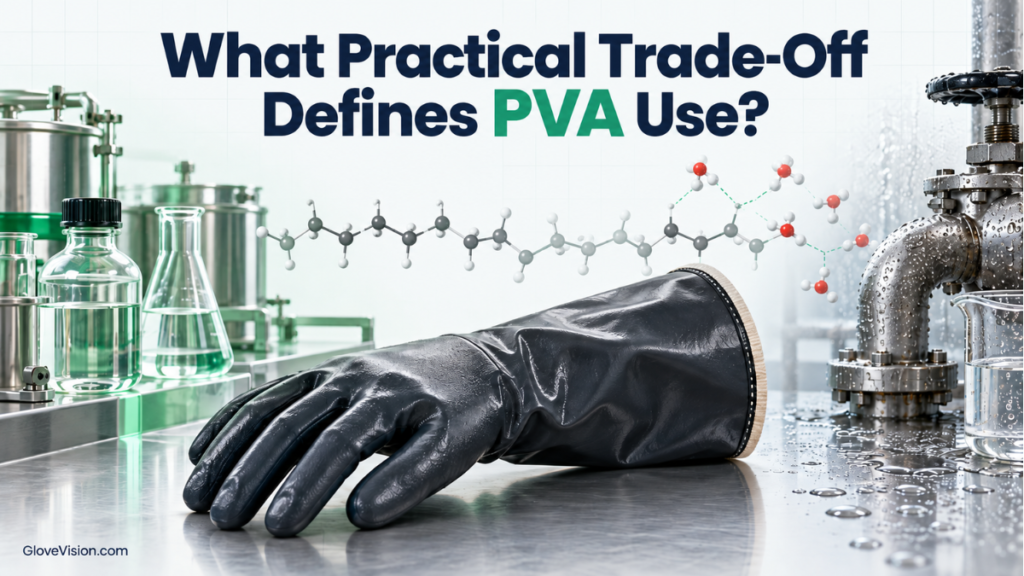
What Practical Trade-Off Defines PVA Use?
The defining trade-off of PVA Gloves is exceptional resistance to many difficult dry organic solvents in exchange for severe moisture sensitivity, weak performance in selected chemical zones such as light alcohols, higher cost, and narrower operational flexibility.
PVA therefore makes the most practical sense when a difficult dry solvent—especially an aromatic or chlorinated solvent—requires protection that more general-purpose gloves do not adequately provide. If another exact glove already provides sufficient protection with fewer moisture, cost, or workflow constraints, PVA specialization may add little practical value.
What Practical Trade-Off Most Defines PVA Gloves Selection?
The defining trade-off of PVA Gloves is narrow but unusually valuable dry-solvent resistance versus severe moisture sensitivity, higher cost, and reduced flexibility across wet, mixed, or general-purpose tasks.
What Is the Main Protective Advantage of PVA Gloves?
PVA occupies a specialist organic-solvent niche. OSHA lists aliphatics, aromatics, chlorinated solvents, ketones except acetone, esters, and ethers among generic PVA application areas, making those useful screening categories rather than automatic approvals for a finished glove. [OSHA] For the mechanism behind this specialization, see PVA chemistry and solvent resistance.
What Is the Main Practical Limitation of PVA Gloves?
Water sensitivity is the defining environmental limitation. OSHA specifically identifies PVA as water-sensitive. [OSHA] The practical equation is therefore strong dry-solvent barrier + water-sensitive polymer = narrow operating envelope. The operational consequences are explored further in PVA dry-only limits.
Why Are PVA Gloves Not General-Purpose Chemical Gloves?
PVA’s strong and weak zones are sharply polarized. OSHA identifies poor performance versus light alcohols and lists acetone as an exception to the generic ketone application category for PVA. [OSHA] Water, wet formulations, relevant humidity, light alcohols, acetone, and mixed process conditions should therefore trigger chemical- and product-specific verification rather than broad PVA extrapolation.
Why Does Narrow Specialization Still Create Value for PVA Gloves?
Narrow but adequate specialist protection can be more valuable than broader but inadequate general-purpose resistance. The value comes from solving the actual barrier problem, not from maximizing the number of chemical families a glove can theoretically cover.
Why Is High Price Not Proof of Better Overall Protection from PVA Gloves?
OSHA characterizes PVA as a specialty glove for organic solvents and lists “very expensive” among its disadvantages. [OSHA] Cost is therefore not a compatibility rating. Higher price ≠ broader protection.
What Is the Correct Selection Question for PVA Gloves?
Does this task need PVA’s specific dry-solvent strength enough to justify its moisture sensitivity, cost, and narrower operational flexibility?
The visual balance and table form one proof asset, separating PVA’s specialist barrier value from the limitations that can reduce its complete-task usefulness.
| Selection Factor | Potential PVA Advantage | PVA Limitation |
|---|---|---|
| Aromatic solvents | Strong specialist candidate | Exact product still required |
| Chlorinated solvents | Strong specialist candidate | Moisture can undermine advantage |
| Dry organic processing | Strong practical fit | Dry environment must be maintained |
| Water exposure | Little generic value | Defining material weakness |
| Light alcohol | Weak generic fit | Another barrier may be preferable |
| Acetone | Important exception | Chemical-specific alternative needed |
| Purchase cost | Justifiable when specialization matters | High burden when specialization is unnecessary |
| Workflow flexibility | Strong in controlled dry task | Weak in mixed wet/dry process |
| Physical task | Exact glove may perform well | Chemistry does not prove puncture or abrasion fitness |
Why Does Specialist Solvent Resistance Create High Value for PVA Gloves?
PVA Gloves create their highest value when a difficult dry organic solvent exposes a barrier gap in more general-purpose materials and an exact PVA product provides stronger applicable evidence.
Why Can Aromatic Solvents Increase the Value of PVA Gloves?
OSHA includes aromatics among the generic chemical categories listed for PVA use. [OSHA] Benzene, toluene, xylene, or another aromatic solvent should still be treated as an exact-chemical and exact-product decision rather than receiving automatic approval from the family name alone. See the PVA aromatic-solvent boundary.
Why Can Chlorinated Solvents Increase the Value of PVA Gloves?
Chlorinated solvents are also listed by OSHA among generic PVA use categories. The correct evidence progression remains family-level candidate → exact chemical → exact glove verification, not family name → automatic use.
Why Can Specialist Resistance Beat Convenience for PVA Gloves?
A convenient glove with inadequate chemical protection is a poor task fit. A more specialized glove can be justified when applicable product evidence demonstrates the barrier performance the task actually needs and the specialist glove can be used within its supported conditions.
When Does PVA Gloves Specialization Add Little Value?
Specialization adds less value when another exact product already provides adequate chemical protection for the necessary duration and contact mode, adequate physical performance, better wet-process flexibility, simpler workflow, or lower lifecycle burden.
Why Must Product-Level Evidence Control PVA Gloves Selection?
Finished-glove performance must be evaluated at the product level. For AlphaTec 15-554 specifically, Ansell documents a PVA coating with advanced resistance to aromatic and chlorinated solvents, an anatomical design, and a soft two-piece knit liner; Ansell also states that contact with water or use in high-humidity environments will greatly decrease chemical protection. [Ansell] Those statements apply to that documented model and should not be transferred automatically to every PVA glove.
How Do Moisture, Cost, and Task Constraints Reduce the Practical Value of PVA Gloves?
PVA Gloves lose practical value when maintaining their dry-use requirements, paying for specialist construction, or meeting physical task demands becomes more burdensome than the solvent-protection advantage they provide.
Why Is Water More Than a Minor Limitation for PVA Gloves?
Wet equipment, condensation, rinse residues, relevant high humidity, washdown, or water-containing formulations can change the actual barrier environment. For AlphaTec 15-554 specifically, Ansell states that contact with water or use in high-humidity environments will greatly decrease chemical protection. [Ansell] Strong solvent resistance + unavoidable water exposure = compromised specialist advantage.
Why Can Mixed Wet/Dry Workflows Reduce the Value of PVA Gloves?
A mixed workflow may require separation of wet and dry stages, glove changes, surface-moisture control, prevention of aqueous contamination, and repeated condition checks. PVA can remain valuable in one dry step while becoming awkward as the sole glove for the complete process.
How Does High Cost Change PVA Gloves Selection?
OSHA lists “very expensive” among the disadvantages of PVA gloves. [OSHA] Cost should therefore be considered only after chemical adequacy, task adequacy, and usable service conditions are established—not as evidence that PVA is inherently safer or broader in coverage.
When Can the Higher Cost of PVA Gloves Still Be Rational?
Higher cost can be rational when the solvent hazard is difficult, less costly products lack adequate evidence, exact PVA performance materially improves protection, dry conditions can be maintained, and the finished glove’s service conditions match the task.
When Can PVA Gloves Become Economically Inefficient?
PVA may lose practical value when specialist resistance is unnecessary, moisture repeatedly forces glove switching, wet/dry changes dominate the workflow, mechanical damage ends service early, or another adequately protective product works with fewer restrictions.
Why Must PVA Gloves Be Evaluated as Finished Glove Systems?
A commercial glove can combine the PVA coating with a liner, shaped construction, extended cuff, and other physical features. AlphaTec 15-554, for example, is documented by Ansell as having an anatomical design and soft two-piece knit liner. Those features are model-specific and should not be generalized to every PVA glove.
Why Do Dexterity and Grip Matter for PVA Gloves?
Chemical resistance is useful only if the exact glove can also provide the finger mobility, grip, fit, tactile control, and tool handling required by the task. Ergonomic claims should therefore be verified for the selected product.
Why Do Abrasion and Puncture Matter for PVA Gloves?
Strong solvent resistance does not establish cut resistance, puncture resistance, abrasion durability, or suitability around sharp objects. Those physical demands require their own product-specific evidence.
What Is the Correct Usability Sequence for PVA Gloves?
Chemical adequacy → physical durability → dexterity, grip and comfort → workflow practicality → cost. Price belongs near the end of the selection process because an inexpensive glove that fails the chemical requirement is not an adequate substitute.
Which Tasks Most Justify the Specialist Trade-Off of PVA Gloves?
PVA Gloves are most strongly justified in dry solvent tasks where their specialist barrier performance solves a chemical-protection problem that more general-purpose gloves do not adequately solve.
When Do Dry Aromatic-Solvent Tasks Strongly Favor PVA Gloves?
Exact-product-supported exposure to benzene, toluene, xylene, or related aromatic process chemicals can occupy a high-value PVA candidate zone. The aromatic family does not provide a shared barrier value, so exact solvent and exact glove data remain necessary.
When Do Dry Chlorinated-Solvent Tasks Strongly Favor PVA Gloves?
PVA can be a strong candidate when the exact chlorinated chemical is identified, applicable product data exist, water exposure is controlled, and the task conditions match that evidence. See PVA chlorinated-solvent resistance.
When Can Transfer Operations Justify PVA Gloves?
Transfer of dry compatible liquids between vessels, tanks, or process equipment can justify PVA where exact manufacturer and chemical data support the operation and the physical handling demands fit the glove.
When Can Maintenance Work Justify PVA Gloves?
Solvent-exposed maintenance around process equipment, valves, lines, pumps, or laboratory equipment can enter the candidate zone when solvent compatibility is supported, moisture is controlled, and the glove’s physical construction matches the mechanical task.
When Can Leak or Spill Response Justify PVA Gloves?
Only when the exact spilled chemical matches applicable PVA evidence, an incompatible aqueous phase does not control the exposure, contact conditions remain within supported limits, and physical hazards are manageable. A manufacturer’s application statement for one product should not be generalized to every spill scenario.
When Are PVA Gloves Usually Over-Specialized?
PVA specialization may add little value for routine water handling, general aqueous cleaning, food handling, routine low-hazard handling, light-alcohol work, generic mechanical tasks, or work already adequately covered by a simpler verified product.
The task-zone visual and matrix form one proof asset, distinguishing where PVA’s specialization is likely to create value from tasks where its limitations dominate.
| Task Condition | PVA Practical Fit | Main Qualification |
|---|---|---|
| Dry aromatic transfer | Strong | Exact solvent and product evidence |
| Dry chlorinated-solvent handling | Strong | Exact model required |
| BTX-type dry process maintenance | Strong candidate | Moisture controlled |
| Dry specialist-solvent transfer | Strong | Barrier and physical-task match |
| Water-based cleaning | Poor | Defining material weakness |
| Alcohol-heavy work | Weak | Light-alcohol limitation |
| Mixed wet/dry processing | Weak / conditional | Switching and workflow burden |
| General low-hazard handling | Usually unnecessary | Specialist chemistry adds little |
| High mechanical-damage task | Product-dependent | Abrasion and puncture must be verified |
How Should PVA Gloves Be Compared and Verified Before Their Specialist Trade-Off Is Accepted?
PVA Gloves should be selected only when their exact specialist advantage clearly outweighs the moisture, cost, physical, and workflow constraints of the complete task.
When Can Fluoroelastomer Be More Practical Than PVA Gloves?
An exact fluoroelastomer product can be compared when strong organic-solvent resistance remains necessary, water sensitivity makes PVA difficult, and the fluoroelastomer evidence better matches the chemical and physical task. See fluoroelastomer adoption limits.
When Can Butyl Be More Practical Than PVA Gloves?
Butyl can be compared for selected ketones, glycol ethers, and esters when exact product evidence supports the proposed exposure. It is a complementary candidate rather than a universal PVA replacement. See Butyl selection trade-offs.
When Can Nitrile Be More Practical Than PVA Gloves?
An exact nitrile glove can be more practical where its chemical resistance is adequate, moisture is present, physical durability matters, and PVA-level specialization is unnecessary. Familiarity or convenience should never substitute for chemical compatibility evidence.
When Can Neoprene Be More Practical Than PVA Gloves?
An exact neoprene product can be evaluated where wet or mixed environments dominate, its chemical compatibility is sufficient, and PVA cannot remain within its supported dry-use conditions.
When Can a Multilayer Barrier Be More Practical Than PVA Gloves?
A verified multilayer product may warrant comparison when the mixture is complex, water and aggressive solvent coexist, PVA’s specialization is too narrow, the consequence of failure is high, or broader tested coverage is needed.
Why Should No Alternative Be Ranked Universally Above PVA Gloves?
Every alternative has its own chemical gaps, physical trade-offs, cost, comfort, construction, availability, and testing boundaries. The useful comparison is therefore exact product versus exact task—not material reputation versus material reputation.
The decision route and matrix form one proof asset. It does not rank materials universally; it identifies when the complete task should trigger exact alternative-product comparison.
| Controlling Need | PVA Direction | Alternative Direction |
|---|---|---|
| Dry aromatic solvent | Strong candidate | Exact fluoroelastomer or multilayer product may also qualify |
| Dry chlorinated solvent | Strong candidate | Compare exact specialist products |
| Water + organic solvent | Weak PVA fit | Wet-compatible specialist or multilayer product |
| Ketone / ester outside PVA fit | Conditional | Exact butyl product may warrant comparison |
| Light alcohol | Weak PVA zone | Exact alternative required |
| High physical demand | Construction-dependent | Exact reinforced or physically stronger system may be more practical |
| Complex mixed exposure | Narrow PVA coverage | Mixture-tested multilayer or other exact product |
| Routine lower-severity task | Often over-specialized | Simpler adequate product may provide better practical value |
What Chemical Information Must Be Confirmed for PVA Gloves?
Record the exact chemical, CAS number, concentration, complete formulation or mixture, and solvent purity. PVA specialization should be relevant to the actual hazard rather than inferred from a broad solvent label.
Why Must Moisture Be a Separate Gate for PVA Gloves?
Confirm water content, humidity where relevant, condensation, wet equipment, rinse residues, and aqueous process stages. Moisture should not be buried inside a generic mixture field because water sensitivity is one of PVA’s defining selection limitations.
Which Product Details Must Match for PVA Gloves?
Verify manufacturer, exact model, PVA coating or material, thickness where available, liner or support, cuff, intended use, relevant certifications, and manufacturer moisture restrictions. Evidence from one construction should not automatically transfer to another.
Which Performance Data Must Be Reviewed for PVA Gloves?
Review permeation, breakthrough, degradation, exact test chemical, concentration, temperature, duration, material thickness, and the relevant standard or test method. ASTM F739 is a standard test method for permeation of liquids and gases through protective clothing materials under conditions of continuous contact. [ASTM] Test results should be interpreted within the documented method and conditions rather than converted automatically into a workplace safe-wear interval.
Which Physical Variables Must Be Checked for PVA Gloves?
Assess grip, dexterity, abrasion, puncture, coverage, comfort, cuff design, and handling requirements. Chemical-barrier evidence and physical-task evidence answer different questions and both must be adequate.
Which Practical Variables Matter After Protection Is Established for PVA Gloves?
Assess wet/dry glove switching, workflow interruption, storage and procurement complexity, replacement frequency, training burden, purchase cost, and lifecycle practicality. These factors matter only after adequate chemical and physical protection has been established.
When Are PVA Gloves No Longer Worth the Trade-Off?
PVA loses its practical case when another exact glove provides adequate protection with fewer constraints, moisture cannot be controlled, specialist resistance is unnecessary, physical durability is inadequate, workflow becomes excessively complex, exact evidence is missing, or higher cost produces no meaningful protection advantage.
Chemical Gate
- Exact solvent identified.
- CAS number confirmed.
- Concentration known.
- Complete mixture reviewed.
- PVA specialization is relevant to the hazard.
Moisture Gate
- Water absent or adequately controlled.
- Humidity acceptable under applicable product guidance.
- Condensation controlled.
- Wet surfaces excluded or addressed.
- Aqueous process steps identified.
- Manufacturer moisture limitations reviewed.
Product Gate
- Exact PVA manufacturer and model confirmed.
- PVA construction matches the evidence.
- Coating or thickness documented where available.
- Liner and support known.
- Cuff and coverage appropriate.
- Intended use relevant.
Performance Gate
- Chemical-specific permeation reviewed.
- Breakthrough endpoint understood.
- Degradation acceptable.
- Temperature supported.
- Duration and contact conditions supported.
- Physical demands adequate.
- No automatic safe-wear time inferred.
Practical Gate
- Dexterity acceptable.
- Grip adequate.
- Abrasion and puncture demands addressed.
- Workflow can remain sufficiently dry.
- Glove-switching burden understood.
- Cost justified by the specialist need.
Alternative Gate
- Fluoroelastomer considered where the moisture and solvent profile justifies comparison.
- Butyl considered where selected polar-organic exposure justifies comparison.
- Nitrile considered where exact evidence is adequate and greater practicality matters.
- Neoprene considered for supported wet or mixed conditions.
- Multilayer considered for complex or high-consequence mixtures.
- Every alternative evaluated as an exact product.
Final Decision
What Should Readers Remember About the Practical Trade-Off of PVA Gloves?
PVA Gloves trade broad operational convenience for narrow but valuable specialist performance. Their strongest role is in selected dry organic-solvent tasks where more general-purpose gloves do not provide an adequate barrier, particularly when exact PVA evidence supports demanding aromatic or chlorinated-solvent exposure. Choose PVA Gloves when exceptional verified dry-solvent resistance solves a protection problem that more practical materials cannot.
That specialist advantage becomes less practical when water, relevant high humidity, light alcohols, unsupported chemicals, repeated wet/dry process changes, mechanical demands, or another adequately protective product removes the need for such a narrow barrier. PVA should therefore be chosen because its specific solvent resistance solves the complete task—not merely because it is expensive or specialized; move away from it when moisture sensitivity, cost, physical demands, or workflow restrictions outweigh that specialist benefit.
Which Questions Clarify the Practical Trade-Off of PVA Gloves?
Why Are PVA Gloves Considered Specialty Gloves?
Because their main value is strong performance in selected dry organic-solvent tasks rather than broad all-purpose chemical coverage. Their specialization is useful when the exact solvent requires a barrier that more general-purpose products do not adequately provide.
Are PVA Gloves Expensive?
OSHA characterizes PVA as a very expensive specialty glove material. That cost can still be justified when exact PVA performance solves a difficult solvent-protection problem that cheaper or more convenient products do not solve adequately.
Is Water Sensitivity the Biggest Practical Limitation of PVA Gloves?
Within this selection framework, water sensitivity is the defining practical limitation. Water, relevant high humidity, condensation, and aqueous process conditions can undermine the dry-state specialist advantage and create significant workflow restrictions.
Are PVA Gloves Worth Using for Routine Chemical Handling?
Only when the routine task genuinely benefits from PVA’s specialist dry-solvent resistance. General aqueous, low-hazard, light-alcohol, or easily controlled tasks may be better served by another exact glove with fewer constraints.
When Should Another Material Replace PVA Gloves?
Compare another exact barrier when moisture cannot be controlled, the chemical lies outside PVA’s strongest dry-solvent zone, physical demands exceed the glove construction, another product provides adequate protection with fewer operating restrictions, or PVA’s cost and workflow complexity add no meaningful protection benefit.