
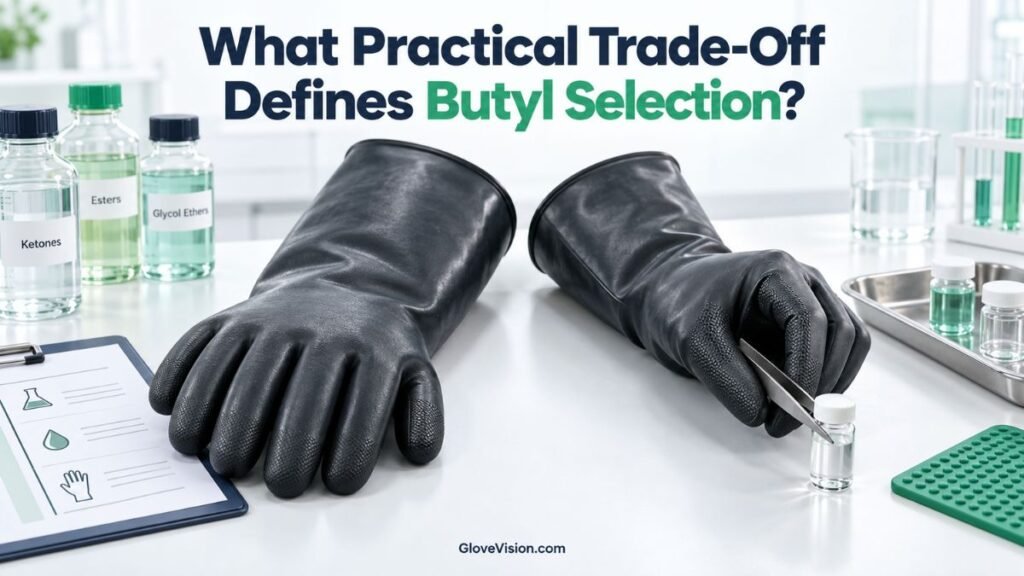
What Practical Trade-Off Defines Butyl Selection?
The main Butyl Rubber trade-off is specialist chemical protection versus complete-task versatility. Butyl can provide valuable protection against defined chemicals such as selected ketones, glycol ethers, esters, aldehydes, and aggressive acids, but its usefulness falls sharply when the controlling exposure lies outside those validated strength zones.
That trade-off cannot be reduced to “chemical resistance versus poor dexterity.” Modern thin Butyl products can provide useful flexibility, tactile control, and engineered grip, so the correct comparison is between exact chemically adequate products and their actual mechanical and ergonomic task fit. This page moves through core trade-off, specialist value, practical limitations, alternative comparison, and final exact-product decision.
What Practical Trade-Off Defines Butyl Rubber as a Specialist Barrier?
Butyl Rubber is a specialist barrier whose value comes from unusually strong protection against selected chemical hazards rather than universal compatibility across every solvent and task.
What Does Butyl Rubber Gain Through Chemical Specialization?
OSHA’s current material guidance places Butyl in a specialty zone for polar organics including glycol ethers, ketones, and esters, while also warning about hydrocarbons and chlorinated solvents. That combination defines a material with pronounced strength zones rather than universal breadth. [OSHA]
See Butyl resistance strengths for the deeper chemical map.
Why Is Stronger Chemical Protection Not Automatically Better Complete-Task Performance?
The glove may also need adequate grip, dexterity, abrasion and puncture resistance, flexing performance, cuff coverage, fit, and compatibility with tools or other PPE. OSHA 1910.138 requires selection to reflect performance characteristics relative to the task, conditions, duration, and hazards—not polymer reputation alone. [OSHA 1910.138]
Why Must the Trade-Off Be Evaluated at Finished-Glove Level?
Exact Butyl products differ in thickness, finish, geometry, cuff, flexibility, mechanical ratings, and chemical data. Finished-product details determine whether the chemical advantage survives the real task. See Butyl Rubber gloves.
| Decision Dimension | Potential Butyl Advantage | Possible Counter-Trade-Off | Final Question |
|---|---|---|---|
| Ketones | Strong specialist zone | Exact product limits remain | Is the ketone fully supported? |
| Esters | Important candidate family | Individual esters vary | Which exact ester/product? |
| Glycol ethers | Generic strength zone | Formulation-specific evidence needed | Is complete formulation known? |
| Hydrocarbons | Limited generic fit | Chemical mismatch may dominate | Is another barrier stronger? |
| Chlorinated solvents | Major warning zone | Specialist alternative may be needed | Does exact Butyl evidence exist? |
| Dexterity | Can be useful in thin designs | Product/thickness dependent | Is manipulation adequate? |
| Grip | Can be engineered | Surface/task dependent | Does exact finish suit conditions? |
| Mechanical durability | Product-specific | Chemical barrier may not solve physical hazard | Can glove survive the task? |
Why Can Butyl Rubber’s Chemical Advantage Justify Specialization?
Butyl Rubber specialization is most valuable when the controlling hazard falls inside a verified Butyl strength zone and chemical-barrier failure would matter more than modest differences in cost, thickness, or convenience.
Why Do Ketone Exposures Strengthen the Case?
Ketones sit inside OSHA’s generic Butyl specialty zone, so a controlling ketone with strong exact-product data can make chemical specialization the dominant selection factor. See Butyl ketone resistance.
Why Can Ester and Glycol-Ether Exposures Favor Butyl Rubber?
These are also recognized generic candidate zones, but the exact molecule, formulation, concentration, temperature, and finished product still control. See Butyl ester resistance.
Why Can Aldehydes and Concentrated Mineral Acids Strengthen the Case?
AlphaTec 38-514 is an exact 0.35-mm unsupported Butyl product whose manufacturer positions it for aldehydes, ketones, esters, and concentrated mineral acids, while also describing a curved ergonomic form, soft Butyl formulation, enhanced flexibility and dexterity, and rough-finish grip. These are product-specific attributes, not universal Butyl claims. [Ansell 38-514]
| Task Pattern | Why Butyl Rubber Value Can Rise | Trade-Off Tolerance |
|---|---|---|
| Defined ketone exposure | Established specialty chemistry | Higher where evidence is strong |
| Defined glycol ether | Recognized candidate zone | Product-specific |
| Selected ester | Useful specialist potential | Depends on exact ester |
| Supported aldehyde | Strong exact-product evidence possible | Higher |
| Supported aggressive acid | High-consequence barrier need | Higher |
| Broad multi-solvent workflow | Specialist depth may add little | Lower |
| Exposure outside Butyl chemistry | Specialist advantage disappears | Reject/compare |
Which Practical Limits Determine Whether Butyl Rubber Fits the Task?
Once Butyl Rubber passes the chemical-protection gate, practical fit depends on the exact product—not a stereotype about Butyl gloves as a class.
Why Can Chemical Breadth Limit Butyl Rubber More Than Ergonomics?
Hydrocarbons and chlorinated solvents are generic warning zones for Butyl. Better grip or greater dexterity cannot correct an inadequate chemical barrier.
Does Butyl Rubber Necessarily Mean Poor Dexterity?
No. AlphaTec 38-514 is 0.35 mm thick and uses a soft formulation and curved ergonomic design intended to improve flexibility and dexterity. The evidence belongs to that product only.
How Can Grip Change the Butyl Rubber Trade-Off?
SHOWA 874 and SHOWA 874R are both 0.35-mm unsupported Butyl constructions, but the 874 uses a smooth grip while the 874R uses a rough grip; SHOWA describes the smooth design around tactility and the rough design around precision and durability. [SHOWA 874/874R]
How Can Mechanical Demands and Thickness Reduce Task Fit?
Abrasion, puncture, tearing, flex fatigue, sharp edges, and repeated tool use can damage a chemically adequate glove. Greater thickness can lengthen the diffusion path but may also alter bending resistance and tactile response. See Butyl flexibility limits.
| Limitation | Type | Possible Task Effect | Can Product Design Solve It? |
|---|---|---|---|
| Hydrocarbon incompatibility | Chemical | Inadequate barrier | Not generically |
| Chlorinated-solvent incompatibility | Chemical | Inadequate barrier | Exact data required |
| Greater thickness | Product/design | Reduced tactile response possible | Different validated product may help |
| Grip mismatch | Product/design | Handling/control problem | Surface engineering can help |
| Dexterity demand | Product/task | Difficult fine manipulation | Thin/ergonomic design may help |
| Abrasion/puncture demand | Mechanical | Barrier damage | Construction/system strategy may help |
| Multiple incompatible chemicals | Workflow | Material mismatch | Task-specific systems may be needed |
How Should Butyl Rubber Be Compared With Alternative Barrier Strategies?
Butyl Rubber should be compared with alternatives only using sufficiently matched chemical and exposure data; after all remaining candidates provide adequate protection, ergonomics and mechanical task fit can legitimately influence the final choice.
Which Chemical Question Comes First?
Ask whether the exact Butyl glove adequately protects against the controlling chemical and actual contact conditions. If not, stop ergonomic comparison and evaluate another barrier.
When Can PVA Enter the Comparison?
For selected solvent exposures outside Butyl’s strongest chemistry, an exact PVA product may deserve evaluation while its water/humidity boundary is also verified. See PVA selection trade-offs.
When Can Fluoroelastomer Enter the Comparison?
For selected hydrocarbon, aromatic, or chlorinated exposures, an exact fluoroelastomer product may warrant comparison. See fluoroelastomer adoption limits.
Which Practical Factors Can Break a Tie?
Only after chemical adequacy: dexterity, grip, fit, cuff, abrasion, puncture, fatigue, wet/oily handling, PPE interaction, and procurement. OSHA Appendix B specifically directs employers to consider dexterity, duration, frequency, physical stresses, manufacturer test documentation, mixture behavior, and cost only where performance remains acceptable. [OSHA Appendix B]
| Controlling Condition | Butyl Rubber Direction | Alternative Direction | Decision Logic |
|---|---|---|---|
| Supported ketone dominates | Strong Butyl candidate | Compare only if needed | Specialist depth matters |
| Supported ester/glycol ether dominates | Strong candidate | Product-specific alternatives | Exact data decide |
| Hydrocarbon dominates | Generic Butyl warning | Compare other barriers | Chemistry shifts |
| Chlorinated solvent dominates | Generic Butyl warning | Specialist alternative likely | Exact evidence required |
| Several incompatible stages | Single Butyl strategy weakens | Task-specific barriers | Workflow breadth matters |
| All candidates chemically adequate | Butyl remains viable | Compare exact alternatives | Task fit can decide |
| Butyl chemically superior but mechanics inadequate | Chemical advantage retained | Different construction/system | Whole-task safety needed |
When Should Butyl Rubber Be Accepted, Limited, or Rejected for a Task?
Butyl Rubber should be accepted only when its chemical-specific advantage is necessary and supported by exact product evidence, and the same glove remains mechanically and ergonomically adequate for the real task.
What Chemical Gate Must Butyl Rubber Pass First?
Define the exact chemical or mixture, concentration, temperature, contact mode, duration, and consequence. Then review permeation, degradation, and penetration. ASTM F739-20 covers continuous contact and warns that its data cannot automatically establish safe exposure levels; F1383-20 addresses intermittent contact. [F739] [F1383]
Which Practical Variables Follow the Chemical Gate?
Assess dexterity, grip, fit, flexing, abrasion, puncture, fatigue, tool interaction, and wet/dry/oily handling. ISO 374-1:2024 defines chemical-glove requirements and notes that other protection features such as mechanical risks require their own relevant performance standards. [ISO 374-1]
Butyl Rubber Selection Verification Checklist
Chemical Gate
- Exact chemical/CAS identified.
- Complete formulation known.
- Concentration and temperature defined.
- Contact pattern and duration defined.
- Consequence considered.
Chemical Evidence
- Exact Butyl product identified.
- Permeation data reviewed.
- Degradation reviewed.
- Penetration/integrity considered.
- Test conditions sufficiently match use.
Exact Product & Task Fit
- Thickness, construction and cuff known.
- Grip and fit suitable.
- Dexterity adequate.
- Abrasion/puncture demands addressed.
- Repeated flexing and wet/oily handling considered.
Alternative Comparison
- Relevant alternative barriers identified.
- Chemical evidence compared under sufficiently similar conditions.
- Alternative weaknesses reviewed.
- Practical comparison made only after chemical adequacy.
What Should Readers Remember About the Practical Trade-Off in Butyl Rubber Selection?
Butyl Rubber should be viewed as a specialist barrier rather than a universally stronger chemical glove. Its value rises when the controlling chemical aligns with a verified Butyl strength zone and the additional chemical protection materially improves the safety margin.
The remaining trade-offs belong to the exact glove, not the polymer stereotype. Thin, ergonomic, or textured Butyl constructions can reduce dexterity and grip compromises, but no design can turn an unsupported chemical exposure into an acceptable one. Chemical adequacy comes first; complete-task fit decides among the products that pass that gate.
Which Questions Clarify the Practical Trade-Off in Butyl Rubber Selection?
Is Butyl Rubber More Chemically Resistant Than Other Glove Materials?
Not universally. Butyl Rubber is especially valuable for defined specialist exposures such as selected ketones, glycol ethers, and esters, while other barrier materials may provide stronger performance against chemicals such as hydrocarbons or chlorinated solvents. The exact chemical and finished product determine the comparison.
Does Butyl Rubber Always Reduce Dexterity?
No. Dexterity is product- and construction-specific. Current 0.35-mm Butyl products such as AlphaTec 38-514 are specifically designed for enhanced flexibility and dexterity, so a generic “Butyl is awkward” assumption is not defensible.
Is Thicker Butyl Rubber Always Better?
No. Greater thickness can increase the diffusion path, but the actual selection must also consider exact chemical data, contact duration, formulation, dexterity, grip, and mechanical demands. Thickness alone does not establish the best glove.
When Is Butyl Rubber Worth a Higher Practical or Procurement Cost?
When its exact chemical-protection advantage is necessary for the controlling exposure and cheaper or more convenient alternatives do not provide equally adequate protection. Cost should influence selection only after required performance is satisfied.
When Should Butyl Rubber Be Replaced by Another Barrier?
Compare or replace Butyl Rubber when the controlling chemical falls outside the exact glove’s validated protection range, another barrier provides materially stronger chemical evidence, or multiple chemically adequate options exist and another exact product provides substantially better whole-task performance.