
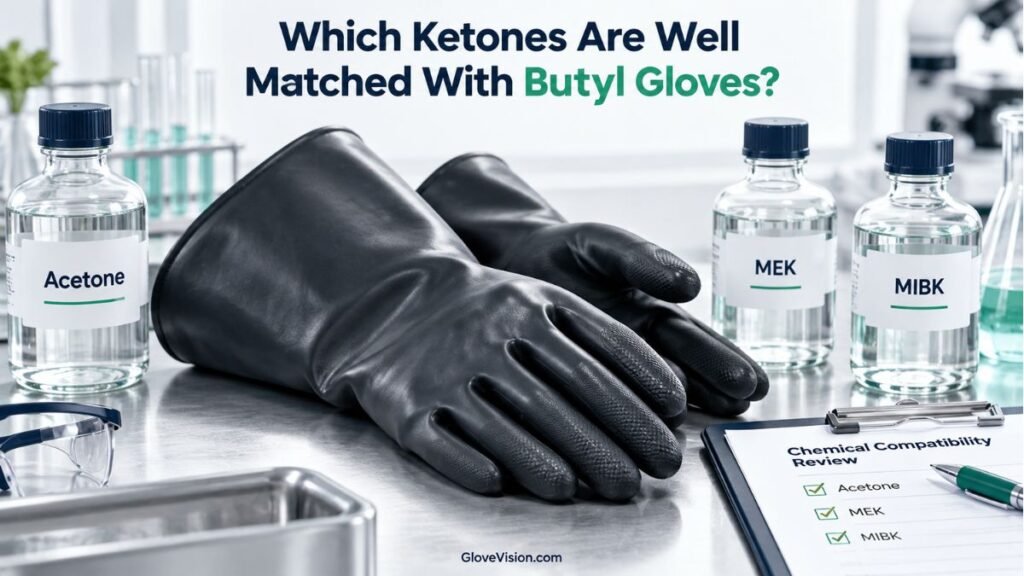
Which Ketones Are Well Matched With Butyl Gloves?
Acetone and MEK are among the best-established ketone candidates for Butyl Gloves, while MIBK and other ketones can also be compatible but require exact product-level verification because performance differs across individual chemicals and glove constructions.
“Ketone resistant” is not a universal glove rating. Molecular structure, concentration, temperature, formulation, contact duration, splash versus immersion, glove thickness, construction, and non-ketone mixture components can materially change performance. This page moves through match criteria, mechanism, candidate ketones, exact verification, and the final compatibility boundary.
What Determines Whether a Ketone Is Well Matched With Butyl Gloves?
A ketone is well matched with Butyl Gloves only when the exact finished glove has adequate evidence for that ketone, concentration, temperature, contact pattern, and duration—not simply because the chemical belongs to the ketone family.
Which ketone identity must be confirmed?
Confirm the exact chemical name, CAS number, synonym, concentration or purity, and complete formulation. Acetone, MEK (2-butanone), MIBK (4-methyl-2-pentanone), 2-hexanone, cyclic ketones, and substituted ketones should be treated as separate challenges.
Why does molecular structure matter?
Molecular size, branching, cyclic versus open-chain structure, volatility, polarity, and Butyl affinity can change sorption and diffusion. The same carbonyl group does not create identical glove performance.
How do permeation and contact mode define a good match?
Review breakthrough time, permeation rate, challenge concentration, temperature, test method, and specimen thickness. ASTM F739-20 covers continuous-contact permeation for protective-clothing materials. [F739] ASTM F1383-20 separately addresses intermittent contact, so splash evidence and immersion evidence are not interchangeable. [F1383]
How do thickness and construction change the match?
Thin versus thick constructions, supported versus unsupported designs, cuffs, seams, liners, and surface design can all change the finished barrier. See Butyl Rubber gloves for material and construction context.
| Selection Factor | Why It Matters | Required Evidence |
|---|---|---|
| Exact ketone | Individual ketones can differ substantially | Name + CAS |
| Concentration | Changes chemical activity and uptake | Matching concentration |
| Temperature | Can accelerate transport | Relevant test temperature |
| Contact pattern | Splash differs from continuous exposure | Matching contact evidence |
| Duration | Determines required barrier margin | Defined task duration |
| Thickness | Changes diffusion path | Exact tested thickness |
| Construction | Seams, liners and cuff affect whole glove | Finished-product evidence |
| Degradation | Physical change can undermine protection | Chemical-specific result |
| Penetration | Defects bypass molecular barrier | Whole-glove integrity |
Why Do Butyl Gloves Provide Strong Specialist Protection Against Many Ketones?
Butyl Gloves can provide strong ketone protection because favorable ketone–Butyl interactions can combine with Butyl Rubber’s intrinsically low molecular transport to slow permeation, but the effect remains ketone- and product-specific.
How does Butyl Rubber restrict ketone transport?
The Butyl matrix offers low intrinsic molecular transport while the exact ketone controls how much chemical sorbs into the polymer and how quickly it diffuses. The mechanism is developed further under Butyl low-permeation behavior.
Why does Butyl perform differently with ketones than with hydrocarbons?
OSHA’s current material guidance describes Butyl as a specialty barrier for polar organics and lists ketones as a principal use area while warning about hydrocarbons and chlorinated solvents. [OSHA]
What does a current finished Butyl product show?
SHOWA 874 is an unsupported 0.35-mm Butyl glove positioned for ketones and esters. This supports current specialist positioning, not universal approval without exact chemical data. [SHOWA 874]
Which Ketones Are the Strongest Candidates for Butyl Gloves?
Acetone and MEK are among the best-established Butyl Gloves candidates, while MIBK and other ketones can also perform well but should be treated as exact chemical and exact product decisions.
Why is acetone a strong candidate?
OSHA’s chemical-resistance chart rates Butyl VG — Very Good for acetone and G — Good for diisobutyl ketone, illustrating that individual chemicals should not be assumed equivalent. [OSHA Chart]
What do exact AlphaTec 38-514 data show?
Ansell’s direct report identifies AlphaTec 38-514 as 0.35-mm Butyl and reports 337 min for 100% acetone, 76 min for 100% MEK, and 69 min for 100% MIBK under its listed EN ISO 374 results. These figures apply only to that exact product and stated test conditions. [Ansell 38-514]
Why is MIBK especially product-dependent?
AlphaTec 38-003 is a different 0.70-mm Butyl construction whose direct report lists >480 min for 100% MIBK under both reported EN ISO 374 and ASTM F739 results. The contrast with 38-514 demonstrates product/construction dependence; it must not be attributed to thickness alone. [Ansell 38-003]
How should other ketones be handled?
Cyclohexanone, 2-hexanone, higher ketones, substituted ketones, and mixtures require separate exact-product evidence. For the broader specialist map, see Butyl resistance strengths.
| Ketone | Butyl Gloves Position | Evidence Boundary | Selection Status |
|---|---|---|---|
| Acetone | Strongly established candidate | Exact product/conditions control | High-priority candidate |
| MEK / 2-butanone | Strongly established candidate | Product-specific breakthrough may be finite | High-priority candidate |
| MIBK | Strong product-dependent candidate | Large model/construction variation possible | Exact glove required |
| Diisobutyl ketone | Favorable generic guidance | Modern product data preferred | Candidate |
| Cyclohexanone | Chemical specific | No transfer from acetone/MEK | Exact data required |
| 2-Hexanone | Chemical specific | Structure/transport differ | Exact data required |
| Ketone mixture | Formulation specific | Another component may control compatibility | Complete-mixture evidence |
Butyl’s other specialist solvent family is covered separately under Butyl ester resistance.
How Should Butyl Gloves Be Verified Before Ketone Exposure?
Butyl Gloves should be approved for ketone exposure only after the exact ketone or complete formulation and actual workplace conditions are matched to current data for the exact glove model and construction.
What information must be confirmed?
Record exact chemical, CAS, concentration, purity, full formulation, other solvents, additives, water, temperature, SDS revision, contact mode, duration, frequency, spray or pressure, and mechanical demands.
Which product details must match?
Verify manufacturer, model, Butyl formulation, thickness, supported/unsupported construction, liner, cuff, seams, and reusable status. Do not substitute another Butyl product’s data.
Which standards framework applies?
Review breakthrough, permeation rate, cumulative permeation where available, degradation, penetration, challenge concentration, temperature, contact method, and thickness. ISO 374-1:2024 is the current published terminology and performance-requirement framework for protective gloves against dangerous chemicals. [ISO 374-1]
Ketone Verification Checklist
Ketone Identity
- Exact chemical/CAS confirmed.
- Concentration confirmed.
- Complete formulation reviewed.
- Other solvents/additives identified.
- Temperature known.
Exposure Definition
- Contact mode, duration and frequency defined.
- Spray/pressure considered.
- Mechanical demands identified.
Exact Product
- Butyl Gloves model identified.
- Thickness and construction match evidence.
- Cuff/coverage are appropriate.
Performance Evidence
- Breakthrough reviewed.
- Permeation rate reviewed where available.
- Degradation and penetration considered.
- Test concentration, temperature and contact method match sufficiently.
Favorable evidence exists.
Exact product supports task.
Narrower exposure only.
Another barrier deserves evaluation.
Conditions uncertain.
Family reputation is main evidence.
When Do Ketone Conditions Push Butyl Gloves Beyond a Defensible Match?
A ketone can move beyond a defensible Butyl Gloves match when actual exposure conditions or formulation components differ enough from the supporting product data to reduce the chemical or mechanical protection margin.
How do heat and long contact change the margin?
Higher temperature can increase molecular mobility and permeation potential, while long continuous contact sustains sorption and diffusion. Splash evidence should not be used as immersion evidence.
Why are mixtures higher risk?
A formulation may contain hydrocarbons, aromatics, chlorinated solvents, esters, alcohols, resins, stabilizers, or water. The non-ketone component can become barrier-limiting, so “contains acetone” or “contains MEK” is not enough.
How can mechanical task demands limit Butyl Gloves?
Chemical resistance is insufficient if grip, dexterity, abrasion, puncture, repeated flexing, or tool handling do not fit the task. Review Butyl flexibility limits and Butyl selection trade-offs.
| Boundary Condition | Why the Match Weakens | Required Direction |
|---|---|---|
| Elevated temperature | Faster transport may reduce margin | Temperature-matched evidence |
| Long continuous contact | Sustained diffusion challenge | Continuous-contact data |
| Different/thinner construction | Transport path and formulation differ | Exact product data |
| Ketone + hydrocarbon | Hydrocarbon may control compatibility | Complete-mixture assessment |
| Ketone + chlorinated solvent | Known Butyl warning chemistry may dominate | Compare alternative barrier |
| Unknown formulation | Compatibility cannot be established | Identify/escalate |
| Significant degradation | Barrier/function compromised | Replace/reject |
| High mechanical stress | Chemical resistance alone is insufficient | Verify whole-task construction |
Decision rule: Exact ketone → CAS → complete formulation → concentration → temperature → contact mode → exact Butyl Gloves model → thickness/construction → permeation + degradation + penetration evidence → use, limit, compare, escalate, or reject.
For volatile or high-consequence ketone exposures requiring broader PPE assessment, review Butyl vapor protection.
What Should Readers Remember About Matching Ketones With Butyl Gloves?
Butyl Gloves are among the most important specialist barriers for ketones, with acetone and MEK especially well established and other ketones—including MIBK—showing useful performance in specific finished products.
Ketone-family strength does not create universal compatibility. Exact molecular identity, formulation, concentration, temperature, contact duration, glove model, thickness, and construction determine whether a Butyl Gloves match remains strong enough for the actual task.
Which Questions Clarify Ketone Compatibility With Butyl Gloves?
Are Butyl Gloves Good for Acetone?
Yes. Acetone is one of the strongest established Butyl candidates. OSHA's generic chart rates Butyl very favorably for acetone, and an exact 0.35-mm AlphaTec 38-514 reports 337 minutes against 100% acetone under its listed EN ISO 374 conditions. The exact glove and task must still be matched.
Are Butyl Gloves Good for MEK?
Butyl is a well-established MEK candidate, but product-specific breakthrough can be finite. AlphaTec 38-514 reports 76 minutes for 100% MEK, showing why broad ketone resistance still has to be translated through exact-product data.
Are Butyl Gloves Suitable for MIBK?
Potentially, but MIBK is strongly product-dependent. AlphaTec 38-514 reports 69 minutes, while a different AlphaTec 38-003 Butyl construction reports more than 480 minutes for 100% MIBK. Do not transfer either result to another glove or attribute the difference to thickness alone.
Can Acetone Data Be Used to Select Butyl Gloves for Other Ketones?
No. Acetone data establish only acetone performance for the tested product and conditions. MEK, MIBK, cyclohexanone, 2-hexanone, diisobutyl ketone, and other ketones require their own evidence.
When Should Butyl Gloves Be Rejected for Ketone Work?
Reject or escalate when the ketone or complete formulation is unknown, applicable exact-product data are absent, actual temperature or contact exceeds testing, another solvent component controls compatibility, significant degradation occurs, or the glove construction cannot safely perform the mechanical task.