
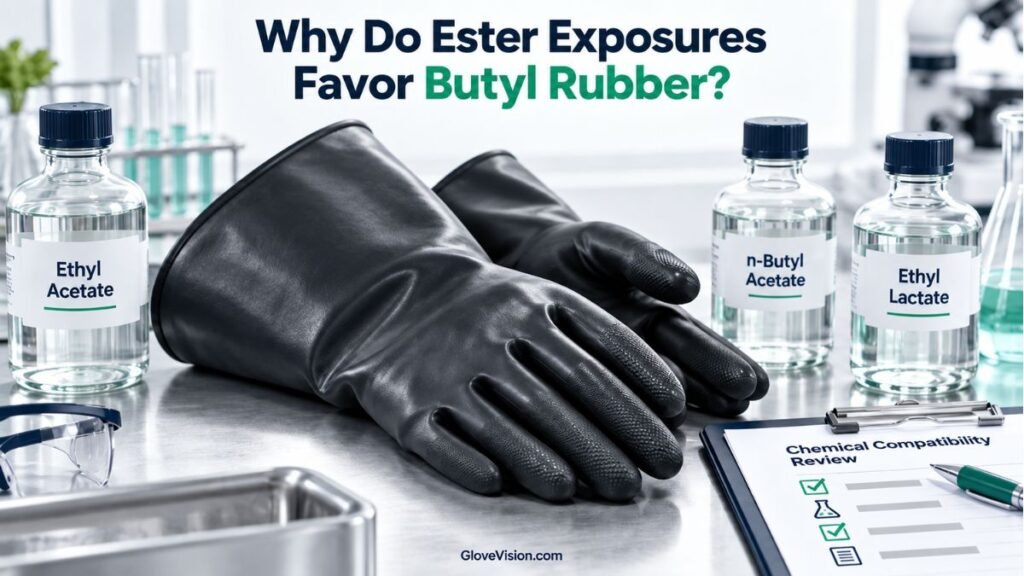
Why Do Ester Exposures Favor Butyl Rubber?
Ester exposures often make Butyl Rubber a strong candidate because Butyl is an established specialist barrier for selected polar organics and exact finished products can provide useful resistance to several solvent esters.
Ester resistance is highly variable. Ethyl acetate, n-butyl acetate, ethyl butyrate, ethyl lactate, glycol-ether acetates, and other esters can produce very different breakthrough results depending on molecular structure, concentration, temperature, glove formulation, thickness, and contact conditions. This page moves through match criteria, sorption and diffusion, candidate esters, exact verification, and the final ester boundary.
What Determines Whether an Ester Exposure Favors Butyl Rubber?
An ester favors Butyl Rubber only when the exact ester and exact finished product show adequate barrier performance under exposure conditions close enough to the real task.
Why Must the Exact Ester Be Identified First?
Use the ester functional group only as a screening category. Final assessment requires the exact chemical name, CAS number, ester subtype, concentration, purity, and complete formulation. OSHA’s PPE guidance emphasizes matching gloves to the specific hazard, task, duration, physical stress, and manufacturer performance data. [OSHA-PPE]
How Does Ester Molecular Structure Affect Butyl Rubber?
Molecular size, alkyl-chain length, branching, hydrophobic character, polarity, and molecular shape can change polymer affinity, sorption, diffusion, swelling, and volatility. These variables help explain why two esters can perform differently, but they should not be turned into a universal molecular-size rule.
How Does Polymer–Ester Affinity Affect Butyl Rubber?
Manageable affinity can limit ester uptake and leave fewer molecules available to diffuse, while stronger affinity can increase sorption, swelling, and transport. A favorable permeation result must still be considered alongside degradation and whole-glove integrity.
Why Does Exact Butyl Rubber Construction Matter?
Thickness, formulation, cure, support, lining, cuff, seams, and overall construction can change measured performance. Current product data show ethyl acetate at 55 minutes on one 0.35-mm Butyl product and 100 minutes on a different 0.50-mm Butyl product. That demonstrates product/construction dependence, not proof that thickness alone caused the difference.
For broader construction context, see Butyl Rubber gloves.
| Selection Factor | Why It Matters | Required Evidence |
|---|---|---|
| Exact ester | Family members behave differently | Chemical name + CAS |
| Molecular structure | Changes sorption and diffusion | Ester-specific evidence |
| Concentration | Alters chemical activity | Matching concentration |
| Temperature | Can accelerate transport | Relevant test temperature |
| Contact pattern | Splash differs from continuous contact | Exposure-matched data |
| Duration | Determines required barrier margin | Defined task duration |
| Thickness | Changes diffusion path | Exact product thickness |
| Formulation | Additives and co-solvents alter interaction | Complete formulation |
| Degradation | Physical change can undermine protection | Chemical-specific result |
Why Does Butyl Rubber Provide Strong Resistance to Selected Ester Exposures?
Butyl Rubber can resist selected esters well when the ester does not sorb strongly enough to overcome the polymer’s restricted molecular transport, but this balance changes with ester structure and finished compound.
What Must an Ester Molecule Do to Permeate Butyl Rubber?
The sequence is surface contact → sorption into the polymer → diffusion through the matrix → arrival at the inner surface → desorption. Lower uptake can reduce the amount of ester available for diffusion, while stronger uptake or swelling can shrink the barrier margin.
How Does Butyl Rubber’s Low-Transport Architecture Help?
The isobutylene-rich matrix and crosslinked elastomeric network can restrict molecular transport where the polymer–ester interaction remains favorable. The molecular foundation is covered in more detail under Butyl low-permeation behavior.
Why Is Ester Polarity Useful but Insufficient?
OSHA places esters within Butyl’s broad polar-organic specialty zone, alongside ketones and glycol ethers. That is a useful screening signal, but not an automatic approval for every ester. [OSHA]
Which Ester Exposures Are Strong Candidates for Butyl Rubber?
Some esters are credible Butyl Rubber candidates, but current evidence shows that breakthrough can range from relatively short intervals to more than 480 minutes depending on the ester and exact glove.
Where Does Ethyl Acetate Fit?
OSHA’s generic chemical-resistance chart rates Butyl Good for ethyl acetate, while rating amyl acetate and butyl acetate Fair. This demonstrates that ester-family membership does not produce one uniform Butyl rating. [OSHA Chart]
What Does AlphaTec 38-514 Show?
Ansell’s direct chemical report identifies AlphaTec 38-514 as a 0.35-mm Butyl product and reports 55 minutes for 100% ethyl acetate, 39 minutes for 100% n-butyl acetate, and 17 minutes EN ISO / 19 minutes ASTM for 100% ethyl butyrate. These values apply only to that exact product and its stated test conditions. [Ansell 38-514]
What Does AlphaTec 38-520 Show?
Ansell’s direct 38-520 report identifies a 0.50-mm Butyl construction and reports 100 minutes for 100% ethyl acetate, 77 minutes EN ISO / 80 minutes ASTM for 100% n-butyl acetate, 135 minutes ASTM for 100% n-propyl acetate, >480 minutes ASTM for 100% ethyl lactate, and >480 minutes ASTM for 100% ethyl glycol ethyl ether acetate. These results belong only to AlphaTec 38-520. [Ansell 38-520]
What Do These Examples Teach?
Ethyl acetate is a credible product-specific candidate, n-butyl acetate is more conditional, ethyl butyrate can be relatively short on one exact product, while ethyl lactate and a glycol-ether acetate show very long results on another exact product. These examples demonstrate variability, not a universal ester ranking.
For the broader specialist map, see Butyl resistance strengths. For the neighboring solvent family, see Butyl ketone resistance.
| Ester Exposure | Example Butyl Evidence | Screening Position | Page-Level Status |
|---|---|---|---|
| Ethyl acetate | 55 min / 100 min across two exact products | OSHA: Good | Product-specific candidate |
| n-Butyl acetate | 39 min; 77–80 min across exact products | OSHA: Fair | Conditional |
| Amyl acetate | Generic OSHA chart | OSHA: Fair | Exact product data required |
| Ethyl butyrate | 17–19 min on 38-514 | Variable/short for this product | Conditional/limited |
| Ethyl lactate | >480 min on 38-520 | Strong exact-product evidence | Strong candidate for that product |
| Ethyl glycol ethyl ether acetate | >480 min on 38-520 | Overlapping ester/glycol-ether chemistry | Strong product-specific candidate |
| Ester-containing mixture | No family-wide assumption | Another component may control | Complete-mixture evidence |
How Should Butyl Rubber Be Verified Before an Ester Exposure Is Selected?
Butyl Rubber should be selected for ester work only after the exact ester or commercial formulation and actual exposure conditions are matched to current data for the exact finished glove.
What Ester and Exposure Information Must Be Confirmed?
Record exact chemical name, CAS number, concentration, purity, complete formulation, other solvents, additives, water content, temperature, current SDS, contact mode, duration, frequency, spray or pressure, and mechanical demand.
Which Butyl Rubber Product Details Must Match?
Verify manufacturer, exact model, Butyl formulation, thickness, supported or unsupported construction, liner, cuff, seams, and reusable/disposable design. Do not substitute data from another Butyl glove.
Which Barrier Results Matter Most?
ASTM F739-20 is the active continuous-contact method and treats breakthrough time, permeation rate, and cumulative permeation as key barrier measures. [F739] ASTM F1383-20 separately addresses intermittent contact, so splash/intermittent and continuous-contact evidence answer different questions. [F1383]
Which Chemical-Glove Framework Applies?
ISO 374-1:2024 is the current published requirements and terminology framework for protective gloves against dangerous chemicals. Standard compliance does not establish universal ester compatibility; the exact ester and product evidence still control. [ISO 374-1]
Ester Verification Checklist
Ester Identity
- Exact chemical/CAS confirmed.
- Concentration confirmed.
- Complete formulation reviewed.
- Co-solvents/additives identified.
- Temperature known.
Exposure
- Contact mode defined.
- Duration known.
- Frequency defined.
- Spray/pressure considered.
- Mechanical demands identified.
Exact Product
- Butyl model identified.
- Thickness matches evidence.
- Construction matches evidence.
- Cuff/coverage are appropriate.
Barrier Evidence
- Breakthrough reviewed.
- Permeation rate reviewed where available.
- Degradation reviewed.
- Penetration considered.
- Test concentration and temperature are relevant.
- Contact method matches sufficiently.
Exact ester/product evidence is favorable.
Evidence supports the actual task.
Only narrower exposure is supported.
Another barrier deserves evaluation.
Mixture or conditions remain uncertain.
Family reputation is the main evidence.
When Do Ester Chemistry or Exposure Conditions Push Butyl Rubber Beyond Its Strongest Range?
An ester moves beyond the strongest Butyl Rubber zone when its molecular interaction or actual use conditions produce transport, degradation, or uncertainty that the exact glove evidence cannot adequately cover.
How Can Different Ester Structures Change Performance?
Different alkyl groups, branching, additional functional groups, and molecular shape can alter polymer affinity, sorption, and diffusion. Ethyl acetate, n-butyl acetate, ethyl butyrate, ethyl lactate, and glycol-ether acetate results demonstrate variability, not a simple carbon-chain or molecular-size rule.
How Do Temperature and Immersion Change the Barrier Demand?
Higher temperature can increase molecular motion and accelerate permeation or degradation. Continuous immersion sustains sorption and diffusion and should not be inferred from splash or intermittent-contact data.
Why Must Product Thickness and Construction Be Matched?
38-514 and 38-520 show different results for the same esters, but they also differ in thickness and other product characteristics. The contrast demonstrates product dependence; thickness alone should not be treated as the explanation.
Why Can Ester Mixtures Defeat a Favorable Match?
A commercial formulation can contain ketones, aromatic or aliphatic hydrocarbons, chlorinated solvents, alcohols, glycol ethers, water, resins, plasticizers, and additives. A non-ester ingredient may control the glove decision.
Which Alternative Barriers May Need Comparison?
Where exact Butyl evidence is weak, compare the exact exposure with validated PVA gloves, fluoroelastomer gloves, or another specialist system. The broader selection logic is covered under Butyl selection trade-offs.
| Boundary Factor | Why Performance Can Shift | Required Direction |
|---|---|---|
| Different ester structure | Polymer affinity and sorption may change | Exact ester evidence |
| Higher temperature | Molecular transport may accelerate | Temperature-matched data |
| Continuous immersion | Sustained permeation challenge | Continuous-contact evidence |
| Different/thinner construction | Diffusion path and formulation differ | Exact product evidence |
| Mixed-solvent product | Non-ester may control compatibility | Full formulation assessment |
| Hydrocarbon/chlorinated co-solvent | May enter a Butyl weak zone | Compare another barrier |
| Significant degradation | Barrier/mechanical state changes | Replace/reject |
| Unknown formulation | Compatibility cannot be established | Identify/escalate |
Decision rule: Exact ester → CAS number → complete formulation → concentration → temperature → contact mode → exact Butyl Rubber glove → thickness/construction → permeation + degradation + penetration evidence → use, limit, compare, escalate, or reject.
What Should Readers Remember About Why Ester Exposures Favor Butyl Rubber?
Butyl Rubber is legitimately associated with ester resistance because esters sit within its established polar-organic specialty zone and current finished products demonstrate useful performance against several individual esters.
The ester functional group does not determine protection by itself. Current exact-product results range from relatively short breakthrough for some esters to more than 480 minutes for others, so exact molecular identity, formulation, temperature, contact conditions, and glove construction must determine the final decision.
Which Questions Clarify Ester Resistance With Butyl Rubber?
Is Butyl Rubber Generally Good for Esters?
Butyl Rubber is an established ester candidate because OSHA places esters within its polar-organic specialist zone. However, ester performance varies substantially, so the family label should only trigger exact-product verification.
Is Butyl Rubber Good for Ethyl Acetate?
It can be a useful candidate. OSHA’s generic chart rates Butyl Good for ethyl acetate, while current exact products report 55 minutes and 100 minutes under their respective test conditions. Those results apply only to the tested products.
Is Butyl Rubber Good for n-Butyl Acetate?
Treat n-butyl acetate more cautiously. OSHA’s generic chart rates Butyl Fair, while current exact Butyl products show 39 minutes and roughly 77–80 minutes depending on the product and test. Exact task and glove evidence therefore matter.
Can Ethyl Acetate Data Be Used for Other Esters?
No. Ethyl acetate cannot stand in for amyl acetate, n-butyl acetate, ethyl butyrate, ethyl lactate, glycol-ether acetates, or another ester because structure, affinity, sorption, and diffusion can differ substantially.
When Should Butyl Rubber Be Rejected for Ester Work?
Reject or escalate when the exact ester or full formulation is unknown, applicable exact-product evidence is missing, temperature or continuous contact exceeds testing, degradation appears, another solvent component controls compatibility, or another verified barrier provides materially stronger evidence.