
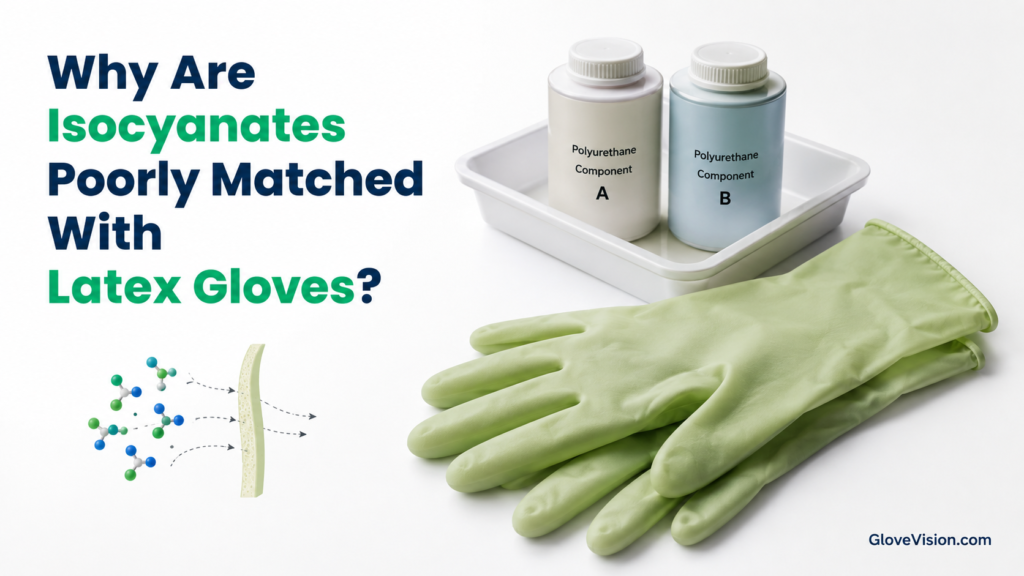
Why Are Isocyanates Poorly Matched With Latex Gloves?
Isocyanates are reactive chemicals used in many polyurethane products, and Latex Gloves cannot be assumed to resist every monomer, oligomer, prepolymer or commercial formulation. Thin disposable latex may permeate or lose performance during meaningful contact, while carrier solvents may weaken the film independently before visible damage appears.
Suitability depends on the exact isocyanate form, complete formulation, solvent content, concentration, temperature, splash, aerosol, wiping, wet contact or immersion, duration, exact glove model, thickness and manufacturer evidence—not elasticity, close fit, material reputation or appearance.
What Isocyanate Exposures Must Be Identified Before Evaluating Latex Gloves?
Latex Gloves cannot be evaluated against “isocyanates” as one uniform exposure because monomers, oligomers, prepolymers, solvents, concentrations, physical states and application methods create different glove demands.
Which Isocyanates May Appear in Workplace Products?
Products may contain methylene diphenyl diisocyanate (MDI), toluene diisocyanate (TDI), hexamethylene diisocyanate (HDI), isophorone diisocyanate (IPDI), polymeric MDI, oligomers, prepolymers or other aromatic and aliphatic forms. Identity alone does not define free-monomer concentration or the complete mixture.
How Do Monomers, Oligomers and Prepolymers Differ?
Monomers are comparatively small reactive molecules; oligomers contain limited linked units; prepolymers are partially reacted materials retaining reactive groups; polymeric mixtures may contain several species. Physical behavior and exposure potential differ, so data for one form cannot automatically transfer to another.
Which Products May Create Isocyanate Contact?
Two-component paints, automotive refinishing products, polyurethane coatings and spray foam, adhesives, sealants, elastomers, casting compounds, hardeners, activators, resin components and binders may create contact. Job title or product category does not determine glove suitability.
Which Product Details Must Be Verified?
Record exact product, manufacturer, code, current SDS, isocyanate identity and CAS number where disclosed, concentration, chemical form, carrier solvents, relevant ingredients, physical state, application, cure instructions and manufacturer glove guidance. An older SDS may not represent the current formulation. [OSHA]
Which Contact Patterns Must Be Distinguished?
Separate closed-container handling, small or repeated splash, wet-component mixing, brush or roller use, solvent-wet wiping, spray deposition, aerosol settling, wet-part handling, spill cleanup, immersion, cuff entry and trapped liquid. They cannot share one generic change schedule. The Latex Gloves guide provides broader material context.
| Information | Why it matters | Verify with | If missing |
|---|---|---|---|
| Exact product | Separates formulations | Container and records | Do not make a generic decision |
| Isocyanate identity | Distinguishes MDI, TDI, HDI, IPDI | Current SDS | Contact supplier |
| Chemical form | Separates monomer, oligomer and prepolymer | SDS and technical data | Do not transfer results |
| Concentration | Controls relevance | SDS or supplier | Use qualified assessment |
| Carrier ingredients | May control compatibility | Formulation information | Evaluate disclosed hazards |
| Physical state | Liquid, mist and aerosol differ | Task assessment | Define actual process |
| Contact pattern | Defines exposure demand | Task observation | Separate all modes |
| Glove model and thickness | Makes data relevant | Glove manufacturer | Reject material assumptions |
| Test conditions | Define claim boundaries | Resistance report | Request guidance |
Why Can Isocyanate Formulations Undermine Latex Gloves?
Isocyanate-containing products can undermine Latex Gloves through molecular permeation, physical penetration, chemical degradation or carrier solvents and additives that weaken natural-rubber film.
How Can Permeation Occur?
Product contacts the exterior, molecules partition into the material, diffuse through intact latex and reach the inner surface. Permeation is molecular passage through intact material and may begin before a standardized breakthrough threshold is reported. Appearance cannot prove zero passage. [ASTM]
How Can Degradation Change Natural-Rubber Gloves?
Swelling, softening, tackiness, stiffening, shrinkage, distortion, discoloration, lost elasticity, strength reduction, cracking or tearing can alter fit, grip, dexterity and barrier reliability. Degradation is damaging physical or chemical change—not the same as permeation.
How Does Penetration Differ?
Penetration is bulk passage through a hole, tear, pinhole, cuff opening, seam or defect. Punctures, abrasion, stretched thin regions, torn cuffs or liquid entry can produce rapid contamination even before the intact film permeates.
Why Can Carrier Solvents Control Performance?
A carrier solvent may permeate or degrade latex independently, change fit, strength or grip and make single-isocyanate data irrelevant to the mixture. The least compatible relevant ingredient may control selection. See the paint-thinner exposure guide for solvent-specific boundaries.
Why Do Fit and Elasticity Fail to Prove Protection?
Close fit supports conformity and elasticity supports recovery; neither measures diffusion. Tight fit can thin local film, and a flexible glove may already have uncertain barrier performance. Chemical evidence must be separate from the latex elasticity mechanism.
Why Does Dermal Isocyanate Exposure Matter With Latex Gloves?
Dermal exposure matters because skin contact may contribute to irritation or sensitization, and exposure can occur without immediate pain, burning, rash or obvious failure of Latex Gloves.
How Can Isocyanates Reach Skin During Glove Use?
Routes include permeation, damaged film, cuff entry, wrist aerosol, contaminated doffing, touching skin with glove exteriors, contaminated sleeves, wet tools, surfaces and reused gloves. Palm coverage alone does not control cuffs, wrists or removal.
Why Is No Irritation an Unsafe Decision Rule?
Exposure may not hurt immediately, symptoms may be delayed, evaporating solvent can produce misleading cooling and odor does not measure dose. Wearers cannot sense molecular permeation; no discomfort is not evidence of protection.
How Can Dermal Exposure Contribute to Sensitization?
Isocyanates are recognized sensitizers, and dermal exposure may contribute to immune sensitization while inhalation remains a major concern. Risk varies by substance, dose, route, frequency and person; gloves are only one part of exposure control. [NIOSH]
Which Symptoms Require Prompt Escalation?
Follow workplace procedures and obtain assessment for wheezing, chest tightness, shortness of breath, persistent cough, facial or throat swelling, widespread rash, significant eye exposure, severe skin symptoms or symptoms continuing after exposure. This page does not diagnose the cause.
Why Must Latex Allergy Remain Separate?
Latex proteins, isocyanates, glove accelerators and carrier solvents are separate potential causes of allergy, sensitization, dermatitis or irritation. A reaction during glove use does not identify its source automatically.
Which Isocyanate Tasks Challenge Latex Gloves Most?
Latex Gloves face greater uncertainty during mixing, spraying, wet application, spill cleanup, equipment cleaning and repeated handling of uncured products because these tasks increase splash, aerosol, duration, movement and contamination.
Screening only—not a Latex Gloves approval or safe-contact schedule.
Why Does Two-Component Mixing Increase Demand?
Opening, pouring, measuring, stirring, connecting equipment and handling wet tools can involve concentrated or uncured components, repeated splash, sustained wet contact and cuff contamination.
Why Is Spraying Especially Difficult?
Mist can deposit broadly across gloves, cuffs, sleeves and surfaces, while repeated trigger movement adds flexing. Respiratory and dermal controls must work together; thin disposable Latex Gloves cannot be presumed adequate.
How Do Wet Application and Part Handling Increase Contact?
Brushing, rolling, wiping, spreading adhesives and touching freshly coated parts can create continuous contact and contamination transfer even without immersion. Grip pressure may intensify the interface.
Why Do Cleanup and Spill Tasks Need Separate Decisions?
Cleanup may involve concentrated product plus cleaning solvents, retained liquid in rags, squeezing and abrasion. Spill quantities can exceed routine assumptions, so every chemical and emergency procedure must be evaluated separately.
How Do Time, Heat and Abrasion Accelerate Failure?
Long contact, repetition, warm product, tight fit, fingertip stretch, flexion, rough surfaces, solvent-wet rags, trapped liquid and contaminated layers weaken transfer from static laboratory results to real work.
| Task | Likely contact | Why latex may be poorly matched | Decision |
|---|---|---|---|
| Closed containers | Controlled limited contact | Residue may remain | Verify task suitability |
| Component mixing | Pouring, splash, wet tools | Uncured contact | Require exact evidence |
| Brush or roller | Repeated wet contact | Duration increases | Match complete formulation |
| Spray application | Aerosol deposition | Coverage may be inadequate | Use verified system |
| Wet parts | Sustained contact | Material remains on glove | Set validated change schedule |
| Equipment cleaning | Product plus solvents | Several chemicals control | Evaluate each chemical |
| Spill response | High or unpredictable | Exceeds routine assumptions | Use emergency PPE |
| Cured parts | Different from uncured | Cure or residue may be uncertain | Verify cure and hazards |
How Should Latex Gloves Be Rejected and Monitored for Isocyanate Work?
Latex Gloves should be rejected as the default unless applicable data support the exact product, glove model, thickness, temperature, contact pattern and duration; replacements must also be verified against the complete formulation.
What Must Be Verified Before Approval?
Confirm product, SDS, isocyanate identity and form, concentration, carrier solvents, physical state, application, frequency, duration, temperature, splash, aerosol and immersion, exact glove model and thickness, test data, limitations, change schedule, removal and disposal. ISO 21420 general glove requirements do not replace chemical-specific evidence. [ISO 21420]
How Should Resistance Data Be Interpreted?
Match chemical or mixture, concentration, temperature, glove model, thickness, method, reporting threshold, breakthrough, permeation rate, degradation, contact conditions and limitations. Laboratory breakthrough is neither automatic safe-wear time nor first molecular passage. [ISO 374]
When Must Latex Gloves Be Replaced?
Reject or replace when the manufacturer says unsuitable, data show unacceptable passage or degradation, formulation or solvent compatibility is unresolved, task exceeds tests, aerosol or immersion is unrepresented, change controls fail, damage exists or protection cannot be verified.
Why Is Nitrile Not an Automatic Replacement?
Nitrile formulations and thicknesses vary; thin disposable nitrile is not equivalent to thicker chemical-resistant construction. Performance differs across chemicals, solvents, mixtures, heat and duration. Product-level evidence still controls selection.
How Should Contaminated Gloves Be Removed?
Stop work, leave the source, avoid skin and clean surfaces, follow established doffing, contain or dispose, follow product-specific skin instructions, report the event and reassess before resuming. Never wipe or wash disposable gloves for reuse, smell-test them or clean skin with solvent.
Which Stop-Use Conditions Must Be Controlled?
Track elapsed time, contact, aerosol, cuffs, grip, fit, swelling, softening, tackiness, hardening, tears and unknown contamination. Stop at qualified change time, exceeded conditions, immersion, uncovered-skin contamination, degradation, damage, product change or uncertainty.
Product identity
- Exact product and SDS known
- Isocyanate form understood
- Concentration known
- Carrier solvents identified
- Physical state documented
Task conditions
- Splash, aerosol, wet contact and immersion separated
- Duration and repetition estimated
- Temperature considered
- Cuffs and sleeves controlled
- Cleanup chemicals included
Glove evidence
- Exact model and thickness known
- Data match chemical and conditions
- Breakthrough reviewed
- Permeation rate reviewed
- Degradation reviewed
- Limitations understood
- Change schedule exists
Stop-use conditions
- Approved contact exceeded
- Cuff or uncovered skin contaminated
- Material, grip or fit changes
- Puncture or tear develops
- Change time reached
- Identity or protection uncertain
Exact product → chemical form and carriers → application and contact → temperature and duration → exact Latex Gloves model → breakthrough, permeation and degradation evidence → controls and change schedule → use, restrict, replace or reject.
Conclusion
Isocyanates are not one uniform exposure, and Latex Gloves may become unreliable through permeation, penetration, degradation or carrier-solvent interaction without immediate visible warning or discomfort.
Identify the complete formulation and task, match them to exact glove-model evidence and a qualified change schedule, and reject Latex Gloves whenever chemical form, carrier ingredients, realistic contact or protective duration cannot be verified.
Frequently Asked Questions
Do Latex Gloves protect against isocyanates?
Not by default. Protection requires data for the exact formulation, glove model, thickness, temperature, duration and task. Without that evidence, Latex Gloves should be rejected as the default.
Can isocyanates pass through Latex Gloves without visible damage?
Yes. Permeation can occur through intact material without immediate visible change. Appearance, odor and skin sensation cannot confirm barrier effectiveness.
Does double gloving make Latex Gloves suitable for isocyanates?
Not automatically. Two unsupported layers do not create verified compatibility and may trap contamination, reduce dexterity, complicate removal or conceal degradation.
Are fully cured polyurethane products the same hazard as uncured components?
No. Fully cured polyurethane differs from uncured components, but cure status, residual reactive material, surface contamination and other task hazards must be verified before controls are reduced.
Which gloves should replace Latex Gloves for isocyanate work?
There is no universal replacement. Select using the exact chemical form, complete formulation, carrier solvents, concentration, temperature, contact pattern, construction, thickness, test data and manufacturer recommendations.