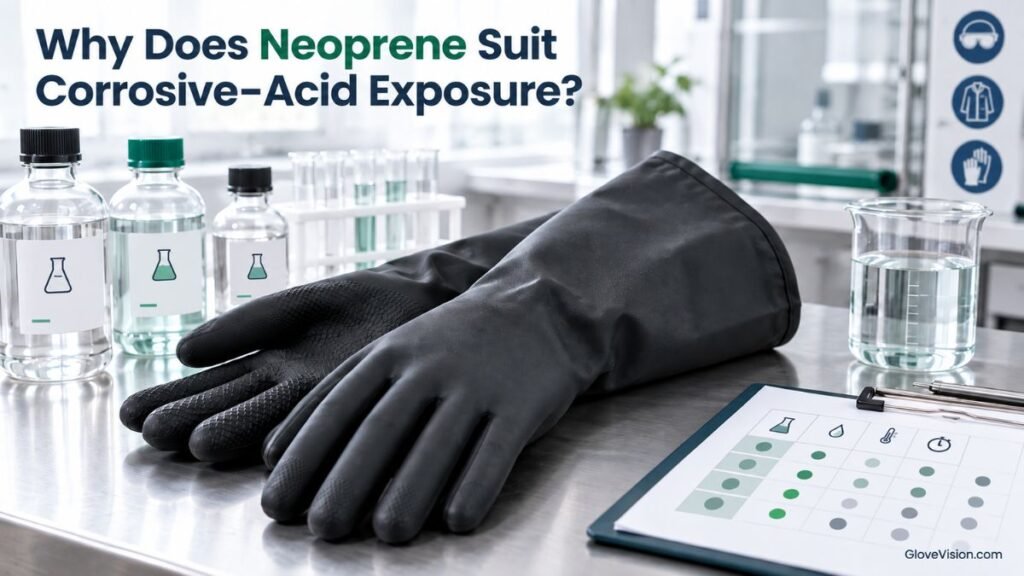
Why Does Neoprene Suit Corrosive-Acid Exposure?
Neoprene can suit selected corrosive-acid exposures because certain crosslinked polychloroprene glove constructions can slow chemical transport while retaining useful physical integrity and flexibility under compatible acid conditions.
The benefit is conditional rather than universal. Acid identity, concentration, oxidizing character, water content, temperature, contact mode, duration, glove formulation, thickness, construction, current condition, and product-specific evidence can move the same material from plausible candidate to inadequate barrier. This page follows the decision path from mechanism to chemical differences, candidate exposures, verification, and the final limit or reject decision.
What Makes Neoprene a Credible Barrier for Selected Corrosive-Acid Exposures?
Neoprene can become a credible barrier for selected corrosive-acid exposures because crosslinked polychloroprene can retain useful elastomeric integrity while slowing molecular transport when the exact acid and finished glove construction are chemically compatible. Chemical protection still has to be judged across permeation, degradation, and penetration rather than from the material name alone. [OSHA]
How Does Crosslinked Polychloroprene Help Neoprene Retain Barrier Integrity?
Crosslinks connect polymer chains into an elastomeric network that limits unrestricted chain flow while supporting deformation and recovery. Under chemically compatible conditions, that network can help the finished barrier retain continuity during normal glove movement. Crosslinking does not make Neoprene impermeable or block every acid molecule.
How Does Molecular Transport Occur Through Neoprene?
Permeation follows a molecular sequence: surface contact → sorption into the material → diffusion through the barrier → desorption at the inner surface. A glove can remain visually intact while permeation is occurring, and workplace behavior can differ from laboratory breakthrough results because temperature, pressure-point thinning, degradation, reuse, mixtures, batches, and models can change performance. [Glove]
Why Does Flexibility Matter to a Neoprene Acid Barrier?
Useful flexibility supports hand movement, stable coverage, gripping, and ordinary flexing without gross loss of barrier continuity. It is a functional advantage of a suitable construction, not proof that the material is chemically compatible with a particular acid.
Why Does the Finished Neoprene Glove Matter More Than the Polymer Name Alone?
Thin and thick, supported and unsupported, lined and unlined, blended and non-blended, fully coated and partially coated constructions can behave differently. Seams, cuffs, formulation, support fabric, and thickness all matter. Manufacturer documentation for one commercial Neoprene glove illustrates why certification and intended chemical use belong to the finished product rather than to every glove made from the polymer. Neoprene gloves provide the broader material context. [Ansell]
Why Does Broad Neoprene Chemical Performance Not Equal Universal Acid Protection?
Neoprene’s broader chemical profile can justify investigation across several acid types, but the exact acid and finished product control the final result. The dedicated page on the broad resistance behavior of Neoprene owns the wider material profile.
Neoprene Acid-Resistance Mechanism Pathway
Why Does Neoprene Perform Differently Across Corrosive Acids?
Neoprene performs differently across corrosive acids because compatibility depends on the complete chemical interaction with the finished polychloroprene barrier—not simply on whether a substance is acidic or has a low pH.
Why Is Acid Strength Alone an Incomplete Predictor of Neoprene Performance?
Acid strength, pH, corrosivity, concentration, molecular structure, oxidizing character, water content, and polymer affinity describe different aspects of the exposure. A “stronger” acid does not automatically permeate faster, and a lower pH does not automatically identify the better or worse glove material.
Why Does Concentration Change Neoprene Acid Resistance?
Changing concentration can alter water content, chemical activity, transport behavior, degradation potential, and the relevance of a published test. Results at one concentration should not be transferred automatically to another concentration of the same acid.
Why Do Oxidizing Acids Require Additional Caution With Neoprene?
Oxidizing character can add degradation pathways beyond ordinary acid corrosivity by attacking polymer compounds or formulation ingredients. Nitric acid is therefore a product-, concentration-, and temperature-specific exposure rather than a generic “acid-resistant glove” decision. Deeper oxidizer-specific ownership remains with Neoprene oxidizer exposure.
Why Do Mineral and Organic Acids Need Separate Neoprene Evidence?
Molecular structure, water content, co-solvents, additives, and formulation can change polymer affinity, diffusion, swelling, or degradation. Acetic acid and other organic-acid systems should not inherit compatibility assumptions from mineral-acid data.
Why Can Acid Mixtures Defeat Simple Compatibility Charts?
Individual-component compatibility does not guarantee mixture compatibility. A carrier or co-solvent can dominate transport or swelling, and chemical combinations can behave more aggressively toward protective materials than the individual ingredients suggest.
Neoprene Acid-Resistance Boundary Factors
| Boundary Factor | Why It Changes Neoprene Performance | Evidence Needed |
|---|---|---|
| Exact acid identity | Different molecules interact differently with the polymer compound | Exact chemical/CAS |
| Concentration | Changes water content and chemical interaction | Matching tested concentration |
| Oxidizing character | Can introduce additional degradation mechanisms | Chemical-specific data |
| Temperature | Can accelerate permeation and chemical reaction | Test vs. use temperature |
| Contact pattern | Intermittent contact differs from continuous exposure | Matching exposure-mode evidence |
| Duration | Longer contact increases barrier demand | Defined task/contact duration |
| Thickness | Alters diffusion path | Exact tested thickness |
| Glove formulation | Additives, blends, and curing systems can alter behavior | Exact model data |
| Construction | Seams, liners, supports, and partial coatings alter the finished barrier | Finished-product evidence |
| Mixture composition | Another ingredient may dominate compatibility | Complete formulation |
Which Corrosive-Acid Exposures May Suit Verified Neoprene Gloves?
Verified Neoprene gloves may suit selected hydrochloric, sulfuric, phosphoric, organic-acid, nitric-acid, or hydrofluoric-acid exposures only when testing for the exact glove and relevant conditions supports the intended contact. The acid name alone does not establish the selection.
When May Hydrochloric Acid Suit Neoprene?
Hydrochloric acid can place an exact Neoprene glove in the candidate zone when concentration, temperature, model, thickness, contact mode, and relevant permeation and degradation evidence all match the task. A result for one glove or concentration should not be generalized to all Neoprene constructions.
When May Sulfuric Acid Suit Neoprene?
Do not assume concentrated sulfuric acid is automatically a Neoprene strength. Performance can change sharply with concentration, formulation, temperature, and glove construction, so exact product data must control the decision.
When May Phosphoric Acid Suit Neoprene?
Some exact products can show strong phosphoric-acid performance, but that does not make “mineral acid” a sufficient selection category. Match concentration, model, thickness, temperature, and contact duration to the evidence.
When May Acetic or Other Organic Acids Suit Neoprene?
Organic-acid selection requires the exact acid, concentration, water content, co-solvents or additives, glove model, and temperature. Performance for one organic acid should not be transferred to another.
When May Nitric Acid Suit Neoprene?
Nitric acid is a high-caution oxidizing-acid exposure. Product-, concentration-, and temperature-specific evidence is essential, and generic “acid-resistant Neoprene” language is not enough to approve the task.
When May Hydrofluoric Acid Suit Neoprene?
Hydrofluoric acid is a specialized high-hazard case. Concentration, exact glove model, thickness, tested performance, coverage, and the workplace’s complete HF control program must determine selection; this page does not provide treatment or emergency-response instructions.
Neoprene Corrosive-Acid Candidate Matrix
| Acid Exposure | Appropriate Page-Level Position | Variables That Control the Decision | Prohibited Shortcut |
|---|---|---|---|
| Hydrochloric acid | Credible candidate when exact evidence supports it | Concentration, temperature, thickness, contact | “Neoprene resists HCl” |
| Sulfuric acid | Strongly model/concentration dependent | Concentration, formulation, thickness, heat | Transferring another glove’s result |
| Phosphoric acid | Can be a strong candidate for some tested products | Concentration, model, duration | Assuming all mineral acids behave alike |
| Acetic/organic acids | Formulation specific | Concentration, water, co-solvents | Treating all organic acids as one group |
| Nitric acid | High-caution/product-specific | Oxidation, concentration, temperature | Generic “acid-resistant” approval |
| Hydrofluoric acid | Specialized high-hazard case | Concentration, exact glove, complete control program | Selecting from material name alone |
| Proprietary acid mixture | High uncertainty | Complete formulation and interaction | Rating only the named acid |
How Should Neoprene Be Verified Before Corrosive-Acid Work?
Neoprene should be verified for corrosive-acid work by matching the exact acid and workplace contact conditions to current performance data for the exact glove model, then confirming that the complete glove’s construction, coverage, fit, function, and condition suit the task. ISO 374-1:2024 provides the current international terminology and performance framework for protective gloves against dangerous chemicals, but compliance is not universal acid approval. [ISO]
What Acid Information Must Be Identified Before Evaluating Neoprene?
Record the chemical name, CAS number where applicable, concentration, complete formulation or mixture, current SDS, physical state, temperature, additives or carriers, and relevant reaction hazards.
What Contact Conditions Must Be Defined?
Document incidental splash, repeated or intermittent contact, continuous contact, immersion, spray or pressure, expected duration, frequency, quantity, hand/wrist/forearm exposure, and mechanical demands. ASTM F739 addresses continuous-contact permeation, while ASTM F1383 addresses intermittent-contact conditions; the two exposure modes should not be treated as interchangeable. [F739] [F1383]
Which Neoprene Product Details Must Match the Evidence?
Verify manufacturer, exact model, material or blend, thickness, supported versus unsupported design, disposable versus reusable construction, lining, full versus partial coating, seams, and cuff length. A Neoprene-coated palm is not equivalent to a fully protective chemical glove.
Which Chemical-Resistance Results Matter?
Prioritize breakthrough detection or standardized breakthrough time, permeation rate, cumulative permeation where reported, degradation, penetration or leak data, challenge concentration, test temperature, test method, specimen thickness, and contact mode. Do not convert one laboratory breakthrough number into a universal safe-wear period.
How Should Fit, Coverage, and Condition Be Evaluated?
Check correct size and secure fit, task-required dexterity, realistic wet or chemical grip, adequate cuff and forearm coverage, interaction with sleeves and other PPE, holes, cracks, cuts, punctures or seam damage, swelling, softening, hardening or tackiness, and prior chemical exposure or contamination.
How Should Care, Reuse, and Storage Be Addressed?
Use the exact manufacturer’s care instructions, workplace decontamination procedure, and exposure-specific retirement criteria. Do not invent universal rinsing, detergent, drying, storage, reuse, or replacement rules when safe product-specific instructions are unavailable.
Neoprene Corrosive-Acid Verification Checklist
Acid Identity
- Exact acid or formulation is identified.
- CAS number is confirmed where useful.
- Concentration is known.
- Complete mixture information is reviewed where available.
- Temperature is defined.
Exposure
- Splash, intermittent contact, continuous contact, or immersion is defined.
- Contact duration is known.
- Spray or pressure risk is assessed.
- Required hand or forearm coverage is defined.
- Mechanical stress is considered.
Exact Product
- Manufacturer and model are confirmed.
- Material or blend matches the evidence.
- Thickness matches the tested product or specimen.
- Construction and coating coverage match.
- Cuff and coverage match the task.
Performance Evidence
- Permeation data are reviewed.
- Breakthrough results are interpreted correctly.
- Degradation results are reviewed.
- Penetration or leak information is considered where relevant.
- Test concentration and temperature are checked.
- Test method and contact mode are checked.
Whole-Task Decision
When Should Neoprene Be Limited, Compared, Escalated, or Rejected for Corrosive Acids?
Neoprene should be limited, compared, escalated, or rejected when acid conditions exceed the evidence available for the exact glove, because generic material reputation cannot compensate for missing or mismatched product-level performance data. The broader Neoprene chemical-resistance boundaries page owns the full cross-chemical boundary model.
When Does Higher Concentration Invalidate Existing Neoprene Evidence?
Data for concentration A cannot automatically approve concentration B. A concentration change can alter water content, chemical activity, transport, and degradation without following one simple universal direction.
Why Does Heat Move the Neoprene Resistance Boundary?
Higher temperature can accelerate molecular transport and chemical interaction, reducing the margin between laboratory evidence and workplace use. Temperature is therefore a required match point rather than a minor detail.
Why Must Splash and Immersion Remain Separate?
Splash or intermittent evidence does not establish continuous-contact or immersion performance. Sustained contact is a different barrier challenge and requires appropriately relevant test evidence.
When Does Thickness Become a Critical Limitation?
Thickness changes the diffusion path, so a thin glove can behave very differently from a thick reusable construction. Historical NIOSH recommendations explicitly excluded their generic guidance for very thin Neoprene and several other glove materials at 0.3 mm or less; that historical statement is a screening warning, not a modern universal safety threshold. [NIOSH]
Why Do Oxidizing, Heated, or Mixed Acids Require Stronger Evidence?
These conditions can add degradation pathways, faster molecular transport, and mixture interactions that pure-chemical data may not represent. Conservative selection requires exact-product evidence close to the real exposure.
How Should Conflicting Neoprene Acid Charts Be Resolved?
Compare exact chemical or CAS → complete formulation → concentration → manufacturer and model → thickness and construction → test method → test temperature → contact mode → permeation, degradation, and penetration result → current product status. Never average ratings or choose the most favorable chart.
When Should Another Barrier Be Compared?
Compare another verified material when Neoprene evidence is weak, product-specific data are absent, tested conditions do not match use, permeation or degradation is unacceptable, or the finished glove cannot provide needed coverage or function. Deeper ownership belongs to Neoprene specialization trade-offs and broad chemical coverage versus maximum specialization.
When Should Neoprene Be Rejected or Escalated?
Reject or escalate when acid identity is unknown; consequential concentration is unknown; complete mixture information is inadequate; exact-product data are missing for a high-hazard exposure; temperature falls outside relevant evidence; immersion is planned but only splash or intermittent data exist; exact model or construction differs from tested data; glove integrity is compromised; significant degradation occurs; previous exposure is unknown; required protection extends beyond the glove; or emergency-response conditions apply.
Neoprene High-Uncertainty Acid Decision Matrix
| Condition | Why Confidence Falls | Required Decision |
|---|---|---|
| Unknown acid | No defensible compatibility basis | Reject until identified |
| Unknown concentration | Evidence cannot be matched | Identify or escalate |
| Heated acid | Permeation or degradation may accelerate | Require temperature-relevant evidence |
| Strong oxidizing acid | Additional degradation mechanisms may apply | Require exact-product evidence |
| Continuous immersion | Greater sustained barrier challenge | Require continuous-contact evidence |
| Acid mixture | Individual-component data may mislead | Evaluate complete formulation |
| Thin construction | Different diffusion path from thick reusable gloves | Require exact thickness/model data |
| Damaged or previously exposed glove | Barrier state is uncertain | Replace or formally reassess |
| Conflicting charts | Exposure or test conditions may differ | Resolve evidence mismatch before use |
| Missing product-level evidence | Generic polymer reputation is insufficient | Compare, escalate, or reject |
What Should Readers Remember About Neoprene and Corrosive-Acid Resistance?
Neoprene can legitimately enter the shortlist for selected corrosive-acid handling because certain polychloroprene glove constructions combine barrier continuity, flexibility, and useful product-specific permeation resistance. That suitability belongs to defined acid and product conditions, not to Neoprene as a universal material claim.
Neoprene’s acid-resistance boundary is created by the exact acid, formulation, concentration, oxidation potential, temperature, contact pattern, and tested performance of the exact glove. The material name starts the investigation; finished-product evidence determines the decision.
Which Questions Clarify Corrosive-Acid Protection With Neoprene?
Do Neoprene Gloves Resist Hydrochloric Acid?
Yes, some Neoprene products provide useful resistance to defined hydrochloric-acid exposures, but compatibility depends on concentration, temperature, thickness, contact mode, duration, construction, and exact product test data. A result for one glove or concentration must not be generalized to all Neoprene gloves.
Do Neoprene Gloves Resist Sulfuric Acid?
Some Neoprene constructions may suit defined sulfuric-acid exposures, but performance varies sharply by glove and concentration. Do not treat concentrated sulfuric acid as an automatic Neoprene strength; exact permeation, degradation, temperature, thickness, and contact data must control the selection.
Are Neoprene Gloves Suitable for Nitric Acid?
Some exact Neoprene products have nitric-acid permeation data, but nitric acid’s oxidizing character makes product-, concentration-, and temperature-specific evidence essential. A generic “acid-resistant Neoprene” label is not sufficient to approve nitric-acid handling.
Are Neoprene Gloves Suitable for Hydrofluoric Acid?
Neoprene may have product-specific compatibility evidence for defined hydrofluoric-acid conditions, but HF is a specialized high-hazard exposure. Exact concentration, glove model, thickness, tested performance, coverage, and the workplace’s complete HF control program must determine selection.
When Should Neoprene Be Rejected for Corrosive-Acid Work?
Reject or escalate Neoprene when the acid or concentration is unknown, relevant exact-product evidence is missing, temperature or contact exceeds tested conditions, significant degradation or glove damage occurs, or the overall hazard requires protection beyond the verified capability of the glove.