
When Is Broad Chemical Coverage More Useful Than Maximum Specialization?
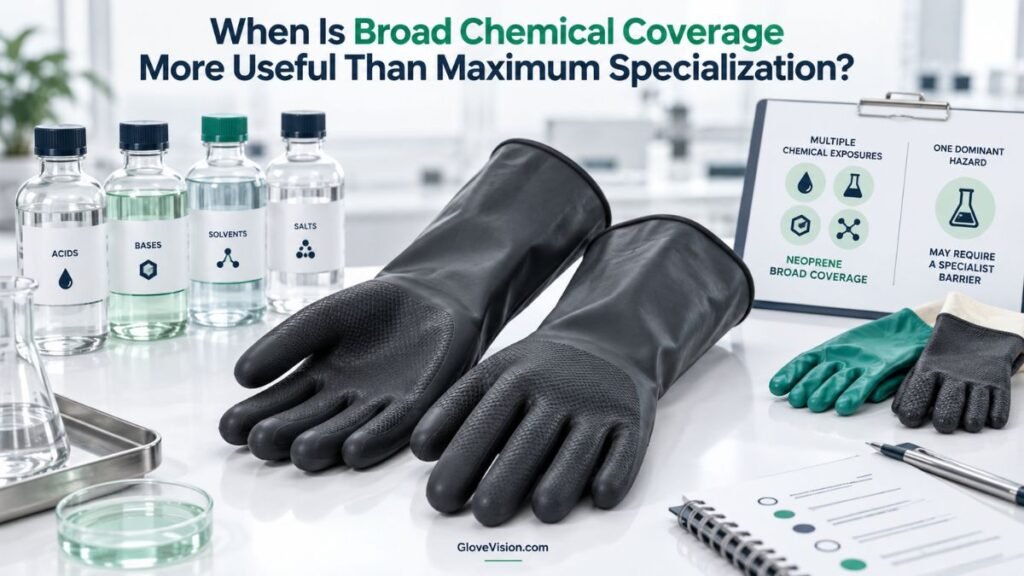
Broad chemical coverage can be more useful when an exact Neoprene glove provides adequate verified protection across every chemical encountered in a workflow and its construction also supports the required grip, dexterity, mechanical durability, coverage, and task switching.
Breadth loses its advantage when the weakest or dominant exposure exceeds Neoprene’s defensible protection margin. High toxicity, severe degradation, prolonged immersion, poor breakthrough performance, uncertain mixtures, or stronger specialist evidence can make a narrower barrier the better choice. This page moves through breadth versus depth, operational value, workplace patterns, exact-product verification, and specialist escalation.
What Makes Broad Chemical Coverage With Neoprene Different From Maximum Specialization?
Broad Neoprene coverage means that the exact glove has adequate evidence across several chemicals actually present in the task; maximum specialization means choosing a different barrier because one dominant exposure requires materially stronger chemical-specific performance.
What Does Broad Chemical Coverage Mean for Neoprene?
Legitimate breadth is built exposure by exposure: Chemical A supported + Chemical B supported + Chemical C supported + matching concentration, temperature, and contact conditions. A general reputation for versatility is not enough. OSHA likewise emphasizes selecting gloves for the specific anticipated hazard rather than assuming one material protects against every chemical. [OSHA-PPE]
Move from material screening to finished-product selection through Neoprene gloves and the broad resistance behavior of Neoprene.
What Does Maximum Specialization Mean Compared With Neoprene?
Specialization becomes relevant when one dominant chemical or exposure condition controls the decision and an exact butyl, PVA, fluoroelastomer, multilayer, or other product shows a materially stronger protection case. Generic material tables can identify candidate niches, but every family also has counter-limitations. [OSHA-Chart]
How Does Protection Breadth Differ From Protection Depth?
Breadth asks how many actual workplace exposures are adequately supported. Depth asks how strong the barrier is against one defined exposure, considering permeation, degradation, penetration, concentration, temperature, contact mode, and duration. High breadth and strong depth can coexist; neither term guarantees the other.
Why Does the Weakest Exposure Matter More Than the Average?
A broad-coverage strategy is only as defensible as its weakest required exposure. Strong performance against chemicals A, B, and C cannot compensate for inadequate evidence against required chemical D.
Why Is “One Glove for Everything” Different From Verified Neoprene Breadth?
Verified breadth means every relevant chemical and condition has adequate exact-product evidence. Convenience breadth extends one glove into unsupported conditions because changeovers are inconvenient. Only the first is defensible.
Neoprene Breadth-vs-Depth Factors Table
| Decision Dimension | Broad Neoprene Strategy | Maximum Specialization | Governing Question |
|---|---|---|---|
| Chemical set | Several verified exposures | One or few dominant exposures | How diverse is the actual workflow? |
| Protection depth | Adequate for every required exposure | Potentially much stronger for target chemical | Does one hazard require additional margin? |
| Weakest exposure | Must still remain adequate | Specialist may solve the weak point | Which exposure limits the strategy? |
| Task switching | Can add value | May require glove changes | Do stages change frequently? |
| Physical/task factors | Balanced construction may help | Exact specialist product varies | What does the task require after chemical adequacy? |
| Final priority | Complete workflow adequately covered | Dominant chemical controls | Which hazard determines failure? |
Why Can Broad Neoprene Coverage Create Practical Value Across Varied Tasks?
Broad Neoprene coverage creates practical value only after every required chemical exposure passes the chemical-protection gate; once that condition is met, one suitable glove can reduce unnecessary switching and provide more consistent task performance across compatible operations.
How Can Neoprene Reduce Material Switching Between Compatible Tasks?
Several verified chemicals handled by one exact glove can simplify procedures, reduce inventory complexity, and improve worker familiarity. Those operational gains are legitimate only when every exposure is supported; fewer glove changes are not a safety benefit by themselves.
Why Can Neoprene’s Finished Construction Matter Across Several Tasks?
Flexibility, grip, abrasion resistance, repeated movement, liner, cuff, and coverage can affect whole-task performance after chemical adequacy is established. AlphaTec 09-430 is one product-level example: Ansell describes a supported 2.02-mm Neoprene glove with cotton jersey lining, long gauntlet coverage, chemical resistance, mechanical protection, and ergonomic shaping. [Ansell-09-430]
How Can Neoprene Support Combined Chemical and Mechanical Work?
The stronger argument is not “Neoprene is mechanically better,” but rather: adequate chemical barrier + required grip + suitable abrasion/puncture/tear performance + movement + coverage = a better whole-task fit. OSHA explicitly includes chemical type, contact frequency and duration, immersion versus splash, concentration, temperature, abrasion/puncture/tear needs, dexterity, grip, thermal protection, size, and comfort among glove-selection factors. [OSHA-Dermal]
Why Can Workflow Changes Increase the Value of Neoprene Breadth?
A staged process may move from one compatible chemical to another, then to a rinse or mechanical handling step. Breadth can be useful when the exact glove has separate evidence for each stage; compatibility cannot be inferred simply because the stages occur in the same workflow.
When Does Simplification Become a Risk Instead of a Benefit?
Stop the broad strategy when one chemical lacks evidence, one condition exceeds testing, degradation becomes unacceptable, contaminated gloves could transfer chemicals into later stages, or convenience becomes the main reason for accepting weaker protection.
Which Workplace Patterns Favor Broad Neoprene Coverage Over Maximum Specialization?
Broad Neoprene coverage is most useful where several known exposures are individually supported by the exact glove, none requires a greater protection margin, and one balanced construction improves the complete workflow.
When Do Multiple Moderate Exposures Favor Neoprene?
Several identified chemicals with known concentrations, manageable contact durations, adequate exact-product results, and no single controlling hazard can create a legitimate breadth advantage. The decision still rests on the weakest supported exposure, not on how many other chemicals perform well.
When Does Frequent Task Switching Favor Neoprene?
Maintenance, staged processing, laboratory handling, cleaning sequences, and equipment servicing may benefit from one verified construction when chemical-by-chemical validation supports every stage.
When Can Wet or Aqueous Work Favor Neoprene Over a Specialist?
PVA is a useful counter-example. Ansell’s AlphaTec 15-554 is designed for aromatic and chlorinated solvent resistance, but Ansell explicitly warns that PVA is water soluble and that water or high humidity greatly decreases chemical protection. A specialist niche can therefore lose practical value when the environment violates a critical material boundary. [Ansell-PVA]
For the deeper wet/dry trade-off, see PVA selection trade-offs.
When Can Grip, Dexterity, and Mechanical Demands Increase Neoprene’s Value?
Valves, hoses, tools, containers, rough components, and repeated gripping can make complete-glove ergonomics and mechanical properties important, but those factors only enter the comparison after the chemical barrier is adequate.
When Do Combined Chemical and Mechanical Hazards Favor a Balanced Neoprene Construction?
Assess chemical barrier, abrasion, puncture or tear exposure, repeated flexing, cuff coverage, grip, and compatibility with other PPE. These are finished-product properties, not automatic consequences of the polymer name.
When Does Routine Work Favor Breadth More Than Exceptional Exposure?
Known, repeatable, verified workflows can reward breadth. Rare, severe, poorly characterized, or high-consequence exposures shift the decision toward hazard-specific or specialist selection.
Neoprene Broad-Coverage Use-Case Matrix
| Workplace Pattern | Why Breadth May Help | Required Condition | Likely Direction |
|---|---|---|---|
| Several compatible chemicals | One verified glove covers several stages | Adequate evidence for every chemical | Broad Neoprene may win |
| Frequent task switching | Fewer unnecessary barrier changes | No stage exceeds Neoprene limits | Breadth may add value |
| Wet multi-chemical process | Avoids some specialist environmental limits | Wet + chemical performance verified | Compare complete systems |
| Chemical + mechanical handling | Whole-task properties matter | Chemical and mechanical performance adequate | Balanced glove may win |
| Routine repeatable workflow | Stable exposure profile | Conditions remain within evidence | Breadth can be efficient |
| Rare severe/high-consequence exposure | Chemical margin dominates | High-hazard evidence required | Specialist more likely |
| Unknown or variable formulation | Breadth cannot be established | Chemical identity/formulation unresolved | Escalate |
How Should Broad Chemical Coverage With Neoprene Be Verified Across a Full Workflow?
Broad Neoprene coverage should be chosen only after the full workflow is mapped and the exact glove is shown to provide adequate evidence for every chemical and exposure condition it will encounter.
What Chemical Inventory Must Be Built?
Record the chemical or product name, CAS number where applicable, concentration, complete mixture, additives, solvents or carriers, temperature, physical state, and current SDS.
What Exposure Conditions Must Be Defined for Every Stage?
Identify incidental splash, repeated or intermittent contact, continuous contact, immersion, duration, frequency, pressure or spray, quantity, hand or forearm coverage, and mechanical demands.
Which Exact Neoprene Product Details Must Match the Evidence?
Verify manufacturer, exact model, material or blend, thickness, lining, supported or unsupported construction, cuff, seams, coating coverage, and disposable or reusable design.
How Should Neoprene Coverage Be Tested Across the Entire Chemical Set?
Check each required chemical separately and then identify the exposure with the smallest or least-certain protection margin. Mapa’s UltraNeo 382 illustrates why this matters: its listed 37-mil polychloroprene data show >480 minutes for 2-propanol 99% and 295 minutes for 2-butoxyethanol 99%, but only 7 minutes for acetone 99%. Those results belong to that exact product and listed test conditions; they must not be generalized to other Neoprene gloves. [Mapa]
When the weakest point appears, use Neoprene chemical-resistance boundaries to investigate it rather than averaging performance across the chemical set.
How Should the Dominant Hazard Be Identified?
Consider toxicity, dermal absorption, corrosivity, concentration, contact duration, temperature, permeation, degradation, immersion or spray conditions, and the consequence of failure. The dominant hazard is not automatically the chemical with the shortest numeric breakthrough time.
Which Operational Factors Should Be Evaluated After the Chemical Gate?
Only after Neoprene is chemically adequate across the workflow should you compare dexterity, wet/dry/oily grip, abrasion and puncture resistance, flexibility, cuff and coverage, interaction with other PPE, task switching, fit, validated reuse, and replacement logistics.
How Should Conflicting Compatibility Charts Be Resolved?
Use this order: exact product → exact chemical → exact concentration → exact contact conditions → comparable test method → current manufacturer data → conservative interpretation. When charts conflict, use the exact finished-product result that best matches the real chemical and exposure conditions rather than averaging generic scores.
Neoprene Coverage-or-Specialization Selection Checklist
Chemical Map
- Every required chemical or formulation is identified.
- Concentrations are known.
- Mixtures and additives are reviewed.
- Temperatures are defined.
- Current SDS information is available.
Exposure Map
- Splash, intermittent, continuous, or immersion contact is defined.
- Duration and frequency are known.
- Pressure or spray is considered.
- Mechanical demands are recorded.
- Wet or dry environment is defined.
Exact Neoprene Evidence
- Exact model is identified.
- Every required exposure has relevant evidence.
- Permeation is adequate.
- Degradation is acceptable.
- Penetration and construction risks are controlled.
- Weakest-supported exposure is identified.
Specialist Comparison
- Dominant hazard is identified.
- Relevant specialist exact product is identified.
- Specialist advantage is demonstrated rather than assumed.
- Specialist counter-limitations are reviewed.
- Whole-task fit remains acceptable.
Decision
When Should Maximum Specialization Override Broad Neoprene Coverage?
Maximum specialization should override broad Neoprene coverage when one required exposure cannot be adequately protected by the exact Neoprene glove and another exact barrier provides materially stronger evidence for that controlling hazard.
When Does Weak Neoprene Permeation Performance Override Breadth?
Several supported exposures do not rescue a workflow if one required chemical has an inadequate permeation margin. There is no universal acceptable breakthrough threshold; the required protection margin depends on the exact hazard and task.
When Does Severe Neoprene Degradation Override Operational Convenience?
Reject breadth when the exact product shows unacceptable swelling, softening, hardening, cracking, delamination, loss of strength, or loss of grip or fit.
When Does High Chemical Consequence Favor Maximum Specialization?
When very small skin exposure could have serious consequences, protection depth becomes more important and a larger verified barrier margin can outweigh flexibility, familiarity, or workflow simplicity.
When Does Sustained Contact or Immersion Shift the Decision?
Short intermittent contact and continuous immersion are different barrier demands. If the actual contact pattern exceeds the Neoprene evidence, a specialist or task-specific system should take priority.
When Do Aggressive Solvent Exposures Favor a Specialist?
Selected ketones and esters can justify a butyl comparison; SHOWA 874, for example, is an exact butyl product positioned for corrosive acids, ketones, and esters. [SHOWA-874] Compare its exact evidence rather than assuming every butyl glove behaves the same. See butyl selection trade-offs.
For selected aromatic or chlorinated solvent work, PVA or fluoroelastomer products may deserve comparison where exact data support them. Use fluoroelastomer adoption limits for the relevant counter-boundaries.
When Do Mixtures or Unknowns Defeat Broad Neoprene Coverage?
Mixture behavior may not match pure-component tests, and one permeating component can change how another behaves. OSHA’s chemical-protective-clothing guidance recommends conservative treatment of mixtures and unknowns when matched data are unavailable. [OSHA-Mix]
What Specialist Trade-Offs Must Still Be Checked?
Even when specialist chemistry is stronger, verify water or humidity limits, other weak chemical families, construction, grip, dexterity, puncture and abrasion needs, coverage, fit, and compatibility with other PPE. Operational preferences cannot reverse a necessary chemical-safety decision.
Neoprene Specialist-Escalation Matrix
| Trigger | Why Breadth Loses Value | Required Direction |
|---|---|---|
| Inadequate Neoprene permeation performance | Weakest required exposure fails | Compare stronger barrier |
| Severe degradation | Material integrity or function compromised | Reject exact Neoprene product |
| High-consequence chemical | Small exposure may matter greatly | Prioritize larger verified margin |
| Long continuous contact or immersion | Protection depth becomes dominant | Compare specialist evidence |
| Aggressive solvent with weak Neoprene data | Chemical niche exceeds breadth | Evaluate specialist product |
| Unknown mixture | Coverage cannot be verified | Identify or escalate |
| Specialist has stronger chemistry but major environmental limit | New failure mode may appear | Compare complete systems |
| Emergency or highly uncertain exposure | Routine broad-coverage logic is insufficient | Full hazard-specific PPE assessment |
Neoprene Broad-vs-Specialist Trade-Off Table
| Decision Factor | Broad Neoprene Strategy | Specialist Strategy | Priority |
|---|---|---|---|
| Every chemical adequately covered | Strong candidate | May add unnecessary specialization | Breadth can win |
| One dominant high-risk chemical | Secondary consideration | Strong candidate | Specialization can win |
| Frequent compatible task switching | Operational advantage | May require stage-specific changes | Consider after chemical gate |
| Grip, dexterity, mechanical demand | Exact Neoprene construction may balance needs | Exact specialist construction varies | Compare products |
| Long immersion | Product-specific | Specialist may offer greater margin | Protection depth first |
| Wet environment | Product-specific | PVA and some systems may have sharp limits | Environmental fit matters |
| Unknown formulation | Cannot prove breadth | Cannot prove specialization automatically | Escalate |
| Specialist advantage creates new critical weakness | Neoprene may remain preferable if adequately protective | Reassess specialist | Complete system decides |
For the deeper material-versus-specialist decision, see Neoprene specialization trade-offs.
What Should Readers Remember About Broad Chemical Coverage With Neoprene?
Broad Neoprene coverage is useful when the exact glove adequately protects every required chemical while also meeting grip, dexterity, mechanical, wet-use, and coverage needs.
Breadth stops helping when the weakest or dominant exposure needs more protection. Let the controlling hazard—not convenience—decide whether Neoprene breadth or specialization wins.
Which Questions Clarify When Broad Neoprene Coverage Beats Maximum Specialization?
Is Broad Neoprene Coverage Better Than Maximum Resistance?
Only when the exact Neoprene glove already provides adequate protection for every relevant chemical and exposure condition. If one controlling hazard exceeds its limits, broader compatibility with the remaining chemicals cannot compensate for that weakness.
Can One Neoprene Glove Cover Several Chemicals?
Potentially, but each chemical or formulation, concentration, temperature, contact pattern, and duration must be supported by relevant data for that exact glove. Multi-chemical suitability must be demonstrated exposure by exposure rather than inferred from the material name.
When Is a Specialist Better Than Broad Neoprene Coverage?
A specialist is preferable when a dominant chemical requires materially stronger permeation, degradation, or exposure performance than the exact Neoprene glove provides and the specialist’s own environmental, chemical, and task limitations remain acceptable.
Do Fewer Glove Types Make Broad Neoprene Safer?
Not inherently. A simpler glove program can reduce workflow complexity, but simplification is valuable only after adequate chemical protection has been verified for every task being consolidated. Convenience cannot compensate for an unsupported or inadequate exposure.
When Should Broad Neoprene Coverage Be Rejected?
Reject the strategy when any required exposure lacks adequate exact-product evidence, the weakest exposure exceeds Neoprene performance, mixture composition is uncertain, significant degradation occurs, actual contact exceeds tested conditions, or one high-consequence hazard requires stronger specialist protection.