
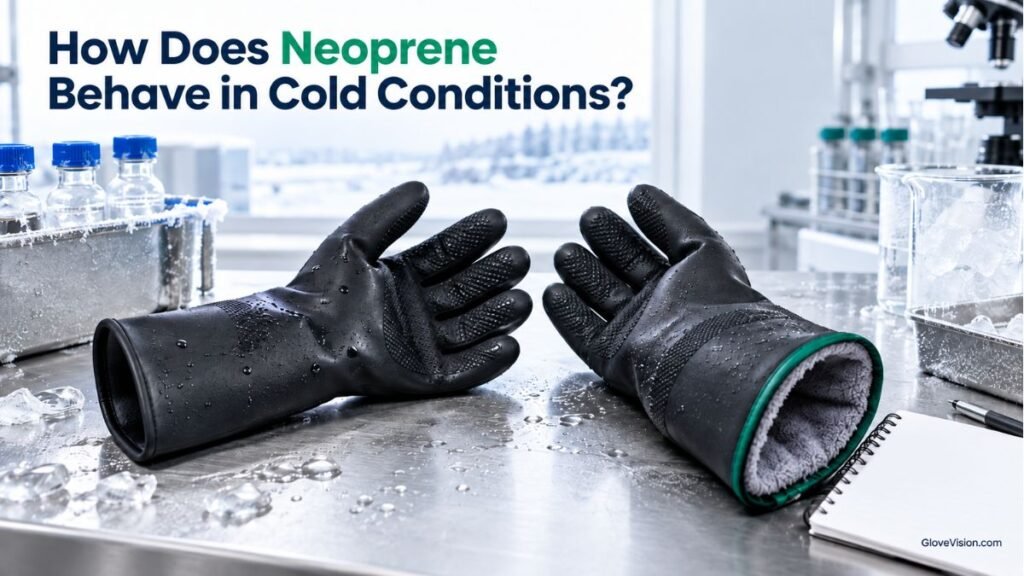
How Does Neoprene Behave in Cold Conditions?
Neoprene can retain useful flexibility in many cold conditions, but falling temperature reduces polymer mobility and can increase stiffness, while prolonged cold may also promote formulation-dependent crystallization.
Polymer cold flexibility is only one part of glove performance. Actual suitability also depends on temperature, exposure duration, ambient versus contact cold, wind, moisture, Neoprene grade and formulation, thickness, liner, glove construction, dexterity, repeated flexing, chemical exposure, and finished-product cold evidence. This page moves through cold behavior, low-temperature mechanisms, usable conditions, limit conditions, and exact-product verification.
What Changes in Neoprene as Cold Conditions Lower Its Temperature?
As Neoprene becomes colder, molecular mobility generally decreases, which can progressively increase stiffness and reduce elastic response even while suitable formulations and finished products remain usable below freezing.
How Does Falling Temperature Change Neoprene Molecular Mobility?
Lower temperature reduces segmental motion, so the material can require more force to bend, stretch, or recover. The amount of change depends on formulation, compounding, thickness, and time rather than one universal temperature threshold.
How Can Cold Change Neoprene Elasticity and Recovery?
Extension, bending, compression, and recovery can become slower or firmer as temperature falls. Repeated flexing can also feel different as the glove stiffens, but not every Neoprene compound loses useful elasticity at the same temperature.
How Can Cold Affect Neoprene Grip and Dexterity?
Grip and dexterity reflect more than polymer chemistry. Glove thickness, liner bulk, finger geometry, surface texture, wetness or ice, and the worker’s own hand cooling can all reduce practical control.
Why Can Neoprene Remain Useful Below Freezing?
Polychloroprene can be formulated for low-temperature service. Denka currently lists grades with medium, slow, very slow, and extremely slow crystallization rates, including grades specifically positioned for low- and extremely-low-temperature resistance. [Denka] Finished Neoprene gloves still require their own construction and cold-performance evidence.
Why Is Neoprene Cold Flexibility Different From Cold Insulation?
Cold flexibility asks whether the material and glove remain mechanically usable. Cold insulation asks how the complete glove system limits heat loss from the hand. Liner, trapped air, overall construction, moisture, fit, contact material, and exposure duration can dominate thermal protection. The broad resistance behavior of Neoprene should therefore be kept separate from cold-insulation claims.
Neoprene Cold-Behavior Factors
| Cold Variable | Possible Neoprene Response | Possible Task Effect | Verification Required |
|---|---|---|---|
| Falling temperature | Reduced molecular mobility | Increasing stiffness | Product/material data |
| Prolonged cold | Possible crystallization in susceptible formulation | Progressive hardening | Grade + duration context |
| Thickness | More material and bending resistance | Dexterity/thermal trade-off | Exact construction |
| Thermal liner | Changes heat transfer from hand | Improved wearer insulation | Exact product rating |
| Moisture | Changes heat loss and surface grip | Faster hand cooling/slip risk | Wet-condition assessment |
| Wind | Increases wearer heat loss | Greater cold stress | Workplace exposure assessment |
| Repeated flexing | Adds mechanical stress to colder material | Fatigue/cracking concern | Inspection/task evaluation |
| Cold-surface contact | Conductive heat transfer | Local hand cold risk | Contact-cold evidence |
Why Can Neoprene Remain Flexible Yet Stiffen During Prolonged Cold Exposure?
Neoprene can remain rubber-like at temperatures where prolonged exposure still promotes crystallization, because cold crystallization and glass-transition behavior are distinct mechanisms with different dependencies on temperature, time, and formulation.
What Is Cold Crystallization in Neoprene?
Some polychloroprene chains can form more ordered regions, increasing stiffness as crystallinity develops over time. Polymer research documents crystallization behavior in polychloroprene, while current grade data show that crystallization rate can vary substantially among formulations. [Crystallization]
Why Can Neoprene Stiffen Without Reaching Its Glass-Transition Region?
In a crystallization-susceptible compound, prolonged cold can increase molecular ordering and stiffness while the material remains above its glass-transition region. This is why duration can matter as well as temperature.
How Is Neoprene Glass Transition Different From Cold Crystallization?
Cold crystallization is time- and grade-dependent and creates more ordered regions. Glass transition reflects a much stronger loss of segmental mobility as temperature falls. Published measurements on particular cross-linked chloroprene-rubber formulations place glass-transition values in roughly the −50 to −40°C range; those results are formulation- and test-specific, not a universal Neoprene glove cutoff. [Tg Study]
Why Does Neoprene Formulation Change Cold Behavior?
Polymer grade, structural regularity, curing system, plasticizers, fillers, copolymer modification, and finished compounding can all shift low-temperature behavior. The same material family can therefore contain grades intended for very different crystallization rates and cold-service needs.
Why Should One Neoprene Temperature Number Be Treated Carefully?
A temperature number may refer to raw-material flexibility, a glass-transition measurement, brittleness, finished-glove contact cold, convective cold, a manufacturer use claim, thermal insulation, or chemical-barrier performance. Those endpoints are not interchangeable.
Neoprene Low-Temperature Mechanism Pathway
Which Cold Conditions Can Remain Within the Practical Performance Range of Neoprene?
Neoprene can remain practical in many cool and sub-zero environments when the exact finished glove remains flexible enough for the task and provides the insulation, grip, coverage, and cold-performance evidence required by the exposure.
When Can Neoprene Remain Useful in Cool or Moderately Cold Air?
A finished glove can remain a candidate when flexibility, insulation, exposure duration, grip, and dexterity are all adequate. Ambient-air cold must still be distinguished from touching a cold solid or liquid surface.
When Can Neoprene Work Below Freezing?
Assess air temperature, wind, wetness, exposure duration, work intensity, liner, grip, required dexterity, and contact with cold surfaces. NIOSH notes that strong air movement adds heat loss, wet gloves and clothing should be avoided, and insulated waterproof gloves are among the PPE options for cold environments. [NIOSH-Cold]
When Can an Insulated Neoprene Glove Support Colder Work?
Exact product evidence matters. Ansell AlphaTec 09-022 uses a quilted cotton insulated gauntlet, carries EN 511:2006 rating 111, and is described for intermittent cold handling down to −25°C. That −25°C claim belongs to this exact finished construction, not bare Neoprene. [09-022] A second model, AlphaTec 19-026, uses a double-insulating liner and carries EN 511:2006 rating 121. [19-026]
When Can Neoprene Suit Cold Liquid or Chemical Handling?
Verify chemical compatibility, liquid or contact temperature, insulation, contact duration, cuff and forearm coverage, grip, and liner wetness independently. A chemically resistant Neoprene coating does not establish cold insulation. Where hazards overlap, use the dedicated Neoprene chemical-resistance boundaries.
When Can Neoprene Remain Practical During Repeated Flexing?
Assess formulation, thickness, liner, glove geometry, repetition, exposure duration, observed stiffening, and mechanical fatigue. Finished-product function—not the polymer name alone—controls the practical answer.
Neoprene Cold-Use Suitability Matrix
| Cold Scenario | Possible Neoprene Role | Main Variables | Selection Boundary |
|---|---|---|---|
| Cool ambient work | Often plausible | Duration, dexterity, grip | Exact glove suitability |
| Sub-zero ambient air | Potentially suitable | Temperature, wind, moisture, liner | Finished-product evidence |
| Insulated cold handling | Strong candidate where certified/tested | Exact glove + liner + rating | Product-specific claim |
| Cold liquid handling | Conditional | Chemical + thermal exposure | Both hazards verified |
| Direct cold-surface contact | Product specific | Surface temperature + contact time | Contact-cold performance |
| Wet/freezing environment | Conditional | Wetness, grip, insulation | Whole-system assessment |
| Prolonged extreme cold | High uncertainty | Formulation, crystallization, insulation, duration | Specialist product evidence |
How Do Exposure Conditions Push Neoprene Beyond Reliable Cold Performance?
Neoprene moves beyond reliable cold performance when actual temperature, time, wetness, mechanical demand, or contact-cold conditions exceed the evidence and functional limits of the exact finished glove.
How Does Prolonged Cold Exposure Increase Neoprene Stiffness?
Cold, time, and a crystallization-prone formulation can promote more ordered regions and progressive stiffening. Different grades crystallize at different rates, so no single duration or temperature applies to all compounds.
Why Can Extreme Cold Reduce Neoprene’s Rubber-Like Behavior?
At sufficiently low temperature, segmental motion decreases strongly, elastic recovery can fall, and repeated bending can impose greater mechanical demand. A universal brittle temperature should not be assigned to all Neoprene.
How Do Thin and Thick Neoprene Constructions Differ in Cold Work?
Thinner constructions usually reduce bulk and may improve dexterity, while thicker constructions add material and can increase bending resistance. Thermal performance still depends heavily on liner, trapped air, fit, moisture, and the tested glove system.
Why Do Moisture and Wind Make Neoprene Cold Work More Demanding?
Wetness can accelerate wearer heat loss, wet liners can lose useful thermal performance, surface water or ice can reduce grip, and wind increases environmental cooling. NIOSH similarly emphasizes keeping gloves dry, using appropriate cold-weather PPE, and protecting against strong air movement. [NIOSH]
How Can Repeated Flexing Expose Cold-Stiffened Neoprene Weaknesses?
Fingertips, thumb web, knuckles, palm creases, cuff transitions, and coating interfaces can experience higher local stress as stiffness rises. Greater stiffness plus repeated bending means greater mechanical demand, not guaranteed cracking at a fixed temperature.
Why Can Chemical Exposure Complicate Neoprene Cold Performance?
Chemical swelling, degradation, extraction of formulation ingredients, changing permeation behavior, and combined chemical-plus-flexing stress can alter the barrier. Lower temperature should not automatically be interpreted as safer chemical exposure.
When Should a Generic Neoprene Cold Claim Be Rejected?
Escalate or reject when actual temperature, contact-surface temperature, or duration is undefined; relevant finished-product data are missing; moisture cannot be controlled; significant stiffening or cracking develops; dexterity becomes unsafe; or simultaneous chemical and cold hazards have not both been verified. When another system may be needed, review Neoprene specialization trade-offs.
Neoprene Cold-Limit Decision Matrix
| Condition | Why Generic Neoprene Guidance Is Inadequate | Required Decision |
|---|---|---|
| Prolonged sub-zero exposure | Time-dependent crystallization may matter | Verify formulation/product + duration |
| Very low temperature | Rubber-like mobility can decline strongly | Require exact low-temp data |
| Cold-metal/object contact | Conductive heat transfer dominates | Require contact-cold evidence |
| Wet/freezing environment | Moisture alters wearer heat loss and grip | Whole-system assessment |
| Thin unlined glove | Material flexibility does not equal insulation | Add verified thermal protection or change glove |
| Chemical + cold exposure | Two independent protection requirements interact | Verify both hazards |
| Significant stiffness/cracking | Functional/mechanical reliability uncertain | Replace/reject |
| Unsafe loss of dexterity | Task risk exceeds practical glove function | Limit or change glove |
How Should Neoprene Be Selected and Verified for Cold Conditions?
Neoprene should be selected for cold work only after the actual cold exposure is defined and finished-product evidence confirms that the exact glove provides the flexibility, insulation, grip, coverage, and other task performance required.
What Cold Conditions Must Be Defined Before Neoprene Is Selected?
Document minimum ambient temperature, contact-surface or liquid temperature, exposure duration, continuous or intermittent contact, wind, wetness, immersion, work/rest pattern, and required dexterity.
Which Neoprene Construction Details Matter?
Verify the exact model, documented formulation where available, thickness, supported or unsupported design, liner type, insulation, cuff, coating coverage, seams, grip surface, and fit.
Which Cold-Performance Evidence Should Be Reviewed?
Review applicable EN 511 results, convective-cold and contact-cold performance where relevant, water-penetration information where relevant, manufacturer use guidance, test conditions, and the exact product construction. BSI currently lists BS EN 511:2006 as current. [BSI]
How Should Material-Level Neoprene Temperature Claims Be Interpreted?
Use a strict hierarchy: material claim → screening information; finished-glove construction → actual protective system; applicable cold test and manufacturer product data → task decision. A polymer-temperature statement should never be converted into a worker-protection temperature by itself.
What Should Be Inspected During Cold Use?
Check for unusual stiffness, cracking, crazing, delamination, poor elastic recovery, coating damage, wet lining, loss of grip, unsafe dexterity, and cuff or seam damage.
How Should Care, Drying, and Reuse Be Handled?
Use the exact manufacturer’s cleaning, drying, storage, and reuse instructions together with the workplace cold-PPE procedure. Do not invent universal heater temperatures, detergents, laundering methods, storage temperatures, or reuse intervals.
When a different material family or glove system may better fit the task, compare the broader options in glove materials explained.
Neoprene Cold-Condition Verification Checklist
Cold Environment
- Minimum ambient temperature is known.
- Contact-surface or liquid temperature is known where relevant.
- Exposure duration is defined.
- Wind is considered.
- Wet/dry conditions are known.
Task Requirements
- Required dexterity is defined.
- Grip conditions are known.
- Flexing frequency is understood.
- Ambient and contact cold are separated.
- Chemical and mechanical hazards are assessed separately.
Exact Product
- Exact Neoprene glove model is identified.
- Thickness is known.
- Liner and insulation are identified.
- Coverage and cuff are appropriate.
- Construction matches the tested product.
Evidence
- Relevant finished-glove cold data are available.
- EN 511 or other applicable performance information is reviewed.
- Manufacturer conditions are compared with the task.
- Chemical resistance is separately verified if relevant.
Decision
What Should Readers Remember About Neoprene Performance in Cold Conditions?
Neoprene can retain useful elastomeric behavior across many cold conditions, and low-crystallizing formulations plus insulated finished-glove constructions can extend practical performance into sub-zero work.
Neoprene cold performance is not defined by one material temperature. It is the interaction of temperature, time, formulation, crystallization behavior, thickness, liner, moisture, contact conditions, task movement, and the tested performance of the exact finished glove.
Which Questions Clarify How Neoprene Behaves in Cold Conditions?
Does Neoprene Become Hard in Cold Weather?
Neoprene can become progressively stiffer as temperature falls, and some polychloroprene formulations can also undergo time-dependent crystallization. The rate and severity depend on polymer grade, formulation, temperature, exposure duration, thickness, and finished-glove construction rather than one universal threshold.
At What Temperature Does Neoprene Lose Flexibility?
There is no universal temperature for all Neoprene. Published chloroprene-rubber studies report glass-transition values in roughly the −50 to −40°C range for particular formulations, while grade data show that low-temperature behavior can be deliberately modified. None of these values is a universal glove-use limit.
Can Neoprene Gloves Be Used Below Freezing?
Yes, selected finished Neoprene gloves are designed for sub-zero work. Ansell AlphaTec 09-022, for example, has an insulated liner, EN 511 certification, and manufacturer guidance for intermittent cold handling down to −25°C. That claim applies only to that exact glove construction.
Does Thicker Neoprene Always Provide Better Cold Protection?
No. Thickness can change heat transfer, stiffness, and dexterity, but finished-glove thermal performance also depends on insulation, liner, moisture, fit, contact conditions, exposure duration, and tested construction. Greater material thickness alone does not establish adequate cold protection.
When Should Neoprene Be Rejected for Cold Work?
Reject or escalate Neoprene when actual conditions exceed the exact glove’s verified cold performance, insulation is inadequate, significant stiffness or cracking develops, moisture compromises the system, dexterity becomes unsafe, or combined chemical and cold hazards have not both been validated.