
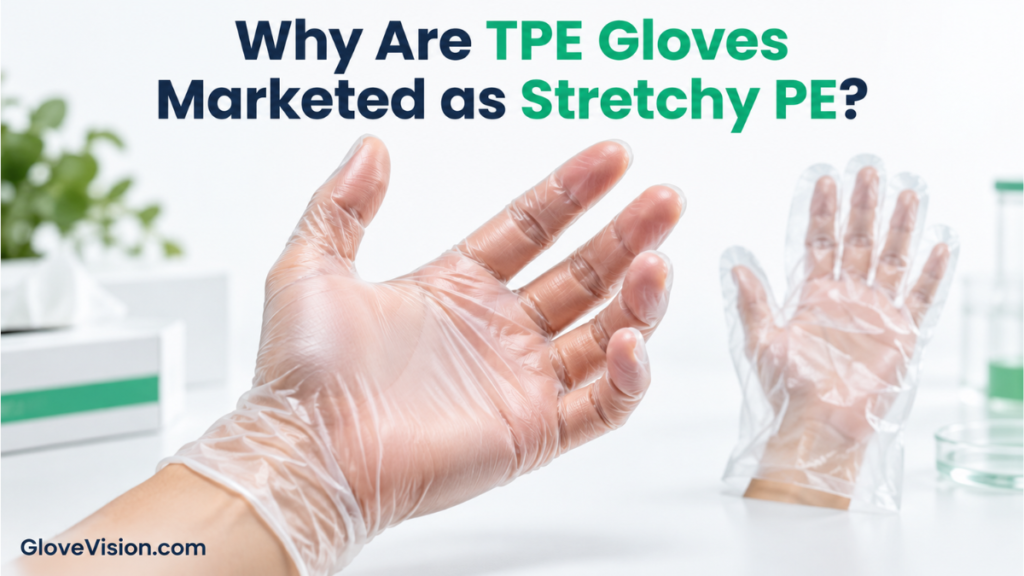
Why Are TPE Gloves Marketed as Stretchy PE?
TPE Gloves are marketed as “stretchy PE” because they can preserve several practical traits associated with ordinary lightweight PE gloves—thin disposable construction, thermoplastic processing, economical positioning, and rapid replacement—while adding greater rubber-like stretch and hand conformity.
The phrase is not a precise polymer definition. TPE is a broad materials class whose chemistry, architecture, additives, thickness, processing, and glove construction can produce different recovery, strength, puncture behavior, fit, barrier performance, and intended use. This page moves from marketing meaning and PE-like traits through elastomeric stretch and recovery to the limits of the shorthand and exact-product verification.
What Does the “Stretchy PE” Positioning Mean for TPE Gloves?
The “stretchy PE” positioning for TPE Gloves is a functional shorthand suggesting PE-like disposable convenience with greater elastomeric stretch and hand conformity—not proof that TPE is chemically polyethylene.
What Does “Stretchy PE” Try to Communicate?
The phrase compresses several practical ideas into a familiar comparison: lightweight disposable construction, economical single-use positioning, thermoplastic manufacture, and more stretch and conformity than many conventional loose PE-film gloves. It describes market positioning rather than a standardized polymer specification.
Why Is PE the Natural Comparison?
Ordinary thin-film PE gloves are widely associated with economical, lightweight, loose-fitting disposable use. Many rely more on simple glove geometry than elastomeric recovery, making PE a useful practical reference when explaining why added stretch can change fit. The broader PE basic-protection profile shows why that comparison must remain task-specific rather than universal.
Why Is the Phrase Commercially Useful?
“Stretchy PE” quickly communicates a simple proposition: preserve some of the convenience associated with ordinary PE while adding greater extensibility and conformity. That can be easier for a buyer to understand than a detailed explanation of thermoplastic-elastomer architecture.
Why Is It Technically Incomplete?
TPE is not one fixed chemistry or architecture. A peer-reviewed review describes TPEs with multiple macromolecular architectures—including linear triblock, multiblock, star, graft, bottlebrush, and hyperbranched systems—and discusses how architecture relates to material properties. [TPE Architecture]
What Is the Correct Interpretation?
The safe interpretation is simple: “stretchy PE” = functional comparison, not exact chemical identity. The phrase can explain why a product occupies a PE-like disposable niche, but it cannot establish its exact chemistry, elasticity, mechanical protection, chemical resistance, or regulatory status.
Marketing language can orient the reader, but each impression needs a technical qualification.
| Marketing Idea | What It Usually Tries to Communicate | Technical Qualification |
|---|---|---|
| PE-like | Lightweight disposable positioning | Does not mean the TPE is chemically polyethylene |
| Stretchy | Greater elastomeric deformation | Actual stretch is formulation- and product-dependent |
| Better fit | Greater conformity than many loose PE constructions | Recovery, sizing, thickness, and geometry still matter |
| Economical | High-volume disposable positioning | Price does not establish protection |
| Disposable | Short-use workflow | Does not define barrier quality or medical status |
Which PE-Like Features and Elastomeric Design Traits Shape TPE Gloves?
TPE Gloves can retain PE-like disposable characteristics while adding elastomeric material behavior that supports greater deformation and hand conformity than ordinary non-elastomeric PE film.
Which PE-Like Characteristics Can TPE Gloves Retain?
Depending on the exact product, TPE Gloves can occupy a lightweight, thin-film, thermoplastically processed, high-volume disposable role similar to ordinary PE gloves. Those similarities explain the market comparison, but they do not make the two material categories chemically identical.
Why Can Both Materials Fit Frequent-Change Workflows?
Both can be candidates for short, low-demand disposable tasks such as selected food handling, packaging, sorting, or general handling when the exact product is suitable. For PE specifically, frequent-change convenience is part of the practical role described in PE food-service use.
What Does TPE Add Beyond Ordinary PE?
The central material-science difference is elastomeric behavior combined with thermoplastic processing. A peer-reviewed review of polyolefin thermoplastic elastomers describes TPEs as combining elastomeric characteristics with thermoplastic behavior and notes that most TPEs contain a thermoreversible physical network with finely dispersed hard and soft phases. [P-TPE Review]
What Creates Rubber-Like Behavior in TPE Systems?
The exact mechanism depends on the TPE family, but many systems use hard and soft regions within a physical network. The hard phase can provide reversible physical junctions while the softer phase supports elastomeric deformation; the balance between them affects material behavior. [P-TPE Review]
Why Can Soft Segments Deform More Readily in Segmented TPU Systems?
Segmented TPU provides one documented example of hard-soft TPE morphology. A peer-reviewed review describes TPU soft segments as flexible oligomers with very low glass-transition temperatures and shows that soft-segment structure, polarity, and molecular weight strongly influence microphase morphology and properties. This TPU evidence illustrates a mechanism; it should not be transferred quantitatively to every TPE glove. [TPU Review]
What Can Hard Domains Contribute?
In a studied set of thermoplastic polyurethanes, hard domains embedded in a soft matrix acted as physical crosslinks and also showed filler-like behavior. Their role changed during tensile deformation, demonstrating why hard-domain behavior can influence extensibility and mechanical response in those specific TPU systems. [SAXS]
Why Is This Different From Ordinary PE Film?
Ordinary PE is thermoplastic, but conventional loose disposable PE film is not selected because it provides the same elastomeric hard-soft physical-network behavior. Its practical disposable profile relies more heavily on thin film and glove geometry than on rubber-like elastic recovery.
What Is the Practical Glove Result?
When the exact TPE formulation and glove construction provide useful extensibility, the film can follow finger, palm, and knuckle movement more closely than a conventional loose PE glove. That can reduce a bag-like feel without proving stronger mechanical or barrier protection.
Ordinary PE can provide a lightweight thermoplastic disposable profile. TPE can combine thermoplastic processing with elastomeric hard-soft physical-network behavior that supports greater stretch and conformity. The result explains the stretchy PE comparison but does not establish chemical equivalence.
How Do Hard-Soft Phase Balance, Fit, and Recovery Shape TPE Gloves?
Hard-soft architecture can shape TPE Gloves by influencing how readily the material deforms, how its physical network stabilizes that deformation, and how well the finished glove returns toward its prior dimensions after movement.
Why Does Hard-Soft Balance Matter?
For multiphase TPE systems, hard and soft regions contribute different functions. A review of polyolefin TPEs explains that mechanical properties and processability can be adjusted through structural variables and that the ratio of hard and soft phases can be used to tailor toughness and large-strain elasticity. This principle does not establish the performance of any finished glove by itself. [P-TPE Review]
Why Can Two TPE Gloves Feel Completely Different?
Products carrying the same broad TPE label can differ in polymer family, architecture, blend composition, additives, thickness, processing, geometry, and sizing. The material-family name therefore cannot establish one standardized softness, stretch, stiffness, or recovery profile.
Why Can Added Stretch Improve Finger Conformity?
A more extensible film can accommodate changing knuckle position, fingertip movement, palm width, and grasping geometry with less reliance on excess loose film. That can support a closer functional fit when the finished glove is correctly sized.
Why Can TPE Gloves Reduce the “Baggie Glove” Effect?
Many conventional PE gloves use loose geometry for easy donning and removal. An elastomeric TPE product can instead use material deformation to follow the hand more closely when its formulation, sizing, and construction support that behavior. The limitations of basic loose-film construction are discussed further in PE minimal-barrier behavior.
Why Does Recovery Matter as Much as Stretch?
Stretch and recovery are not interchangeable. The polyolefin-TPE review distinguishes deformation from elastic recovery and describes cyclic loading methods used to quantify strain recovery. A glove can therefore stretch substantially without necessarily showing the same recovery after repeated movement. [P-TPE Review]
What Can Poor Recovery Look Like During Wear?
Product-dependent signs can include fingertip bagging, film loosening, folds, reduced conformity, or less precise handling. Those observations should trigger a fit or product reassessment rather than an assumption that all TPE products behave similarly.
Why Are TPE Gloves Not Automatically Equivalent to Permanently Crosslinked Rubber?
TPEs combine elastomeric behavior with thermoplastic processability and commonly use thermoreversible physical networks, whereas conventional vulcanization creates irreversible chemical crosslinks. The distinction helps explain why TPEs can be melt processed while still showing elastomeric behavior. [P-TPE Review]
A loose PE film outline sits outside a hand shape, while a TPE conformity line follows the hand more closely. Closer fit depends on the exact product and does not establish stronger protection.
| Property | Ordinary PE Film Direction | TPE Direction |
|---|---|---|
| Thermoplastic processing | Core material characteristic | Core TPE processing characteristic |
| Lightweight disposable use | Common practical role | Possible practical role |
| Elastic stretch | Limited elastomeric response in conventional loose film | Can be greater; formulation-dependent |
| Hand conformity | Often geometry-dependent and loose | Can improve with useful stretch and sizing |
| Recovery | Not assumed from loose PE geometry | Requires product-specific evidence |
| Bagging tendency | Can occur with loose geometry | Can be reduced in a well-fitted product |
| Puncture resistance | Requires exact-product evidence | Requires exact-product evidence |
| Chemical performance | Exact product and exposure required | Exact formulation, product, and exposure required |
Where Does the “Stretchy PE” Description Become Misleading for TPE Gloves?
The “stretchy PE” description becomes misleading when it is treated as a chemical identity, standardized performance specification, medical claim, or proof that greater stretch also means stronger mechanical or barrier protection.
Does TPE Mean Polyethylene?
No. TPE describes a thermoplastic-elastomer category rather than one polyethylene chemistry. Polyolefin TPEs are one particular TPE class; the broader TPE category contains multiple architectures and chemistries.
Are All TPE Gloves PE-Based?
No universal assumption should be made. The exact formulation or manufacturer description should be used where available. Marketing language cannot substitute for material identification.
Does More Stretch Mean More Puncture Resistance?
No. Elongation, tensile strength, puncture resistance, and tear behavior describe different aspects of mechanical performance. Greater extensibility therefore cannot be converted into a puncture or tear claim without applicable finished-product evidence.
Can Stretching Create Local Film Thinning?
Large deformation changes film geometry, so a stretched region should not be assumed to retain the same local dimensions it had before deformation. Added extensibility therefore does not remove the need to evaluate the finished film’s mechanical limits.
Does Better Fit Mean Better Chemical Protection?
No. Chemical barrier performance depends on the exact material or formulation, thickness, chemical identity or mixture, concentration, temperature, contact type, duration, permeation behavior, degradation, and finished construction. Closer fit does not answer those questions.
Why Is Chemical Resistance Formulation-Specific?
TPE is a diverse materials category. Differences in chemistry, architecture, morphology, additives, and construction can change material behavior, so “TPE” or “stretchy PE” cannot function as a chemical compatibility chart.
Does TPE Automatically Mean Medical Grade?
No. Medical status belongs to the exact product. FDA record K172678 identifies one specific “THERMOPLASTIC ELASTOMER EXAMINATION (TPE) GLOVE” as a Polymer Patient Examination Glove and records a substantially equivalent decision dated November 24, 2017. That record cannot be generalized to unrelated TPE gloves. [FDA]
Why Does Medical Status Not Prove Industrial Chemical Resistance?
A medical examination-glove regulatory record and chemical-permeation evidence answer different questions. An examination glove should not be assumed suitable for aggressive chemicals, prolonged immersion, heat, cuts, or other specialist hazards unless the exact product has applicable evidence.
Why Can Temperature Matter to TPE Behavior?
TPE physical behavior is temperature-dependent. A peer-reviewed polyolefin-TPE review explains that multiphase TPE behavior depends on the thermal transitions of hard and soft phases and that the usable temperature range is bounded by those phase properties. Exact glove temperature limits still require product-specific evidence. [P-TPE Review]
What Is the Correct Protection Rule?
Added stretch can improve usability and conformity, but it does not automatically improve puncture, tear, chemical, medical, thermal, or other specialist protection. The same hazard-first principle applies when interpreting PE protection limits.
The stretchy PE phrase can communicate lightweight disposable positioning, thermoplastic processing, added stretch, and conformity potential. Exact polymer identity, mechanical performance, chemical barrier performance, medical status, and temperature limits require separate evidence.
| Marketing Impression | Technical Reality |
|---|---|
| “Stretchy PE” | Functional shorthand, not a standardized material specification |
| TPE = PE | Incorrect as a universal chemical rule |
| All TPEs behave alike | Incorrect; chemistry and architecture vary |
| More stretch = more puncture resistance | Separate mechanical evidence is required |
| Better fit = stronger chemical barrier | Chemical performance requires separate evidence |
| Disposable = medical grade | Regulatory status is product-specific |
| One TPE exam glove = all TPE medical | Regulatory records apply to exact products |
| Stretch = recovery | Different performance concepts |
How Should TPE Gloves Be Matched, Compared, and Verified Before “Stretchy PE” Guides Selection?
TPE Gloves should be selected from exact product data rather than the phrase “stretchy PE”; the task should determine whether added stretch provides useful value and whether the glove also meets the required mechanical, barrier, and intended-use conditions.
Which Tasks Can Capture the “Stretchy PE” Value?
Selected light food handling, packaging, sorting, and other low-demand disposable tasks can benefit when ordinary PE feels excessively loose and greater conformity improves handling. Candidate status still depends on the exact product, exposure, duration, and task requirements.
When Can Food Handling Favor TPE Gloves?
A TPE product can be considered when its exact food-contact or intended-use documentation is appropriate, the task is short and controlled, frequent changes are expected, and added stretch improves usability without introducing unsupported protection assumptions.
When Can Packaging and Sorting Favor TPE Gloves?
Light packaging or sorting can suit an exact TPE product when more stable finger positioning or less loose film is useful and sharp, abrasive, high-puncture, chemical, or thermal hazards do not exceed the product’s documented capabilities.
When Can Medical Examination Use Fit TPE Gloves?
Only when the exact product has appropriate regulatory status and intended examination use. FDA K172678 identifies a specific Thermoplastic Elastomer Examination (TPE) Glove as a Polymer Patient Examination Glove and records a substantially equivalent decision on November 24, 2017. This is product-specific evidence, not category-wide approval. [FDA]
When Does the “Stretchy PE” Advantage Stop Being Enough?
The shorthand stops being useful when the controlling requirement becomes high puncture resistance, cut protection, aggressive chemical compatibility, heat protection, prolonged immersion, biological barrier performance, or another specialist property requiring direct evidence.
When Is Ordinary PE Still More Practical?
Ordinary PE can remain practical when the task is extremely simple, loose fit is acceptable, rapid changes matter, and added elastomeric conformity provides little useful benefit. Selection should follow the actual PE selection trade-off rather than assuming more stretch is always better.
When Does TPE Improve on the Practical PE Experience?
TPE can add value where greater extensibility, closer conformity, reduced excess-film movement, or more flexible hand motion improves the task. Those usability gains remain separate from puncture, chemical, medical, or other protection claims.
When Can Vinyl/PVC Be More Practical?
An exact Vinyl/PVC product can be a better match when its construction, fit, thickness, availability, intended use, or documented performance better serves the task. The comparison should be between finished products rather than generic material reputations.
When Can Nitrile Be More Appropriate?
An exact nitrile product may be preferable when the task requires stronger documented mechanical or chemical performance than the selected TPE glove demonstrates. Nitrile should still be verified at product level rather than treated as universally superior.
Why Should Latex Be Considered Separately?
Latex can provide high elasticity, recovery, and conformity in suitable products, but it has its own formulation, user-sensitivity, chemical, and task considerations. It should therefore be compared as a distinct exact-product option.
What Is the Correct Comparison Rule?
Start with the controlling task requirement. PE may fit when simplicity is enough; TPE may add useful stretch and conformity; another elastomeric or specialist glove may become preferable when stronger verified protection is required. The broader glove-material framework helps keep those comparisons evidence-controlled.
What Does the Manufacturer Mean by TPE?
Where available, identify the material family, blend or block-copolymer description, formulation information, and exact product specification. If the manufacturer does not disclose the formulation, do not reverse-engineer one from the phrase “stretchy PE.”
Which Stretch and Recovery Data Matter?
Review applicable elongation, tensile, modulus, recovery, or other mechanical data supplied for the exact product. Elongation alone should not be converted into a recovery, puncture, or tear claim.
Which Construction Details Matter?
Verify film thickness, sizing, glove geometry, surface texture, cuff, construction, and intended use. A useful material formulation can still be a poor task match when the finished construction is unsuitable.
Which Protection Data Matter?
The answer depends on the hazard. Puncture, tear, leak integrity, chemical compatibility, permeation, degradation, and biological-barrier evidence are different questions and should not be inferred from one another.
Which Intended-Use Claims Must Be Verified?
Food handling, general-purpose work, medical examination, and chemical handling are separate use categories. Verify the exact claim and applicable documentation rather than transferring approval or suitability between categories.
When Is “Stretchy PE” Insufficient?
Escalate the decision when formulation is unknown and material identity matters, barrier performance is critical, medical status is assumed rather than documented, chemical protection is required, mechanical demand is substantial, or marketing language is the main evidence supporting selection.
This is the page’s single checklist and converts the “stretchy PE” shorthand into an exact-product decision.
Marketing Gate
- “Stretchy PE” is treated only as functional shorthand.
- No exact polymer identity is inferred from the slogan.
- No protection claim is inferred from added stretch.
Material Gate
- Exact TPE family or formulation is identified where available.
- Finished-product construction is confirmed.
- Hard/soft architecture differences are considered only where documented.
Fit / Recovery Gate
- Applicable stretch information is reviewed.
- Recovery is considered separately from elongation.
- Fit remains functional during representative movement.
- Bagging or loosening remains acceptable.
- Dexterity matches the task.
Mechanical Gate
- Tensile evidence is reviewed where relevant.
- Puncture performance is adequate for the task.
- Tear behavior is adequate where relevant.
- Film thickness and finished construction are considered.
- Stretch is not used as a substitute for mechanical evidence.
Barrier Gate
- Required barrier type is defined.
- Leak-integrity evidence is appropriate where relevant.
- Chemical data are reviewed for the exact exposure where needed.
- Permeation or degradation data are reviewed when relevant.
- Better fit is not treated as proof of better barrier performance.
Use / Regulatory Gate
- Exact intended task is confirmed.
- Food-contact documentation is verified where relevant.
- Medical or examination status is verified where relevant.
- Specialist claims are independently confirmed.
Alternative Gate
- PE is compared when added stretch provides little value.
- Vinyl/PVC is compared when its exact construction better fits the task.
- Nitrile is compared when stronger documented performance is required.
- Latex is considered separately where appropriate.
- Every comparison is made between exact products rather than generic rankings.
Final Decision
What Should Readers Remember About Why TPE Gloves Are Called “Stretchy PE”?
TPE Gloves are called “stretchy PE” because they can occupy a similar lightweight disposable niche to ordinary PE while adding elastomeric deformation and greater hand conformity through thermoplastic-elastomer design. That makes the phrase commercially intuitive for users comparing simple disposable glove options, especially when conventional PE feels too loose and added conformity improves handling.
The phrase remains only a shorthand. TPE chemistry, architecture, thickness, processing, recovery, mechanical strength, barrier performance, and intended use vary by product, so “stretchy PE” should never be interpreted as proof of polyethylene chemistry, Nitrile-like strength, medical status, or specialist chemical protection. Use the phrase to understand practical positioning; use exact finished-product evidence to determine protection.
Which Questions Clarify Why TPE Gloves Are Marketed as “Stretchy PE”?
Are TPE Gloves Actually Made From Polyethylene?
Not necessarily. TPE describes a broad thermoplastic-elastomer class rather than one polyethylene chemistry, so the exact formulation should be verified from product information where available.
Why Do TPE Gloves Stretch More Than Ordinary PE Gloves?
Many TPE systems use a thermoreversible physical network with hard and soft regions that can combine thermoplastic processing with elastomeric deformation. Exact behavior depends on the TPE system and finished glove.
Do TPE Gloves Fit Better Than PE Gloves?
They can provide greater hand conformity than many conventional loose PE gloves because added stretch can let the film follow hand movement more closely, but actual fit still depends on formulation, thickness, sizing, geometry, and recovery.
Does “Stretchy PE” Mean TPE Gloves Are as Strong as Nitrile?
No. Stretch, recovery, tensile strength, puncture resistance, tear resistance, and barrier performance are separate properties and must be compared using exact-product evidence.
When Should TPE Gloves Be Chosen Instead of PE Gloves?
An exact TPE product can be considered when the same lightweight disposable workflow fits the task but added stretch, conformity, and movement provide useful value. Ordinary PE may remain more practical when those benefits are unnecessary.