
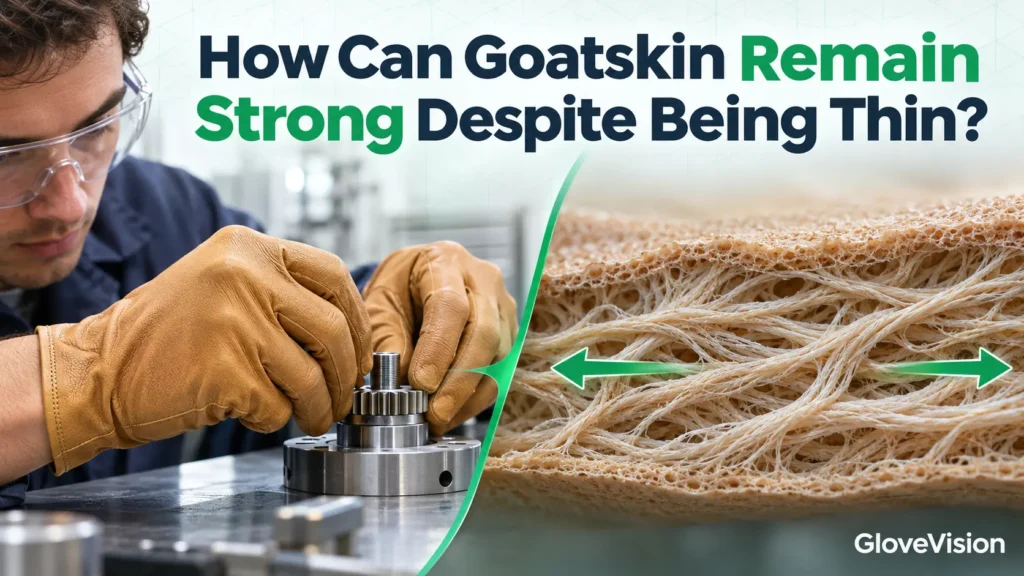
Thin goatskin leather can retain useful tensile strength because its interconnected collagen fibers and fiber bundles form a load-bearing network. Fiber organization, orientation, compactness, material continuity and processing influence how that network resists pulling. Thinness alone therefore does not establish whether leather is strong or weak.
This guide explains the structure behind goatskin’s tensile behavior, the role of fiber-bundle compactness and apparent density, the distinction between thickness and strength, and how hide variation and processing affect material properties. It also explains how those findings should—and should not—guide the selection of protective work gloves.
What Allows Thin Goatskin Leather to Maintain Useful Mechanical Strength?
Thin goatskin can provide useful tensile resistance because its collagen-fiber network carries applied loads through connected structural pathways. The result depends on network quality, bundle orientation, compactness and leather processing rather than material thickness alone.
What Does Thin Goatskin Leather Mean?
Thin goatskin leather is processed goat hide manufactured at a relatively low thickness for a particular use. No single measurement universally defines all goatskin products as thin. Thickness can also differ across the hide and between finished glove panels. The parent guide to goatskin glove structure and supple handling explains the broader material category.
Why Does Thinness Not Automatically Mean Weakness?
Thickness is a physical dimension, whereas tensile strength is a maximum nominal stress measurement. Leather with a smaller cross-section may exhibit useful tensile stress resistance even when its total load capacity differs from thicker material.
What Structural Features Support Strength?
Interwoven collagen-fiber bundles, connected load paths and material continuity may contribute to the way leather carries tension. A study of Brazilian goatskin leathers reported that strength was strongly associated with apparent density, which was related to fiber-bundle weave compactness in the studied samples. [Goatskin]
How Can Thin Goatskin Support Glove Construction?
Suitably prepared leather can contribute strength while limiting material bulk in some designs. Whether this becomes a useful glove depends on panel placement, stitching, reinforcement, linings, fit and protection requirements.
What Limits the Potential Strength Advantage?
Material defects, cuts, local thin spots, inappropriate processing, seam damage and unsuitable exposure can limit performance. A laboratory tensile result cannot predict every finished-glove failure.
| Characteristic | Structural Role | Possible Strength Effect | Evidence Required | Limitation |
|---|---|---|---|---|
| Collagen interconnection | Creates connected pathways. | May transfer tensile load. | Structural and mechanical data. | Does not prove equal stress sharing. |
| Bundle weave | Interweaves fibrous regions. | Influences tensile response. | Microstructural assessment. | No universally superior weave. |
| Compactness | Describes bundle arrangement. | Associated with strength in studied hides. | Relevant structural measurement. | Correlation is not universal causation. |
| Orientation | Changes alignment relative to pulling. | May alter directional response. | Documented sample direction. | Not identical across every hide. |
| Thickness | Changes specimen cross-section. | Influences total force at a given stress. | Thickness and tensile testing. | Not itself a protective rating. |
| Processing | Modifies leather’s physical condition. | Can change strength or softness. | Process-specific test data. | No universally optimal treatment. |
| Defects and damage | Interrupt local structural continuity. | May promote failure. | Inspection and relevant testing. | Some defects are not visible. |
How Does the Collagen-Fiber Network Contribute to Goatskin Leather Strength?
Leather’s collagen network provides the structural pathways through which applied tensile loads can be carried. Fiber bundles are interconnected rather than acting as isolated straight strands, allowing a complex response to stretching and pulling.
What Is the Main Structural Protein in Goat Hide?
Collagen is a major structural protein of the dermal connective tissue. Type I collagen is especially important in its load-bearing fibrous framework. Processing changes the hide into leather, but its collagen-based organization remains central to its mechanical behavior.
How Are Collagen Fibers Organized?
Collagen forms fibrils, fibers and larger bundle arrangements. These are connected in a three-dimensional tissue network. Molecular structure, fibrils and macroscopic leather bundles should not be treated as identical structural scales.
What Happens During Tensile Loading?
As a specimen is pulled, parts of the network deform and transmit force. Fiber bundles may straighten, reorient or extend according to local conditions. The response is not necessarily uniform through the entire sample.
How Do Connected Bundles Transfer Force?
The interwoven network can transfer loads between neighboring fibrous regions. Its overall behavior is influenced by fiber orientation, interconnections and defects. For a related explanation, see leather mechanical durability and collagen-fiber structure.
Why Is Orientation Important?
Because leather is a naturally organized fibrous material, its resistance to pulling may depend on specimen direction. Direction-dependent behavior must be examined through appropriate material testing.
Where Might Load Transfer Become Weaker?
Cuts, damage, weakened fiber regions, manufacturing defects and local discontinuities can create stress concentrations. Their significance depends on the loading mode and the condition of the material.
Why Does Fiber-Bundle Compactness Influence Thin Goatskin Strength?
Fiber-bundle compactness describes part of leather’s internal arrangement. In examined goatskin populations, compactness of the weave was associated with apparent density, which in turn correlated with measured strength. This relationship does not prove that increasing compactness will improve every leather.
What Does Fiber-Bundle Compactness Describe?
It describes how closely bundles are arranged within the fibrous framework. It is not the same as surface smoothness, leather grade or finished-glove thickness.
What Is Apparent Density?
Apparent density is mass divided by volume. It can provide supplementary information about leather structure but does not directly measure every aspect of weave arrangement, fiber integrity or orientation.
What Did Brazilian Goatskin Research Establish?
The investigated skins were assessed for features including collagen content, bundle-weave compactness and material properties. Leather strength was strongly associated with apparent density in that research. The authors also considered animal age and breed differences. Those findings should remain specific to the material population and procedures used.
Does Greater Density Always Mean Greater Tensile Strength?
No. Density does not independently establish fiber quality, processing effects or the presence of damage. A direct tensile test is needed before comparing mechanical strength.
How Is Compactness Different From Thickness?
Thickness measures the separation between leather surfaces. Compactness concerns the internal network arrangement. Materials of similar thickness may therefore have different mechanical responses.
Does Compactness Prove Better Flexibility or Glove Protection?
No. Flexibility, abrasion resistance, cut resistance, tear behavior and puncture resistance are distinct properties. Compactness cannot stand in for their relevant testing.
| Feature | What It Describes | Potential Contribution | Evidence | Limit |
|---|---|---|---|---|
| Fiber weave | Bundle organization. | Connected mechanical pathways. | Microstructure and tensile tests. | One weave is not universally best. |
| Apparent density | Mass per unit volume. | May be associated with strength. | Sample-specific research. | Not a glove protection rating. |
| Compactness | Closeness of bundle arrangement. | May influence network response. | Structural comparison. | Association is not causation. |
| Orientation | Direction relative to load. | Can alter response. | Directional tensile tests. | Sample-dependent. |
| Defects | Local interruptions in structure. | May concentrate stress. | Inspection and testing. | Hidden damage can remain. |
| Processing | Manufacturing treatment. | Can change physical properties. | Process-specific studies. | No universal recipe. |
How Does Goatskin Tensile Strength Remain Distinct From Material Thickness?
Tensile strength is a stress measurement calculated from the maximum applied force and the specimen’s original cross-sectional area. Thickness is one dimension of that area. Thin leather may therefore exhibit useful normalized strength without carrying the same total force as a thicker, otherwise comparable specimen.
What Does Thickness Measure?
Thickness is the distance between the surfaces of leather and is usually expressed in millimeters. The ISO 2589 method defines leather thickness measurement. [ISO 2589]
What Is Tensile Strength?
ISO 3376:2020 specifies testing for leather tensile strength and elongation at a specified load or maximum force. [ISO 3376] Maximum nominal tensile strength uses the peak force divided by the original specimen cross-section.
Why Is Maximum Force a Separate Measurement?
Maximum force is the highest measured load in newtons. Strength normalizes that force by area in N/mm² or MPa. Force at rupture may differ from the maximum applied force and should not be substituted for it without evidence.
How Does Cross-Sectional Area Affect Results?
For a suitable rectangular specimen, initial width multiplied by initial thickness produces the original cross-sectional area. At otherwise comparable nominal strength, specimens with different cross-sectional areas can have different maximum forces.
Can Two Equally Thick Specimens Differ in Strength?
Yes. Their collagen structure, orientation, processing, condition and defects may differ. Thickness alone cannot establish mechanical equivalence.
Does Higher Tensile Strength Guarantee Greater Glove Durability?
No. Surface abrasion, tearing, puncture, cuts and construction failures require different evidence. Tensile strength is only one material property.
| Situation | Area | Force | Tensile Interpretation | Selection Boundary |
|---|---|---|---|---|
| Thinner comparable material | Smaller at equal width. | May carry lower peak force. | Normalized strength may remain comparable. | No automatic protection claim. |
| Thicker comparable material | Larger at equal width. | May carry higher peak force. | Not necessarily stronger per area. | Bulk and task suitability still matter. |
| Different widths | Changes with width. | May change. | Compare normalized results. | Document geometry. |
| Different hide areas | May vary. | May vary. | Direct testing required. | Do not generalize one sample. |
| Different treatments | May be similar. | May differ. | Properties depend on processing. | Check comparable evidence. |
How Do Hide Location and Fiber Orientation Affect Goatskin Leather Strength?
Goatskin is not perfectly uniform. Hide location, fiber orientation and biological or processing factors can alter its physical and mechanical response. A sample obtained from one area does not necessarily represent every region of the finished leather.
Does Every Hide Region Have the Same Properties?
No. Different areas can have different thicknesses, fiber organizations and mechanical characteristics. There is no reliable universal ranking of back, belly or shoulder strength without comparable measurements.
What Is Direction-Dependent Strength?
A fibrous material may respond differently when loaded along different reference directions. This anisotropic behavior is one reason specimen cutting direction is important.
Why Is Representative Sampling Necessary?
Measurements from only one location can conceal variation elsewhere. Testing programs should document sampling positions, orientations, conditions and material batches as appropriate.
Can Animal Characteristics Influence Leather?
Age, breed and hide characteristics can influence the raw material entering leather production. The Brazilian goatskin research examined several of these variables; the findings are not universal rankings across every commercial goatskin source.
How Does Orientation Matter for Glove Panels?
Panel orientation may influence response to task loading. Cutting decisions should be informed by appropriate material evidence, construction requirements and intended use.
Does Orientation Establish Protection Ratings?
No. An orientation-dependent tensile result is not equivalent to a finished-glove cut, puncture, abrasion or tear rating.
How Do Tanning and Fiber Lubrication Preserve Goatskin Strength in Thin Leather?
Tanning stabilizes the collagen-based hide, while later processing steps can modify leather softness, mechanical characteristics and surface feel. Results are specific to the substances and manufacturing conditions used.
What Does Tanning Do?
Tanning converts prepared hide into leather through stabilization of its collagen-based material. The process changes physical properties but does not make every resulting leather equally strong.
Can Retanning Modify Material Properties?
Yes. Research on snow-white goatskin glove leather compared retanning treatments and documented differences in measured physical properties. The effects must be interpreted within the tested procedures, not as a universal manufacturing guarantee. [Retanning]
What Is Fatliquoring?
Fatliquoring is a leather-manufacturing operation that introduces lubricating substances to influence fibrous material movement and suppleness. It is distinct from applying consumer leather-care products to finished gloves.
How Can Lubrication Affect Flexibility?
Lubrication may change how fiber structures move relative to each other. This can influence the feel or bending response, but greater softness is not proof of improved tensile strength.
Can Tanning Improve Every Mechanical Property?
Not necessarily. Tensile strength, tear resistance, flexibility and other properties may respond differently to processing. Each claim should be supported by a method relevant to that property.
Why Does Finishing Matter?
Surface finishes can alter friction, texture and handling characteristics. Smoothness does not independently establish a material’s strength or its glove’s protective rating.
Can Similar Thickness Produce Different Strength?
Yes. Different fiber arrangements and processing histories can result in different measured tensile properties even when thickness is comparable.
Why Can Thin Goatskin Leather Strength Fail Under Certain Mechanical Conditions?
Thin goatskin may resist tensile loading yet fail under abrasion, cutting, puncture, tear propagation or seam stress. Each hazard involves a different loading condition, so no single tensile result provides universal mechanical protection.
Why Is Tensile Strength Not a Complete Protection Rating?
Tensile strength evaluates material response to pulling, whereas EN 388 covers distinct mechanical risks including abrasion, blade cutting, tearing and puncture, with impact assessment where applicable. [EN 388]
How Can Cuts and Notches Cause Problems?
A cut interrupts material continuity and may concentrate stress under further loading. An intact tensile specimen cannot fully predict how damaged leather will fail.
Why Is Puncture a Separate Hazard?
A pointed object applies force to a concentrated area. Resistance to pulling does not prove resistance to penetration by a specific point or needle.
What Happens During Repeated Abrasion?
Friction can progressively remove leather material from a contact region. The actual rate of wear depends on the surface, contact pressure and glove construction. The dedicated guide on leather abrasion resistance and progressive surface wear explains that separate hazard.
Why Can Strong Leather Have Weak Seams?
Thread, stitch placement, needle holes and joining geometry can affect how a glove holds together. Seam quality must not be inferred from material-panel strength alone.
Why Do Local Defects Matter?
Severe thinning, holes, scratches, cuts or poor material joining may reduce local integrity. Visible damage requires inspection; some structural weaknesses may be hidden.
When Should Damaged Gloves Be Removed?
Remove gloves from use when damage, deterioration or loss of handling control compromises required protection. Follow the manufacturer’s instructions and workplace replacement requirements.
When Is an Alternative Design Better?
Choose a suitably tested specialized glove whenever a goatskin design does not meet required protection or safe movement. Greater thickness alone cannot resolve every hazard.
| Exposure | Failure Mechanism | Tensile Limitation | Warning Sign | Decision |
|---|---|---|---|---|
| Abrasion | Surface material loss. | Does not predict frictional wear. | Thinning or holes. | Verify abrasion suitability. |
| Blade cutting | Localized blade damage. | Not a cut test. | Open cuts. | Use rated protection. |
| Puncture | Point penetration. | Different geometry. | Small holes. | Verify relevant puncture performance. |
| Tearing | Propagation of a split. | Different failure mode. | Growing tear. | Remove compromised glove. |
| Seam stress | Thread or joint separation. | Standalone material test excludes joins. | Open stitching. | Assess complete construction. |
| Thin spots | Localized weakness. | Average result may miss defect. | Visible uneven region. | Inspect or reject. |
| Repeated rough work | Combined wear and stress. | No fixed service-life prediction. | Recurring damage. | Reassess and replace. |
| Reinforcement damage | Loss of local coverage. | Material strength does not prove attachment. | Detached panel. | Remove as instructed. |
How Can Buyers Verify Thin Goatskin Leather Strength Before Glove Selection?
A buyer should verify the material specification, the relevant tensile-test method, sampling conditions, the complete glove’s protective ratings and safe task handling. Material data are supplementary evidence, not a substitute for protection testing.
What Should the Hazard Assessment Identify?
Identify the task, handled material, contact conditions, sharp edges, repeated wear, grip requirements and any additional chemical, thermal, electrical or other hazards.
What Material Information Is Useful?
Request the leather specification, relevant thickness, manufacturer’s details, processing information where needed and suitable mechanical test results.
How Should Tensile Results Be Read?
Check maximum force, cross-sectional area, nominal strength and percentage elongation with their appropriate test definitions and units.
Why Should Sampling Be Documented?
Specimen direction, hide area, preparation and conditioning can affect measurement comparability. Different tests should not be treated as interchangeable.
What Should Buyers Check About Material Uniformity?
Review thickness consistency, surface condition, visible defects and quality-control information. Appearance alone cannot verify internal fiber-bundle compactness.
How Are Protective Ratings Verified?
Use documentation for the exact finished glove, relevant standards and identified workplace hazards. The related leather glove construction and protection guide covers the difference between raw material properties and complete-product safety.
Why Must Fit and Dexterity Be Checked?
A glove must support secure grasping, appropriate finger movement and safe task control. A nonhazardous handling trial does not replace formal protective testing.
When Is More Evidence Necessary?
Request more evidence whenever product identity, performance claims, hazards or test data cannot be reliably matched.
- Document the exact task and hazards.
- Identify the manufacturer and exact glove model.
- Review material type and thickness.
- Confirm the tensile-test method.
- Distinguish force from normalized strength.
- Interpret elongation correctly.
- Record specimen sampling direction.
- Review material consistency and visible damage.
- Inspect seams, lining and reinforcement.
- Verify relevant protective ratings.
- Assess safe fit and controlled movement.
- Record approval, rejection or reassessment.
Which Thin Goatskin Glove Designs Preserve Strength Without Unnecessary Bulk?
The best candidate is the complete glove that meets required hazards while providing adequate flexibility, fit, secure seams and protected contact areas. Thinness may help some precision tasks; reinforcement or specialist materials may be necessary for more demanding work.
When Can Thin Goatskin Support Precision?
It may support accurate object handling when suitable leather, well-positioned seams and correct sizing reduce excess bulk without compromising required protection.
Why Should Panel Orientation Be Considered?
Direction-dependent mechanical properties may affect how material behaves during certain movements or loads. Manufacturing choices should use appropriate evidence.
When Is Reinforcement Useful?
Reinforcement may support high-contact areas without thickening every panel. Check attachment integrity, coverage and its impact on grip.
Why Are Seam Locations Important?
Seams influence pressure points, finger movement and overall integrity. They should match the intended work rather than being treated as a cosmetic detail.
How Does Fit Change Handling?
Loose gloves may slip or bunch, while tight gloves may restrict closure. Correct fit is essential even when the leather has suitable tensile properties.
When Should Thicker Material Be Considered?
Thicker leather may be useful for a particular design or workload, but it is not automatically safer and may increase bulk. Required protective results remain decisive.
When Should Specialized PPE Replace Ordinary Goatskin?
Use a properly selected specialized product where required cut, puncture, heat, chemical, electrical or other performance cannot be established for the ordinary goatskin glove.
| Task | Possible Benefit | Construction Need | Protective Evidence | Decision |
|---|---|---|---|---|
| Fine assembly | Low bulk. | Good fit and finger seams. | All identified hazards. | Thin design if adequate. |
| Repeated gripping | Flexible handling. | Palm and seam integrity. | Relevant mechanical ratings. | Balanced construction. |
| High-friction contact | Potential mobility. | Reinforced contact zones. | Abrasion performance. | Reinforced or alternative PPE. |
| Tool handling | Controlled motion. | Stable fit and grip. | Task-specific ratings. | Verified protective design. |
| Sharp sheet edges | Movement alone insufficient. | Cut-resistant construction. | Relevant blade-cut testing. | Appropriately rated PPE. |
| Point hazards | No assumed protection. | Hazard-specific layers. | Puncture or needle-specific evidence. | Specialist selection. |
| Rough repetitive work | Task-dependent mobility. | Wear-resistant zones and secure seams. | Mechanical ratings. | Robust verified product. |
| Specialized exposure | No universal suitability. | Specialized materials. | Relevant heat, chemical or electrical evidence. | Specialist PPE or No-Go. |
What Thin Goatskin Leather Strength Checks Confirm Safe Glove Performance?
The glove should be accepted only when its exact protective evidence, material condition, construction, fit and functional handling match the workplace task. Useful collagen structure or tensile strength does not override a failed safety requirement.
Is the Task Defined?
Identify the actual work activity, exposure types, object characteristics and required hand movements.
Is Thickness Documented?
Use meaningful material specifications rather than estimates from photographs, appearance or softness.
Are Material Test Results Available?
Check appropriate test reports where material tensile performance is important to a product claim or selection.
Are Force and Strength Properly Distinguished?
Separate maximum force in newtons from nominal tensile strength in N/mm² or MPa.
Has Structural Variation Been Considered?
Take account of region, direction, processing history, material condition and relevant quality control.
Are the Necessary Protective Ratings Adequate?
Confirm that the exact finished glove satisfies all identified hazards using the relevant documentation.
Are Seams and Reinforcements Suitable?
Check panel joins, stitching, lining, protected contact zones and attachment integrity.
Is Fit and Dexterity Safe?
Confirm secure grip, finger movement and appropriate sizing for the task.
When Should Another Glove Be Used?
Select an alternative if essential protection is missing, construction is compromised or safe hand control cannot be achieved.
- Task and hazards documented.
- Exact glove model identified.
- Thickness information reviewed.
- Material testing interpreted correctly.
- Force and tensile stress distinguished.
- Sampling variations considered.
- Relevant glove ratings verified.
- Seams and reinforcement suitable.
- Fit and grip satisfactory.
- Material condition acceptable.
- Manufacturer limitations reviewed.
- Final selection decision recorded.
Protection, condition and safe task handling are all supported.
One or more mandatory requirements are not met.
Relevant test data or exact-model evidence is incomplete.
Why Can Thin Goatskin Remain Strong Without Guaranteeing Universal Protection?
Thin goatskin may retain useful tensile strength because its interconnected collagen-fiber network provides load-bearing pathways within relatively low material thickness. Fiber-bundle compactness, apparent density, orientation, hide variation and processing can influence measured behavior. Scientific findings are sample- and method-dependent and do not establish universal guarantees.
Tensile strength describes material stress rather than total maximum force or the force at rupture. It cannot independently establish resistance to cuts, punctures, abrasion or other glove hazards. The correct decision depends on the exact finished glove’s documented protection, construction, fit, present condition and ability to support safe work.
Frequently Asked Questions
Why Can Thin Goatskin Leather Be Strong?
Its interconnected collagen bundles can support useful tensile loading even at relatively low thickness. Actual performance varies with the material’s structure, processing, condition and test circumstances.
Does Dense Collagen Always Make Goatskin Stronger?
No. Apparent density and fiber-bundle compactness have been associated with strength in particular studies, but the relationship is not a universal guarantee. Orientation, defects and processing also matter.
Is Tensile Strength the Same as Breaking Force?
No. Tensile strength is based on maximum force divided by the original cross-sectional area, while breaking force describes the load at rupture. The two force values may also differ.
Does Strong Thin Goatskin Resist Cuts and Punctures?
Not automatically. Material tensile performance does not establish a protective glove’s cut or puncture rating. Separate hazard-specific evidence is required.
How Can Buyers Verify Thin Goatskin Gloves Are Suitable?
Buyers should review the exact glove’s intended use, material specifications, relevant protective ratings, seams, reinforcement, fit, condition and workplace hazards before approval.