
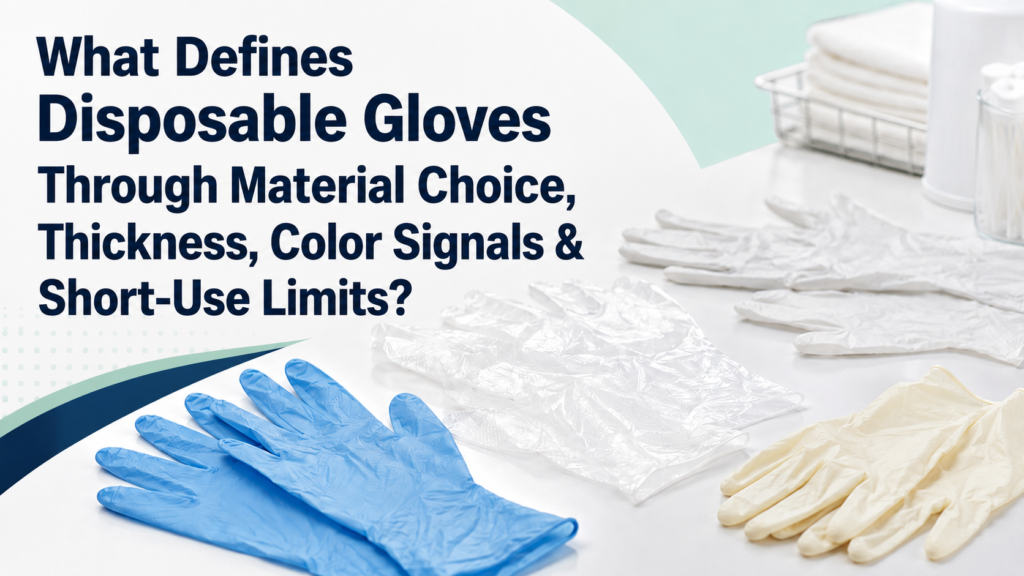
What Defines Disposable Gloves Through Material Choice, Thickness, Color Signals & Short-Use Limits?
Disposable gloves are defined by material choice, thickness, color signals, short-use limits, barrier integrity, task exposure, and replacement discipline.
This page explains what disposable gloves are, why thin-barrier integrity matters, how polyethylene, vinyl, latex, and nitrile differ, how mil thickness changes durability and tactility, how color signals support workflow, when gloves should be changed, why failures happen, and which checklist helps verify selection before use or purchase.
This article is for educational disposable glove-selection guidance only and does not replace manufacturer instructions, workplace PPE rules, food-safety procedures, medical-use requirements, SDS guidance, chemical compatibility data, or professional safety evaluation. For medical, food-contact, chemical, hazardous, cleaning, laboratory, industrial, or regulated workplace tasks, verify labeling, material limits, exposure conditions, change-out rules, and applicable procedures before relying on a disposable glove for protection.
What are disposable gloves, and how do they differ from reusable or task-specific gloves?
Disposable gloves are short-use gloves designed to be worn for a limited task and discarded after contamination, damage, task change, or use limit.
Disposable gloves are not the same as reusable work gloves, household gloves, chemical-resistant gloves, or sterile surgical gloves. Some disposable gloves are medical-grade, food-contact suitable, or chemical-tested only when those claims are verified by labeling and manufacturer data.
Disposable gloves can help reduce direct contact with contaminants, fluids, grime, or irritants, but they do not guarantee protection and should not be reused beyond their intended task. Medical-use claims need verified medical labeling, and food-contact use needs suitable labeling and hygiene procedures. [FDA]
Screen polyethylene, vinyl, latex, nitrile, or another material against the task and exposure.
Set replacement triggers before contamination, damage, sweat, task switching, or chemical contact creates risk.
Confirm labeling, manufacturer data, food-contact status, medical status, and compatibility where relevant.
| Type | Common Use | Main Benefit | Main Limit | Verification Needed |
|---|---|---|---|---|
| Polyethylene | Very short food handling or light cleanup | Fast changes and easy donning | Loose fit and weak puncture resistance | Food-contact suitability and change-out |
| Vinyl | Low-stress, short-duration tasks | Latex-free option and low cost | Lower elasticity under stress | Intended use and task stress |
| Latex | Short-use tasks needing stretch where allowed | Elasticity and tactile control | Latex allergy risk | Latex policy and user sensitivity |
| Nitrile | Broader short-use tasks needing latex avoidance | Latex-free and more durable context | Not automatically chemical-safe | Manufacturer data and exposure duration |
| Medical-grade disposable | Clinical tasks when labeled | Medical-use expectations | Not universal clinical approval | Medical labeling and workplace policy |
| Food-contact disposable | Food tasks when suitable | Barrier between hands and food | Misuse can transfer contamination | Food-contact labeling and hygiene rules |
Why does thin-barrier integrity matter in disposable gloves during short-use tasks?
Thin-barrier integrity matters because disposable gloves can fail during short-use tasks through tearing, puncture, stretching, degradation, sweat buildup, or contamination transfer.
The rule is to match the disposable glove to the task, exposure type, contact duration, and change-out requirement. A glove can look usable while the film is stretched, damaged, contaminated, degraded, or no longer fit for the next task.
Very short-use glove choices need puncture awareness because polyethylene puncture resistance is limited for rough, sharp, chemical, medical, or long wet tasks.
| Failure Type | What It Means | Common Trigger | Safer Response |
|---|---|---|---|
| Tear | Film splits at fingers, palm, thumb web, or cuff | Wrong size, thin film, sharp edge, high friction | Stop, remove safely, replace, and reassess task match |
| Puncture | Small hole or breach appears | Sharp parts, nails, tools, rough surfaces | Replace and consider stronger glove category |
| Stretching | Glove no longer fits or controls well | Too-small glove, long wear, high movement | Change glove and reassess size or material |
| Chemical degradation | Swelling, wrinkling, softening, stiffening, or texture change | Chemical, oil, solvent, cleaner, disinfectant | Stop and verify compatibility data before continuing |
| Sweat buildup | Hands become damp, slippery, or irritated | Long wear, poor fit, occlusion | Change gloves, dry hands, adjust material or frequency |
| Contamination transfer | Residue moves from one task or surface to another | Task switching without glove change | Replace before clean task, food zone, or new material |
How do polyethylene, vinyl, latex, and nitrile disposable gloves differ by short-use task?
Polyethylene, vinyl, latex, and nitrile disposable gloves differ by fit, elasticity, puncture resistance, tactile control, allergy concern, cost sensitivity, and task verification needs.
Material choice matters because disposable materials shape allergy and barrier limits.
How do polyethylene disposable gloves fit very short-use tasks?
Polyethylene disposable gloves can fit very short, low-risk food handling or light cleanup tasks where fast glove changes matter more than tight fit or high durability.
How do vinyl disposable gloves fit low-stress tasks?
Vinyl disposable gloves can fit selected short-duration, low-stress tasks where latex-free use and low cost matter.
Food-contact suitability still needs verification because vinyl food-contact suitability depends on composition, labeling, intended use, and local rules.
How do latex disposable gloves fit stretch and tactility needs?
Latex disposable gloves can offer strong elasticity, comfort, and tactile feel, but natural rubber latex can trigger allergic reactions in sensitized users.
How do nitrile disposable gloves fit broader short-use tasks?
Nitrile disposable gloves are widely used where latex avoidance, better puncture resistance, and broader short-use versatility are needed.
Latex avoidance often drives material choice because nitrile latex allergy reduction can help avoid natural rubber latex proteins, but nitrile is not automatically safe for every chemical, solvent, oil, or exposure duration.
| Material | Common Short-Use Task | Strength | Limitation | Verification Question |
|---|---|---|---|---|
| Polyethylene | Very short food handling or light cleanup | Fast changes and loose easy donning | Low tactile control and weak puncture resistance | Is this a low-risk, short-contact task? |
| Vinyl | Low-stress, short-duration tasks | Latex-free option and low cost | Lower elasticity and poorer fit under stress | Is the task low-fluid and labeling-supported? |
| Latex | Short-use tasks needing stretch where allowed | Elasticity, comfort, tactile control | Natural rubber latex allergy risk | Is latex allowed for this user and task? |
| Nitrile | General short-use tasks needing latex avoidance | Broader task versatility and durability context | Chemical suitability is product-specific | Is the exact glove compatible with the exposure? |
How does mil thickness change disposable glove durability, tactility, and wear limits?
Mil thickness changes disposable glove durability, tactility, and wear limits by shifting the balance between fingertip feel, tear resistance, comfort, and task stress.
Thickness changes the task trade-off because disposable glove thickness changes task performance.
Thin-gauge disposable gloves can support fingertip feel for quick tasks. Standard-gauge gloves balance feel and short-use durability. Heavier disposable gloves may add structure, but thickness alone does not prove chemical resistance, puncture protection, or high-risk suitability.
| Thickness Type | Typical Feel | Durability Expectation | Common Use | Must Still Verify |
|---|---|---|---|---|
| Thin-gauge | High fingertip feel and movement | Lower tear and abrasion tolerance | Quick food handling, light hygiene, low-stress tasks | Task exposure, labeling, change-out rule |
| Standard-gauge | Balanced feel and durability | Moderate short-use durability | General cleanup, food handling, light maintenance | Material, fit, fluid exposure, task stress |
| Heavier disposable | More structure and durability | Better tear resistance context | Selected heavier short-use tasks | Compatibility, tactile need, exposure duration |
| Any thickness | Depends on material and product design | Thickness is only one variable | Any disposable task | Labeling, manufacturer data, task suitability |
What do disposable glove color signals mean across food, cleaning, medical, and industrial workflows?
Disposable glove color signals usually help teams separate tasks, zones, departments, inventory types, or contamination levels, but color does not prove protection.
Color should be treated as a workflow cue because disposable glove colors support task visibility.
Food handling may use visible colors for task separation. Cleaning teams may use multiple colors to reduce crossover. Automotive, tattoo, industrial, beauty, or clinical workflows may choose dark, white, clear, or blue gloves for visibility or workflow preference. The meaning is usually facility-defined, not universal.
| Color Use | Possible Workflow Meaning | Best Environment | What Color Does Not Prove |
|---|---|---|---|
| Blue gloves | Visibility in food handling or task separation | Food service, processing, hygiene workflows | Food-contact suitability, chemical resistance, or puncture protection |
| Black or dark gloves | Grease/stain masking or defect contrast | Automotive, tattoo, industrial, beauty services | Chemical resistance or medical approval |
| White or clear gloves | General hygiene or visual cleanliness | Light handling, food service, general use | Sterility or barrier quality |
| Multiple colors | Zone, shift, department, or task separation | Cleaning, food prep, healthcare, facility work | Universal safety code |
| Any color | Inventory and workflow cue | Facility-defined systems | Protection level without labeling and data |
When should disposable gloves be changed during short-use tasks?
Disposable gloves should be changed when damage, contamination, task change, chemical contact, sweat buildup, discomfort, or workplace policy makes the short-use barrier unreliable.
Fixed universal time rules can be unsafe because replacement depends on the task, material, exposure, condition, and procedure. The safer approach is to define change-out triggers before the task begins.
When should disposable gloves be changed after damage?
Disposable gloves should be changed immediately when they tear, puncture, stretch, lose shape, or no longer support controlled handling.
When should disposable gloves be changed after contamination?
Disposable gloves should be changed after contamination because continuing to use a contaminated glove can transfer residue, germs, food contamination, chemicals, or grime to other surfaces.
When should disposable gloves be changed after chemical, oil, solvent, or cleaner contact?
Disposable gloves should be reassessed after chemical, oil, solvent, or cleaner contact because compatibility depends on material, concentration, exposure time, temperature, and manufacturer data.
When should disposable gloves be changed after sweat, dampness, or irritation?
Disposable gloves should be changed when hands feel sweaty, damp, irritated, or uncomfortable because moisture and occlusion can increase discomfort, grip issues, and skin irritation risk.
When should disposable gloves be changed after task switching?
Disposable gloves should be changed when the task changes because a disposable glove can carry contamination from one activity to another.
| Trigger | Why It Matters | Immediate Action | Better Owner Page/Tool if Needed |
|---|---|---|---|
| Tear, puncture, stretching, or shape loss | Barrier or control may be compromised | Stop, remove safely, replace | Stronger glove category or fit tool if repeated |
| Contamination | Can transfer residue, germs, food contamination, chemicals, or grime | Change before moving to a clean task or new zone | Food Handling / Medical Gloves if workflow-specific |
| Chemical, oil, solvent, or cleaner contact | Compatibility depends on material and exposure | Follow compatibility data, SDS, manufacturer instructions, and workplace procedure | Hazard Match / chemical-resistant page; URL missing |
| Sweat, dampness, irritation, or discomfort | Can reduce grip and increase irritation risk | Remove, dry hands, reassess material/fit/change-out timing | Fit or allergy tool; URL missing |
| Task change | Disposable gloves are task-based barriers | Change gloves before a new task, zone, surface, or material | Food, medical, or workplace procedure if applicable |
Why do disposable gloves fail, and how can common barrier, grip, or skin problems be corrected?
Disposable gloves fail when the material, thickness, fit, exposure type, contact duration, surface condition, or change-out rule does not match the task.
Failure signals should trigger re-screening rather than guesswork. Tearing, texture change, grip loss, irritation, and reuse all point back to material, thickness, fit, exposure, and replacement rules.
Why do disposable gloves tear at the fingertips, palm, or cuff?
Disposable gloves that tear at the fingertips, palm, or cuff usually indicate wrong size, thin material, sharp contact, high friction, poor donning, or task mismatch.
Why do disposable gloves swell, wrinkle, soften, stiffen, or change texture?
Disposable gloves that swell, wrinkle, soften, stiffen, or change texture may be showing chemical degradation or material incompatibility.
Why does disposable glove grip fail during wet, oily, or greasy tasks?
Disposable glove grip can fail during wet, oily, or greasy tasks when the glove surface, material, fit, or texture does not match the handling condition.
Why can disposable gloves cause itching, dryness, redness, or rash?
Disposable glove-related itching, dryness, redness, or rash can come from latex allergy, rubber accelerators, powder residue, sweat, friction, soaps, or repeated occlusion. Persistent or worsening symptoms deserve medical or occupational guidance.
Why is reusing disposable gloves unsafe?
Reusing disposable gloves is unsafe because task-based single-use barriers can carry contamination, lose fit, degrade, or fail after the original task.
| Failure Signal | Likely Cause | Safer Correction | Route Deeper If Needed |
|---|---|---|---|
| Tears at fingertips, palm, or cuff | Wrong size, thin material, sharp contact, high friction, poor donning, task mismatch | Re-check size, thickness, material, and whether a stronger glove type is needed | Fit tool or stronger glove type page; URL missing if not supplied |
| Swells, wrinkles, softens, stiffens, or changes texture | Chemical degradation or material incompatibility | Stop task, remove safely, clean hands as appropriate, verify compatibility | Hazard Match / chemical-resistant page; URL missing |
| Grip fails in wet, oily, or greasy tasks | Smooth surface, wrong material, poor fit, contamination | Use appropriate texture, fit, material, and verified task suitability | Material or task-specific page if available |
| Itching, dryness, redness, or rash | Latex, accelerators, powder, sweat, friction, soaps, repeated occlusion | Stop suspected glove, document pattern, consider alternatives, seek guidance if persistent | Allergy/comfort tool; URL missing |
| Gloves are reused | Cost pressure or misunderstanding of disposable limits | Treat as task-based single-use barriers and replace according to trigger | Buying/procurement page if cost issue; URL missing |
Which checklist helps verify disposable glove selection before use or purchase?
A disposable glove verification checklist helps confirm task, exposure, material, thickness, color use, labeling, change-out triggers, storage, and correct routing before use or purchase.
Selection claims need careful reading because disposable glove safety claims affect whether a glove can be used for food contact, medical use, chemical exposure, latex-free needs, biodegradable claims, or general-purpose tasks.
- ☐ Identify whether the glove is for food handling, cleaning, medical use, light industrial work, beauty services, household tasks, laboratory support, or general hygiene.
- ☐ Confirm the exposure type: food contact, body fluids, mild cleaning agents, oils, solvents, chemicals, dirt, grime, wet surfaces, or short dry handling.
- ☐ Choose polyethylene, vinyl, latex, nitrile, or another disposable material based on task fit, allergy concerns, durability needs, and verification data.
- ☐ Match thickness to dexterity, tear risk, wear duration, and task stress without assuming thickness alone proves protection.
- ☐ Use glove color only as a workflow cue unless a facility-specific rule defines its meaning.
- ☐ Confirm labeling for food contact, medical use, chemotherapy, chemical resistance, latex-free status, biodegradable claims, or general-purpose use where relevant.
- ☐ Define change-out triggers for contamination, damage, task change, chemical contact, sweat buildup, discomfort, or workplace policy.
- ☐ Check storage requirements for temperature, sunlight, humidity, ozone, packaging integrity, and shelf-life according to manufacturer instructions.
- ☐ Route medical, food-safety, chemical, sizing, material-comparison, and buying decisions to the correct owner page or tool only when the exact URL is supplied or selected.
Pre-use verification: Disposable glove selection should be treated as a short-use screening and verification process, not a guarantee of protection. For medical, food-contact, chemical, hazardous, cleaning, or workplace tasks, users should follow manufacturer labeling, workplace procedures, hygiene rules, compatibility data, and applicable safety standards before relying on a disposable glove for protection.
Conclusion
Disposable gloves are best understood as short-use barrier tools defined by material choice, thickness, color signals, task exposure, barrier integrity, and replacement discipline.
Disposable glove selection is not a guarantee of protection. Medical, food-contact, chemical, hazardous, or workplace tasks require labeling, manufacturer data, compatibility review, hygiene rules, and applicable procedures before a disposable glove is relied on for protection.
Frequently Asked Questions
Are disposable gloves the same as single-use gloves?
Disposable gloves are usually treated as single-use gloves because they are meant to be worn for a limited task and discarded after contamination, damage, task change, or use limit.
Are all disposable gloves food-safe?
Not all disposable gloves are food-safe because food-contact suitability depends on labeling, material, intended use, and local food-safety rules.
Are disposable gloves medical-grade?
Disposable gloves are medical-grade only when they are labeled and verified for medical use.
Does thicker disposable glove material always mean safer protection?
Thicker disposable glove material does not automatically mean safer protection because thickness is only one variable in barrier performance.
What does glove color mean?
Glove color usually means a facility-defined workflow cue, not a universal safety standard.
When should disposable gloves be changed?
Disposable gloves should be changed when they are torn, punctured, contaminated, affected by chemical contact, uncomfortable, or used across a task change.
Can disposable gloves be reused?
Disposable gloves should not be reused because they are task-based short-use barriers that can carry contamination, lose fit, degrade, or fail after the original task.