
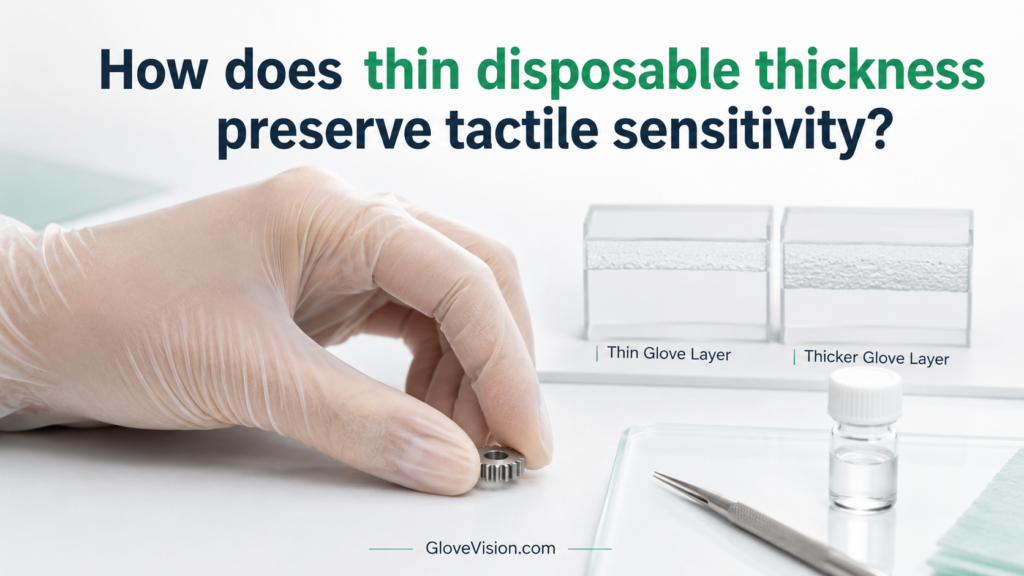
How does thin disposable thickness preserve tactile sensitivity?
Thin disposable thickness may preserve tactile sensitivity by reducing the material layer between the hand and the work surface. Thinner Disposable Gloves may allow more fine pressure, texture, vibration, and surface cues to reach the skin, which can support fingertip control and precision handling, but thinness does not prove safety, puncture resistance, chemical compatibility, medical suitability, sterile-procedure readiness, or hazardous-drug protection.
This page explains thin glove thickness meaning, tactile feedback, polymer formulation differences, precision medical task selection, AQL boundaries, fit and donning controls, fatigue monitoring, failure response, and a final tactile integrity checklist.
This article is educational only. Thin Disposable Gloves must be selected by material, thickness location, fit, task, exposure risk, glove category, product labeling, manufacturer testing, chemical compatibility data, facility policy, hand hygiene procedure, and failure-response protocol—not by thinness or tactile feel alone.
Why can thinner Disposable Gloves improve tactile feedback during precision tasks?
Thinner Disposable Gloves can improve tactile feedback during some precision tasks because a reduced material layer may let more pressure, texture, vibration, and surface cues reach the hand.
Thin glove selection belongs inside the broader category because Disposable Gloves differ by material choice, thickness, color signals, and short-use limits.
What does thin glove thickness mean?
Thin glove thickness means a reduced material layer between the hand and the work surface.
Thickness may be measured in mils, millimeters, palm thickness, fingertip thickness, or cuff thickness. Measurement location matters because fingertips, palms, cuffs, and textured areas may not have the same thickness.
How can thinner Disposable Gloves affect tactile feedback?
Thinner Disposable Gloves may affect tactile feedback by letting more fine pressure, vibration, and surface cues reach the skin.
This can support texture awareness, small-object handling, fingertip control, grip adjustment, delicate surface detection, and tool feel. The result still depends on material, fit, texture, stiffness, design, and task type.
Why should “optimize mechanoreceptor feedback” be avoided?
“Optimize mechanoreceptor feedback” should be avoided because thinner Disposable Gloves do not automatically optimize the body’s touch receptors.
The safer explanation is that thinner barriers may reduce dampening between the hand and the work surface, which can support tactile perception in some precision tasks without over-medicalizing the claim.
What are the trade-offs?
The trade-off is that thinner Disposable Gloves may improve tactile feel while reducing durability or increasing vulnerability to tearing in some products.
Thinness does not prove puncture resistance, chemical resistance, medical suitability, sterile-procedure suitability, hazardous-drug protection, or task safety.
This board reads like an article decision aid: each thinness signal shows the tactile upside, barrier trade-off, and verification step before selection.
Durability may be lower in some products or tasks.
Check material, thickness location, and manufacturer testing.
Fingertip thickness does not prove palm or cuff strength.
Confirm measurement location and product specification.
Tear behavior and chemical behavior can vary by formula.
Use product testing, labeling, and intended-use documentation.
Medical category, exposure risk, and sterile needs still control use.
Confirm medical labeling, category, and facility policy.
Swelling, softening, or permeation risk may appear with mismatch.
Require compatibility or permeation data for exact exposure.
Use this board as a benefit-risk check, not as a tactile score or thin-glove ranking.
How do different polymer formulations in thin-gauge Disposable Gloves influence elasticity and stretch limits?
Different polymer formulations influence elasticity and stretch limits in thin-gauge Disposable Gloves because material chemistry, formulation, texture, thickness location, fit, and testing can change how the glove feels and fails.
Food-service glove selection should stay task-based because Food Handling Gloves focus on food contact, task discipline, and short-duration barrier needs.
How should thin nitrile Disposable Gloves be discussed?
Thin nitrile Disposable Gloves should be treated as product-specific options, not automatic puncture-resistant or chemical-resistant choices.
Check formulation, thickness location, texture, elasticity, accelerator profile, chemical compatibility, intended use, and manufacturer testing.
How should thin latex Disposable Gloves be discussed?
Thin latex Disposable Gloves should be discussed as product-specific options that may provide elasticity and tactile feel, while also requiring latex allergy and facility policy review.
Latex selection should consider user allergy history, facility policy, medical category, product labeling, and task risk. Latex should not be treated as universally better because of elasticity.
How should thin vinyl Disposable Gloves be discussed?
Thin vinyl Disposable Gloves should be discussed carefully because many vinyl products have lower elasticity than nitrile or latex.
Check stretch, fit, task stress, moisture, tear risk, intended use, and documentation. Do not claim micro-pore formation unless product testing supports that wording.
Why is material comparison product-specific?
Material comparison is product-specific because similar thickness does not mean similar performance.
Material, formulation, manufacturing quality, texture, fit, design, exposure, duration, intended use, and testing can all change how thin Disposable Gloves feel and fail.
Material comparison should feel like a quick editorial scan, not a ranking table. Each material needs its own documentation check.
May offer tactile feel with useful durability in certain products.
Check: formula, texture, accelerator profile, and compatibility data.
May support elasticity and tactile feel in some products.
Check: natural rubber latex allergy risk, labeling, and facility policy.
May feel simple and light for some low-stress tasks.
Check: elasticity, moisture, tear risk, and intended use.
May provide lightweight tactile separation for short tasks.
Check: loose fit, low elasticity, and task/contact documentation.
May provide flexible feel in some documented products.
Check: task limits, chemical claims, compatibility, and labeling.
Do not use this board to claim one material is always best for tactile sensitivity.
Which delicate diagnostic and procedural tasks may be supported by medical Disposable Gloves?
Delicate diagnostic and procedural tasks may be supported by medical Disposable Gloves only when the glove category, tactile need, exposure risk, sterile requirement, product documentation, and facility policy match the task.
Medical use needs category control because Medical Gloves differ through clinical contact, sterile barrier needs, and precision fit. FDA medical glove context identifies examination gloves, surgical gloves, and chemotherapy gloves as category-specific medical glove types. [FDA]
When may thinner medical Disposable Gloves be useful?
Thinner medical Disposable Gloves may be useful when tactile feedback matters and the glove is labeled for the required medical use.
Possible uses include fine palpation, basic exams, venipuncture, delicate instrument handling, lab handling, and low-stress patient-care tasks when exposure risk, fit, labeling, and facility policy align.
How should surgical precision tasks be handled?
Surgical precision tasks should be handled through sterile surgical glove labeling, procedure risk, tactile requirements, fit, barrier performance, facility policy, team protocol, and product documentation.
Sterile procedures require a different glove category because Surgical Gloves are shaped by sterile exposure, anatomical shaping, and precision fit. Do not assign a universal mil threshold without exact product documentation.
How should diagnostic use be handled?
Diagnostic use should be handled by confirming that the glove is labeled for patient examination use and that exposure risk, fit, dexterity, and facility policy support the choice.
Diagnostic use may require category-specific products because Examination Gloves are built for routine clinical contact, ambidextrous use, and standard fit.
How should AQL be explained?
AQL should be explained as lot-sampling or leak-quality information used in medical glove contexts, not as a tactile-sensitivity score or individual-glove guarantee.
AQL is not a tactile-sensitivity score, puncture-resistance score, or individual-glove guarantee. It should stay in its medical lot-sampling or leak-quality context. [eCFR]
What should the article avoid saying?
The article should avoid saying that thin gloves are best for all delicate tasks, automatically surgical-safe, sterile by default, chemical-resistant, or proven safe by one mil threshold.
Hazardous-drug or chemotherapy claims require product-specific testing, labeling, documentation, and facility policy support, not thinness alone. [FDA]
Chemical selection should not rely on thinness because Chemical-Resistant Lab Gloves require material matching and handling-fit verification.
Define diagnostic, procedural, surgical, lab, food, cleaning, chemical, or light precision work.
Check examination, sterile surgical, chemotherapy-tested, or specialty need.
Confirm whether sterile-field protocol applies.
Identify palpation, small-object handling, tool feel, or instrument feel.
Review fluid, chemical, hazardous-drug, food, cleaning, or mechanical risks.
Select only a glove whose labeling, testing, category, and facility approval match.
Select controlled fit, not maximum tightness.
Avoid cuff pulling, fingernail pressure, twisting, and overstretching.
Confirm tactile control without excess slack or restriction.
Reassess if numbness, cramping, stiffness, bunching, or grip loss appears.
Replace torn, caught, swollen, softened, or contaminated gloves.
Clean hands according to setting-specific procedure.
This workflow prevents thinness from becoming the only selection factor.
How should healthcare practitioners fit and don protective Disposable Gloves to maintain tactile acuity without accelerating hand fatigue?
Healthcare practitioners should fit and don protective Disposable Gloves to maintain tactile acuity by choosing controlled fit, avoiding default sizing down, donning gently, monitoring fatigue, and following setting-specific hand hygiene procedure.
Step 1: Select the best-fitting approved glove
The best-fitting approved glove stays secure without loose fingertips, palm bunching, cuff slippage, restricted thumb movement, webbing tension, circulation restriction, tactile loss, or early fatigue.
Fit should support tactile control without forcing the glove into tension. A better-fitting approved model may be safer than sizing down.
Step 2: Avoid sizing down as a default fix
Sizing down should not be used as a default fix for tactile feel because a smaller glove can increase fatigue, webbing pressure, glove stress, circulation restriction, dexterity loss, and tearing risk.
If tactile feel is poor, the first review should be glove model, material, fingertip fit, texture, and approved alternatives rather than automatic tightness.
Step 3: Don Disposable Gloves gently
Disposable Gloves should be donned gently because excessive pulling, fingernail pressure, twisting, webbing overstretching, or forcing gloves onto wet hands can damage thin glove material.
A glove damaged during donning should be replaced before the task starts because tactile benefit does not offset barrier compromise.
Step 4: Monitor tactile control and fatigue
Tactile control and fatigue should be monitored because numbness, cramping, stiffness, bunching, grip loss, or reduced fingertip precision can signal a glove-task mismatch.
Persistent fatigue, numbness, or control loss should trigger supervisor, safety, or occupational-health review according to the work setting.
Step 5: Follow setting-specific hand hygiene procedure
Disposable Gloves do not replace hand hygiene.
Hands should be cleaned before donning and after glove removal according to the relevant healthcare, laboratory, food-service, or workplace procedure, and gloves should be removed carefully to reduce hand contamination risk. [CDC]
What corrective protocols manage sudden material breaches or tearing in compromised Disposable Gloves during active tasks?
Corrective protocols for sudden material breaches or tearing in compromised Disposable Gloves should stop the task safely, remove the glove, follow hygiene or exposure procedure, replace the glove, and reassess whether thinness matches the task.
Cleaning-agent contact needs separate review because Cleaning Gloves are shaped by household chemical exposure, lining, reuse care, and task fit.
What should happen after a tear or puncture?
After a tear or puncture, Disposable Gloves should be removed and replaced because the barrier may no longer separate the user, task, or surface as intended.
Disposable gloves should be changed when torn, punctured, contaminated, or when barrier function is compromised, while the setting-specific procedure controls the exact response. [OSHA]
What should happen if a glove catches on an instrument or sharp object?
If a glove catches on an instrument or sharp object, the user should stop movement safely and avoid pulling forcefully against the caught material.
The glove should be inspected and replaced if the material tears, stretches, punctures, or becomes uncertain. Repeated catching suggests task stress, glove fit, or product selection should be reassessed.
What should happen after chemical swelling or softening?
After chemical swelling or softening, Disposable Gloves should be removed because the material may be incompatible with the exposure.
Chemical compatibility requires the exact product, material, thickness, chemical, concentration, duration, manufacturer compatibility or permeation data, SDS review, and facility protocol.
What should happen after possible contamination or exposure?
After possible contamination or exposure, users should follow the relevant workplace protocol for the substance, setting, and exposure type.
Blood, body-fluid, hazardous-drug, chemical, patient-care, lab, cleaning, or food-contamination events should be handled through the relevant procedure, not general article advice.
Why should absolute pathogen-prevention claims be avoided?
Absolute pathogen-prevention claims should be avoided because immediate glove removal reduces continued exposure risk but does not guarantee that all transmission or contamination has been prevented.
Hand protection should be matched to hazards such as cuts, abrasions, punctures, chemical burns, and harmful substances, but thin-glove performance still requires product-specific documentation. [OSHA]
This response board keeps the action sequence visible without a spreadsheet-style table.
The barrier may be compromised, especially during sharp, rough, or high-stress contact.
A snag can stretch or tear thin material if the user pulls forcefully.
Material change may signal chemical incompatibility or unsupported contact duration.
The task boundary may have changed, especially between patient, food, lab, or cleaning steps.
Blood/body-fluid, hazardous-drug, chemical, or food-contamination events need local procedure.
Repeated tearing, catching, or softening usually signals a product-task mismatch.
Prompt response reduces continued exposure risk, but it is not an absolute pathogen-prevention claim.
Which multi-point audit checklist verifies that alternative Disposable Gloves satisfy tactile sensitivity and barrier safety needs?
A multi-point audit checklist verifies that alternative Disposable Gloves satisfy tactile sensitivity and barrier safety needs by checking tactile need, material, puncture risk, chemical compatibility, medical category, fit, hand hygiene, and failure response.
Tactile integrity and barrier safety checklist
Alternative Disposable Gloves satisfy tactile sensitivity and barrier safety needs only when tactile need, material, puncture risk, chemical compatibility, medical category, fit, hand hygiene, and failure response align with product documentation.
The checklist supports task review, but it does not replace product labeling, manufacturer testing, SDS review, medical category labeling, sterile procedure protocol, hazardous-drug policy, or facility procedure.
Fine pressure, texture, tool feel, or small-object control is identified.
Palm, fingertip, cuff, or textured-zone thickness is clear.
Nitrile, latex, vinyl, PE, or another material is matched to the task.
Sharp objects, tools, bones, packaging, or rough surfaces are considered.
Exact chemical, concentration, duration, and manufacturer data are checked.
Examination, sterile surgical, chemotherapy-tested, or specialty needs are identified.
Fingertip slack, webbing pressure, restriction, and fatigue are reviewed.
Users avoid excessive cuff pulling, fingernail pressure, twisting, and overstretching.
Before-donning and after-removal procedure is integrated.
Tear, puncture, catching, swelling, softening, contamination, and exposure steps are clear.
This checklist supports safer comparison, not product approval.
Conclusion
Thin disposable thickness may support tactile sensitivity by reducing the material layer between the hand and the work surface. That reduced dampening can help pressure, texture, vibration, and surface cues reach the hand during some precision tasks.
Thin Disposable Gloves still need material, thickness-location, fit, exposure-risk, medical-category, chemical-compatibility, hand-hygiene, and failure-response verification. Thinness does not prove puncture resistance, chemical resistance, sterile readiness, hazardous-drug protection, or task safety.
Frequently Asked Questions
Do thin Disposable Gloves always improve tactile sensitivity?
No. Thin Disposable Gloves may improve tactile sensitivity in some tasks, but the effect depends on material, fit, texture, stiffness, glove design, and task type.
Are thin Disposable Gloves safe for medical procedures?
Thin Disposable Gloves are suitable for medical procedures only when the product is labeled for the required medical use and the exposure risk, fit, barrier requirements, and facility policy support that choice.
Are thin Disposable Gloves sterile by default?
No. Thin Disposable Gloves are not sterile by default; sterile use requires a product labeled and packaged for sterile procedure needs.
Can thin Disposable Gloves protect against chemicals?
Thin Disposable Gloves should be used with chemicals only when manufacturer compatibility or permeation data supports the exact chemical, concentration, material, thickness, and contact duration.
Is AQL a tactile-sensitivity score?
No. AQL is not a tactile-sensitivity score; it is lot-sampling or leak-quality information in medical glove contexts.