
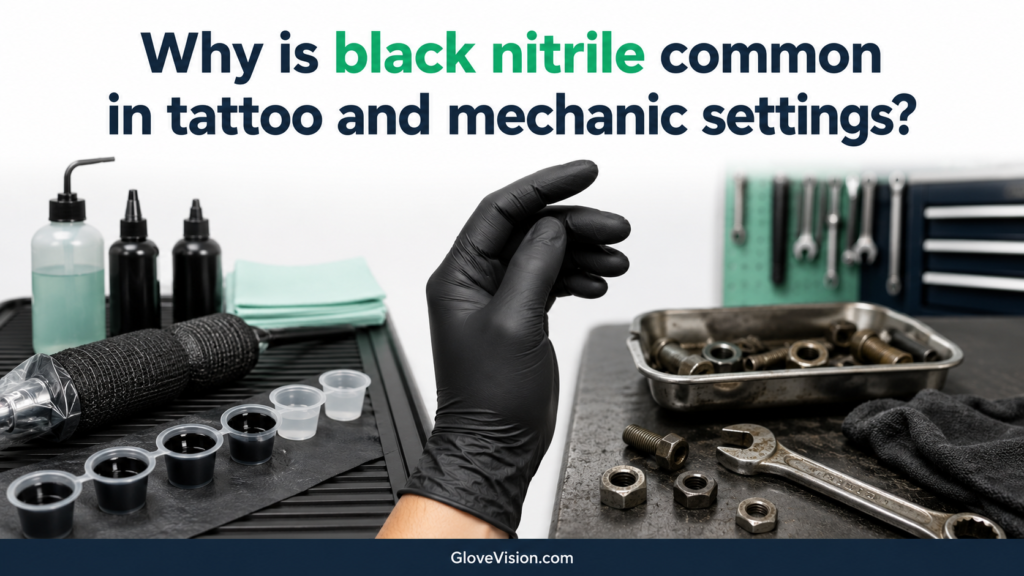
Why is black nitrile common in tattoo and mechanic settings?
Black Nitrile Gloves are common in tattoo and mechanic settings because the dark color may reduce the visible appearance of black ink, grease, grime, oils, and shop residue while supporting a consistent professional look. Color does not prove safety, cleanliness, chemical resistance, puncture resistance, tattoo suitability, mechanic suitability, or medical suitability.
This article covers black color and visibility, nitrile comparison with vinyl and latex, tattoo/body-art and mechanic task selection, fit and donning, sharps, tear, and chemical response, and a final performance and safety checklist.
This article provides educational guidance about Black Nitrile Gloves in tattoo, body-art, mechanic, automotive, maintenance, and short-use task settings. It does not replace product labeling, manufacturer documentation, chemical compatibility data, Safety Data Sheets, medical or examination glove requirements, local tattoo/body-art rules, workplace policy, infection-control procedures, or exposure-response protocols.
Why can standard Black Nitrile Gloves reduce the visibility of dark stains, inks, or grease?
Standard Black Nitrile Gloves can reduce the visibility of dark stains, inks, or grease because the dark surface may visually conceal some black ink, grime, oils, carbon residue, or shop contaminants.
They still belong within the wider short-use category of Disposable Gloves, where material, thickness, color, labeling, and task duration all matter.
What does black color do in Black Nitrile Gloves?
Black Nitrile Gloves may use black pigments or colorants to create a dark glove surface. The exact pigment system and color stability are product-specific and should not be assumed unless manufacturer documentation supports it.
Why may black gloves look useful in tattoo or mechanic work?
Black color may reduce the visible appearance of black tattoo ink, dark grease, grime, carbon residue, oils, and dark shop contaminants. This can support a cleaner professional appearance in some tattoo, body-art, mechanic, or maintenance settings.
What is the downside of black color?
Black color can also make some contamination harder to see. Black color may improve appearance and reduce visible mess, but it may also reduce visual detection of some dark contaminants.
What should the article avoid saying?
The article should not say black color proves the glove is clean, safer, chemically resistant, puncture-resistant, tattoo-safe, mechanic-safe, or able to guarantee contamination detection. It also should not say color replaces inspection or glove changes.
What is the safer explanation?
Black Nitrile Gloves are common partly because the dark surface can support professional appearance, reduce visible staining, and create a consistent visual standard in some work settings. Color is only a visual cue; safety still depends on material, fit, documentation, task exposure, and correct glove use.
Use this matrix to keep black color benefits separate from unsupported safety claims.
| Color Feature | Possible Benefit | Possible Detection Limit | What Color Does Not Prove | Verification Needed |
|---|---|---|---|---|
| Black surface | Reduces visible dark staining | May hide dark contamination | Cleanliness or safety | Inspection procedure |
| Ink stain concealment | Cleaner visual appearance | May reduce ink/residue visibility | Tattoo safety | Local rules / product labeling |
| Grease concealment | Professional shop appearance | May hide grime or oil transfer | Compatibility | Manufacturer data / SDS |
| Consistent glove color | Workflow standardization | Can create false confidence | Professional hygiene | Facility SOP |
| Dark contrast against light surfaces | May improve hand outline | Less useful on dark backgrounds | Puncture resistance | Task inspection rule |
Black color can support appearance and workflow recognition, not safety approval.
How do heavy-duty Black Nitrile Gloves compare with other polymers under solvent, oil, and grease exposure?
Heavy-duty Black Nitrile Gloves may compare favorably with some vinyl or latex options in certain oil, grease, fit, or grip tasks, but chemical and durability performance must remain product-specific.
How should Black Nitrile Gloves be discussed around oils and grease?
Black Nitrile Gloves may be suitable for some oil, grease, grime, or petroleum-related tasks, but compatibility depends on exact glove model, nitrile formulation, thickness, texture, substance, concentration, contact duration, temperature, manufacturer compatibility or permeation data, and workplace policy.
Do not claim all Black Nitrile Gloves resist gasoline, brake fluids, paint thinners, parts-washer solvents, or aggressive chemicals. Chemical claims should be routed to exact compatibility or permeation data, and users may need a documented Chemical-Resistant Lab Gloves approach for stronger exposures.
How should Black Nitrile Gloves be compared with vinyl gloves?
Nitrile and vinyl may perform differently in fit, elasticity, tear resistance, and chemical compatibility. The safer comparison is that Black Nitrile Gloves may be preferred for some mechanic or tattoo workflows because some nitrile products offer useful fit, durability, and grip, but product documentation must confirm suitability.
How should Black Nitrile Gloves be compared with latex gloves?
Properly labeled latex-free Black Nitrile Gloves are not made from natural rubber latex and are not expected to contain natural rubber latex proteins. That may reduce Type I natural rubber latex allergy concern for latex-sensitive users, but nitrile should not be described as universally better than latex.
Latex comparison should consider allergy risk, facility latex policy, elasticity needs, tactile needs, chemical compatibility, product labeling, and task exposure.
How should puncture and tear resistance be handled?
Puncture and tear performance depends on material, formulation, thickness, texture, fit, task stress, sharp edges, manufacturer testing, and intended use. OSHA hand-protection rules frame glove selection around hazards such as cuts, abrasions, punctures, chemical burns, and harmful substances, but they do not prove nitrile thickness-specific performance. [OSHA — Hand Protection]
What is the safe comparison rule?
Choose Black Nitrile Gloves by documented task suitability, not by color or material name alone.
Use this table to separate possible nitrile fit from documentation limits and alternative glove needs.
| Exposure Type | Possible Nitrile Fit | Main Limit | Documentation Needed | Alternative Needed If Unsupported |
|---|---|---|---|---|
| Tattoo ink/contact fluids | May support disposable barrier use | Not tattoo-safe by color | Product labeling / local rules | Medical/exam glove if required |
| Oil and grease | May fit some short-use tasks | Not universal petroleum protection | Compatibility data | Chemical-resistant glove |
| Brake fluid / solvents | Product-specific only | Aggressive chemical risk | SDS / permeation data | Specialized chemical glove |
| Vinyl comparison | Nitrile may offer better fit in some products | Vinyl claims must be tested | Product specs | Task-matched glove |
| Latex comparison | Latex-free option when labeled | Not always more elastic | Latex-free documentation | Latex or other glove if policy allows |
| Sharp/abrasive tasks | May support some durability | Not cut-proof or puncture-proof | Durability testing | Cut-resistant or work glove system |
Color, material name, and thickness are not substitutes for exposure-specific documentation.
Which disposable Black Nitrile Gloves balance tear resistance and tactile feedback during tattoo or mechanic work?
Disposable Black Nitrile Gloves balance tear resistance and tactile feedback during tattoo or mechanic work only when glove thickness, formulation, fit, texture, exposure risk, labeling, and workplace policy match the task.
When may Black Nitrile Gloves fit tattoo or body-art work?
Black Nitrile Gloves may be selected in tattoo or body-art settings for professional appearance, ink stain management, tactile control, glove color consistency, latex-free preference, disposable barrier use, and workflow standardization.
Tattoo, piercing, body-art, cosmetic, or client-contact use must follow local rules, facility policy, product labeling, and exposure-control requirements. Medical-category boundaries should be checked against Medical Gloves requirements when a medical glove category is needed. [FDA — Medical Gloves]
What should be verified for tattoo or body-art use?
Verify product labeling, medical or examination use when required, latex-free status if needed, fit and dexterity, tear resistance, barrier documentation, local body-art rules, facility infection-control policy, and sharps exposure response procedures.
When examination-level contact is required, Examination Gloves context is more relevant than color preference alone.
When may Black Nitrile Gloves fit mechanic or automotive work?
Black Nitrile Gloves may be considered for some mechanic or automotive tasks involving grease, grime, light tool handling, short-duration maintenance, parts inspection, oily equipment, shop cleanup, and non-sharp handling.
Sharp metal, solvents, brake fluids, fuels, adhesives, oils, and parts-washer chemicals require product-specific compatibility review. For heavier reusable or abrasion-focused work, the broader Work Gloves and Mechanic Gloves categories may be better owner pages.
How should thickness be handled?
Do not assign universal thickness ranges for tattoo or mechanic tasks. Choose a product-documented balance of tactile feedback, durability, grip texture, fit, tear resistance, chemical compatibility, task duration, and facility or workplace policy.
When should another glove or handling system be considered?
Consider another documented glove or handling system when the task involves sharp metal, repeated snagging, long solvent contact, aggressive chemicals, heavy abrasion, high heat, cut risk, hazardous drug or biohazard exposure, or task conditions beyond disposable nitrile labeling. Sterile or surgical contexts should be evaluated through Surgical Gloves requirements rather than black color preference.
Use this workflow table before selecting black nitrile for tattoo, body-art, mechanic, maintenance, chemical, or sharps-related tasks.
| Workflow Step | Verification Question | Safe Action | Documentation Needed |
|---|---|---|---|
| Identify Task | Is the task tattoo, body-art, mechanic, maintenance, chemical, or sharps-related? | Separate the task before choosing gloves | Facility/workplace SOP |
| Check Client/Patient Contact | Is body-art, cosmetic, or patient-contact work involved? | Confirm labeling and local rules | Product label / local rules |
| Check Chemical Exposure | Are solvents, fuels, oils, disinfectants, or reagents involved? | Verify exact compatibility | SDS / compatibility data |
| Check Mechanical Risk | Are sharps, wires, sharp metal, tools, or abrasion present? | Match glove to risk or use another system | Task risk assessment |
| Check Fit and Dexterity | Can the user grip tools or control tattoo/body-art tasks? | Choose controlled fit | Facility-approved product list |
| Select Approved Product | Does the glove match task, exposure, fit, and policy? | Use documented approved glove | Product spec / workplace policy |
Tattoo and mechanic workflows may both prefer black gloves, but selection rules are not the same.
How should technicians fit and don protective Black Nitrile Gloves to reduce hand fatigue and preserve barrier integrity?
Technicians should fit and don protective Black Nitrile Gloves by choosing controlled fit, avoiding default sizing down, donning gently, checking grip texture, and following setting-specific hand hygiene.
Step 1: Select the best-fitting approved glove
Choose Black Nitrile Gloves that fit securely without loose fingertips, palm bunching, cuff slippage, severe webbing tension, restricted thumb movement, circulation restriction, reduced grip control, or early hand fatigue. The goal is controlled fit, not maximum tightness.
Step 2: Avoid sizing down as a default fix
Do not automatically size down to improve tactile feel or reduce slack. Sizing down may increase hand fatigue, glove stress, webbing pressure, tearing risk, reduced circulation, and reduced dexterity.
Step 3: Don Black Nitrile Gloves gently
Don Black Nitrile Gloves without excessive cuff pulling, fingernail pressure, twisting, webbing overstretching, or forcing the glove over wet hands unless product instructions allow it. Rough donning can damage cuff, palm, or finger areas.
Step 4: Check grip texture for the task
Textured fingertips or textured palms may help with some wet, oily, or tool-control tasks. Grip performance depends on glove texture, surface condition, oil or fluid type, tool shape, glove fit, hand fatigue, task duration, and product documentation.
Step 5: Follow setting-specific hand hygiene
Black Nitrile Gloves do not replace hand hygiene. Hands should be cleaned before donning when required and after glove removal according to the relevant tattoo, body-art, healthcare, industrial, mechanic, or workplace procedure. CDC hand-hygiene guidance states that gloves are not a substitute for hand hygiene. [CDC — Hand Hygiene]
This supporting table sits inside the fit/donning section. It is not a sixth proof asset.
| Checklist Item | What to Verify | Safe Action | Why It Matters |
|---|---|---|---|
| Size | Does the glove fit securely without excess slack? | Choose best-fitting approved size/model | Reduces bunching and stress points |
| Fingertip Fit | Are fingertips controlled without extra material? | Select better finger length if needed | Preserves tactile control |
| Palm Fit | Is the palm smooth during gripping? | Avoid heavy folds or wrinkles | Improves tool and instrument control |
| Cuff Fit | Does cuff stay in place without overstretching? | Avoid hard cuff pulling | Reduces cuff damage |
| Texture | Does texture match wet, oily, or dry task conditions? | Use documented texture suited to task | Supports grip control |
| Grip Control | Can user control tools or instruments safely? | Reassess glove model if grip slips | Reduces handling error |
| Fatigue | Are cramping, numbness, or stiffness appearing? | Reassess fit, thickness, and task match | Prevents loss of control |
| Hand Hygiene | Are hands cleaned according to procedure? | Clean before/after use as required | Gloves do not replace hygiene |
Fit and donning protect control and barrier integrity; they do not make an unsuitable glove suitable.
What immediate protocols address compromised Black Nitrile Gloves when sharps, tears, or chemical swelling occur?
Immediate protocols for compromised Black Nitrile Gloves should stop the task safely, remove the glove, follow hygiene or exposure response, report sharps incidents when required, and reassess glove selection.
What should happen after a tear or puncture?
If Black Nitrile Gloves tear, puncture, split, or visibly fail, stop safely, maintain control of tools or materials, remove the compromised glove, perform hand hygiene or exposure response, inspect skin if injury or exposure is possible, replace with a suitable glove, and reassess whether the selected glove matched the task.
OSHA bloodborne-pathogen requirements include replacing disposable gloves as soon as practical when contaminated or as soon as feasible when torn, punctured, or barrier-compromised. [OSHA — Bloodborne Pathogens]
What should happen after a tattoo needle, piercing needle, or sharps injury?
If a tattoo needle, piercing needle, or contaminated sharp punctures the glove and skin, stop safely, remove the glove, wash the puncture or cut with soap and water, flush splashes as appropriate, report the incident according to workplace policy, seek medical evaluation according to exposure protocol, and document the exposure context if required.
CDC/NIOSH bloodborne infectious disease guidance supports washing needlestick or sharp punctures and cuts, flushing splashes, reporting the incident, and seeking evaluation according to protocol. [CDC/NIOSH — Sharps Response]
What should happen after sharp metal or tool damage?
If jagged metal, wire, tool edges, or rough surfaces repeatedly damage Black Nitrile Gloves, stop safely, avoid pulling against caught glove material, remove the glove if compromised, check for injury or exposure, and use a documented higher-durability glove or safer handling method if repeat failures occur.
What should happen after chemical swelling or softening?
If solvents, fuels, grease, oils, paint thinners, cleaning chemicals, disinfectants, parts-washer fluids, or task chemicals cause swelling, softening, cracking, stickiness, discoloration, or integrity loss, stop exposure safely, remove the glove, reduce skin exposure risk, perform hygiene or exposure response, check compatibility or permeation data, and replace with a glove documented for that chemical and contact duration.
What should happen after possible contamination?
If glove failure may involve blood, body fluids, tattoo fluids, clinical contamination, industrial chemicals, shop chemicals, or workplace contamination, follow the relevant workplace protocol. This may include exposure reporting, medical evaluation, surface cleaning, tool cleaning, glove substitution, chemical compatibility review, and workflow correction.
Use this response matrix to connect incident type with action, documentation, and future prevention.
| Incident Type | Possible Cause | Immediate Action | Reporting or Documentation Need | Future Prevention |
|---|---|---|---|---|
| Tear or puncture | Sharp edge, poor fit, wrong glove | Stop, remove, hygiene, replace | Product/task review | Better documented glove |
| Needle or sharps injury | Tattoo needle, piercing needle, contaminated sharp | Wash/flush, report, seek evaluation | Exposure report | Sharps protocol and training |
| Tool or metal snag | Wire, jagged edge, rough surface | Stop, avoid pulling, remove | Task risk review | Safer handling method |
| Chemical swelling | Incompatible solvent, oil, cleaner, fuel | Stop exposure, remove glove | SDS / compatibility data | Compatible glove selection |
| Discoloration/softening | Material degradation | Remove and replace | Chemical/contact duration review | Update product choice |
| Possible contamination | Blood, tattoo fluids, shop chemicals | Follow workplace protocol | Incident record if required | Workflow correction |
Response depends on exposure procedure and product suitability, not black color.
Which checklist verifies that alternative Black Nitrile Gloves satisfy task-specific safety and performance requirements?
A checklist verifies that alternative Black Nitrile Gloves satisfy task-specific safety and performance requirements by checking color purpose, durability risk, chemical compatibility, body-art or patient-contact needs, latex avoidance, AQL meaning, fit, hand hygiene, sharps response, and chemical failure response.
Black Nitrile Gloves performance and safety checklist
Use a checklist matrix, not a checkbox box. AQL should be treated as lot-sampling or leak-quality context for surgeons’ and patient examination gloves, not as tattoo safety, puncture resistance, chemical resistance, or an individual-glove guarantee. [eCFR — 21 CFR 800.20]
Use this checklist matrix before substituting or approving an alternative black nitrile product.
| Checklist Category | Core Verification | Safe Action | Documentation Needed |
|---|---|---|---|
| Color Purpose | Is black used for appearance, stain management, workflow consistency, or contrast? | Treat color as a visual cue only | Facility/workplace SOP |
| Task Durability | Are needles, sharp hardware, wire, rough surfaces, oils, or repeated gripping present? | Select documented durability | Product spec / task policy |
| Chemical Compatibility | Are solvents, fuels, oils, cleaners, thinners, or reagents involved? | Verify exact chemical, concentration, duration, and glove model | SDS / compatibility data |
| Body-Art / Patient Contact | Is tattoo, piercing, cosmetic, or client/patient contact involved? | Confirm labeling, local rules, and exposure-control requirements | Product label / local rules |
| Latex Avoidance | Is latex avoidance needed? | Use properly labeled latex-free Black Nitrile Gloves | Product documentation |
| AQL Meaning | Is AQL being interpreted correctly? | Treat AQL as lot-sampling/leak-quality only | Product info / eCFR |
| Fit and Grip | Does glove support secure grip without restriction? | Choose best-fitting approved model | Facility-approved list |
| Hand Hygiene | Are hands cleaned before/after use as required? | Reinforce gloves do not replace hygiene | CDC / facility procedure |
| Sharps Response | Is the team ready for needlestick, cut, or puncture exposure? | Stop, remove, wash/flush, report, seek evaluation per protocol | Exposure protocol |
| Chemical Failure | Is the team ready for swelling, softening, cracking, or discoloration? | Stop exposure, remove glove, check compatibility, replace | SDS / manufacturer data |
This checklist verifies readiness; it does not approve a glove beyond its documentation.
Conclusion
Black Nitrile Gloves are common in tattoo and mechanic settings because they may support professional appearance, dark stain management, latex-free selection when labeled, grip control, and workflow consistency.
Black color does not prove cleanliness, chemical compatibility, puncture resistance, tattoo safety, medical suitability, solvent protection, or professional hygiene. Final selection still depends on material, formulation, thickness, labeling, task exposure, chemical data, fit, local rules, workplace policy, sharps response, and correct glove use.
Frequently Asked Questions
Are Black Nitrile Gloves safer than other glove colors?
No. Black Nitrile Gloves are not safer because of color alone. Safety depends on material, formulation, thickness, labeling, task exposure, compatibility data, and facility policy.
Why do tattoo artists use Black Nitrile Gloves?
Tattoo artists may use Black Nitrile Gloves because the dark color can reduce visible ink staining, support professional appearance, and create workflow consistency, but product suitability still requires documentation and local rule compliance.
Are Black Nitrile Gloves good for mechanic work?
Black Nitrile Gloves may fit some mechanic tasks involving grease, grime, or short-duration handling, but sharp metal, solvents, fuels, and aggressive chemicals require product-specific compatibility and durability review.
Are Black Nitrile Gloves latex-free?
Properly labeled latex-free Black Nitrile Gloves are not made from natural rubber latex, but users should verify product documentation and remember that latex-free does not mean irritation-proof.
Can Black Nitrile Gloves protect against solvents?
Only if manufacturer compatibility or permeation data supports the exact solvent, concentration, glove model, material, thickness, and contact duration.
What should users do if Black Nitrile Gloves tear or swell?
Users should stop safely, remove the compromised glove, follow hand hygiene or exposure response, replace the glove, and reassess product suitability for the task or chemical.