
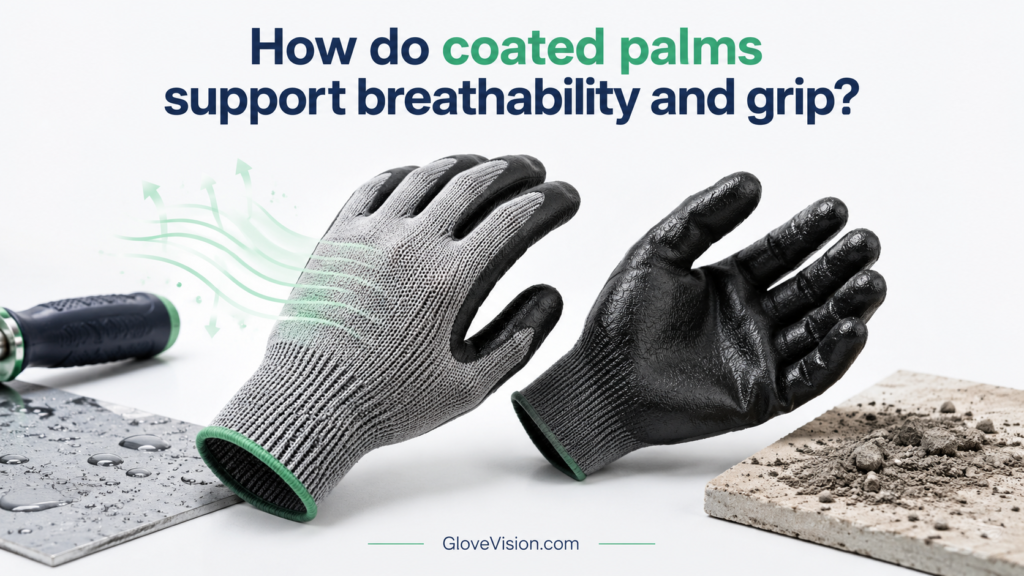
How do coated palms support breathability and grip?
Coated palms support grip by adding a handling-zone coating where the glove contacts tools or materials, while breathability may depend on knit liner structure, uncoated back areas, coating coverage, glove fit, temperature, humidity, workload, and wear time. Coated palms do not guarantee airflow, sweat prevention, chemical resistance, heat resistance, or universal grip.
This article covers grip and breathability trade-offs, mechanical ratings and airflow data as separate signals, coating-to-task matching, fit and donning practices, failure response, and a final breathability, grip, and safety verification checklist.
This article is educational only. Coated-palm glove suitability must be determined by hazard assessment, manufacturer documentation, current standards, SDS review, site PPE policy, coating, liner, fit, exposure, and procedure.
How do standard coated palms balance physical grip with breathability and moisture control?
Standard coated palms balance physical grip with breathability and moisture control by combining a coated handling surface with a liner and less-coated areas that may allow more air movement than fully coated designs.
Use Work Gloves as the broader category boundary, then narrow coated-palm selection by coating coverage, liner design, task exposure, and site procedure.
What makes coated palms different?
Coated palms usually combine a textile or knit glove liner with a polymer coating applied to the palm, fingers, or selected handling zones. The coating may support grip and abrasion resistance, while uncoated or less-coated areas may allow more air movement than a fully coated glove.
How can partial coating support breathability?
The uncoated back or lighter liner areas may allow more air movement and moisture vapor release than fully coated designs, but breathability still depends on liner material, coating coverage, coating thickness, glove size, cuff design, temperature, humidity, workload, wearer sweating pattern, and task duration.
How does palm coating support grip?
The palm coating may help create friction between the hand and the handled surface. OSHA hand-protection rules still require appropriate hand protection to be selected for the actual hazard, including cuts, abrasions, punctures, harmful substances, chemical burns, thermal burns, and harmful temperature extremes. [OSHA]
What should the article avoid saying?
Avoid saying coated palms prevent sweating, guarantee breathability, provide continuous heat transfer, always reduce perspiration buildup, always improve grip, stay breathable in every environment, or prove chemical or heat resistance by coating type alone.
What is the safer explanation?
Coated palms may support a balance between grip and comfort when the coating coverage, liner, fit, task, and environment are properly matched.
Table 1. Coated-palm design features compared by grip benefit, breathability benefit, comfort limit, and verification need.
| Design Feature | Possible Grip Benefit | Possible Breathability Benefit | Comfort Limit | Verification Needed |
|---|---|---|---|---|
| Palm coating | May improve friction on handled surfaces | Limited to coated zone; not airflow feature | Can increase heat in palm area | Coating material and coverage |
| Uncoated back | No direct grip benefit | May allow more air movement | Depends on liner and workload | Liner and design documentation |
| Knit liner | Supports fit and flexibility | May support moisture vapor movement | Comfort varies by fiber and density | Product spec / wearer trial |
| Foam nitrile coating | May help in some wet/oily tasks | Coating coverage still limits airflow | Not universal oil/chemical solution | Manufacturer data / SDS review |
| PU coating | May support dry tactile control | Often lighter coating feel | May wear in abrasive tasks | Product data / task match |
| Latex coating | May support grip on some coarse materials | Breathability depends on coverage | Latex sensitivity concern | Labeling / site policy |
| Fuller coating coverage | May improve coverage in some handling tasks | Usually less open than partial coating | Can increase heat buildup | Product design and work trial |
Treat breathability and grip as product-specific trade-offs, not universal coating promises.
Why should industrial coated palms use mechanical ratings and airflow data as separate selection signals?
Industrial coated palms should use mechanical ratings and airflow data as separate selection signals because mechanical protection, breathability, comfort, and grip measure different glove properties.
What do mechanical ratings show?
Industrial coated-palm gloves may carry mechanical-risk markings or documentation such as EN 388 or ANSI/ISEA 105. EN 388 includes physical tests for abrasion, cutting, tearing, and puncture, while ANSI/ISEA 105-2024 covers hand-protection performance properties and cut levels such as A1–A9 as selection aids. [SATRA] [ANSI]
What do mechanical ratings not show?
Mechanical ratings do not directly prove airflow, breathability, sweat reduction, comfort, chemical resistance, heat resistance, grip in oil, glove fit, protection near rotating machinery, or real-world durability after wear.
How should airflow data be handled?
Air-permeability data may help compare textile components, liner materials, or glove zones. ASTM D737 measures air permeability of textile fabrics under defined test conditions, but it does not prove full-glove comfort or sweat prevention. [ASTM]
Why should EN 388 not be used as a breathability score?
A higher mechanical rating does not automatically mean the glove is denser, less permeable, hotter, or less breathable. Mechanical protection and breathability must stay separate selection signals.
What is the safe standard-use rule?
Use mechanical ratings to understand tested mechanical performance, and use separate product data or workplace trials to evaluate breathability, comfort, and task fit. ISEA describes ANSI/ISEA 105-2024 as a classification and marking system across properties including cut, puncture, abrasion, chemical permeation/degradation, and heat-related properties. [ISEA]
Table 2. Mechanical ratings, airflow data, comfort claims, workplace trials, and chemical documentation interpreted as separate signals.
| Signal Type | What It Measures | What It Does Not Prove | Where to Verify | Selection Rule |
|---|---|---|---|---|
| EN 388 mechanical rating | Abrasion, cut, tear, puncture, impact where applicable | Airflow or sweat reduction | EN marking / product data | Use only for mechanical-risk context |
| ANSI/ISEA 105 rating | Cut, abrasion, puncture and other classified properties | Comfort or field guarantee | Product marking / standard context | Treat as selection aid |
| ASTM D737 air permeability | Airflow through textile fabric under defined conditions | Whole-glove comfort | Product test data | Use separately from EN/ANSI ratings |
| Manufacturer comfort claim | Product-specific comfort context | Universal breathability | Product spec / work trial | Confirm under actual use |
| Workplace trial | User and task-specific fit/comfort | Standardized lab score | Site PPE evaluation | Pair with documentation |
| SDS / chemical data | Chemical hazard and precautions | Grip or breathability | SDS / compatibility data | Use for chemical boundary |
Do not use a mechanical rating as a comfort, airflow, or sweat-reduction score.
Which specific coated palms may support grip and airflow for dry, wet, or oily tasks?
Specific coated palms may support grip and airflow for dry, wet, or oily tasks only when the coating type, liner, coverage, texture, fit, and exposure match the actual task conditions.
How should polyurethane-coated palms be described?
Polyurethane-coated palms may support tactile control and dry handling in some precision, assembly, packaging, or light-duty tasks. For high-dexterity production contexts, compare the decision with Assembly Gloves rather than treating any coating as universally precise.
How should foam nitrile or sandy nitrile coated palms be described?
Foam nitrile, sandy nitrile, or textured nitrile coatings may support grip in some wet, oily, or mixed handling conditions. For oily tool-control tasks, compare the task with Mechanic Gloves when automotive or maintenance handling becomes the better fit.
How should latex-coated palms be described?
Latex-coated or crinkle-latex palms may support grip on some dry, rough, or coarse materials, but they may be unsuitable for latex-sensitive workers or latex-reduced workplaces. Latex coating does not prove chemical resistance, heat resistance, universal grip, cut resistance, medical suitability, or skin tolerance.
How should coating selection be made?
Coating selection should consider dry, wet, oily, dusty, or abrasive surface conditions, required dexterity, grip force, hand fatigue, chemical exposure, heat exposure, latex sensitivity, surface texture, wear rate, manufacturer data, and site PPE policy. For rugged or heavy handling, compare whether Rigger Gloves are the better task-specific owner page.
What is the safe coating rule?
No single coating provides universal grip and breathability. Use coating type as a starting point, then verify the exact glove against the task, environment, exposure, and manufacturer documentation.
Table 3. Workflow for matching coated palms to surface condition, grip need, breathability need, risk checks, product data, and site approval.
| Workflow Step | Verification Question | Safe Action | Documentation Needed |
|---|---|---|---|
| Identify Surface | Is the handled surface dry, wet, oily, dusty, rough, smooth, or chemically contaminated? | Define surface before choosing coating | Task review / hazard assessment |
| Identify Grip Need | Does the task require lifting, tool control, precision, or coarse handling? | Match grip texture to handling need | Product data |
| Check Breathability Need | Is the task long-duration, hot, humid, or high-movement? | Review liner, back-of-hand design, coating coverage | Product spec / work trial |
| Check Chemical/Heat/Allergy Risks | Are chemicals, heat, cold, or latex sensitivity relevant? | Do not rely on coating type alone | SDS / labeling / site policy |
| Review Manufacturer Data | Does product documentation support the task? | Confirm coating, liner, rating, limits | Manufacturer specification |
| Select Approved Glove | Is the glove approved for the task and site? | Use only documented approved option | Site PPE policy |
Surface condition and task exposure should decide the coating path before approval.
How should operators don and fit protective coated palms to reduce heat buildup, slippage, and hand fatigue?
Operators should don and fit protective coated palms by choosing the best-fitting approved glove, aligning the palm coating, preparing hands according to procedure, monitoring moisture, and controlling snag risk.
For construction-style tasks, compare site conditions with Construction Gloves when abrasion, rebar, rough lumber, masonry, or jobsite tool handling becomes the primary page lens.
Step 1: Select the best-fitting approved glove
Choose coated-palm gloves that fit securely without excess fingertip slack, palm bunching, severe webbing tension, restricted thumb movement, reduced circulation, loose cuff material, poor grip control, or early hand fatigue.
Step 2: Align the palm coating before work begins
After donning, check that the palm coating sits in the handling zone, fingertips are seated correctly, seams do not twist across the fingers, the cuff is secure but not restrictive, the liner is not bunched, and the coating is not cracked, peeling, or misaligned.
Step 3: Keep hand preparation setting-specific
Follow the relevant workplace, manufacturing, laboratory, food-service, industrial, or facility procedure before donning when required and after glove removal. Dry hands before donning when the glove instructions and workplace procedure require it.
Step 4: Monitor heat and moisture buildup
Coated palms may reduce heat buildup compared with fully coated alternatives in some tasks, but they cannot prevent sweating. Reassess glove choice if the worker notices slipping, wet liner feel, heavy sweating, skin irritation, reduced grip control, bunching, reduced tactile feedback, or early fatigue.
Step 5: Control snag and rotating-machinery risk
Loose or damaged coated-palm gloves can catch on tool edges, rough hardware, moving parts, rotating shafts, powered spindles, drills, lathes, conveyors, or exposed mechanisms. OSHA machine-guarding rules address hazards such as point of operation, ingoing nip points, rotating parts, flying chips, and sparks; gloves alone do not make rotating-equipment tasks safe. [OSHA]
Supporting table. Fit, breathability, and snag-risk checklist; this is not a sixth proof asset.
| Checklist Item | What to Verify | Safe Action | Safety / Comfort Outcome |
|---|---|---|---|
| Size | Does glove fit without slack or restriction? | Choose best-fitting approved size/model | Better control and lower fatigue |
| Palm Alignment | Is coating aligned with handling zone? | Reseat glove before work | More consistent grip |
| Hand Cleaning | Are hands cleaned/dried as procedure requires? | Follow setting-specific procedure | Reduced contamination and slippage |
| Moisture | Is liner wet or heat buildup excessive? | Change/reassess glove as needed | Better comfort control |
| Grip | Is grip stable on actual surface? | Check coating, wear, oil, dust, water | Reduced handling error |
| Snag Risk | Are loose cuffs or damaged zones present? | Avoid snag-prone fit/tasks | Lower entanglement risk |
| Replacement Trigger | Is coating cracked, peeling, slick, torn, or saturated? | Stop and replace | Maintained task suitability |
Fit and palm alignment support comfort, but they do not replace hazard controls or replacement rules.
What immediate steps address failure or degradation in compromised coated palms during active use?
Immediate steps for compromised coated palms should stop the task safely, secure the tool or material, remove the damaged glove, check for injury or exposure, and replace it with a product documented for the task.
What should happen after tearing, seam splitting, or cut breach?
If coated-palm gloves tear, split, puncture, lose coating, or expose the hand, stop the task safely, maintain control of tools or materials, remove the compromised glove according to procedure, clean hands or follow exposure response as appropriate, inspect for injury or contamination, and replace with a glove documented for the task.
What should happen after coating peeling or grip loss?
If the coating peels, cracks, flakes, becomes slick, or loses grip, stop the task safely, secure the tool or material, inspect the coating and handled surface, check for oil, water, dust, wear, or chemical contamination, and replace the glove if grip is compromised.
What should happen after saturation or chemical softening?
If oils, solvents, cleaning chemicals, disinfectants, fuels, lubricants, or task liquids cause coated-palm gloves to swell, soften, become sticky, peel, or lose integrity, stop exposure safely, remove the degrading glove, reduce skin exposure risk, and clean hands according to the contaminant and site procedure.
For chemical exposure, consult manufacturer compatibility or permeation data and compare the task with Chemical-Resistant Lab Gloves boundaries rather than relying on coating type alone. OSHA SDS guidance explains that SDSs include hazards, protective measures, and safety precautions for chemicals. [SDS]
What should happen near rotating equipment?
If the task involves drills, lathes, rotating shafts, powered spindles, conveyors, or other entanglement hazards, stop and assess whether gloves are appropriate, follow site machinery procedures, use guarding and safe work controls, avoid loose, damaged, or oversized gloves, and do not rely on coating type or rating alone.
OSHA lockout/tagout rules address control of hazardous energy during service and maintenance where unexpected energization, startup, or stored energy could injure workers. [OSHA]
What wording should be avoided?
Avoid barrier bypass, prevent sweating, guaranteed grip, one coating fits all, EN 388 proves breathability, AQL applies to cleanroom by default, coating type proves chemical resistance, or exact heat limits without product data. Wet cleaning-chemical tasks may need a separate Cleaning Gloves review.
Table 4. Coated-palm failure, saturation, chemical softening, grip loss, snagging, and task-mismatch response matrix.
| Failure Type | Possible Cause | Immediate Action | Documentation Check | Future Prevention |
|---|---|---|---|---|
| Tearing or puncture | Sharp edge, wrong glove, wear | Stop, remove, inspect, replace | Rating / product suitability | Match glove to hazard |
| Seam splitting | Poor fit, stress, wear | Stop and replace | Product quality / fit | Reassess size and model |
| Coating peeling | Abrasion, age, chemical contact | Stop if grip/barrier is affected | Product wear guidance | Choose better coating if documented |
| Grip loss | Oil, water, dust, wear, surface mismatch | Secure tool/material and replace if needed | Coating and task data | Match grip to surface |
| Saturation | Water, oil, liquid exposure | Remove and clean hands per procedure | SDS / compatibility data | Select compatible glove |
| Chemical softening | Incompatible solvent/chemical | Stop exposure and remove glove | SDS / manufacturer compatibility data | Use chemical-documented glove |
| Snagging | Loose fit, damaged glove, moving parts | Stop and follow machinery procedure | Site machine policy | Improve fit and guarding controls |
| Task mismatch | Wrong coating or rating for exposure | Stop using for task | Hazard assessment / site PPE policy | Update selection and training |
Failure response starts with stop, secure, remove, inspect, and replace.
Which checklist verifies that alternative coated palms meet task-specific breathability, grip, and safety requirements?
A checklist verifies that alternative coated palms meet task-specific breathability, grip, and safety requirements by checking hazard, mechanical rating, breathability signals, coating match, latex sensitivity, fit, rotating-machinery risk, chemical or heat limits, hand cleaning, medical or cleanroom context, and failure response.
Coated-Palm breathability, grip, and safety verification checklist
Use a checklist matrix, not a checkbox box. The goal is to keep grip, comfort, rating, coating, and safety claims tied to actual task conditions.
Table 5. Final coated-palm verification checklist for breathability, grip, rating, surface condition, chemicals, heat, machinery, hand cleaning, and failure response.
| Checklist Category | Core Verification | Tactical Action | Documentation Needed |
|---|---|---|---|
| Hazard | Are abrasion, cut risk, puncture, friction, heat, cold, chemicals, sharp hardware, or grip loss present? | Select glove by hazard assessment | Job hazard analysis / site SOP |
| Mechanical Rating | Does glove carry relevant EN 388, ANSI/ISEA, or site-required rating? | Use rating as selection aid, not breathability score | Product marking / current standard |
| Breathability | Is long wear, high movement, heat, humidity, or moisture control important? | Review liner, coating coverage, cuff, fit, airflow/comfort data | Product spec / work trial |
| Coating Match | Is surface dry, wet, oily, dusty, rough, smooth, or abrasive? | Match PU, nitrile, latex, leather, or other option to actual surface | Manufacturer data |
| Latex Check | Will latex-coated gloves be used? | Check latex-sensitive users or latex-reduced workplace rules | Product labeling / site policy |
| Fit/Snag Risk | Is there slack, loose cuff, severe tightness, or palm bunching? | Choose secure fit and avoid snag-prone use | Fit trial / supervisor review |
| Rotating Machinery | Are drills, lathes, shafts, spindles, conveyors, or rotating parts involved? | Follow guarding, lockout, and entanglement controls | OSHA/site machinery procedure |
| Chemical/Heat Limit | Are solvents, oils, fuels, cleaners, disinfectants, lubricants, heat, cold, or hot surfaces involved? | Verify limits before use; do not infer resistance from coating | SDS / manufacturer data |
| Hand Cleaning | Are users following correct cleaning and donning procedure? | Clean/dry hands as required before/after glove use | Site procedure |
| Medical/Cleanroom Context | Is this patient-care or controlled cleanroom work? | Use correct medical/cleanroom standards; do not apply AQL by default | Facility standard / product label |
| Failure Response | Are users trained for peeling, splitting, saturation, softening, grip loss, or tearing? | Stop, secure tools/materials, remove glove, inspect, replace | Site PPE response procedure |
The checklist keeps breathability, grip, and safety claims tied to real task conditions.
Sources & Evidence Boundaries
This final page uses 8 exact public sources only. Manufacturer product specifications, SDS/compatibility data, and site PPE policies remain verification documents, not public source-count entries.
- ANSI Blog — ANSI/ISEA 105-2024: Hand Protection & Cut Level Ratings supports the specific claim boundary assigned to it in this article.
- ISEA — 5 Facts About ANSI/ISEA 105-2024 supports the specific claim boundary assigned to it in this article.
- SATRA — EN 388: Protective Gloves Against Mechanical Risks supports the specific claim boundary assigned to it in this article.
- ASTM — D737-18(2023) Standard Test Method for Air Permeability of Textile Fabrics supports the specific claim boundary assigned to it in this article.
- OSHA — 29 CFR 1910.138 Hand Protection supports the specific claim boundary assigned to it in this article.
- OSHA — 29 CFR 1910.212 General Requirements for All Machines supports the specific claim boundary assigned to it in this article.
- OSHA — 29 CFR 1910.147 Control of Hazardous Energy Lockout/Tagout supports the specific claim boundary assigned to it in this article.
- OSHA — Hazard Communication Standard: Safety Data Sheets supports the specific claim boundary assigned to it in this article.
Conclusion
Coated palms can support grip and may improve comfort compared with fully coated options in some tasks when coating coverage, liner design, fit, and work conditions are properly matched. Mechanical ratings, airflow data, and workplace trials should be treated as separate signals rather than combined into one comfort or safety promise.
Coating type does not guarantee breathability, sweat prevention, chemical resistance, heat resistance, or universal grip. Selection still needs task-specific review of PU, nitrile, latex, or other coatings; palm alignment; moisture and fatigue control; snag and rotating-machinery risk; chemical and thermal boundaries; and failure replacement response.
Frequently Asked Questions
Do coated palms prevent sweating?
No. Coated palms may support comfort in some tasks, especially when less-coated areas and liners allow more air movement, but they do not prevent sweating.
Does EN 388 show whether coated palms are breathable?
No. EN 388 is a mechanical-risk standard. It does not directly measure airflow, sweat reduction, comfort, or breathability.
Are nitrile-coated palms best for oily work?
Not always. Some nitrile coatings may support grip in oily or mixed conditions, but oil and chemical performance must be checked against the exact glove, coating, exposure, and manufacturer documentation.
Are latex-coated palms safe for everyone?
No. Latex-coated palms may be unsuitable for latex-sensitive workers or latex-reduced workplaces, and latex coating does not prove chemical resistance, heat resistance, or universal grip.
Should coated-palm gloves be worn near rotating equipment?
Not automatically. Loose, damaged, or unsuitable gloves may create entanglement risk. Follow site machine-guarding, lockout, and entanglement-risk procedures.
When should coated-palm gloves be replaced?
Replace them when coating peels, cracks, becomes slick, loses grip, tears, saturates, chemically softens, exposes the hand, or no longer matches the task hazard.