
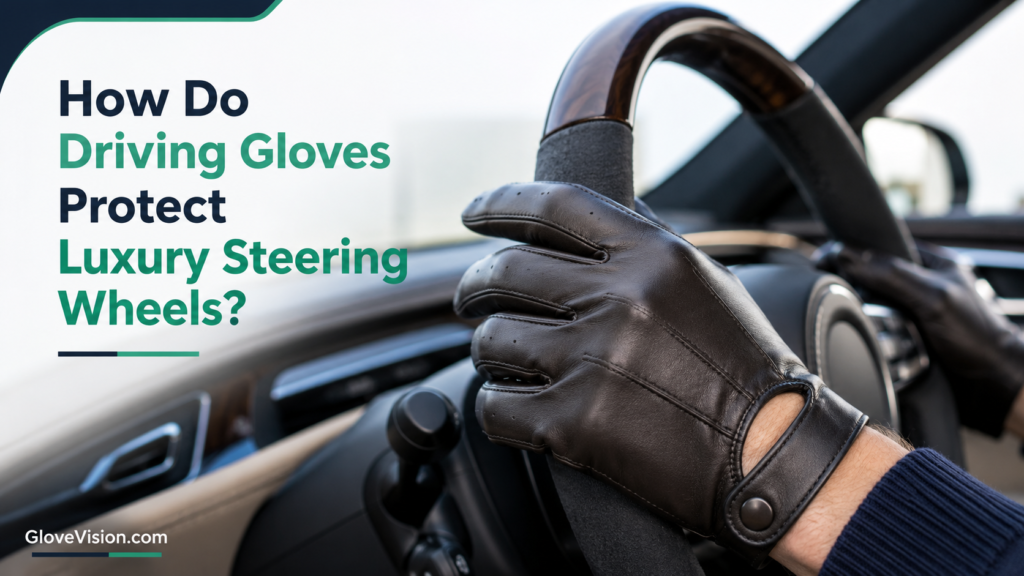
How Do Driving Gloves Protect Luxury Steering Wheels?
Luxury steering wheels repeatedly receive perspiration, skin oils, lotions, sunscreen, dirt, friction, and localized hand pressure where the driver grips and repositions the hands.
Clean, compatible Driving Gloves may create a removable contact layer that reduces some direct hand-to-wheel transfer, but unsuitable gloves can add dyes, finishes, residue, grit, raised seams, hard components, or excessive friction of their own.
Functional qualification: Driving Gloves should not be used solely to preserve a steering wheel if they reduce grip stability, interfere with hand repositioning, or restrict access to vehicle controls. Follow the vehicle manufacturer’s instructions for the exact wheel material and finish.
What Luxury Steering-Wheel Exposures Can Driving Gloves Reduce?
Driving Gloves may reduce direct transfer of some contaminants by separating the skin from the wheel, but they cannot isolate the wheel from every source of aging or damage. Their protective value depends on what reaches the glove, what remains in the palm material, and how that material interacts with the exact steering-wheel finish.
How Do Perspiration and Skin Oils Reach Luxury Steering Wheels?
Repeated bare-hand contact can leave moisture and oily residue on frequently held sections of a steering wheel. Evaporated moisture may leave dissolved residue behind, while oil can change the appearance or feel of some finishes over time. The actual effect remains material- and finish-dependent.
Repeated contact matters because the same hand zones often return to the same sections of the rim. Residue can therefore accumulate unevenly rather than uniformly across the wheel. A glove barrier may reduce some direct deposition at those high-contact zones, but it also becomes a reservoir that can carry previously collected material back to the surface if the palm is not kept in suitable condition.
How Can Lotions, Sunscreen, and Other Hand Products Affect Contact?
Lotions, sunscreen, sanitizer residue, cosmetics, fragrances, topical products, and cleaning residue may transfer from the hand to the wheel. A glove can interrupt that immediate contact, but no single product should be assumed to damage every steering-wheel surface.
Why Do Dirt and Abrasive Particles Matter?
Dust, grit, and embedded debris can alter friction and may create abrasive contact between the hand interface and the wheel. A glove that picks up grit can therefore become a repeated carrier of the very particles it was intended to keep away from the surface.
The risk is not limited to visibly large grit. Fine particles trapped in stitching channels, textured leather, perforations, or palm overlays can become a third body between glove and wheel. Under repeated pressure and sliding, that trapped debris may create localized abrasion. For this reason, a soft glove material should not be assumed nonabrasive when its contact surface is contaminated.
Where Does Driving-Glove Protection End?
Driving Gloves cannot prevent UV and heat aging, oxidation, coating failure, existing damage, incorrect cleaning, stitching deterioration, or damage caused by rings and other hard objects. They are one removable interface, not complete preservation.
How Do Driving Gloves Limit Hand-Residue Transfer?
The basic mechanism is interception: the glove sits between the hand and wheel, so some perspiration, oil, lotion, or dirt may be retained in the glove rather than deposited immediately onto the steering surface. This benefit persists only while the glove itself remains clean and compatible.
How Can Driving Gloves Intercept Perspiration and Oils?
The palm and fingers may absorb or retain some moisture and oils while separating skin from the wheel. Those contaminants can still accumulate, migrate through materials, or change the glove’s surface over time, so the barrier requires continued inspection.
How Can Driving Gloves Reduce Lotion or Sunscreen Contact?
A clean glove may limit immediate contact between treated skin and a wheel’s coating, stitching, textured insert, or decorative trim. That does not prove long-term compatibility; the glove material and any treatments on it still matter.
This barrier is most useful when the glove is donned before treated skin repeatedly touches the rim. It does not remove product already present on the wheel, and it does not guarantee that a lotion or sunscreen cannot migrate through or around the glove during extended use. Driving Gloves should therefore be viewed as one controllable contact layer, not as a chemical barrier with universal resistance.
Why Does Driving-Glove Cleanliness Matter?
A contaminated glove may repeatedly deposit oil, dirt, moisture, dye, conditioner, cleaner residue, or abrasive particles. A glove can look visually clean while still retaining invisible oil, chemicals, or embedded grit.
Cleanliness should be considered together with contact history. A glove worn while handling keys, luggage, tools, food packaging, or dusty surfaces may pick up residue that is difficult to see but relevant to a delicate wheel finish. The removable-barrier concept works only when the barrier is cleaner and more predictable than the bare-hand exposure it is intended to intercept.
Can Material Transfer Come From the Driving Glove Itself?
Yes. Unstable dyes, leather finishes, palm coatings, adhesives, silicone patterns, conditioners, or deteriorated reinforcement can transfer to the wheel. Product-specific palm construction can be designed for steering interaction, but that does not prove universal surface protection. [Porsche]

How Do Driving Gloves Affect Luxury Steering-Wheel Friction and Wear?
Contamination reduction does not guarantee lower mechanical wear. The glove changes the friction interface itself, so a useful contact layer must remain predictable during grip, repositioning, and deliberate release rather than simply maximizing friction.
How Can Driving Gloves Moderate Bare-Hand Contact?
Compatible Driving Gloves may create a more consistent contact surface and reduce direct skin drag or repeated bare-hand rubbing. The broader general Driving Gloves purpose and vehicle control still depends on the complete hand–glove–control interaction, not surface preservation alone.
Mechanical wear depends on more than the number of contacts. Contact area, pressure distribution, sliding distance, wheel texture, glove texture, and repeated hand placement all influence what happens at the surface. A well-fitted glove can spread contact smoothly, while a wrinkled palm or raised seam may concentrate force into a narrow track and create the opposite effect.
What Happens When Driving-Glove Friction Is Excessive?
Too much or inconsistent friction may contribute to localized polishing, surface dragging, texture flattening, uneven wear, glove twisting, or difficult hand repositioning. Maximum friction is therefore not the same as maximum protection.
What Happens When Driving-Glove Friction Is Too Low?
Insufficient friction can cause slipping, repeated repositioning, or greater grip effort. For a broader explanation of palm friction and coating behavior, the important principle is that friction depends on materials, contamination, moisture, surface finish, and contact pressure rather than a glove label alone.
How Can Seams and Reinforcements Mark the Wheel?
Raised palm seams, hard binding, exposed stitching, worn overlays, and reinforcement edges can concentrate contact into smaller zones. Even a soft glove body may create local abrasion if one edge repeatedly drags across the same wheel section.
Why Must Hard Hardware Stay Away From the Steering Wheel?
Hard fasteners, studs, exposed closure parts, rings, watches, or other rigid components may scratch, dent, or damage coated sections. No hard glove component or jewellery should contact the wheel during normal hand placement.
Which Luxury Steering-Wheel Materials Interact Differently With Driving Gloves?
Driving Gloves must be evaluated against the wheel material actually under the hands. Coated leather, genuine Alcantara, suede-like microfiber, finished wood, coated composite, and mixed-material wheels can respond differently to residue, friction, dye transfer, debris, and seam contact.
How Do Driving Gloves Interact With Coated Leather?
The glove normally contacts a surface finish or coating rather than untreated hide. Compatibility depends on the coating, existing wear, glove finish, dye stability, friction, cleanliness, and condition; leather-on-leather contact is not automatically safe.
Coated leather can also vary in gloss, texture, pigmentation, topcoat chemistry, perforation, stitching, and existing wear. A glove that appears compatible with one coated leather wheel cannot automatically be transferred to another vehicle. The relevant question is whether the exact glove surface remains clean, stable, non-marking, and predictable against the exact finish under normal hand pressure and repositioning.
How Should Driving Gloves Be Considered With Genuine Alcantara?
Contamination, fiber matting, texture change, and dye transfer should be considered cautiously. Alcantara publishes material-specific care guidance and cautions against aggressive treatment methods, reinforcing that the exact material should be maintained according to its own instructions rather than generic suede assumptions. [Alcantara]
Is Suede-Like Microfiber the Same as Alcantara?
No. Visual similarity does not make a generic suede-like microfiber identical to Alcantara. Fiber structure, finish, manufacturer requirements, and care instructions can differ, so the exact automotive material should be identified before deciding whether a glove interface is appropriate.
What Matters on Wood and Coated Composite Sections?
Trapped grit, hard hardware, moisture, existing finish damage, clear coatings, and concentrated seam contact can all matter. The glove may reduce fingerprints and skin oils while simultaneously introducing abrasive debris or pressure points.
Finished wood and composite trim can also have narrow high-gloss areas where a small seam, fingernail-adjacent edge, or rigid closure component becomes more significant than on a broad padded rim. Because these sections may be touched only during certain hand positions, compatibility should be checked through the full normal contact range rather than by resting the palm on one central area.
How Should Mixed-Material Steering Wheels Be Evaluated?
Assess each frequent hand-contact zone separately. A glove that behaves acceptably on one material may not interact the same way with an adjacent insert, trim section, or different coating. Traditional fashion-oriented glove materials and finishes should not be treated as proof of automotive-surface compatibility.
Mixed rims are especially important because the hand can cross material boundaries during ordinary repositioning. The same palm may move from coated leather to a microfiber insert and then across a painted, lacquered, or composite spoke. A glove should therefore be judged by the most sensitive frequent-contact zone, not only by the material covering the largest part of the rim.

How Should Driving Gloves Be Evaluated Before Touching a Luxury Steering Wheel?
The safest evaluation starts with the wheel, not the glove. Identify the exact surface, follow manufacturer guidance, inspect the glove for transfer and abrasion risks, and verify control behavior while the vehicle is safely stationary before allowing the glove to become the regular contact interface.
What Should Be Identified About the Steering Wheel First?
Confirm the exact vehicle, wheel materials and finishes, mixed-material contact zones, heating function, existing damage, previous treatments, and manufacturer instructions. Do not assume a visual description such as “leather” or “suede-like” is sufficient.
What Should Be Inspected on the Driving Gloves?
Check the palms for dirt or embedded grit, moisture, surface residue, unstable dye or finish, damaged coatings, raised or broken seams, hard hardware, poor fit, and internal movement. Any one of these can undermine the intended barrier function.

Inspection should include the whole contact path, not just the center of the palm. Finger pads, thumb wrap, palm heel, closure edges, exposed stitching, and any reinforcement that can reach the rim should be checked because the hand changes position during steering. A defect outside the obvious palm center can still touch an expensive surface during repositioning.
How Should Transfer Risk Be Verified?
Use product documentation and vehicle or material guidance first. Never perform experimental dye, solvent, abrasion, or friction tests directly on an expensive steering wheel. Where a separate transfer check is permitted, a sacrificial non-wheel material can provide only a preliminary warning, not proof of compatibility.
Documentation is especially valuable when the glove uses dark dyes, waxy finishes, conditioning treatments, silicone details, adhesives, or mixed materials. A clean white cloth or other sacrificial material may reveal obvious transfer only when such a check is permitted, but a negative result cannot simulate long-term pressure, heat, moisture, or friction on the actual wheel. Manufacturer guidance remains the stronger boundary for an expensive or unusual finish.
How Should Driving Gloves Be Checked for Vehicle Control?
With the vehicle safely stationary, confirm stable wheel contact, smooth hand repositioning, no catching or slipping, natural finger movement, access to required secondary controls, and no hardware-to-wheel contact. Surface preservation must never outrank reliable control.
The control check should reproduce the hand positions the driver actually uses while the vehicle remains parked and secured. That includes normal steering contact, deliberate release, reaching nearby buttons or paddles where relevant, and moving the hand across material transitions. If preserving the surface requires an unnatural grip or avoidance of normal controls, the glove is not an appropriate protection strategy.
When Should Driving Gloves Be Rejected?
Reject gloves that transfer color or residue, contain abrasive debris, expose hard components, catch, slip, rotate, restrict controls, create unstable friction, or cannot be confirmed as compatible with the exact wheel finish.
Rejection does not require visible damage to the wheel. If the glove repeatedly leaves the hand feeling unstable, develops a new tacky or polished contact patch, sheds particles, or changes fit after moisture exposure, continued use creates uncertainty at the interface. Driving Gloves intended for surface preservation should be removed from that role as soon as their contact behavior becomes inconsistent or cannot be verified without risking the wheel.

Conclusion
Driving Gloves may protect luxury steering wheels by creating a removable barrier that reduces direct transfer of perspiration, skin oils, lotions, dirt, and repeated bare-hand contact. That protection requires the glove itself to remain clean, stable, nonabrasive, dye-stable, and compatible with the exact steering-wheel material and finish.
Gloves cannot eliminate UV aging, coating deterioration, stitching wear, incorrect maintenance, or every frictional change. Use Driving Gloves only when their palms are clean and compatible, their seams and hardware cannot damage the surface, and they preserve stable grip, smooth repositioning, and unrestricted control access.
Frequently Asked Questions
Do Driving Gloves Prevent Steering-Wheel Wear?
No. They may reduce direct hand contamination, but they cannot prevent aging, UV exposure, coating deterioration, incorrect cleaning, or all frictional wear.
Can Leather Driving Gloves Damage a Leather Steering Wheel?
Yes. Leather gloves may transfer dye, oil, finish, conditioner, dirt, or excessive friction. The shared material name does not prove compatibility.
Do Driving Gloves Protect Alcantara Steering Wheels?
They may reduce direct skin-oil and perspiration transfer, but dirty, abrasive, or dye-unstable gloves may contaminate or alter the surface. Follow the exact vehicle and material guidance.
Can Driving Gloves Replace Steering-Wheel Cleaning?
No. Driving Gloves may reduce direct contamination, but the wheel still requires manufacturer-approved, material-specific maintenance.
When Should Driving Gloves Not Be Used on a Luxury Steering Wheel?
Do not use them when they slip, catch, restrict controls, transfer color, leave residue, contain grit, expose abrasive components, or cannot be verified as compatible.