
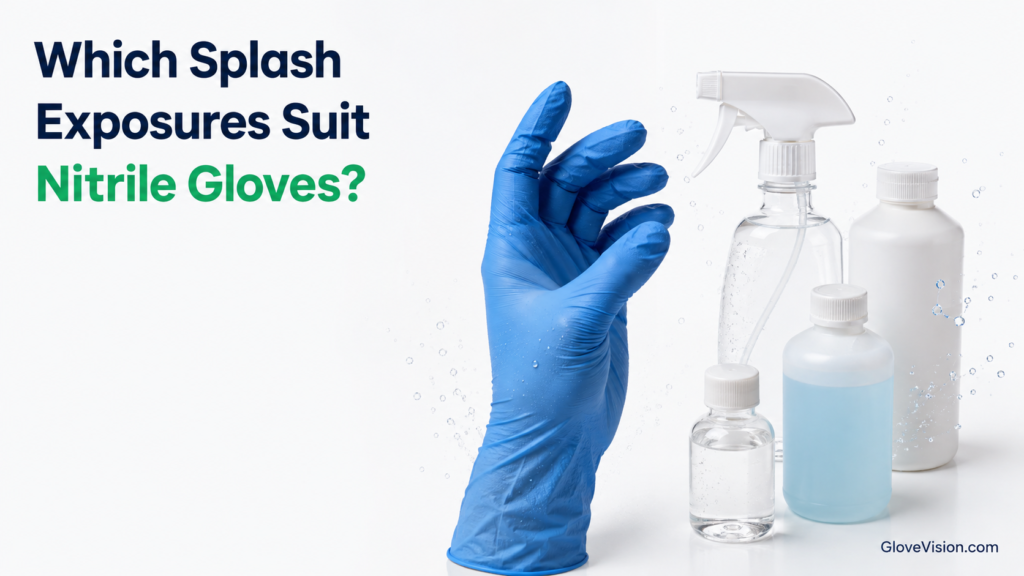
Which Splash Exposures Suit Nitrile Gloves?
Selected Nitrile Gloves may suit brief, controlled splashes of compatible oils, greases, alcohols, water-based products, dilute acids, dilute bases, and other chemicals documented for the exact finished glove.
Repeated splashing, pooling, prolonged wetting, immersion, high pressure, highly toxic chemicals, corrosives, incompatible solvents, heat, or uncertain mixtures may require reusable nitrile, another glove material, task redesign, or broader PPE.
What Counts as Controlled Splash Contact for Nitrile Gloves?
Controlled splash contact for Nitrile Gloves is brief, limited, incidental chemical contact that can be promptly managed without sustained wetting, pooling, cuff entry, repeated contamination, or immersion.
What Features Define a Brief Chemical Splash?
A defensible splash event is limited, has short surface residence, involves no intended immersion, is promptly recognized, allows immediate task stoppage and glove removal, follows a controlled contamination pathway, and has replacement gloves ready. No single duration or volume defines every splash.
How Does Incidental Splash Differ From Intended Contact?
Incidental splash is unintended but foreseeable. Intended contact means the glove is expected to touch or remain wet with the chemical. Repeated splash creates cumulative exposure; continuous contact leaves the film contaminated; immersion places the glove or hand in liquid. If contact is built into the normal task, calling each event a splash does not reduce the actual exposure.
When Does Repeated Splashing Become Continuous Contact?
The boundary is crossed when a glove stays wet between events, chemical accumulates in texture, replacement is impractical, frequency exceeds the change schedule, liquid collects at the wrist, contaminated tools repeatedly transfer liquid, or the task outlasts the supporting evidence. ASTM F1383 addresses intermittent-contact permeation, while ASTM F739 addresses continuous contact; neither result is a universal workplace wear time. [F1383] [F739]
How Does Pooling Change Nitrile Gloves Exposure?
Liquid can collect in palm creases, finger webs, textured fingertips, glove–tool interfaces, sleeve overlaps, rolled cuffs, and wrist folds. Pooling increases surface residence, giving more opportunity for sorption, permeation, or degradation.
Why Is Cuff Entry Different From Permeation?
Cuff entry bypasses the film entirely. Short or rolled cuffs, raised-hand work, contaminated sleeves, and poor overlap can direct liquid onto the wrist or inside the glove. Compatible glove chemistry cannot prevent this exposure route.
Which Splash Events Are Emergency Exposures?
Large-volume releases, high-pressure jets, unknown chemicals, highly volatile or toxic substances, severe corrosives, process failures, multi-area body contamination, respiratory-control needs, or inability to remove gloves promptly sit outside ordinary splash-glove use.
| Exposure pattern | Defining feature | Possible Nitrile Gloves role | Escalation trigger |
|---|---|---|---|
| Single controlled splash | Brief, limited, promptly addressed | Possible with exact product evidence | Incompatible or high-consequence chemical |
| Repeated splash | Multiple separate contacts | Requires cumulative assessment | Glove remains contaminated |
| Surface wetting | Chemical coats the glove | May exceed thin-glove role | Delayed removal |
| Pooling | Liquid collects in folds | Needs specific evidence | Extended residence |
| Continuous contact | Persistent chemical contact | Requires contact-rated protection | Only splash data exist |
| Immersion | Glove enters liquid | Usually needs heavier verified barrier | Thin disposable construction |
| Emergency release | High volume, pressure, or uncertainty | Ordinary splash glove insufficient | Emergency system required |
Which Compatible Liquid Splashes May Align With Tested Nitrile Gloves?
Tested Nitrile Gloves may align with brief splashes of selected oils, greases, alcohols, aqueous detergents, water-based products, dilute acids, and dilute bases when exact product evidence supports the chemical and conditions.
Which Oil and Grease Splashes May Suit Nitrile Gloves?
Potential candidates include selected motor, mineral, lubricating and food oils, petroleum grease, hydraulic fluids, cutting fluids, and oily machine residues. Hot oils, used fluids, additives, contamination, solvent-containing degreasers, and repeated wetting require separate review.
Which Petroleum-Fluid Splashes May Suit Nitrile Gloves?
Some tested products may support brief contact with kerosene, diesel, mineral spirits, selected distillates, or aliphatic cleaners. Aromatic content and additives matter; gasoline needs exact finished-glove evidence, and liquid compatibility does not control flammability or vapor hazards.
Which Alcohol Splashes May Suit Nitrile Gloves?
Ethanol, isopropanol, propanol, and selected alcohol-based disinfectants or laboratory solutions may align with suitable models. Verify the exact alcohol, concentration, co-solvents, repeated wetting, thickness, and change interval.
Which Aqueous Cleaner or Water-Based Product Splashes May Suit Nitrile Gloves?
Mild detergents, soap solutions, selected water-based degreasers, disinfectants, paints, inks, adhesives, and laboratory solutions may be candidates. Water-based does not mean harmless: glycol ethers, ketones, aromatics, oxidizers, strong alkalis, preservatives, reactive hardeners, or proprietary solvent mixtures can change the decision.
Which Dilute Acid or Base Splashes May Suit Nitrile Gloves?
Selected dilute mineral or organic acids, mild acidic cleaners, sodium or potassium hydroxide solutions, dilute ammonia, and buffers may suit exact tested gloves. Never transfer data to concentrated, heated, oxidizing, mixed, or unknown corrosives; hydrofluoric acid must not be grouped casually with ordinary dilute acids.
Why Must Every Candidate Be Verified?
Products in one family can differ in identity, concentration, pH, solvents, additives, temperature, toxicity, permeation, degradation, and intended contact. The broader nitrile resistance-limits guide helps screen families, but only the exact glove data can approve the splash scenario.
Which High-Risk Splashes Exceed the Role of Nitrile Gloves?
Nitrile Gloves may be poor or highly variable splash barriers for ketones, esters, aromatic solvents, halogenated solvents, strong oxidizers, severe corrosives, highly toxic dermal hazards, and poorly characterized mixtures.
Why Can Ketone or Ester Splashes Defeat Nitrile Gloves Quickly?
Acetone, MEK, MIBK, cyclohexanone, ethyl acetate, butyl acetate, and solvent-rich cleaners, coatings, adhesives, or thinners may cause rapid sorption, swelling, softening, diffusion, grip loss, or dimensional change. Ordinary thin nitrile cannot be approved from material reputation.
Why Are Aromatic-Solvent Splashes Variable?
Toluene, xylene, benzene, ethylbenzene, paint thinners, and solvent adhesives depend strongly on NBR formulation, acrylonitrile contribution, crosslinking, thickness, concentration, temperature, duration, and mixture composition. The acrylonitrile solvent-resistance page explains the sorption and diffusion mechanism without converting “variable” into approval.
Why Do Halogenated Solvents Require Another Barrier Assessment?
Dichloromethane, chloroform, trichloroethylene, tetrachloroethylene, and chlorinated degreasers may present rapid permeation, swelling, degradation, and high-consequence exposure after unnoticed passage.
Why Do Strong Oxidizers, Severe Corrosives, and Toxic Dermal Hazards Need More Caution?
Concentrated peroxide, peracetic-acid mixtures, nitric or chromic products, and concentrated hypochlorite may oxidize or crack unsuitable films. A small corrosive or highly toxic exposure can cause serious harm, and trapped liquid or delayed recognition makes casual disposable-glove use indefensible. Chemical degradation is a separate standardized test question under ISO 374-4. [Deg]
Why Are Unknown Mixtures Unsuitable for Assumed Protection?
The fastest-permeating component may control selection, ingredients can alter one another’s transport, evaporation changes ratios, and SDS ranges may be incomplete. One ingredient’s rating cannot approve the formulation.
| Splash category | Initial screening position | Main concern | Required decision |
|---|---|---|---|
| Selected oils and greases | Often potentially suitable | Heat, additives, repeated wetting | Verify exact product |
| Selected alcohols | Often potentially suitable | Concentration and co-solvents | Verify permeation evidence |
| Mild aqueous cleaners | Potentially suitable | Hidden solvents or oxidizers | Review complete formulation |
| Water-based paints | Potentially suitable | Co-solvents and hardeners | Review SDS and glove evidence |
| Dilute acids or bases | Variable but often possible | Concentration, heat, corrosivity | Verify exact chemical |
| Ketones | Frequently poor | Rapid permeation or swelling | Evaluate another material |
| Esters | Frequently poor or variable | Softening and permeation | Require exact test evidence |
| Aromatic solvents | Variable to poor | Formulation-sensitive passage | Do not presume suitability |
| Halogenated solvents | Frequently poor | Rapid passage and toxicity | Select better-matched barrier |
| Strong oxidizers | Highly variable or poor | Reactive degradation | Obtain specific evidence |
| Unknown mixtures | Unacceptable without assessment | Unpredictable interactions | Identify formulation first |
| Emergency releases | Outside ordinary splash role | Volume, pressure, broader exposure | Use emergency protection |
This matrix supports preliminary screening only. It does not approve Nitrile Gloves for any chemical, concentration, temperature, duration, or task.
How Do Working Conditions Escalate Splash Risk for Nitrile Gloves?
Splash risk for Nitrile Gloves increases when volume, repeated events, pooling, heat, pressure, flexing, abrasion, delayed removal, or cuff entry extends contact or compromises the protective system.
How Do Splash Volume and Frequency Change Suitability?
Greater volume covers more area, encourages pooling, complicates removal, and increases wrist or forearm contamination. Repeated events create cumulative contact when the glove stays wet, replacement is delayed, or tools repeatedly transfer chemical. No universal volume limit can represent every chemical and task.
Why Does Elevated Temperature Increase Splash Risk?
Heat may accelerate molecular diffusion and degradation, alter sorption, change glove feel, and add thermal-injury risk. Ambient test data may not represent heated liquid or the temperature inside a worn glove.
How Does Splash Pressure Affect Nitrile Gloves?
Pressure can spread liquid, drive it toward cuffs or through defects, expose the eyes or face, and convert a limited event into an uncontrolled release. Hand protection alone cannot control that scenario.
How Do Flexing, Grip, and Cold Affect Contaminated Nitrile Gloves?
Bending, palm compression, tool friction, fingertip stretch, abrasion, local thinning, and trapped liquid add mechanical stress. Laboratory data may not represent elevated temperature, flexing, pressure, or supplier variation under real use. [Field] Temperature, thickness, and movement also affect task control, as detailed in the acrylonitrile stiffness trade-off.
How Do Delayed Removal, Cuffs, and Sleeve Interfaces Increase Exposure?
Contact continues after the visible splash while sorption and diffusion may proceed. Short cuffs, raised arms, poor sleeve overlap, wrist folds, contaminated clothing, or rushed doffing can bypass or spread contamination.
When Should the Task Be Redesigned?
Use closed transfer, guards, dispensing tools, smaller containers, drainage, lower-pressure delivery, improved positioning, mechanical handling, or automated dosing when splash frequency or volume is avoidable. Engineering controls can be more reliable than repeatedly increasing glove thickness.
| Escalating condition | Why risk increases | Minimum reassessment | Possible control |
|---|---|---|---|
| Greater volume | More area and pooling | Review complete PPE coverage | Guard or longer glove |
| Frequent splashes | Cumulative contact | Evidence-based change schedule | Redesign or tested reusable glove |
| Elevated temperature | Faster permeation and thermal risk | Temperature-specific evidence | Change process or glove system |
| High pressure | Cuff entry and widespread spray | Assess eye, face, and body exposure | Engineering controls and broader PPE |
| Repetitive flexing | Stresses contaminated material | Simulate actual movement | More durable tested construction |
| Delayed removal | Extends contact duration | Review response procedure | Immediate controlled replacement |
| Short cuff | Exposes wrist and forearm | Assess liquid direction | Extended cuff or gauntlet |
| Unknown mixture | Performance unpredictable | Identify complete formulation | Reject until verified |
How Should Nitrile Gloves Be Selected and Managed for Splash Tasks?
Nitrile Gloves should be selected for splash tasks only after the chemical, concentration, temperature, splash pattern, glove model, thickness, cuff coverage, permeation evidence, degradation evidence, and replacement procedure are verified.
What Must Be Defined Before Selection?
Record the chemical and CAS number where available, commercial product, concentration, mixture, temperature, likely volume and frequency, surface residence, cuff-entry potential, mechanical hazards, dexterity, and emergency procedures.
How Should the SDS and Product-Level Evidence Support Selection?
Use the SDS for ingredients, ranges, dermal hazards, corrosivity, toxicity, volatility, initial PPE language, first aid, and spill controls. Then verify the exact glove model, NBR construction, thickness, length, tested chemical, concentration, temperature, breakthrough, permeation, degradation, standard, intended contact, and manufacturer limits. “Wear nitrile gloves” alone is incomplete because nitrile formulations differ.
How Should Disposable and Reusable Nitrile Gloves Be Distinguished?
Disposable nitrile may support brief verified splash work requiring dexterity and immediate replacement. Reusable nitrile may be needed for larger volume, longer or repeated contact, abrasion, or extended cuffs when exact data supports it. Neither construction receives automatic approval.
How Should Thickness, Cuff Length, and Fit Be Selected?
Use this order: compatible material → verified thickness → adequate cuff coverage → functional fit → realistic task control. Longer cuffs cannot correct incompatible chemistry, and thicker film cannot substitute for chemical evidence.
What Should Be Inspected Before Use?
Check tears, punctures, pinholes, cracks, thin areas, sticking, brittleness, distortion, discoloration, cuffs, interior contamination, packaging, storage, and size. ISO 374-2 treats penetration resistance as a distinct test question. [Pen]
What Should Happen Immediately After a Splash?
Follow the established procedure: stop exposure → avoid spreading contamination → perform authorized pre-doffing decontamination only when required → doff safely → dispose of or isolate the glove → wash exposed skin as directed → inspect for contact → replace gloves → report or escalate. Pre-doffing decontamination never authorizes reuse.
When Should Nitrile Gloves Be Replaced or Another System Selected?
Replace when the procedure requires it, the change point is reached, the glove stays wet, pooling or cuff entry occurs, a defect appears, material changes, grip becomes unsafe, or compatibility is uncertain. Escalate when evidence is unfavorable or missing, the chemical is highly toxic or corrosive, contact repeats, immersion is expected, the chemical is heated, broader exposure exists, or emergency response is required. OSHA selection must reflect the task, conditions, duration, and identified hazards. [OSHA]
Exposure identification
- Chemical, concentration, mixture, and temperature are known.
- Volume, frequency, toxicity, and corrosivity are assessed.
Splash classification
- Contact is brief and incidental; persistent wetting, pooling, immersion, and emergency release are excluded.
- Immediate stopping, removal, and replacement are possible.
Product evidence
- Exact model, thickness, cuff length, permeation, and degradation evidence match the scenario.
- Test conditions and manufacturer limitations are understood. ISO 374-1:2024 requirements apply only within their tested scope. [ISO]
Pre-use inspection
- Film, cuff, interior, packaging, storage, fit, and movement are acceptable.
Splash response
- Safe doffing, replacement, disposal, washing, emergency facilities, and broader PPE are available.
Final decision
What Should Readers Remember About Splash Suitability in Nitrile Gloves?
Nitrile Gloves may suit brief, controlled splashes only when the exact glove is compatible with the identified chemical and prompt removal, replacement, and contamination control are possible.
Repeated wetting can become continuous exposure, pooling extends residence, cuff entry bypasses the film, and permeation may occur without visible change. Chemical-family guidance is preliminary; quick removal, greater thickness, or longer cuffs cannot rescue incompatible chemistry.
Exact chemical or mixture → concentration and temperature → splash volume and frequency → incidental or continuous contact → exact Nitrile Gloves data → thickness and cuff coverage → prompt response capability → use, escalate, replace, redesign, or reject.
Conclusion
Splash means brief, limited, incidental contact. Repeated wetting, pooling, delayed removal, and cuff entry can extend or bypass the barrier, while molecular permeation may occur before Nitrile Gloves show visible damage.
Suitability depends on the exact chemical, concentration, temperature, volume, frequency, glove model, thickness, cuff coverage, and test evidence. High-risk or uncontrolled exposure requires stronger protection, task redesign, or a broader PPE system.
Frequently Asked Questions
Are All Nitrile Gloves Suitable for Chemical Splashes?
No. Suitability depends on the exact formulation, thickness, length, chemical, concentration, temperature, contact pattern, and product-specific evidence.
Which Splashes Commonly Align With Tested Nitrile Gloves?
Selected oils, greases, alcohols, aqueous cleaners, water-based products, dilute acids, and dilute bases may align with tested nitrile products. None should be approved from the family name alone.
When Does Repeated Splashing Stop Being Splash Protection?
When the glove remains contaminated, is repeatedly wetted, develops pooling, cannot be replaced promptly, or accumulates contact beyond verified conditions, the task becomes repeated or continuous exposure.
Should Nitrile Gloves Be Replaced After One Chemical Splash?
Sometimes. Replacement depends on the chemical, glove instructions, conditions, and change schedule. A single-use glove must not be washed or reused unless explicitly designed and validated for reuse.
Can Nitrile Gloves Protect Against Vapors From a Splash?
No glove should be treated as respiratory protection. Nitrile may limit compatible liquid contact with skin, but vapor, inhalation, eye, face, and body hazards require separate controls.