
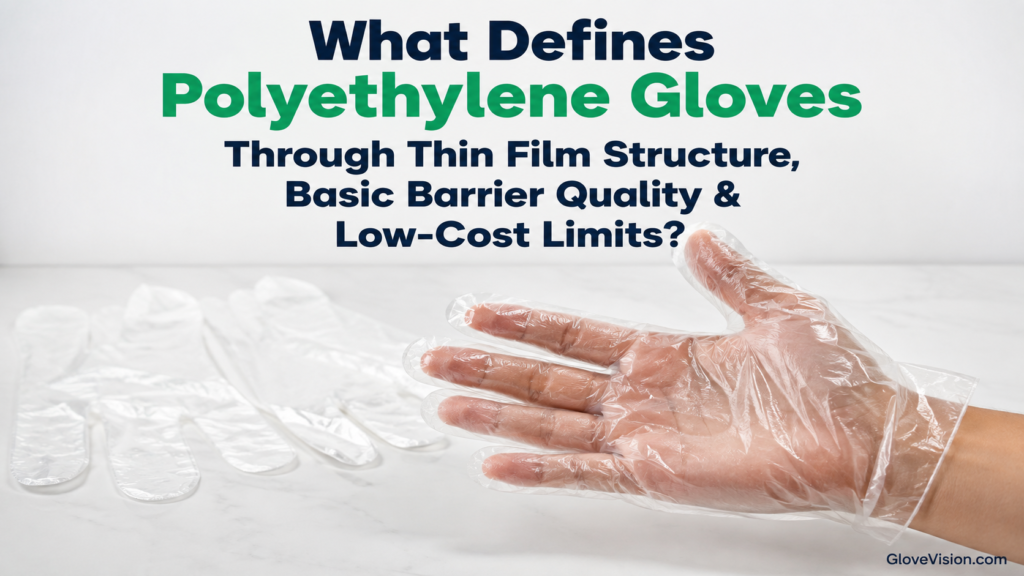
What Defines Polyethylene Gloves Through Thin Film Structure, Basic Barrier Quality & Low-Cost Limits?
Polyethylene Gloves are economical thin-film hand coverings commonly used when short tasks need basic separation between hands and food, clean objects, or other limited-contact materials. Thin PE film, simplified shaping, sealed edges, fast donning, rapid changes, and low unit cost define their practical role.
Low cost can support frequent replacement, but many PE gloves offer limited stretch, loose fit, and product-dependent seam and film integrity. Ordinary food-service Polyethylene Gloves do not replace fitted examination or chemical-protective gloves, so product grade, intended use, documentation, task stress, grip, and condition must control selection.
What Are Polyethylene Gloves, and How Does Their Thin Film Structure Shape Performance?
Polyethylene Gloves are generally produced by forming thin PE film into a simple, unlined glove shape, creating an economical hand covering with limited elasticity, product-dependent physical strength, and less anatomical conformity than most elastomeric gloves. Polyethylene is a thermoplastic polymer, but that material name alone does not establish the behavior or protection of a finished glove.
Which Polyethylene Forms Are Used in Thin-Film Gloves?
Thin-film gloves may use low-density polyethylene, high-density polyethylene, cast polyethylene, documented blends, or other product-specific PE film grades. LDPE may feel softer or more flexible, HDPE may feel crisper and lower-stretch, and cast PE may have a different film feel or drape; none of those labels independently proves softness, strength, grip, freedom from holes, or task suitability.
CPE is ambiguous and should never appear without definition: it can mean cast polyethylene in one context and chlorinated polyethylene in another. Ordinary cast-PE food-service gloves must not be confused with chlorinated polyethylene chemical gloves, PE/EVOH laminates, Silver Shield, or 4H barrier constructions.
How Are Polyethylene Gloves Manufactured?
Polyethylene Gloves are commonly formed from manufactured film that is cut or shaped and joined along selected edges, but exact methods vary by product. Film extrusion or cast-film production may be followed by heat sealing, surface embossing, smoothing, ambidextrous shaping, cuff trimming, and packaging. Manufacturing choices influence film uniformity, seam continuity, hand shape, noise, stiffness, and feel.
A simplified silhouette supports economical production and rapid donning, but it may not reproduce the finger curvature, thumb position, palm contour, or elastic recovery of a fitted elastomeric glove. The exact product specification—not a generic diagram—must identify construction.
How Do LDPE, HDPE, and Cast Polyethylene Gloves Differ?
LDPE, HDPE, and cast Polyethylene Gloves can differ in flexibility, stiffness, surface feel, stretch, noise, hand conformity, and tear behavior. These are tendencies rather than rankings. Finished behavior also depends on resin formulation, film orientation, thickness, additives, embossing, sealing, geometry, manufacturing consistency, and size.
The polymer or film-process category does not determine finished-glove quality by itself. A well-documented product with verified physical properties may fit a narrow task better than another glove carrying a more appealing material label but lacking applicable evidence.
Why Are Many Polyethylene Gloves Loose-Fitting?
Many Polyethylene Gloves fit loosely because limited elastic recovery is combined with simplified, often ambidextrous glove geometry and minimal finger shaping. Excess material can speed donning and removal, accommodate multiple hand shapes, and reduce manufacturing complexity, but it may also create fingertip excess, palm folds, internal hand movement, snagging, or reduced tactile control.
Loose fit is not automatic proof of leakage. It is a functional variable that must be evaluated against the object size, required dexterity, contact pressure, grip demand, and likelihood that folds or movement will stress the film or seams.
How Do Seams and Film Thickness Affect Polyethylene Gloves?
Seam continuity and film uniformity help preserve basic separation, while open seals, pinholes, thin spots, tears, or stressed finger and thumb junctions interrupt it. Thickness can influence tensile behavior, elongation, stiffness, tactile feel, and tear propagation, but greater thickness does not automatically establish barrier reliability or task suitability.
ASTM D7329-07(2024) covers thin-film, unlined food-service gloves made from materials including LDPE, HDPE, and cast PE and addresses freedom from holes, dimensions, tensile strength, yield strength, and elongation. It explicitly excludes safe and proper glove use from its scope, so compliant physical specifications cannot replace task procedures. [ASTM]
| Feature | Possible Function | Practical Limitation |
|---|---|---|
| LDPE film | May provide a softer or more flexible feel | Performance remains product-specific |
| HDPE film | May provide a crisper, lower-stretch structure | Hand conformity may remain limited |
| Cast polyethylene | May provide a different film feel or fit | Must not be confused with chlorinated polyethylene |
| Heat-sealed edges | Form the glove shape economically | Incomplete or damaged seams interrupt separation |
| Embossed surface | May change handling friction | Does not guarantee wet or oily grip |
| Thin unlined construction | Supports fast changes and low cost | Provides little cushioning or mechanical protection |
How Do Polyethylene Gloves Fit, Move, and Maintain Basic Barrier Quality?
Polyethylene Gloves maintain basic barrier quality only while their film, seams, fit, and position remain sufficiently intact for the task; movement, stretching, snagging, puncture, or contamination can interrupt that separation. Basic barrier quality is a practical description, not a certification or promise of leakproof performance.
How Does Loose Fit Affect Polyethylene Gloves?
Loose fit can create internal hand movement, fingertip excess, palm folds, material bunching, snagging, and reduced tactile feedback. Those effects may reduce control of small, smooth, wet, or awkward objects even when no visible hole is present. Easier donning and removal can be useful for rapid task changes, but that convenience does not eliminate the need for a functional size.
The decision is task-specific: a loose glove may remain adequate for a brief, simple contact task yet be unsuitable when exact finger placement, sustained grip, or safe tool control is required.
How Does Limited Elasticity Affect Polyethylene Gloves?
Limited elasticity reduces close hand conformity and recovery after deformation. An undersized glove may restrict motion and concentrate stress around fingers, thumb junctions, or sealed edges; an oversized glove may leave excess film that shifts, folds, or catches. Repeated flexing can turn a marginal fit into stretching, seam loading, or task-dependent tearing.
Fit should be assessed while performing representative motions rather than while the hand is still. The glove must remain positioned through grasping, pinching, reaching, and release without interfering with control.
How Do Seams Affect Polyethylene Gloves Barrier Quality?
Seams create the glove shape and are also potential interruption points if seals are incomplete, open, damaged, or overstressed. Side edges, finger outlines, the thumb junction, cuff edge, and transitions between film planes deserve inspection. Gripping pressure and repeated movement can load a weak seal differently from a static visual check.
An intact-looking seam does not prove that every microscopic defect is absent, and a product-level freedom-from-holes result is not a guarantee that an individual glove remains intact after handling.
How Do Holes and Tears Affect Polyethylene Gloves?
Visible punctures, open seams, and tears directly interrupt separation, while smaller holes can be difficult to notice and may expand during use. Sharp packaging, utensils, rough edges, rings, fingernails, and snag points can damage thin film. A glove should be replaced immediately when damage or uncertain integrity is identified.
Clear appearance is not evidence of freedom from holes. Inspection is necessary but must be combined with product-quality documentation, task control, appropriate change procedures, and avoidance of unsupported hazards.
How Does Surface Texture Affect Polyethylene Gloves Grip?
Embossed or smooth film can change friction, but neither texture guarantees stable handling. Dry handling, surface geometry, oil, grease, water, object weight, contact pressure, external friction, and internal hand slipping all affect control. A pattern that feels useful on one object may perform differently on another.
Grip should be assessed with the exact glove under representative conditions. If the hand moves inside the glove or the outer film slips on the object, resizing or selecting another glove may be safer than increasing grip force.
| Condition | Handling Effect | Barrier Concern | Decision |
|---|---|---|---|
| Correct functional size | More stable hand position | Less unnecessary film stress | Use if task-compatible |
| Excessively loose fit | Bunching and reduced control | Snagging or seam stress | Resize or choose another glove |
| Undersized glove | Restricted movement | Stretching and tearing | Reject |
| Open or weak seam | Unstable construction | Direct barrier interruption | Replace |
| Small puncture | May be difficult to notice | Contaminant passage | Replace immediately |
| Wet or oily surface | Reduced handling stability | Object control may decline | Reassess grip and glove type |
Where Do Polyethylene Gloves Provide Basic Barrier Quality, and Where Does Protection End?
Polyethylene Gloves can provide basic separation during selected short, low-stress tasks, but ordinary thin-film PE gloves do not automatically provide medical, chemical, puncture, abrasion, heat, or prolonged-liquid protection. The useful boundary belongs to the exact product, intended use, exposure, documentation, fit, integrity, and change procedure.
How Can Polyethylene Gloves Support Food Handling?
Documented Polyethylene Gloves can separate hands from selected foods, support frequent changes, and reduce direct hand contact during task-specific hygiene procedures. The FDA Food Code is a model offered for adoption by jurisdictions, so local requirements and the applicable workplace procedure must be checked rather than assumed. [FDA Code]
Food-contact suitability applies to the exact product and conditions. Follow defined food-handling glove procedures, change gloves between incompatible activities, and remember that gloves support—but never replace—correct handwashing.
Why Are Polyethylene Gloves Commonly Used for Short Tasks?
Low unit cost, simple construction, fast donning, rapid removal, and limited-duration contact can make Polyethylene Gloves practical for frequent task transitions. A close tactile fit may be unnecessary when the task is brief, simple, low-mechanical-demand, and supported by clear change procedures.
Frequent changes do not compensate for the wrong glove category. If the task needs prolonged wear, sustained grip, chemical resistance, medical performance, puncture control, heat resistance, or higher durability, rapid replacement of an unsuitable PE glove is not a defensible control.
Are Polyethylene Gloves Suitable for Medical Care?
Ordinary food-service Polyethylene Gloves are not automatically suitable for medical care. Clear appearance, disposable construction, hygiene packaging, or food-contact documentation does not establish medical-device status, examination-glove performance, sterility, clinical barrier requirements, or suitability for blood and body-fluid exposure.
Medical use requires a glove specifically cleared, certified, or documented for the intended clinical task. A general PE material label should never substitute for that product-level evidence.
Do Polyethylene Gloves Protect Against Chemicals?
Polyethylene Gloves protect against a chemical only when chemical-specific evidence supports the exact product, formulation, concentration, temperature, contact pattern, and duration. OSHA notes polyethylene as an option for certain shorter glutaraldehyde exposures, while identifying other materials for full-shift protection; that narrow statement does not approve ordinary food-service PE gloves or transfer to other chemicals. [OSHA Glut]
PE/EVOH and laminate chemical-barrier gloves are separate constructions. Their data must not be transferred to monolayer thin-film PE gloves, and no generic breakthrough or safe-wear time should be published for the material name.
Which Mechanical and Thermal Hazards Exceed Ordinary Polyethylene Gloves?
Knives, sharp edges, punctures, abrasive surfaces, heavy friction, repeated pulling, high-tension gripping, hot objects, open flame, impact, and moving machinery generally exceed the intended role of ordinary thin-film Polyethylene Gloves. Minimal film coverage does not establish cut, puncture, abrasion, impact, or thermal protection.
The hazard assessment must identify the protection category needed. Where another glove is required, it should be tested or documented for that actual hazard rather than selected only because it is thicker or more expensive.
Why Does Low Cost Not Define Polyethylene Gloves Protection?
Price does not measure barrier integrity, and low cost is an economic characteristic rather than proof of poor quality. Economical gloves may fit narrowly defined tasks well, while a higher-priced PE product is not automatically more protective. Total task cost includes change frequency, failures, contamination risk, worker control, disposal volume, and interruptions.
Food-contact authorization and notifications are tied to substance identity, manufacturer or authorization pathway, specifications, and conditions of use—not to the generic word polyethylene. Review the exact documentation and relevant food-contact material risks. [FDA Status]
Which Polyethylene Gloves Match Short, Low-Stress Tasks, and When Is Another Glove Needed?
Polyethylene Gloves generally best match short, low-mechanical-stress tasks where rapid glove changes matter more than close fit, sustained grip, high dexterity, or heavy-duty protection. Selection should move from task and contact conditions to required performance, product evidence, fit, and final decision.
Which Tasks May Suit Polyethylene Gloves?
Short ready-to-eat food handling, light food preparation, brief handling of clean objects, simple assembly without sharp edges, and limited hygiene-support tasks may suit Polyethylene Gloves when exact documentation supports use. The task must remain short, controlled, and free of unsupported chemical, medical, thermal, or mechanical hazards.
Do not approve gloves by job title. “Food worker,” “cleaner,” or “assembler” describes a person, not the actual contact, duration, grip, puncture, contamination, or regulatory demands of one task.
Which Food Conditions Must Be Evaluated?
Food selection should account for dry, wet, oily, or greasy contact; food temperature; contact duration; grip; fine manipulation; exact product documentation; and local food-safety requirements. One PE glove may not remain functional across every ingredient, workstation, and transition.
FDA explains that food-contact notifications and authorizations are specific to intended use and applicable specifications and limitations. A material name alone cannot establish that a finished glove is suitable for every food-contact condition. [FDA FCS]
Which Tasks Require Better Fit or Dexterity?
Fine assembly, detailed inspection, precision handling, small-tool manipulation, sustained grip, and tasks where excess fingertip film interferes with control usually require a more fitted glove. Low material bulk does not guarantee tactile precision when the hand moves inside the glove or folds obscure finger position.
Use the broader disposable glove selection boundary to identify when anatomy, stretch, grip, or sustained control matters more than rapid low-cost changes.
Which Tasks Require Stronger Mechanical Protection?
Cutting, deboning, sharp packaging, abrasive handling, heavy pulling, repetitive friction, machinery work, and hot-material handling require protection tested for the actual hazard. Ordinary PE film provides little cushioning or mechanical reinforcement, and repeated issuing of the same thin glove does not control a hazard that exceeds its capability.
Separate the hygiene function from the hazard-protection function. Where both are needed, the workplace procedure may require a compatible layered system or another documented glove rather than improvisation.
Which Tasks Require Verified Chemical-Protective Gloves?
Corrosive chemicals, toxic substances, solvents without exact PE data, unknown mixtures, skin-absorption hazards, prolonged liquid contact, and immersion require a verified chemical-protective glove. The word polyethylene cannot approve those exposures, and laminate performance cannot be transferred to ordinary monolayer PE.
If the exact chemical, concentration, temperature, duration, contact pattern, and product data are unavailable, select another documented glove or stop the task until suitability can be confirmed.
How Should Cost Be Evaluated When Choosing Polyethylene Gloves?
Cost should be evaluated as task suitability → required change frequency → glove failures → contamination control → disposal volume → total task cost. Lowest box price is not a selection method. A low-cost glove can be efficient when it remains functional for a narrow task and is changed correctly; it can be expensive when tearing, poor fit, contamination, or workflow interruption is frequent.
Claims should be checked against exact documentation and the broader rules for disposable glove safety claims. OSHA requires hand protection selection to reflect performance relative to the task, conditions, duration, hazards, and potential hazards. [OSHA Hand]
| Task Context | Possible PE Advantage | Main Limitation | Decision |
|---|---|---|---|
| Short ready-to-eat food handling | Rapid changes and basic separation | Requires food-contact documentation and hygiene controls | Possible candidate |
| Wet or oily food handling | Disposable hand coverage | Grip and film stability may be inadequate | Test the exact glove |
| Precision handling | Low material bulk | Loose fit may reduce control | Consider a fitted glove |
| Sharp or abrasive task | Minimal separation | Poor mechanical protection | Use hazard-rated protection |
| Medical examination | Disposable appearance | Clinical performance is not established | Use a medical examination glove |
| Chemical handling | Some tested PE constructions have narrow uses | Generic material claims are insufficient | Require exact compatibility evidence |
| Prolonged liquid exposure | Low initial price | Thin film, cuffs, and seams may be inadequate | Select a documented alternative |
How Should Polyethylene Gloves Be Selected, Used, Changed, and Discarded?
Polyethylene Gloves should be selected for one defined task, inspected before use, changed whenever contamination or damage occurs, removed without transferring contaminants, and discarded after their intended single use. The operational sequence is verify → inspect → wash and dry hands → don → use → change → remove → discard → wash hands.
What Should Be Verified Before Selecting Polyethylene Gloves?
Verify intended use, exact product grade, material description, applicable food-contact or other documentation, size, film construction, seam quality, freedom-from-holes specification, grip needs, task duration, mechanical hazards, chemical exposure, local requirements, and manufacturer instructions. Do not infer food, medical, or chemical suitability from color, clarity, packaging, or price.
The exact task should be written narrowly enough to test: identify what is touched, for how long, under which wetness or temperature conditions, with which grip and hygiene transitions, and what would trigger a change.
How Should Polyethylene Gloves Be Inspected?
Inspect for holes, tears, open seams, thin spots, distortion, contamination, incomplete fingers, damaged cuffs, incorrect size, sticking, or degraded film before use. Place all four fingers and the thumb correctly and move the hand through representative motions to confirm that seams stay closed and excess film does not interfere with control.
Visual inspection cannot prove that every tiny hole is absent, but any visible defect, uncertain integrity, or damaged package is sufficient reason to reject the glove.
How Should Polyethylene Gloves Be Donned?
Wash and thoroughly dry hands, select the functional size, handle the cuff without contaminating the working surface, place every finger and thumb fully, and confirm that the seams remain intact. Damp hands can make donning difficult, increase internal slipping, and interfere with fit.
For food work, CDC advises handwashing before and after glove use to help prevent cross-contamination; gloves are an added control, not a substitute for soap and water. [CDC]
When Should Polyethylene Gloves Be Changed?
Change Polyethylene Gloves between incompatible tasks, after touching contaminated surfaces, when moving between raw and ready-to-eat food where procedures require, after tearing or puncture, when grip or fit becomes unreliable, after unsupported chemical contact, and at the end of the intended task. Do not prescribe one universal time interval.
A change is triggered by task, contamination, condition, and procedure—not merely by elapsed time. Hands may also require washing before a clean activity resumes.
Why Should Polyethylene Gloves Not Be Washed and Reused?
Ordinary single-use Polyethylene Gloves should not be washed and reused because their thin film, seams, fit, and contamination status are not supported by a validated reuse process. Washing can leave hidden holes, seam damage, trapped contamination, incomplete decontamination, or degraded film while creating false confidence.
Discard after the intended activity, contamination, damage, unsupported exposure, or loss of functional fit. Reuse should never be improvised from appearance alone.
How Should Polyethylene Gloves Be Removed?
Remove Polyethylene Gloves without touching the contaminated exterior with bare skin, contain the used film, prevent transfer to hands or clothing, discard it appropriately, and complete required handwashing. The exact removal procedure should match the contamination and workplace process.
Do not shake, snap, wash, place on shared surfaces, or save a used glove for a later task. A clean-looking exterior can still carry contamination.
Which Problems Show That the Wrong Polyethylene Gloves Were Selected?
Repeated tearing, seam separation, internal slipping, poor grip, restricted movement, excess film, frequent punctures, uncontrolled liquid entry, unsupported chemical contact, prolonged-wear demands, or the need for medical, thermal, or mechanical protection show that selection should be reconsidered. Reissuing the same glove more often does not solve a category mismatch.
Use, resize, change, replace, select another glove, or stop according to the exact reason the glove no longer matches the task.
- Exact product and intended use are identified.
- Required documentation is available.
- The glove is not being mistaken for medical or chemical protection.
- Size supports stable hand positioning.
- All fingers and thumb are correctly placed.
- No holes, tears, open seams, or cuff damage are visible.
- Grip remains adequate.
- Contact is short and defined.
- No unsupported chemical, sharp, hot, or abrasive hazard exists.
- The glove does not interfere with control.
- A change procedure is available.
- Hands are washed and dried before donning.
- Gloves change between incompatible tasks.
- Removal prevents hand contamination.
- Hands are washed after removal.
- Use: Product, task, fit, documentation, and condition match.
- Resize: The category fits but hand position is unstable.
- Change or replace: Task, contamination status, fit, or integrity changed.
- Select another glove or do not use: Protection or evidence is insufficient.
Conclusion
Polyethylene Gloves are economical thin-film hand coverings designed primarily for short, low-stress tasks where basic separation and frequent changes matter more than close fit, high durability, or specialized protection. LDPE, HDPE, and cast PE are not automatically equivalent; seams, holes, fit, grip, construction, and exact documentation define the finished glove.
Food-contact suitability must be documented, handwashing remains mandatory, and ordinary food-service PE gloves are not automatically medical or general chemical-protective gloves. Select Polyethylene Gloves only when the exact product matches the task, basic separation is sufficient, fit and grip remain functional, no unsupported hazard is present, and reliable inspection and change procedures are available.
Frequently Asked Questions
Are Polyethylene Gloves food-safe?
Only when the exact product is documented as suitable for the intended food-contact conditions and applicable local requirements are followed. A polyethylene material label alone does not establish food-contact compliance.
Are Polyethylene Gloves waterproof?
Not universally. Intact film may separate the hand from limited liquid contact, but seams, cuffs, movement, defects, fit, pressure, and duration prevent a universal waterproof claim.
Can Polyethylene Gloves be used for chemicals?
Only when chemical-specific evidence applies to the exact glove and exposure. Ordinary food-service Polyethylene Gloves should not be treated as general chemical-protective gloves.
Are Polyethylene Gloves suitable for medical examinations?
Not automatically. Use a glove specifically cleared, certified, or documented for the intended clinical task.
Can Polyethylene Gloves be washed and reused?
Ordinary single-use Polyethylene Gloves should not be washed and reused. Replace them after the intended task, contamination, damage, unsupported exposure, or loss of functional fit.