
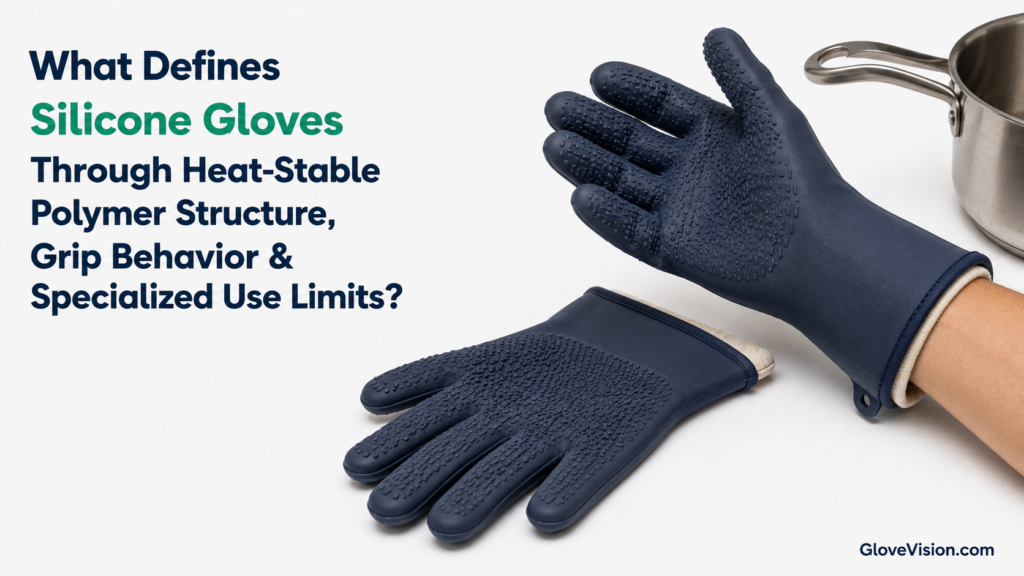
What Defines Silicone Gloves Through Heat-Stable Polymer Structure, Grip Behavior & Specialized Use Limits?
Silicone Gloves are molded, coated, grip-printed, or lined handwear that uses crosslinked polysiloxane elastomers to provide flexible construction, conforming contact, textured grip, and selected thermal performance.
Actual performance varies with silicone thickness and coverage, liner, seams, cuff, texture, temperature, duration, pressure, repetition, moisture, chemicals, fit, product documentation, and current condition.
What Are Silicone Gloves, and How Does Their Polymer Structure Shape Performance?
Silicone Gloves use crosslinked polysiloxane elastomers whose flexible molecular network can support elasticity, shape recovery, surface conformity, and useful thermal stability under defined conditions. Those material traits do not, by themselves, prove finished-glove protection.
What Is the Material Structure of Silicone Gloves?
Silicone elastomers contain a silicon–oxygen backbone with organic side groups. Crosslinking joins polymer chains into a three-dimensional network, producing a flexible solid rather than a flowing liquid. Silicone is different from elemental silicon and from silica.
How Does Crosslinking Help Silicone Gloves Recover Their Shape?
When a suitable network is stretched or compressed within its working range, crosslinks help the chains return toward their original arrangement. Formulation, cure quality, fillers, aging, heat history, and damage determine how reliably that recovery continues.
Why Can Silicone Gloves Remain Flexible Across Different Temperatures?
The polysiloxane backbone can retain mobility across a useful temperature range, but “flexible” does not mean thermally insulating. Heat can still conduct through the glove toward the skin, especially under sustained pressure or repeated contact.
How Do Molded and Coated Silicone Gloves Differ?
A molded glove may use silicone across much of its body, while a coated textile glove relies on a fabric carrier and may cover only the palm or fingers. A grip print adds even less coverage. Liners, seams, cuffs, and uncovered zones change liquid entry, insulation, durability, and fit.
How Do Fillers and Additives Change Silicone Gloves?
Fillers, pigments, cure systems, and processing aids can alter hardness, tear behavior, friction, aging, and thermal response. The polymer name cannot replace product-level testing, identification, or instructions. General glove design and marking requirements are addressed separately from hazard-specific protection. ISO
| Feature | Physical behavior | Practical contribution | Critical limitation |
|---|---|---|---|
| Polysiloxane backbone | Flexible chain motion | Elastic behavior across defined conditions | Does not prove insulation |
| Crosslinked network | Shape recovery | Conforming fit | Aging and damage reduce recovery |
| Molded body | Continuous silicone zones | Flexible coverage | Cuff and damage may permit entry |
| Silicone coating | Localized surface layer | Grip or abrasion contribution | Textile remains part of protection |
| Grip texture | More contact edges | May improve control | Condition-specific, not universally non-slip |
| Insulated liner | Air and fiber layer | May slow heat transfer | Compression, moisture, and wear matter |
| Extended cuff | Additional coverage | May protect beyond wrist | Openings and seams remain boundaries |
How Do Silicone Gloves Manage Contact Heat Without Becoming Heatproof?
Silicone Gloves may slow heat transfer through silicone thickness, surface geometry, trapped air, and insulating liners, but heat continues moving toward the hand and can cause injury before the exterior visibly fails.
Why Is Heat Stability Different From Heat Insulation in Silicone Gloves?
Thermal stability describes whether a material retains useful form or properties under heat. Insulation describes how quickly heat reaches the hand. A silicone exterior may look intact while the inner surface and skin temperature continue rising.
How Do Thickness and Liners Affect Silicone Gloves’ Thermal Performance?
Additional thickness or a dry, intact liner may lengthen the heat path, but it can also reduce dexterity, increase grip force, and slow object release. Compression removes insulating air and can accelerate transfer. Thicker is therefore not automatically safer.
How Do Temperature, Time, Pressure, and Repetition Interact?
Higher temperature, longer contact, greater pressure, and short recovery periods can raise cumulative heat exposure. A brief-contact result cannot be transferred to prolonged holding or repeated cycles. Do not wait for discomfort; stay within the exact product’s documented limits.
Why Are Steam and Hot Liquids Different From Dry Contact Heat?
Steam can condense and release heat rapidly, while hot liquids may enter through cuffs, seams, damaged areas, or permeable liners and remain against skin. Dry-contact evidence does not establish steam or hot-liquid protection.
Why Do Flame and Molten Materials Exceed Ordinary Silicone Gloves’ Role?
Flame, radiant heat, convective heat, and molten splash involve different energy and exposure mechanisms. They require purpose-specific PPE systems and evidence; an ordinary cookware or grip glove must not be reassigned to welding or firefighting.
Which Signs Indicate Heat Damage in Silicone Gloves?
Distortion, hardening, softening, permanent tackiness, cracks, color change, delamination, liner scorching, seam failure, and lost grip can indicate degradation. Remove uncertain gloves from service rather than relying on appearance alone.
| Exposure | Transfer mechanism | Possible glove role | Missing protection / evidence required |
|---|---|---|---|
| Brief dry contact | Conduction | Documented contact-heat handling | Exact temperature and contact-time evidence |
| Prolonged holding | Sustained conduction | Only if expressly documented | Do not extend brief-contact evidence |
| Repeated cycles | Cumulative heating | Work-cycle management | Recovery interval and liner condition |
| Hot-liquid splash | Convection and retained liquid | Model-specific only | Coverage, cuff, seams, liquid evidence |
| Steam | Condensation heat | Specialized system only | Steam-specific evidence |
| Radiant heat | Radiation | Ordinary silicone role uncertain | Radiant-heat testing |
| Flame | Direct flame and convection | Not assumed | Flame-specific PPE |
| Molten material | Splash and retained heat | Not assumed | Molten-splash system evidence |
| Cold contact | Heat loss from hand | Lined model may help | Cold-contact evidence and dry liner |
How Does Grip Behavior Change Across Silicone Gloves and Contact Conditions?
Silicone Gloves may provide strong grip through surface friction, conformity, and texture, but handling control changes with object material, moisture, oil, soap, contamination, pressure, fit, and wear.
Why Can Silicone Gloves Provide Strong Dry Grip?
A compliant surface can conform to small surface variations and increase real contact area. Raised ribs, dots, or channels can add contact edges. The effect depends on surface pairing and does not make every glove non-slip.
How Does Surface Texture Affect Silicone Gloves?
Texture may interrupt liquid films, create drainage paths, or increase local friction, but deep patterns can trap residue and complicate cleaning. Worn or contaminated texture may behave differently from a clean new surface.
How Do Water, Oil, Soap, and Residue Change Grip?
Each condition changes the interface differently. Water may drain from some textures, while oil or soap can create a persistent lubricating film. Test the exact glove with a safe object and the expected nonhazardous surface condition.
How Does Grip Pressure Affect Heat Transfer and Control?
More pressure may temporarily stabilize an object, but it compresses liners, increases fatigue, and can speed conductive heat transfer. A glove that requires excessive force or delays release fails the control check.
When Can High Friction Become a Disadvantage?
Excessive friction can catch during repositioning, resist quick release, increase hand effort, or distort a loose glove. The goal is controlled grip with predictable release—not maximum friction in isolation.
How Should Silicone Gloves’ Grip Be Function-Tested?
Use a nonhazardous task simulation with the expected object material, orientation, surface condition, and movement. Confirm stable grasp, controlled repositioning, release, finger clearance, and cuff stability. Never test grip with an uncontrolled hot object.
Which Specialized Uses and Protection Limits Apply to Silicone Gloves?
Silicone Gloves may suit selected cooking, food-service, laboratory, industrial, or cold-contact tasks when their complete construction supports the required temperature, grip, hygiene, and dexterity, but unverified chemical, mechanical, flame, steam, or electrical protection must never be assigned.
Which Cooking and Baking Tasks May Suit Silicone Gloves?
A documented model may support brief handling of specified dry cookware or trays. Extended holding, hot liquid, steam, open flame, sharp edges, and wet liners are separate hazards. Product-level food-contact documentation is also required where the glove touches food.
When May Silicone Gloves Suit Laboratory or Industrial Handling?
They may assist with selected heated glassware, warm components, cold objects, or controlled grip tasks when temperatures, contact cycles, chemicals, breakage hazards, and dexterity needs match the exact model. Laboratory use does not automatically mean chemical protection.
Why Are Silicone Gloves Not Automatically Chemical-Resistant?
Permeation, degradation, swelling, seams, substrate fabrics, thickness, temperature, and exposure time vary by chemical and construction. Use chemical-specific data for the exact glove; otherwise select documented chemical-resistant gloves. OSHA requires hand protection selected for the identified hazard. OSHA
Why Are Silicone Gloves Not Automatically Cut- or Puncture-Resistant?
Flexible silicone can be sliced or punctured, and a coating may leave areas uncovered. Sharp edges and points require separate mechanical testing and may call for documented cut-resistant gloves. Mechanical-glove standards do not let material names substitute for test results. Mech
Why Are Silicone Gloves Not Automatically Electrically Insulating?
Electrical protection depends on a purpose-built, classified, inspected, and tested system. Ordinary silicone cookware or work gloves are not a substitute for electrical insulating gloves governed by dedicated workplace requirements. Elec
When Does Food-Contact Suitability Require Separate Verification?
Always when the finished glove will contact food. Verify the exact formulation, intended food type, temperature, duration, repeated-use conditions, migration or extractive limits, and manufacturer declaration. A generic “food-grade silicone” statement does not automatically cover the finished glove. U.S. rules for repeated-use rubber articles illustrate why formulation and use conditions matter. FDA
| Task | Potential silicone role | Main limitation | Required verification |
|---|---|---|---|
| Brief cookware handling | Grip and contact-heat layer | Heat keeps transferring | Exact temperature/time rating |
| Extended hot-object holding | Only if expressly designed | Cumulative heating | Duration, pressure, work cycle |
| Wet kitchen handling | Textured grip may help | Liquid entry and steam | Wet-grip and liquid evidence |
| Oily equipment | Condition-specific grip | Lubricating film | Safe oily-surface function check |
| Steam | Not assumed | Condensation heat | Steam-specific PPE evidence |
| Heated glassware | Grip and selected heat handling | Breakage, chemicals, prolonged contact | Full task assessment |
| Cold contact | Lined model may slow heat loss | Moisture and compression | Cold-contact evidence |
| Chemicals | Only exact documented model | Permeation and degradation | Chemical-specific compatibility |
| Sharp objects | No automatic role | Cut and puncture | Mechanical test evidence |
| Electrical work | No ordinary-glove role | Shock and arc hazards | Dedicated electrical system |
| Food contact | Possible with documentation | Formulation and migration | Finished-product compliance |
How Should Silicone Gloves Be Selected, Fitted, Inspected, and Maintained?
Silicone Gloves should be selected only after the heat source, transfer mechanism, temperature, duration, pressure, repetition, grip condition, secondary hazards, hygiene requirements, construction, fit, and documented performance are defined.
What Must Be Defined Before Selecting Silicone Gloves?
Identify whether exposure is dry contact, radiant heat, steam, hot liquid, flame, molten material, or cold contact. Record temperature, duration, pressure, repetition, recovery time, surface condition, sharp edges, chemicals, electrical hazards, food contact, and required coverage.
Which Construction Features and Ratings Should Be Verified?
Check model identity, intended use, test standard, rating scope, silicone coverage, thickness, texture, liner, seams, cuff, closure, size range, care limits, chemical data, and hygiene documentation. Do not borrow a rating from another model.
How Should Silicone Gloves Fit?
Fingers and thumb should seat without excess tip material; the palm should not twist; the cuff should remain stable; and the user should grasp, reposition, and release a safe object without excessive force. Tightness, bunching, or liner movement can undermine control.
How Should Silicone Gloves Be Function-Tested?
Use a nonhazardous simulation under expected dry, wet, oily, or soapy conditions. Confirm reach, grip, release, tool clearance, cuff stability, and compatibility with other PPE. Do not improvise a live heat test.
What Should Be Inspected Before Silicone Gloves Are Reused?
Inspect the exterior, fingertips, thumb web, palm, seams, coating edges, liner, cuff, and closure for cuts, punctures, cracks, hardening, softening, tackiness, distortion, delamination, lost texture, contamination, and unstable fit.
How Should Silicone Gloves Be Cleaned, Dried, and Stored?
Follow the exact manufacturer’s detergent, temperature, method, rinse, drying, sanitizing, and reuse instructions. Dry the exterior and liner fully, then store away from heat, sunlight, chemicals, sharp edges, compression, and contamination. Cleaning does not restore damaged material or undocumented protection.
When Should Silicone Gloves Be Replaced?
Replace or isolate them when damage, permanent material change, liner failure, delamination, contamination, lost grip, unstable fit, missing identification, or uncertain care history makes performance unreliable.
Task and hazard
- Heat-transfer mechanism identified
- Temperature and duration defined
- Pressure and repetition defined
- Dry, wet, oily, or soapy condition specified
- Steam, liquid, flame, sharp, chemical, and electrical hazards separated
Construction and documentation
- Exact model and intended use confirmed
- Silicone coverage and liner checked
- Seams, cuff, closure, and texture reviewed
- Relevant rating scope verified
- Food or chemical documentation verified when needed
Fit and function
- Finger and thumb length correct
- Palm and liner remain stable
- Required coverage maintained
- Safe simulation completed
- Grip, repositioning, and release remain controlled
Condition and contamination
- No cuts, punctures, cracks, or distortion
- No hardening, softening, or tackiness
- No delamination or liner failure
- No unresolved contamination
- Care history and identification remain reliable
Task → heat-transfer mechanism → temperature and duration → pressure and repetition → exact construction → grip condition → secondary hazards → fit and dexterity → hygiene and care → current condition → use, test, clean, dry, isolate, replace, or reject.
What Should Readers Remember About Silicone Gloves?
Silicone Gloves combine a flexible crosslinked polymer structure with molded, coated, textured, or lined construction, producing thermal and grip behavior that changes with the complete design and contact condition.
The exact glove must match the temperature, duration, pressure, repetition, grip condition, secondary hazards, fit, hygiene requirements, documentation, and current condition; otherwise test safely, clean, dry, isolate, replace, or reject it.
Which Questions Clarify Silicone Gloves’ Heat, Grip, and Use Limits?
Are Silicone Gloves heatproof?
No. They may provide documented contact-heat performance, but heat continues transferring toward the hand. Protection depends on the complete construction and stated exposure limits.
How long can Silicone Gloves hold a hot object?
There is no universal duration. Follow the exact glove’s documented temperature, contact-time, pressure, and work-cycle restrictions rather than relying on discomfort as a warning.
Do Silicone Gloves provide non-slip grip?
Not universally. Grip depends on texture, fit, object material, moisture, oil, soap, contamination, pressure, and wear.
Are Silicone Gloves waterproof and food-safe?
Not automatically. Intact molded silicone may resist liquid passage locally, but cuffs, seams, liners, openings, and damage can permit entry. Food-contact suitability requires finished-product documentation.
When should Silicone Gloves be replaced?
Replace them when cuts, punctures, cracks, hardening, softening, permanent tackiness, distortion, delamination, liner failure, lost grip, contamination, or unstable fit makes performance unreliable.