
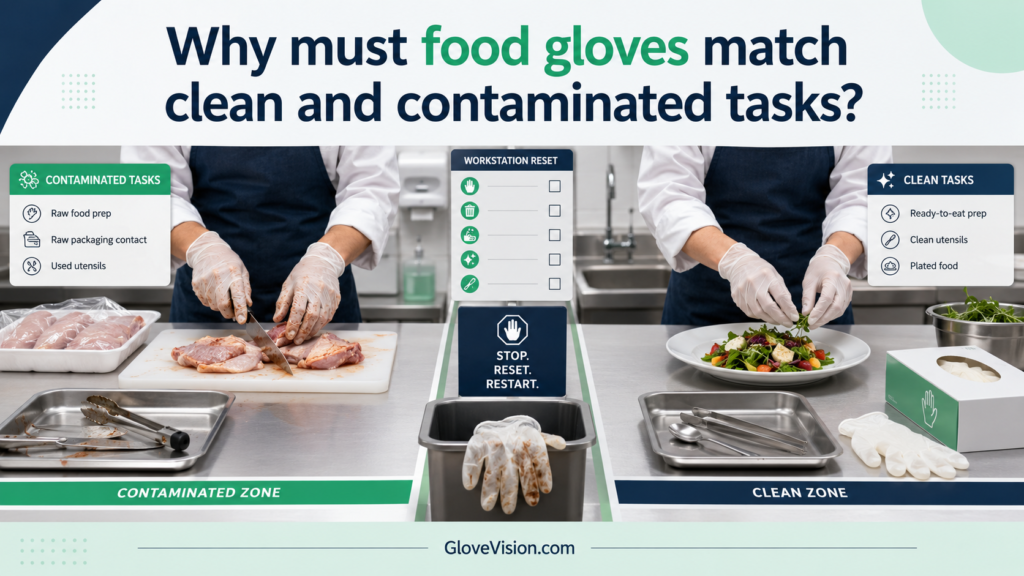
Why must food gloves match clean and contaminated tasks?
Food gloves must match clean and contaminated tasks because every food, tool, surface, allergen, chemical, and non-food contact changes the status of the glove surface. Workers should verify the current task, what the gloves touched, whether the next task is compatible, whether the gloves remain intact, and whether handwashing and workstation reset are required.
This article explains which transitions require fresh gloves, how to verify glove suitability, how to change tasks hygienically, and how to restore food-contact controls after damage or contamination. It treats glove matching as a task, contact, product, and facility-procedure decision rather than a color or material shortcut.
This article provides educational guidance about matching food gloves to clean, contaminated, raw-food, ready-to-eat, allergen, and non-food tasks. It does not replace local food law, the facility food-safety plan, handwashing requirements, allergen procedures, sanitation programs, exact product documentation, worker training, supervision, machine guarding, chemical controls, or task-specific PPE. Verify the exact glove, food type, contact condition, task, jurisdiction, and facility procedure before use.
Why Must Food Gloves Remain Matched to One Controlled Food-Handling Task?
Food gloves must remain matched to one controlled task because every food, tool, surface, and non-food contact can change the contamination status of the glove surface.
Food gloves form a task-specific branch within the broader category of food-handling gloves, so the relevant question is not only what the glove is made from, but whether the current pair still matches the next food-contact task.
How Do Food Gloves Make Task Boundaries Easier to Notice?
Food gloves may make task boundaries easier to notice because workers can track which foods, tools, surfaces, and non-food objects the current pair has contacted. FDA describes the Food Code as a model for retail food safety, and the Food Code page identifies the 2022 Food Code as the most recent full edition. [FDA] [FDA 2022]
Why Can One Glove Pair Spread Contamination Between Tasks?
One glove pair can spread contamination when residues from a raw, dirty, allergen, chemical, or non-food task remain on the glove during the next task. Raw food to RTE food, dirty utensils to clean utensils, payment handling to food preparation, waste to prep, or chemicals to food-contact areas can all create incompatible next-task conditions.
Why Do Gloves Not Replace Handwashing or Sanitation?
Gloves do not replace handwashing or sanitation because the glove surface can become contaminated and contaminated hands, utensils, food, equipment, and surfaces remain uncontrolled after a glove change. Task matching applies to the complete food-handling process—not only to glove material or color.
Which Clean, Contaminated, and Non-Food Transitions Require Fresh Food Gloves?
Fresh gloves should be used whenever the worker crosses into a task with a different food category, contamination status, allergen condition, contact history, or workstation context, as required by the applicable food code and facility procedure.
Which Raw-to-Ready-to-Eat Transitions Require Fresh Gloves?
Before moving from raw animal food or raw-food contamination sources to ready-to-eat food, workers should apply the fresh-glove, handwashing, utensil, equipment, and workstation controls required by the applicable food code and facility procedure. The Food Code full document is the exact source for provisions involving handwashing, RTE handling, glove use, and contamination controls. [Food Code]
Which Dirty-to-Clean Transitions Require Fresh Gloves?
Dirty-to-clean transitions require a new glove assessment whenever the worker moves from cleaning, waste, dirty equipment, floor contact, payment handling, outer packaging, or another uncontrolled activity to controlled food preparation or sanitized equipment.
Which Allergen Transitions Require Fresh Gloves?
Fresh gloves should be included wherever required by the facility allergen procedure when moving between allergen-containing foods, controlled orders, shared equipment, or allergen-cleanup tasks. Glove replacement alone does not prevent allergen cross-contact because utensils, surfaces, equipment segregation, ingredients, labeling, and food disposition may also need control.
Which Glove Conditions Require Immediate Replacement?
Torn, punctured, split, soiled, sticky, contaminated, chemically exposed, heat-deformed, loose, tight, slippery, degraded, or fragment-shedding gloves require immediate replacement. A time-based interval should not override contamination, task transition, glove damage, interruption, visible soil, or loss of control.
Table 1. A transition matrix showing when the current glove pair no longer matches the next food-handling task.
| Current Task | Next Task | Main Risk | Glove Action | Handwashing Need | Food/Surface Reset |
|---|---|---|---|---|---|
| Raw animal food | Ready-to-eat food | Microbial transfer | Discard and replace | Follow applicable procedure | Replace tools and reset station |
| Raw packaging | Clean preparation | Contaminated packaging residue | Replace | Wash where required | Clean affected preparation area |
| Dirty utensils | Clean utensils | Recontamination | Replace | Follow facility rule | Replace or sanitize tools |
| Cleaning or waste | Food preparation | Dirt, microbes, or chemical residue | Discard immediately | Wash | Reset station |
| Payment handling | RTE assembly | Non-food contamination | Replace | Wash where required | Assess contact points |
| Allergen food | Controlled order | Cross-contact | Replace under allergen SOP | Follow allergen procedure | Replace tools and clean area |
| Workstation departure | Controlled food task | Unknown contact history | Replace before restart | Follow facility rule | Recheck workstation |
| Damaged glove | Any food task | Hand contact or fragments | Stop and discard | Wash | Inspect affected food and surfaces |
This matrix focuses on task compatibility and transition decisions rather than a universal glove-wear interval.
How Should Food Gloves Be Verified and Matched to Specific Food-Contact Tasks?
A food glove is suitable only when its documentation, formulation, fit, contact conditions, and performance limitations match the actual food-handling task.
General work gloves may address grip, heat, cuts, or mechanical hazards, but they should not be assumed suitable for direct food contact.
What Documentation Should Verify Food-Contact Suitability?
The manufacturer or supplier should provide documentation showing that the exact glove is suitable for the intended food, temperature, duration, task, and jurisdiction. FDA’s food-contact-substance page explains the general U.S. framework for substances that come into contact with food, but it does not approve every finished glove by category. [FDA]
How Should Food Type and Contact Conditions Affect Selection?
A glove documented for one food type, duration, or temperature should not automatically be assumed suitable for another. Dry, aqueous, acidic, oily, fatty, alcohol-containing, cold, room-temperature, warm, short-duration, and repeated-contact conditions may need different product documentation.
How Do Common Food-Glove Materials Differ by Task?
Polyethylene, vinyl, nitrile, and latex gloves may suit different tasks only when the exact formulation and intended conditions are documented. Regulation (EC) No 1935/2004 provides the general EU food-contact framework, while Regulation (EU) No 10/2011 is specific to applicable plastic materials and articles rather than every glove component. [EU] [EU]
Which Tasks Require Different PPE, Tools, or Controls?
Standard disposable food gloves do not replace thermal gloves, cut-resistant systems, chemical-resistant gloves, utensils, machine guards, or applicable lockout procedures. OSHA’s hand-protection rule supports hazard-based hand-protection selection, while its machine-guarding rule supports separate guarding decisions for points of operation and moving parts. [OSHA] [OSHA]
Table 2. A verification table for matching the exact glove product to the intended food-contact condition and task boundary.
| Glove Material | Required Documentation | Potential Task Type | Food-Contact Question | Main Limitation | Different Control Needed |
|---|---|---|---|---|---|
| Polyethylene | Exact food-contact statement | Quick, frequent-change transfer tasks | Is the intended food and condition covered? | Product-specific fit and grip limits | Tool or different documented glove |
| Vinyl | Formulation and intended-use statement | Selected service or preparation | Are food type, time, and temperature covered? | Product-specific durability and migration conditions | Different documented product |
| Nitrile | Exact food-contact and use-condition statement | Wet or higher-dexterity tasks where documented | Are food, duration, and temperature covered? | Not automatically heat, cut, or chemical resistant | Task-specific PPE |
| Latex | Food-contact and facility approval | Selected dexterity tasks where permitted | Are sensitivity controls adequate? | Allergy and policy considerations | Alternative documented material |
| Reusable protective glove | Food-contact and cleaning documentation | Specialized cut or thermal system | Can hygiene be controlled between uses? | Maintenance and cross-contamination | Sanitation procedure |
| Any material | Exact product and jurisdictional evidence | Only documented use | Does the exact task match? | Material name alone proves little | Verify before use |
This table keeps material discussion conditional and product-specific instead of ranking materials universally.
How Should Food Workers Wash, Select, Don, Change, and Doff Food Gloves Hygienically?
A hygienic food-glove workflow begins with clean, dry hands and ends only after used gloves are discarded and the worker, food, tools, equipment, and workstation are controlled for the next task.
Most products discussed here are single-use disposable gloves, but disposable status does not prove food-contact suitability or allow one pair to cross incompatible tasks.
What Should Workers Do Before Donning Food Gloves?
Before donning gloves, workers should follow the applicable handwashing procedure, dry their hands, select a documented glove and size, and inspect it for damage or contamination. Do not insert an unsupported handwashing duration unless the applicable authority or facility procedure provides it.
How Should Food Gloves Be Extracted and Donned Hygienically?
Gloves should be removed from a protected supply without contaminating the glove exterior, surrounding gloves, or nearby food-contact equipment. Handle near the cuff where practical, avoid touching multiple gloves, discard dropped gloves, protect boxes from splash and chemicals, keep boxes off floors, and use “hygienic,” not “aseptic,” for ordinary food service.
How Should Food Gloves Be Used and Changed During the Task?
One glove pair should remain assigned to one controlled task until a food-category, contamination, allergen, non-food-contact, interruption, glove-condition, or validated facility trigger occurs. Workers should monitor glove condition, recognize current-task and next-task compatibility, stop at contamination boundaries, and never let an interval override damage or contamination.
How Should Food Gloves Be Removed and Discarded?
Food gloves should be removed in a way that minimizes contact between contaminated exteriors and clean skin. Use the facility’s required removal method where one exists, discard removed single-use gloves immediately, and wash hands where required before moving to the next task.
How Should the Workstation Be Reset Before Fresh Gloves Are Donned?
Fresh gloves should be donned only after affected food, utensils, equipment, surfaces, and hand hygiene have been controlled for the next task. Assess food, isolate affected ingredients, replace utensils, clean and sanitize surfaces, check for glove fragments, and confirm the next task before selecting a suitable replacement glove.
Table 3. A change-out workflow that executes the transition from one controlled task to another.
| Step | Action | Decision or Trigger | Corrective Response |
|---|---|---|---|
| Detect change | Identify task, contamination, allergen, non-food, damage, or interruption trigger | Does the current pair match the next task? | Stop if not compatible |
| Stabilize task | Place food, tools, and equipment safely | Can gloves be removed without spreading contamination? | Isolate affected items |
| Doff | Remove gloves using the required procedure | Skin contacts contaminated exterior | Wash hands |
| Discard | Dispose immediately | Removed glove retained or reused | Correct practice |
| Wash | Follow applicable handwashing procedure | Washing required but not completed | Do not continue |
| Assess | Check food, tools, equipment, and surfaces | Contamination or fragments suspected | Isolate and reset |
| Reset | Clean, sanitize, replace, discard, or reprocess as required | Controls incomplete | Do not restart |
| Select and don | Use a fresh documented glove matching the next task | Product or fit uncertain | Replace product |
| Begin task | Start one new controlled task | Another trigger occurs | Repeat workflow |
This workflow separates glove replacement from handwashing, food assessment, workstation reset, and next-task verification.
What Should Workers Do When Food Gloves Tear, Become Contaminated, or Prove Unsuitable?
When gloves fail or become contaminated, workers should stop the task, remove the gloves, assess affected food and surfaces, restore controls, and restart only with suitable replacement gloves, tools, or PPE.
What Is the General Stop-and-Reset Sequence?
The general response is to stop, stabilize the task, discard the gloves, wash hands, isolate affected items, restore controls, and restart only when the next task can begin safely. The response should cover affected food, utensils, equipment, surfaces, allergens, chemicals, fragments, and task-control failures.
How Should Tears, Punctures, or Glove Fragments Be Handled?
A tear, puncture, split, or fragment concern requires immediate task stoppage and assessment of affected food, equipment, and surfaces. Do not assign universal puncture thresholds; assess the event using the exact product, task, and facility procedure.
How Should Raw-Food, Allergen, or Chemical Contamination Be Handled?
Raw-food, allergen, or chemical contamination requires control of the affected worker, food, utensils, equipment, and surfaces—not merely a fresh glove pair. Isolate affected food, replace utensils, follow the relevant SOP, clean and sanitize, review segregation and labeling, and prevent premature restart.
How Should Heat Deformation, Poor Fit, or Grip Loss Be Handled?
Heat deformation, excessive looseness, tightness, slippage, or grip loss means the glove no longer matches the task. Stop safely, remove unsuitable gloves, assess affected food or equipment, choose a suitable size or product, and use heat-rated PPE, tools, or other controls where needed.
Table 4. A response matrix for glove damage, contamination, allergen contact, chemical exposure, heat deformation, and fit failure.
| Failure | Immediate Risk | Food/Surface Decision | Reset Action | Replacement Control | Restart Condition |
|---|---|---|---|---|---|
| Tear or puncture | Hand contact or fragments | Isolate and inspect affected food | Wash, inspect, clean | Suitable size or product | Fragment and surface control completed |
| Raw-food contamination | Microbial transfer | Isolate RTE food and tools | Wash and sanitize | Fresh gloves | Controlled workstation |
| Allergen contact | Cross-contact | Follow allergen food decision | Replace tools and clean area | Fresh gloves | Allergen procedure completed |
| Phone, money, or waste | Non-food contamination | Assess food and contact points | Wash and sanitize | Fresh gloves | Contact area controlled |
| Chemical contact | Food and skin contamination | Isolate food and surfaces | Follow SDS and facility procedure | Chemical PPE for cleaning | Chemical control completed |
| Heat deformation | Material and grip failure | Assess food and equipment | Remove hot-contact hazard | Thermal PPE or tool | Correct protection available |
| Poor fit or grip | Task-control failure | Assess mishandled food | Correct size and setup | Suitable glove | Control restored |
This matrix includes restart conditions so a fresh glove pair is not treated as the only corrective action.
Which Shift-Start Checks Confirm That Food Gloves Match Clean and Contaminated Tasks?
Before food handling begins, supervisors should confirm that glove supplies, task assignments, transition rules, hygiene facilities, product suitability, and contamination-response procedures are ready.
Table 5. A shift-start screen for documentation, task assignment, material fit, hygiene readiness, supply, change rules, boundaries, and response readiness.
| Check | Verification | Corrective Action |
|---|---|---|
| Food-contact documentation | Exact glove is documented for intended food, task, condition, and jurisdiction | Do not use undocumented gloves |
| Task assignment | Clean, raw, RTE, allergen, dirty, and non-food tasks are clearly defined | Clarify task boundaries |
| Material and task match | Material, size, fit, grip, and dexterity match the assigned work | Replace product, size, or control |
| Handwashing readiness | Running water, soap, drying supplies, and disposal are available | Do not begin glove-dependent handling |
| Storage hygiene | Boxes are protected from splash, raw food, chemicals, floors, dust, and dirty surfaces | Relocate or replace supplies |
| Replacement supply | Correct sizes and adequate replacement stock are available | Restock before service |
| Change rules | Workers know raw/RTE, dirty/clean, allergen, non-food, interruption, damage, and contamination triggers | Retrain and post prompts |
| Protection boundaries | Workers understand when heat, cut, chemical, tool, machine, or guarding controls are required | Provide correct PPE and procedure |
| Failure response | Workers can stop, discard, wash, isolate, reset, replace, and restart safely | Correct response gaps |
This checklist verifies readiness before work; it is not a substitute for supervision, local law, sanitation validation, or an allergen program.
This checklist is a pre-service screen, not proof of complete legal compliance, sanitation validation, allergen-program adequacy, chemical-resistance assessment, machine-safety inspection, or active supervision.
Sources & Evidence Boundaries
This page uses 8 public sources. Exact product specifications, food-contact statements, supplier declarations, Declaration of Compliance records where required, exact regulatory bases, migration documentation, intended food types, contact duration, temperature limits, formulation information, allergen SOPs, sanitation SOPs, chemical SDS, machine instructions, local food codes, and facility glove-change procedures remain task-specific verification requirements.
- FDA — Food Code supports FDA Food Code model-code context, edition status, and adoption context; it does not prove local adoption or finished-glove suitability.
- FDA — Food Code 2022 supports the official 2022 Food Code page and edition access context; it does not replace local law or facility procedure.
- FDA — Food Code 2022 Full Document supports exact Food Code text for employee hygiene, ready-to-eat food, glove use, and contamination controls; it does not approve a specific glove product.
- FDA — Food Packaging and Other Food-Contact Substances supports the general U.S. food-contact-substance framework; it does not approve a specific finished glove or every formulation.
- EUR-Lex — Regulation (EC) No 1935/2004 supports the general EU framework for materials and articles intended to contact food; it does not prove material-specific glove compliance.
- EUR-Lex — Commission Regulation (EU) No 10/2011 supports the EU plastics measure and current EUR-Lex record context; it does not automatically apply to every glove component.
- OSHA — 29 CFR 1910.212 General Machine Guarding supports the machine-guarding boundary for moving parts and points of operation; it does not approve glove use around any specific food machine.
- OSHA — 29 CFR 1910.138 Hand Protection supports hazard-based hand-protection selection boundaries; it does not establish food-contact suitability.
Frequently Asked Questions
Can One Pair of Food Gloves Be Used for Several Tasks?
No. One pair should remain assigned to one controlled task until a food-category, contamination, allergen, non-food-contact, damage, or facility trigger requires replacement.
Must Gloves Be Changed Between Raw and Ready-to-Eat Food?
Before moving from raw-food contamination sources to ready-to-eat handling, workers should apply the fresh-glove, handwashing, utensil, equipment, and workstation controls required by the applicable food code and facility procedure.
Should Gloves Be Changed After Touching Money or Payment Equipment?
Yes. Payment handling creates a non-food-contact boundary before controlled food preparation resumes.
Do Fresh Gloves Make Contaminated Surfaces Safe?
No. Fresh gloves restore only the glove surface; affected food, utensils, equipment, and surfaces must also be controlled.
Are All Nitrile, Vinyl, Polyethylene, or Latex Gloves Suitable for Food Contact?
No. Suitability depends on the exact formulation, food type, contact duration, temperature, task, jurisdiction, and supplier documentation.
Can Single-Use Food Gloves Be Washed and Reused?
No. Removed, contaminated, or task-completed single-use gloves should be discarded rather than washed, sanitized, or stored for reuse.
When Can Food Handling Restart After a Glove Failure?
Food handling should restart only after the gloves are discarded, hands are controlled, affected food is assessed, utensils and surfaces are reset, and suitable replacement gloves are donned.
Conclusion
Food gloves must match clean and contaminated tasks because their surfaces take on the status of the foods, tools, surfaces, allergens, chemicals, and non-food objects they touch. One pair should remain assigned to one controlled task until the current task, next task, food category, contact history, allergen status, glove condition, or facility procedure requires replacement.
Fresh gloves alone do not clean hands, food, utensils, equipment, or preparation surfaces. Safe task matching depends on handwashing, exact product documentation, fit and control, hygienic change-out, workstation reset, failure response, supervision, and facility rules.