How does layered protection support electrical work?
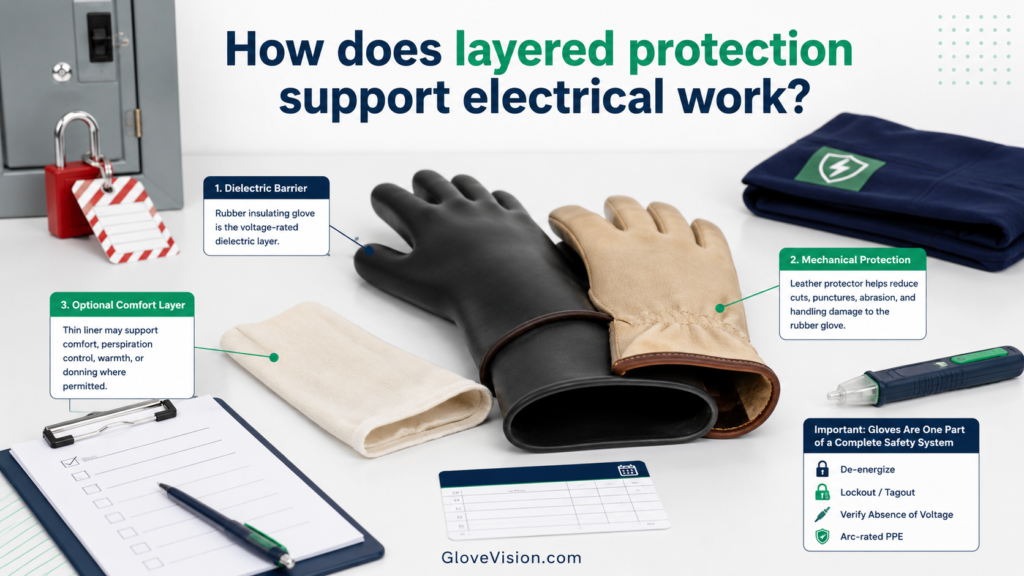
Layered protection supports electrical work by combining a voltage-rated rubber insulating glove with a compatible mechanical protector and, where permitted, an optional comfort liner. The rubber provides the dielectric barrier, the leather helps shield the rubber, and the liner may support comfort without becoming a safety barrier.
This article explains how the layers differ, how OSHA and ASTM requirements apply, and what to verify for voltage class, cuff clearance, inspection, testing, storage, contamination, de-energization, and LOTO. It does not authorize energized work or make any layer a guarantee of protection.
This article provides educational guidance about layered electrical hand protection. It does not authorize energized work or replace voltage assessment, de-energization, applicable lockout/tagout procedures, verification of absence of voltage, qualified-worker requirements, approach boundaries, arc-flash assessment, electrical testing, manufacturer instructions, or the employer’s electrical-safety program. Verify the exact rubber glove class, type, test status, protector requirement, liner permission, cuff relationship, condition, and site procedure before use.
How Do the Layers in an Electrical Glove System Perform Different Functions?
An electrical glove system uses separate layers because dielectric protection, mechanical protection, and comfort support are different functions.
The relationship between the dielectric and mechanical layers is explained in more detail through the rubber protectors page, while this page explains how rubber, leather, liners, arc-rated PPE, and work controls fit into one verification system.
Which Layer Provides Dielectric Protection?
The rubber insulating glove provides the primary dielectric barrier against electrical shock within its class, test, and condition limits. ASTM D120 covers rubber insulating gloves used for electrical shock protection and identifies Type I/Type II and Classes 00–4 in the rubber glove specification context. [ASTM]
What Does the Leather Protector Do?
The leather protector helps shield the rubber glove from cuts, punctures, abrasion, tools, hardware edges, and handling wear. ASTM F696 covers leather protectors intended to fit over rubber insulating gloves without undue wrinkles, and mechanical protection does not equal dielectric protection. [ASTM]
What Does an Optional Liner Do?
An optional liner may support comfort, perspiration control, warmth, or donning when the exact glove system and employer procedure permit it. A liner should not be treated as voltage-rated insulation, a required safety barrier, a mechanical protector, or arc-flash PPE.
What Does Layering Not Guarantee?
Layering does not guarantee protection beyond the rubber glove’s class, after damage or contamination, or when electrical work controls are missing. Failed testing, poor fit, improper clearance, bypassed de-energization, missing LOTO, or incomplete arc-flash PPE can invalidate the system.
Table 1. Rubber insulating gloves, leather protectors, optional liners, rubber cuffs, arc-rated PPE, and work controls separated by function, limitation, and verification.
| Layer or Control | Main Function | Helps Protect | Does Not Prove | Verification |
|---|---|---|---|---|
| Rubber insulating glove | Primary dielectric barrier | Worker from electrical shock exposure | Mechanical immunity or complete arc-flash protection | Class, type, test status, condition |
| Leather protector | Mechanical outer layer | Rubber from cuts, punctures, abrasion, and wear | Primary dielectric protection | F696 documentation, fit, condition |
| Optional liner | Comfort-support layer | Skin comfort, perspiration control, or warmth | Voltage insulation | Manufacturer and employer permission |
| Rubber cuff | Extends insulating coverage | Wrist and forearm area within product design | Universal clearance | Class-specific requirement |
| Arc-rated PPE | Thermal arc protection | Worker from arc thermal exposure | Dielectric shock protection | Separate hazard assessment |
| De-energization/LOTO | Hazard control | Prevents or controls energy exposure | Physical glove condition | Applicable work procedure |
This matrix prevents the liner, leather protector, arc-rated PPE, and LOTO from being mistaken for the rubber glove’s dielectric barrier.
How Do OSHA 1910.137 and ASTM D120, F696, and F496 Divide the Layered-System Requirements?
ASTM D120 governs the rubber glove specification, ASTM F696 governs leather protectors, ASTM F496 governs in-service care and testing, and OSHA 1910.137 governs workplace electrical protective equipment requirements.
Electrical insulating gloves belong to one specialized branch within Glove Types Explained, so broad glove categories should not be merged with voltage-rated dielectric PPE.
What Does ASTM D120 Cover?
ASTM D120 covers manufacturing and testing requirements for rubber insulating gloves used for electrical shock protection. Use it for rubber glove specification, type designation, class designation, manufacturing context, and electrical test context, not for leather protector scope.
What Does ASTM F696 Cover?
ASTM F696 covers leather protectors intended to fit over rubber insulating gloves without damaging or excessively wrinkling the rubber. F696 is the protector standard, not the rubber-glove standard, and it does not establish dielectric insulation.
What Does ASTM F496 Cover?
ASTM F496 covers in-service care, inspection, testing, use voltage, and related service decisions for insulating gloves and sleeves. ASTM F496-24 supports in-service care and testing context without proving that later field damage did not occur. [ASTM]
What Does OSHA 1910.137 Require?
OSHA 1910.137 establishes workplace requirements for marking, inspection, air testing, protector use, periodic testing, storage, and removal of defective electrical protective equipment. OSHA compliance does not independently prove current field integrity, exact glove/protector compatibility, energized-work permission, or complete arc-flash protection. [OSHA]
The standards-based table below separates D120, F696, F496, OSHA 1910.137, manufacturer instructions, and employer procedure into their correct roles.
Table 2. ASTM D120, ASTM F696, ASTM F496, OSHA 1910.137, manufacturer instructions, and employer programs separated by role and limitation.
| Standard or Rule | Applies To | Helps Verify | Does Not Prove | Worker Action |
|---|---|---|---|---|
| ASTM D120-22 | Rubber insulating gloves | Types, classes, construction, and test context | Current field integrity | Check label and test status |
| ASTM F696-24 | Leather protectors | Intended use, fit, construction, and protector role | Dielectric protection | Verify compatible protector |
| ASTM F496-24 | In-service gloves and sleeves | Care, inspection, testing, and use voltage | Energized-work permission | Follow employer test program |
| OSHA 1910.137 | Workplace electrical PPE | Marking, inspection, air test, protectors, testing, storage | Product endorsement | Follow applicable employer procedure |
| Manufacturer instructions | Exact product system | Layer order, liner permission, fit, and storage | Universal use | Follow exact model instructions |
| Employer program | Local work control | Approved system, testing, task use, and removal | Universal approval | Follow current site procedure |
This table keeps product standards, in-service standards, workplace rules, model instructions, and employer procedures in their correct lanes.
How Should Voltage Class, Protector Fit, and Cuff Clearance Be Verified?
Voltage class, protector fit, and cuff clearance must be verified together because the glove system must match the actual exposure without allowing the outer layers to damage or improperly cover the rubber.
Layered gloves form only one part of controlling live-voltage exposure during qualified electrical work, so class selection does not replace hazard assessment, voltage verification, or employer authorization.
How Is Voltage Class Selected?
The glove class must cover the maximum voltage to which the worker may actually be exposed under the applicable system configuration and work method. Exposure assessment may require phase-to-ground or phase-to-phase review depending on the system and task.
How Is Protector Fit Checked?
The leather protector must fit over the rubber glove without pinching, folding, cutting, overstretching, or creating excessive wrinkles. Hand size, finger alignment, protector length, cuff shape, leather condition, movement, and tool control all matter.
Why Does Cuff Clearance Matter?
Cuff clearance preserves the required exposed rubber distance between the dielectric glove and the non-dielectric protector cuff. Clearance is one part of the system and does not by itself prove complete electrical safety.
Where Should Exact Values Be Verified?
Exact voltage and clearance values should be verified from the complete applicable OSHA or ASTM table, manufacturer instructions, and employer procedure. Partial examples should not be reproduced as the full rule.
Table 3. Exposure, glove class, phase condition, protector specification, fit, cuff clearance, and test status checked before use.
| Verification | Core Question | Evidence Needed | Failure Response | Does Not Prove |
|---|---|---|---|---|
| Maximum exposure | What voltage may the worker actually contact? | System and task assessment | Reassess work method | Work authorization |
| Glove class | Does the class cover that exposure? | Label, complete applicable table | Select correct tested glove | Safe approach distance |
| Phase exposure | Is the risk phase-to-ground or phase-to-phase? | System review | Reassess selection | Arc-flash protection |
| Protector specification | Is it intended for rubber insulating gloves? | F696 and product documents | Replace unsuitable protector | Dielectric protection |
| Protector fit | Does it avoid pinching and wrinkles? | Fit trial and instructions | Re-pair system | Correct clearance |
| Cuff clearance | Is class-specific rubber exposure maintained? | Complete table and instructions | Correct pairing | Complete electrical safety |
| Test status | Is electrical testing current? | Test record | Remove and test | No later field damage |
This verification table avoids unsupported voltage or clearance numbers while preserving the required decision logic.
How Should the Layered Glove System Be Inspected, Donned, Used, and Stored?
The layered glove system should be used only after the electrical work setup is reviewed, the rubber glove is verified and air-tested, the liner is confirmed as permitted, and the leather protector is inspected and correctly fitted.
Ordinary work gloves address grip, abrasion, cut, and handling risks but should not replace voltage-rated rubber gloves, documented protectors, or permitted liners in an electrical glove system.
Step 1 — Verify the Work Controls
De-energize and apply the applicable electrical lockout/tagout and voltage-verification procedure whenever required by the work and employer program. OSHA 1910.333 supports covered electrical de-energization and work-practice context, but it does not define glove performance. [OSHA]
Step 2 — Verify Glove Documentation
Confirm the rubber glove’s class, type, size, label, and electrical test status before treating the system as ready. Do not use unreadable, expired, or uncertain equipment.
Step 3 — Inspect and Air-Test the Rubber
Inspect the rubber inside and outside and perform the required air test before use. OSHA requires insulating gloves to be inspected before each day’s use and air-tested with that inspection.
Step 4 — Inspect the Protector and Confirm the Liner
Inspect the leather protector for damaging wear or contamination and confirm that any optional liner is permitted and compatible. OSHA’s electric-power eTool gives practical context for insulating gloves, protectors, inspection, testing, and storage, while exact product instructions still control the specific system. [OSHA eTool]
Step 5 — Don and Verify the System
Don the approved liner where permitted, then the rubber glove, followed by the compatible leather protector. Verify that fingers are seated, rubber is not twisted, the protector is not pinching, cuff clearance is maintained, sleeve relationships are appropriate where needed, and grip remains controlled.
Step 6 — Store Without Deforming the Rubber
Store the glove system away from harmful light, heat, ozone, moisture, chemicals, sharp objects, folds, and compression. OSHA requires insulating equipment to be stored to protect it from damaging light, temperature extremes, excessive humidity, ozone, and other injurious conditions.
Table 4. A normal-use workflow from work controls through documentation, rubber inspection, air test, outer-layer check, fit verification, and storage.
| Step | Core Check | If Passed | If Not Passed |
|---|---|---|---|
| Review work controls | Qualified worker, de-energization, LOTO, voltage verification, arc assessment | Verify PPE | Do not begin |
| Verify documentation | Class, type, label, test status | Inspect rubber | Remove or route for review |
| Inspect rubber | No disqualifying physical or chemical defect | Perform air test | Remove from service |
| Air-test rubber | No leak or suspicious area | Inspect outer layers | Tag and isolate |
| Check liner/protector | Liner permitted; protector clean, undamaged, and compatible | Don system | Replace or omit unauthorized layer |
| Verify fit and clearance | No pinching, twisting, or incorrect cuff relationship | Begin only under approved procedure | Re-pair system |
| Store | Protected from light, ozone, chemicals, folds, and compression | Retain in service | Evaluate questionable equipment |
This workflow integrates glove-system checks with electrical work controls without becoming a testing manual.
What Should Happen When the Layered Glove System Is Compromised?
Damage, contamination, failed air testing, abnormal electrical sensation, expired testing, or use without required protectors requires removal from service and authorized evaluation before reuse.
Rubber insulating gloves address shock hazards within documented class and condition limits, while leather protectors preserve the rubber mechanically and optional liners support comfort only. Arc thermal exposure still requires separate assessment and task-specific PPE. [OSHA]
What Happens After a Tear, Puncture, Tracking Mark, or Failed Air Test?
A tear, pinhole, cut, puncture, tracking mark, ozone check, texture change, or failed air test requires immediate stop-use action. Tag the system, isolate it, replace it for the task, and route it to authorized inspection, testing, retirement, or replacement.
What Happens After Tingling or Shock Sensation?
Tingling, shock sensation, abnormal heat, burns, numbness, weakness, or unusual sensation requires immediate hazard communication, emergency response, medical evaluation where indicated, incident reporting, and removal of the glove system.
What Happens After Oil, Solvent, or Unknown Contamination?
Oil, transformer fluid, hydraulic fluid, fuel, grease, solvent, adhesive, conductive dust, metal particles, or unknown chemicals make the system uncertain. Stop use, identify the contaminant where possible, review SDS and manufacturer instructions, and route the system for evaluation and electrical retesting where insulating value may be affected.
What Happens After Use Without Required Protectors?
Use without required protectors must remain a documented exception, not a convenience choice. Where OSHA applies, testing rules include retesting after use without protectors, and stricter employer or jurisdictional requirements may apply. [OSHA]
What Happens After Questionable Storage?
Questionable storage means the system should not be cleared by appearance alone. Heat, light, ozone, chemicals, moisture, folds, compression, tool-box abrasion, or sharp-object contact can require inspection and testing before return.
Do not add a sixth compromise-response matrix here. The normal workflow, standards table, and concise checklist already contain the decision structure.
Which Shift-Start Checks Confirm Layered Electrical Glove Readiness?
Shift-start readiness requires confirmed work controls, correct exposure assessment, current electrical testing, passed rubber inspection and air testing, permitted liner use, compatible protectors, verified cuff clearance, and acceptable storage and contamination status.
Table 5. A concise shift-start checklist for work controls, exposure, test status, rubber condition, liner/protector status, cuff clearance, contamination, storage, sleeves, and stop-use triggers.
| Check | Verify | If Not Met |
|---|---|---|
| Work control | Qualified worker, job briefing, de-energization/LOTO, voltage verification, and arc assessment | Do not begin |
| Exposure and class | Rubber glove class covers maximum possible exposure | Reassess and replace |
| Test status | Electrical test remains current | Remove and send for testing |
| Rubber condition | Visual inspection and air test pass | Tag and remove |
| Liner and protector | Liner is permitted; protector is required, compatible, clean, and undamaged | Correct the system |
| Cuff clearance | Class-specific rubber exposure is maintained | Re-pair according to instructions |
| Contamination | No oil, solvent, conductive dust, moisture, or unknown residue | Isolate and evaluate |
| Storage and sleeves | Storage is acceptable and arm protection is verified where needed | Inspect, test, or add required PPE |
| Stop-use trigger | No defect, shock concern, expired test, improper unprotected use, or uncertain status | Remove from service |
This checklist is a shift-start screen, not energized-work authorization or proof of hidden dielectric integrity.
This checklist is a shift-start screen, not energized-work authorization, not a substitute for employer procedure, and not proof that hidden damage is absent.
Sources & Evidence Boundaries
This page uses 8 public sources. Exact rubber glove labels, leather protector labels, liner manufacturer instructions, electrical test certificates, complete class-specific voltage tables, complete cuff-clearance tables, employer electrical-safety programs, applicable lockout/tagout procedures, arc-flash assessments, SDS records, and qualified test facility documentation remain task-specific verification requirements.
- OSHA — 29 CFR 1910.137 Electrical Protective Equipment supports marking, inspection, air testing, protector use, limited exceptions, testing, storage, and defective-equipment removal; it does not authorize energized work or complete arc-flash protection.
- OSHA eTool — Insulating Gloves and Sleeves supports practical insulating glove and sleeve context, protector use, inspection, testing, and storage context; it does not replace employer procedure.
- OSHA — Testing Intervals for Rubber Insulating Gloves supports six-month post-issue testing, the 12-month pre-issue boundary, suspected-value testing, repair, and unprotected-use retesting where OSHA applies.
- ASTM — D120-22 Standard Specification for Rubber Insulating Gloves supports rubber insulating glove scope, Type I/Type II, Classes 00–4, manufacturing, and test context; it does not prove current field condition.
- ASTM — F696-24 Standard Specification for Leather Protectors for Rubber Insulating Gloves supports leather protector scope, intended use over rubber insulating gloves, fit, construction, and mechanical-protection context; it does not prove dielectric protection.
- ASTM — F496-24 Standard Specification for In-Service Care of Insulating Gloves and Sleeves supports in-service care, inspection, electrical testing, use-voltage, and service-decision context; it does not authorize energized work.
- OSHA — 29 CFR 1910.333 Selection and Use of Work Practices supports covered electrical de-energization and work-practice context; it does not define rubber, leather, or liner glove performance.
- OSHA — 1910.269 Appendix E, Protection From Flames and Electric Arcs supports arc thermal hazard context for covered electric-power work; it does not make the glove layers complete arc-flash PPE.
Frequently Asked Questions
Which Layer Provides Electrical Insulation?
The rubber insulating glove provides the voltage-rated dielectric barrier within its documented class, test status, and condition limits.
Do Leather Protectors Provide Electrical Insulation?
No. Leather protectors help shield the rubber from mechanical damage, but they do not provide the rubber glove’s primary dielectric protection.
Are Optional Liners Required?
No. Optional liners may support comfort, perspiration control, warmth, or donning only where the manufacturer and employer procedure permit them.
Can a Liner Replace a Leather Protector?
No. A liner sits inside the glove system for comfort support and cannot replace the outer leather protector’s mechanical role.
Does an Air Test Replace Electrical Testing?
No. An air test helps identify certain physical leaks, while electrical testing verifies dielectric performance under defined test conditions.
Do Rubber Gloves and Leather Protectors Provide Complete Arc-Flash Protection?
No. Rubber insulating gloves address shock exposure and leather protectors shield the rubber mechanically; arc-flash thermal protection requires a separate assessment and PPE system.
Conclusion
Layered protection supports electrical work only when each layer performs its correct function: the rubber insulating glove provides the dielectric barrier, the leather protector reduces mechanical damage to the rubber, and any optional liner supports comfort only where permitted. The system still depends on correct class selection, current electrical testing, passed inspection and air testing, proper fit, cuff clearance, acceptable storage, contamination control, and employer electrical-safety procedure.
No liner, leather protector, air test, visual inspection, test date, or layered arrangement guarantees protection outside the rubber glove’s documented limits or after damage. De-energization, applicable LOTO, voltage verification, approach boundaries, separate arc-flash PPE, and authorized return-to-service decisions must remain outside the glove layers themselves.