
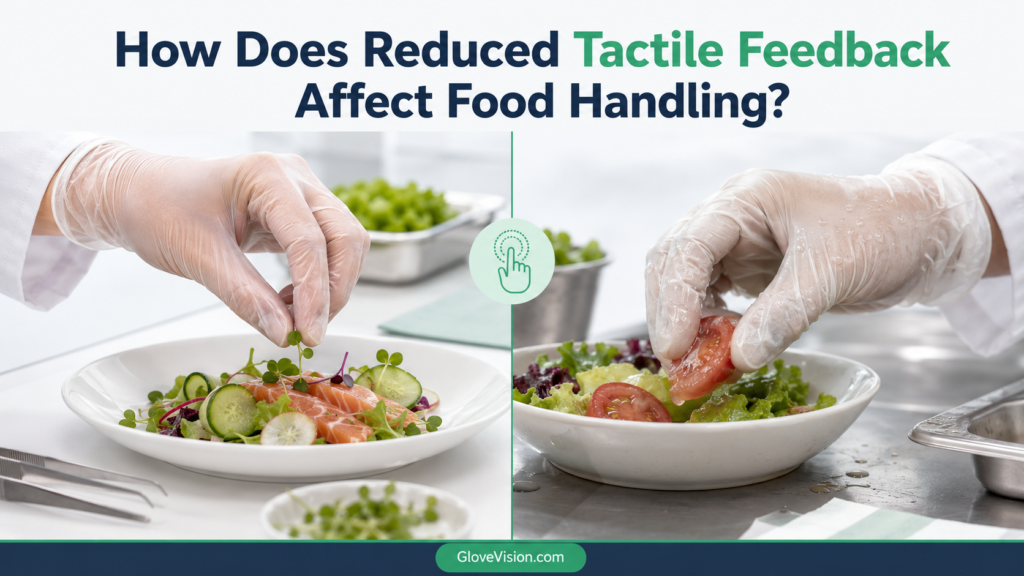
How Does Reduced Tactile Feedback Affect Food Handling?
Reduced tactile feedback may affect food handling by making pressure, texture, slip, object movement, or grip stability more difficult to judge during some tasks. The effect depends on the exact glove, fit, flexibility, surface grip, thickness, moisture, task condition, object or tool, worker, and task duration.
This article explains which tactile cues support control, which glove properties may interfere with them, how to match gloves to food tasks, how to test performance before work, and what to do when control is lost. It treats tactile performance as a glove-worker-task system, not a universal polymer ranking.
This article provides educational guidance about food-glove fit, tactile feedback, grip, dexterity, task matching, and pre-task performance checks. It does not replace food-contact documentation, local food law, handwashing requirements, employer hazard assessment, product instructions, ergonomic assessment, worker training, medical evaluation, machine guarding, or task-specific cut, heat, and chemical protection. Stop the task whenever glove fit, slipping, discomfort, damage, or reduced control makes handling unsafe.
What Does Tactile Feedback Help Workers Detect During Food Handling?
Tactile feedback helps food workers detect surface texture, pressure, slip, object movement, and grip stability while handling ingredients, containers, utensils, packaging, and equipment.
Food-glove tactile performance sits inside the broader category of food-handling gloves, but tactile control is only one part of a safe food-contact decision.
How Does Tactile Feedback Support Grip Stability?
Tactile feedback helps workers judge whether an object is stable, beginning to slip, deforming, or moving inside the hand. OSHA ergonomic guidance lists excessive force, repetition, awkward posture, pressure, and loss of feeling as workplace ergonomic risk factors, so this page treats tactile control as one practical risk-screening factor rather than a fixed medical outcome. [OSHA]
How Does Tactile Feedback Support Fine Food-Preparation Tasks?
Fine food-preparation tasks depend on a combination of fingertip feedback, vision, hand movement, training, tool design, and stable glove fit. Portioning small items, arranging delicate ingredients, opening packaging, placing garnish, using small non-cutting utensils, and operating safe controls can all become harder when the glove does not move with the hand.
What May Happen When Tactile Cues Are Reduced?
When tactile cues are reduced, workers may detect slipping later, use more effort, lose fingertip precision, slow the task, or feel less confident in object control. These outcomes are conditional: they may occur in some tasks, for some workers, and under certain wet, oily, repetitive, or fine-control conditions.
Tactile feedback is one part of safe control; vision, fit, grip, tool design, workstation setup, training, and task pace also influence performance.
How Can Food Gloves Alter Tactile Perception and Hand Control?
Food gloves may alter tactile perception and hand control by changing how pressure, texture, slip, and movement cues reach the hand, but the effect depends on the exact glove, worker, object, and task.
Most products in this page are disposable gloves, but single-use classification does not prove good fit, wet grip, oily grip, or tactile precision.
How Can the Glove Layer Affect Pressure and Texture Cues?
The glove layer may modify pressure and texture cues depending on its construction, fit, thickness, flexibility, surface design, moisture, temperature, and contact object. It should not be described as completely blocking sensation, because performance can differ across smooth packaging, textured packaging, wet surfaces, oily surfaces, small objects, and rigid containers.
How Can Reduced Feedback Affect Grip Effort?
Workers may sometimes grip more firmly when the object feels unstable, the glove surface is slick, fingertip fit is poor, or movement is difficult to detect. OSHA’s tool-ergonomics guidance notes that slick gloves or reduced tactile feel can cause more finger force in some tool tasks, but that evidence should not be converted into a universal percentage for food gloves. [OSHA eTool]
How Can Glove Resistance Affect Hand Movement?
Glove resistance may increase perceived effort when the construction restricts finger flexion, pulls across the palm, bunches at the fingertips, or does not move smoothly with the hand. Thickness and material stiffness are separate variables; a thicker glove is not automatically constructed from a stiffer material.
NIOSH hand-tool ergonomics guidance supports checking glove fit, dexterity, and force as part of tool and hand-control design, but it does not replace a food-task-specific glove trial. [NIOSH]
Table 1. Glove and task factors that may affect sensation, movement, control, and worker checks.
| Glove or Task Factor | Possible Effect on Sensation | Possible Effect on Movement or Control | Worker Check |
|---|---|---|---|
| Fingertip fit | Contact cue may feel delayed when slack is excessive | Bunching or reduced precision | Check alignment and folds |
| Palm and web-space fit | Pressure or tension may distract from task cues | Restricted spreading or flexion | Open and close hand |
| Surface texture | May change friction feedback | May improve or reduce control by condition | Test with representative safe object |
| Flexibility | May affect ease of finger movement | More or less perceived effort | Flex each finger and thumb |
| Thickness | May modify pressure and texture cues | May affect fine control | Balance task needs with documentation |
| Internal moisture | May reduce hand-to-glove stability | Glove may slip on hand | Stop when internal slipping develops |
| External water or oil | May change glove-to-object friction | Container or utensil may slip | Test safe representative condition |
| Task duration | Effects may become more noticeable over time | Discomfort or fatigue may develop | Reassess during repetitive work |
This factor table identifies observable variables rather than assigning fake tactile or grip scores.
Which Glove Properties Most Strongly Affect Tactile Control During Food Preparation?
Tactile control depends more on the exact glove’s fit, flexibility, surface grip, thickness, construction, and task compatibility than on the polymer name alone.
How Does Glove Fit Affect Fingertip Control?
Glove fit affects whether the material follows the fingers and thumb without excessive slack, pressure, bunching, or movement restriction. Exact size interpretation can support the size decision, but the worker still needs a practical movement and grip check before starting the task.
How Do Surface Texture and External Contamination Affect Grip?
Surface grip can change substantially when the same glove moves from dry conditions to water, oil, fat, sauce, condensation, flour, or smooth packaging. Performance should be checked under representative safe conditions instead of assuming that dry grip predicts wet or oily control.
How Do Flexibility and Thickness Affect Dexterity?
Flexibility and thickness may influence dexterity, but neither variable should be judged without considering formulation, fit, geometry, surface design, and task demands. Thin construction may improve feel in some products, while thicker construction may add barrier mass in some products, but neither claim should become a universal rule.
Why Should Workers Avoid Choosing Gloves by Polymer Name Alone?
Gloves sharing the same polymer label can differ in fit, formulation, thickness, texture, cuff design, durability, food-contact documentation, and intended use. Detailed polymer and product differences belong in a separate Glove Material Compare workflow rather than a universal ranking inside this article.
How Should Food Gloves Be Matched to Dry, Wet, Oily, and Fine-Control Tasks?
Food gloves should be matched to the task by checking food-contact documentation, fit, grip, flexibility, dexterity, and control under the actual working conditions.
What Should Workers Check for Short, Dry, Quick-Change Tasks?
Short, dry, frequent-change tasks require easy donning, acceptable fingertip control, documented food-contact suitability, and enough grip for the specific item. Some polyethylene products may suit brief dry transfer tasks, but suitability remains product-specific and task-specific.
What Should Workers Check for Wet, Oily, or Sauced Tasks?
Wet, oily, or sauced tasks require grip testing under representative conditions because dry performance does not predict control on every contaminated surface. Workers should check glove stability on the hand, external grip, bunching, container control, utensil control, food-contact documentation, and replacement supply.
What Should Workers Check for Fine-Control Tasks?
Fine-control tasks require close but comfortable fit, minimal fingertip slack, stable thumb alignment, unrestricted movement, and acceptable control during a brief trial. The selected glove should allow fingertip precision, thumb opposition, smooth movement, task accuracy, and no immediate discomfort.
Which Tasks Require Separate Safety Controls?
Food-glove tactile performance does not establish protection against knives, hot equipment, chemicals, punctures, or moving machinery. OSHA requires employer selection of hand protection based on identified hazards, so broader work gloves, task-specific PPE, guarding, tools, or procedures may be needed for non-food-contact hazards. [OSHA]
Food-contact suitability remains separate from tactile performance: FDA explains the general U.S. food-contact-substance framework, while Regulation (EC) No 1935/2004 provides the general EU food-contact-material framework. [FDA] [EU]
Table 2. Task conditions matched to fit, grip, food-contact, and separate-control checks.
| Task Condition | Main Control Need | Fit Check | Grip Check | Food-Contact Check | Different PPE or Tool Needed |
|---|---|---|---|---|---|
| Short dry transfer | Quick change and adequate control | Check slack and cuff | Dry representative object | Verify intended food | Tool if grip is inadequate |
| Wet preparation | Stable hand and object grip | Check internal slipping | Wet representative surface | Verify food and duration | Different glove or utensil |
| Oily or fatty handling | Product-specific surface control | Check bunching | Oil/fat representative condition where safe | Verify documented food type | Different container or tool |
| Fine assembly | Precision and thumb control | Check fingertip and thumb alignment | Small safe object | Verify intended contact | Fine-handling tool |
| Repetitive handling | Sustained movement and low interference | Check pressure and flexion | Repeat limited safe motion | Verify duration | Rotation or process change |
| Knife or blade task | Cut-hazard control | Fit must not reduce control | Do not use sharp object for test | Verify food contact | Separate cut controls |
| Hot-handling task | Thermal protection | Food glove cannot establish heat safety | No hot-object test | Verify incidental food contact only | Thermal PPE or tool |
| Powered machinery | Guarding and operating procedure | Do not test on operating machine | No live-equipment test | Not the primary question | Guard, shutdown, or lockout |
This matrix helps workers test the glove-task match under representative dry, wet, oily, fine-control, repetitive, and hazard-boundary conditions.
How Should Workers Test Food-Glove Fit, Grip, and Dexterity Before Starting a Task?
Workers should test glove fit, movement, and grip before starting because package size, thickness, and polymer name alone do not confirm acceptable task control.
What Should Workers Do Before Donning the Gloves?
Before donning, workers should complete the applicable handwashing procedure, dry their hands, inspect the glove supply, verify food-contact suitability, and select the expected size. FDA Food Code material provides the food-hygiene context for handwashing, glove use, ready-to-eat handling, and contamination controls; local adoption and facility procedures still control the exact workplace process. [FDA] [Food Code]
How Should Workers Check Anatomical Fit?
Anatomical fit should be checked through full hand opening, closing, finger movement, thumb opposition, fingertip alignment, and cuff stability; exact dimension interpretation can be supported by the Glove Size Translator. Reject the glove when excessive tension develops, large fingertip folds remain, the glove slips during movement, normal motion is restricted, or ordinary flexion tears the glove.
How Should Workers Test Grip and Control?
Grip should be tested with safe, clean, representative objects rather than sharp, hot, chemical, heavy, or powered hazards. Workers can use an empty food container, clean blunt utensil, task-similar packaging, lightweight tray, dry test surface, or safely wetted test surface where relevant.
What Determines Whether the Glove Passes?
The glove passes only when it provides stable fit, sufficient fingertip control, acceptable grip, unrestricted movement, documented food-contact suitability, and no immediate warning sign during the representative test. Documentation, stable fit, grip, and movement must all align before work begins.
Table 3. A practical pre-task checklist for documentation, donning, fit, movement, grip, fine control, and rejection decisions.
| Test Step | Worker Action | Pass Indicator | Reject Indicator |
|---|---|---|---|
| Documentation | Confirm exact product and food-contact use | Intended condition is documented | Documentation absent or mismatched |
| Donning | Don without damage or contamination | Glove seats normally | Glove tears or cannot be seated |
| Fingertip fit | Check finger ends and folds | Minimal slack without pressure | Large folds or strong tension |
| Thumb movement | Move thumb across palm | Free opposition and alignment | Pulling, twisting, or restriction |
| Full movement | Open, close, flex, and extend | Full normal movement | Restriction or tearing |
| Dry grip | Hold safe representative object | Stable control | Slipping or excessive effort |
| Wet/oily simulation | Test only where safe and relevant | Acceptable task-like control | Loss of control |
| Fine-control trial | Perform brief representative motion | Accurate and smooth movement | Bunching or low precision |
| Decision | Review all findings | All controls acceptable | Any unresolved warning sign |
This is a practical screen for obvious control problems; it is not a laboratory friction test or certified dexterity test.
What Should Workers Do When Food Gloves Slip, Tear, or Reduce Hand Control?
When gloves interfere with grip, movement, or control, workers should stop the task, secure the food or tool, remove the gloves, assess affected items, and correct the glove-task match before restarting.
What Should Workers Do After Glove Slippage or Loss of Object Control?
Glove slippage or object-control loss requires an immediate safe stop before the worker continues handling food, containers, utensils, or equipment. The response is to stabilize the object, remove unsuitable or contaminated gloves, wash hands according to procedure, assess affected food and surfaces, select another glove, tool, container, or process, retest safely, and restart only after control is confirmed.
What Should Workers Do After a Tear or Puncture?
A tear or puncture requires immediate glove removal, handwashing as required, food and surface assessment, and a check for glove fragments. Do not assign universal puncture thresholds; the response should use the exact product, task, and facility procedure.
What Should Workers Do When Discomfort, Fatigue, or Cramping Develops?
Discomfort, fatigue, cramping, numbness, or weakness should trigger a safe stop and reassessment rather than an automatic recommendation for a different material or thickness. Glove-related fit, sweating, pressure, or slippage issues can be routed through the Glove Comfort Troubleshooter, while severe or persistent symptoms should follow workplace first-aid or occupational-health procedures.
When Should the Task Be Redesigned Instead of Only Changing Gloves?
The task should be redesigned when acceptable food-contact gloves still do not provide safe control or when the object, tool, repetition, pace, or workstation creates the primary difficulty. Changes may include a different utensil, container, non-slip surface, tool-handle design, two-handed handling, work rotation, or adjusted workstation setup.
Table 4. Corrective responses for glove slippage, object slippage, bunching, movement restriction, tears, discomfort, fatigue, and persistent symptoms.
| Warning Sign | Immediate Action | Factors to Check | Corrective Control | Restart Condition |
|---|---|---|---|---|
| Glove slips on hand | Stop and stabilize object | Size, moisture, fit, cuff | Replace glove or dry/reassess under procedure | Stable internal fit |
| Object slips | Stop and secure object | Surface condition, texture, fit, container | Different glove, tool, or container | Representative grip test passes |
| Fingertip bunching | Stop fine-control work | Size, finger length, glove design | Different size or design | Fingertip control restored |
| Movement restriction | Stop task | Tightness, web tension, flexibility | Different fit or product | Full movement restored |
| Tear or puncture | Stop and discard | Fit, task stress, damage, product | Replacement and food/surface reset | Fragment and contamination control complete |
| Immediate discomfort | Stop and remove glove | Pressure, fit, task, tool | Reassess glove and process | No immediate warning signs |
| Recurrent fatigue | Stop hazardous handling | Repetition, effort, workstation, tool | Task redesign or occupational review | Safe control verified |
| Persistent symptoms | Stop and report | Workplace health procedure | Qualified assessment | Authorized safe return |
This matrix keeps correction focused on stop, stabilize, reassess, correct, retest, and restart conditions.
Which Shift-Start Checks Confirm Acceptable Tactile Performance?
Before food preparation begins, workers should confirm that the selected gloves provide acceptable fit, grip, movement, food-contact suitability, and control under representative task conditions.
Table 5. Shift-start readiness checks for food-contact documentation, size, fit, movement, grip, comfort, hazards, and replacement stock.
| Check | Verification | Corrective Action |
|---|---|---|
| Food-contact documentation | Exact glove is documented for intended food and conditions | Do not use undocumented product |
| Correct size | Finger, palm, thumb, and cuff fit are acceptable | Test another size or design |
| Fingertip control | No excessive slack, folds, or pressure | Replace glove |
| Full hand movement | Fingers, thumb, and palm move freely | Reject restrictive glove |
| Dry-task grip | Representative dry object remains controlled | Select different glove, tool, or container |
| Wet/oily-task grip | Representative safe condition provides adequate control | Change glove or process |
| Fine-control performance | Precise motions can be completed without bunching or excessive effort | Use better-fitting or more flexible documented product |
| Comfort warning signs | No immediate pressure, slipping, restriction, or discomfort | Stop and reassess |
| Separate hazards | Cut, heat, chemical, and machinery controls are available | Do not rely on disposable food glove |
| Replacement readiness | Suitable sizes and replacement stock are available | Restock before work |
This checklist verifies readiness before work; it is not a medical exam, certified test, product-data substitute, or employer hazard assessment.
This checklist is a practical shift-start screen, not a medical examination, certified dexterity test, laboratory friction test, product-data substitute, machine-safety assessment, or employer hazard assessment.
Broader glove-category questions can be routed through Glove Types Explained, while this page stays focused on tactile feedback, fit, grip, dexterity, and safe pre-task performance checks.
Sources & Evidence Boundaries
This page uses 8 public sources. Exact product data sheets, food-contact statements, size charts, thickness specifications, surface-texture descriptions, intended food-contact conditions, temperature or duration limits, grip or dexterity claims, manufacturer test methods, facility-approved products, workstation design, and occupational-health procedures remain task-specific verification requirements.
- FDA — Food Code supports Food Code model-code and edition context; it does not measure tactile performance or prove local adoption.
- FDA — Food Code 2022 Full Document supports food-employee hygiene, glove-use, ready-to-eat, and contamination-control context; it does not rank gloves by dexterity.
- FDA — Food Packaging and Other Food-Contact Substances supports the general U.S. food-contact-substance framework; it does not establish ergonomic suitability or task control.
- OSHA — Ergonomics: Identify Problems supports ergonomic risk-factor context such as force, repetition, awkward posture, pressure, and loss of feeling; it does not prove one universal disposable-food-glove effect.
- OSHA — Electrical Contractor Tool Ergonomics supports the limited context that slick gloves or reduced tactile feel can increase finger effort in some tool tasks; it does not provide a food-glove percentage.
- NIOSH — Ergonomic Use of Hand Tools supports hand-tool ergonomics context for glove fit, dexterity, and force; it does not replace task-specific food-glove testing.
- OSHA — 29 CFR 1910.138 Hand Protection supports hazard-based hand-protection selection; it does not establish food-contact suitability.
- EUR-Lex — Regulation (EC) No 1935/2004 supports the general EU food-contact-material framework; it does not prove tactile performance or finished-glove suitability.
Frequently Asked Questions
Do All Food Gloves Reduce Tactile Feedback?
No. The effect varies with the exact glove, fit, construction, task, surface condition, object, worker, and duration of use.
Are Thinner Food Gloves Always Better for Dexterity?
No. Thin construction may improve flexibility or feel in some products, but fit, formulation, surface grip, task demands, and barrier needs also matter.
Does Nitrile Always Provide the Best Tactile Sensitivity?
No. Nitrile products differ substantially, and the polymer label alone does not establish fit, grip, flexibility, thickness, or task performance.
How Can Workers Tell Whether a Glove Is Too Large?
A glove may be too large when excessive fingertip material, palm bunching, cuff instability, or internal slipping interferes with controlled movement.
How Can Workers Tell Whether a Glove Is Too Tight?
A glove may be too tight when it creates excessive fingertip or web-space tension, restricts movement, pulls across the palm, or tears during ordinary motion.
Should Workers Test Food Gloves With Knives or Hot Equipment?
No. Pre-task tests should use safe representative objects and must not expose workers to sharp, hot, chemical, heavy, or powered hazards.
What Should Workers Do When Gloves Cause Hand Fatigue?
They should stop hazardous handling, remove the gloves, reassess fit and task design, and report severe, recurrent, or persistent symptoms through workplace procedures.
Can Good Tactile Performance Replace Cut or Heat Protection?
No. Grip and dexterity do not establish cut, thermal, chemical, puncture, or machinery protection.
Conclusion
Reduced tactile feedback may affect food handling by making slip, pressure, texture, movement, and grip stability more difficult to judge, but the effect depends on the complete glove-worker-task system. Fit, fingertip slack, thumb alignment, flexibility, thickness, dry grip, wet or oily grip, task duration, and object design all influence whether a glove allows acceptable control.
A glove should be accepted only when it is documented for the intended food contact and allows stable fit, adequate grip, unrestricted movement, sufficient precision, and safe control under representative task conditions. When control is lost, workers should stop, stabilize the task, reassess the glove-task match, correct the problem, and restart only after safe control is verified.