
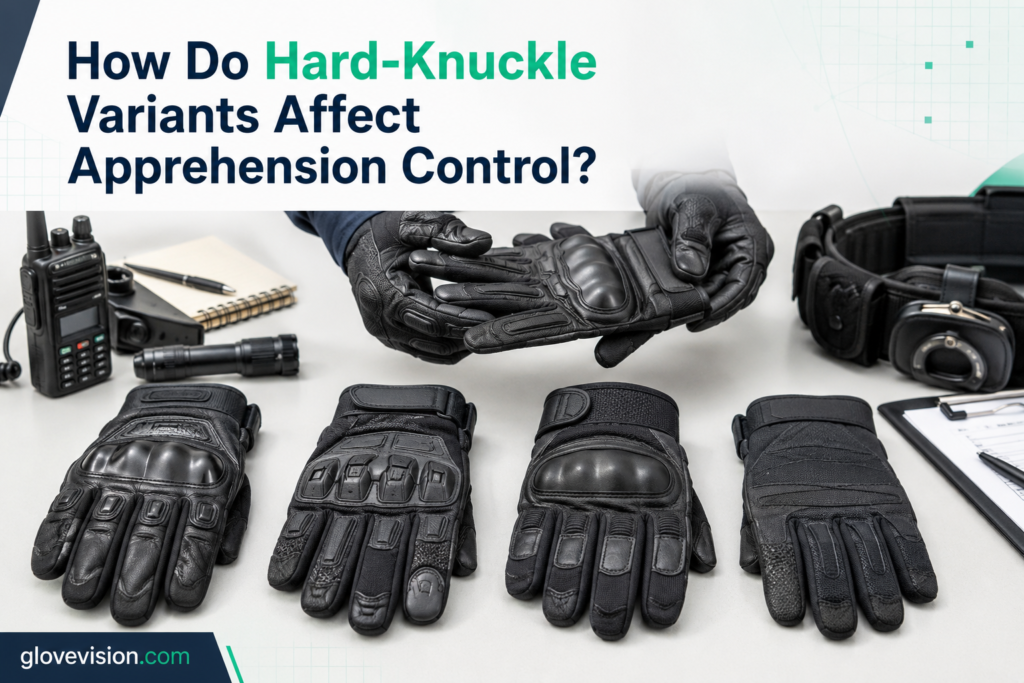
How Do Hard-Knuckle Variants Affect Apprehension Control?
Hard-knuckle police duty gloves can add back-of-hand protection where documented impact or abrasion hazards justify reinforced construction. Protector architecture, anatomical fit, full hand closure, palm stability, grip, and required equipment compatibility all influence whether the complete glove remains suitable for the duty role.
Hard knuckles do not improve apprehension effectiveness or substitute for policy, training, or correct glove selection. Rigidity can create movement trade-offs, misalignment can create pressure, excess profile can snag, and personally owned or commercially marketed equipment should not be treated as duty-authorized without the applicable agency approval.
Occupational safety and scope notice: This article discusses Hard-knuckle police duty gloves as occupational protective equipment and does not provide arrest, restraint, subject-control, striking, use-of-force, firearm-operation, or tactical instruction. Duty use should follow the applicable agency’s equipment policy, hazard assessment, training requirements, inspection procedures, jurisdictional safety requirements, and the exact glove manufacturer’s instructions.
What Are Hard-Knuckle Police Duty Gloves?
Hard-knuckle police duty gloves are role-specific protective gloves that use a rigid, segmented, flexible-reinforced, or similarly structured dorsal protector as one component of the complete glove.
ISO 21420:2020 covers general protective-glove design and construction, comfort, efficiency, marking, and manufacturer information; it does not establish hazard-specific protective properties by itself, and ISO lists the edition as current following its 2025 confirmation. [ISO 21420]
Which components create hard-knuckle protection?
Protector systems may use thermoplastic, molded elastomer, composite structures, segmented guards, floating panels, foam backing, leather or textile attachment panels, and stretch zones. Material names describe construction, not a universal impact class.
How do rigid, flexible, and segmented protectors differ?
Compare stiffness, coverage, segmentation, profile, attachment, weight, movement resistance, and the way the protector follows hand anatomy. Rigid does not automatically mean safer, flexible does not automatically mean weak, and segmentation does not guarantee unrestricted movement.
Why does visual bulk not prove impact protection?
A large or hard shell is not a test result. ANSI/ISEA 138-2019 remains listed by ISEA for testing, classification, and labeling of back-of-hand impact protection, so exact product-level evidence matters more than armored appearance. The standard is occupational, not police-specific. [ANSI 138]
Why is the shell only one part of Hard-Knuckle Police Duty Gloves?
The protector must be evaluated with its attachment, stretch zones, fingers, fourchettes, palm, thumb, reinforcement, liner, seams, wrist closure, cuff, and complete fit. A protector can be well designed while the finished glove still fits or functions poorly.
| Construction | Intended Protective Role | Potential Handling Benefit | Potential Limitation | Evidence Required |
|---|---|---|---|---|
| Continuous rigid shell | Broad dorsal impact coverage where documented | Stable continuous protective surface | High rigidity, leverage, pressure, profile | Exact finished-glove impact evidence |
| Segmented rigid guard | Localized dorsal impact protection | May support articulation between segments | Gaps, edge pressure, alignment sensitivity | Impact evidence plus protected-zone documentation |
| Flexible molded guard | Conforming dorsal protection where documented | May follow hand contour during movement | Thickness, heat, deformation behavior | Product-specific impact evidence |
| Floating protector | Dorsal protection with relative movement | May reduce direct shell restriction | Attachment movement, migration, snag profile | Impact evidence plus attachment/coverage data |
| Foam-backed shell | Impact-management system using shell and backing | Backing may reduce localized pressure | Compression, heat, condition sensitivity | Complete-system performance evidence |
| Low-profile overlay | Abrasion/contact reinforcement or documented low-profile protection | Lower profile may improve equipment clearance | May not meet required impact need | Exact abrasion/impact evidence as applicable |
Which Hazards Justify Hard-Knuckle Police Duty Gloves?
Hard-knuckle police duty gloves are justified only when the duty role includes a credible back-of-hand hazard whose required protection outweighs the protector’s added bulk, stiffness, heat, fit sensitivity, or equipment-interference potential.
For covered workplaces, OSHA’s general PPE framework requires hazard assessment, appropriate selection, proper fit, training, and rejection of defective or damaged PPE. This page uses that as an occupational-PPE framework while agency policy and applicable jurisdiction remain separate questions. [OSHA PPE]
When is back-of-hand impact protection relevant?
Potential occupational contexts include accidental contact with hard structures, confined equipment spaces, vehicle-related contact, moving objects, repeated incidental dorsal knocks, or another documented role-specific impact exposure. This is a hazard-selection question, not a striking or subject-control question.
How should impact and abrasion hazards be separated?
Impact concerns mechanical force transfer, whereas abrasion concerns scraping or surface wear. ANSI/ISEA 105-2024 separately classifies properties including abrasion, cut, and puncture, so those ratings should not be transferred to dorsal impact protection. [ANSI 105] A separate police back-of-hand impact protection assessment should determine whether a credible dorsal impact hazard exists before a rigid or reinforced knuckle system is accepted.
Which hazards do hard knuckles not automatically address?
A dorsal protector does not automatically establish palm abrasion, cut, puncture, needle, blood/body-fluid, chemical, thermal, cold, water, or ballistic protection. ISO 23388:2018 separately addresses abrasion, blade cut, tear, puncture and, where applicable, impact; ISO currently lists the 2018 edition as published while a second edition is under development. [ISO 23388]
Why must agency authorization remain a separate gate?
Protective suitability does not establish permission. Commercial availability, personal ownership, or “law enforcement” marketing does not override agency equipment, uniform, safety, training, or role requirements. Police duty glove authorization should be verified from the applicable agency requirements rather than inferred from appearance.
| Hazard | Possible Design Response | Handling Requirement | Evidence Requirement |
|---|---|---|---|
| Minimal impact | Low-profile or no rigid protector if policy/hazard allows | High articulation and equipment clearance | Hazard assessment + product role |
| Repeated incidental contact | Flexible or reinforced dorsal construction | Comfort, full closure, prolonged wear | Exact product data for intended protection |
| Abrasive surface | Abrasion-resistant dorsal material/overlay | Low snag profile and mobility | Abrasion evidence; do not infer impact |
| Localized impact | Segmented or targeted protector where suitable | Correct segment alignment and articulation | Product-level impact evidence |
| Higher-impact role | More substantial documented dorsal system | Full movement and equipment compatibility still required | Applicable impact classification + role authorization |
| Mixed mechanical hazards | Multi-property glove/system | Do not sacrifice required handling unnecessarily | Separate evidence for impact, abrasion, cut, puncture as relevant |
How Do Hard-Knuckle Police Duty Gloves Affect Grip and Movement?
Hard-knuckle police duty gloves can change handling when protector stiffness, placement, attachment, or back-of-hand layering alters hand closure, finger independence, palm position, thumb movement, or wrist function.
OSHA glove-selection guidance identifies mechanical resistance, dexterity, dry/wet/oily grip, glove features, thermal protection, size, and comfort as relevant selection factors, supporting separate evaluation of protection and handling. [OSHA Fit]
How can protectors affect hand closure?
Back-of-hand resistance, protector lifting, stretch-panel tension, knuckle pressure, glove migration, and palm displacement can all change how the hand closes. A protector that remains protective but blocks required closure is still a functional mismatch for that wearer and role.
How can protectors affect finger independence?
Assess continuous shells, segmentation, flex zones, finger-back padding, attachment stiffness, alignment, and size. A segmented design may permit articulation, but the actual result depends on segment placement and the wearer’s joint geometry.
Why can dorsal movement affect palm grip?
Protector resistance or misalignment can move the glove, which can displace the palm or fingertips and make equipment contact less stable. External palm texture cannot correct movement occurring inside the glove.
How can protector construction affect tactile handling?
Extra movement effort, reduced thumb range, whole-glove rotation, persistent pressure, or interference around small controls can reduce useful tactile handling even though the protector itself is on the back of the hand.
How can protection affect prolonged wear?
Assess heat, sweat, localized pressure, edge friction, moisture, drying, and cold-related stiffness without assuming every protector changes them in the same direction. The broader balance between police duty glove protection and dexterity becomes important whenever added protection changes articulation, tactile handling, bulk, or prolonged-wear comfort.
| Protector Feature | Possible Protection Contribution | Possible Handling Effect | What to Verify |
|---|---|---|---|
| Rigid shell | Documented dorsal impact role | Back-of-hand resistance, pressure, profile | Impact evidence, alignment, closure |
| Segmented guard | Localized impact coverage | Articulation may improve or edges may interfere | Segment spacing, coverage, alignment |
| Flexible protector | Conforming impact system where documented | May deform with movement; can still add heat/bulk | Finished-product evidence and fit |
| Floating protector | Relative movement between guard and glove | May reduce restriction but can migrate or snag | Attachment stability and clearance |
| Foam backing | Part of impact-management construction | Compression, heat, moisture retention | Condition and complete-system evidence |
| Stiff attachment panel | Stabilizes protector | Can transmit resistance into glove body | Stretch zones, palm stability, hand closure |
How Do Knuckle Constructions in Hard-Knuckle Police Duty Gloves Differ?
Knuckle constructions in Hard-knuckle police duty gloves differ in rigidity, coverage, segmentation, articulation, attachment, heat burden, profile, alignment sensitivity, and documented impact performance.
How does a continuous rigid protector behave?
Evaluate broad coverage, shell rigidity, flex-zone geometry, leverage against the glove body, localized pressure, and equipment profile. A continuous shell may provide a stable protective surface while also increasing alignment sensitivity.
How do segmented rigid protectors differ?
Evaluate local coverage, articulation gaps, segment placement, edge effects, and coverage continuity. Segmentation may support movement, but poorly located gaps or edges can still create pressure or interference.
How do flexible molded protectors differ?
Evaluate conformability, deformation during movement, thickness, heat behavior, and product-specific impact performance. Flexibility is a construction characteristic rather than evidence of weak or strong protection.
How do floating protectors differ?
Evaluate relative movement, attachment security, coverage stability, migration, and snag profile. A floating design can reduce direct restraint in some gloves while still requiring careful alignment and attachment assessment.
Why does attachment architecture matter?
Stitching, bonding, supporting panels, stretch material, reinforcement, and load transfer determine how the protector interacts with the rest of the glove. Attachment failure can change both coverage and hand function even if the protector itself remains intact.
| Architecture | Rigidity | Coverage | Articulation | Heat / Profile | Snag Potential | Alignment Sensitivity | Required Evidence |
|---|---|---|---|---|---|---|---|
| Continuous rigid | High relative stiffness | Broad/continuous | Depends on shell geometry and flex zones | Potentially higher profile | Check edges/interfaces | High | Exact impact performance + coverage |
| Segmented rigid | High segments with gaps | Localized/distributed | Depends on segment spacing | Moderate to high | Check segment transitions | High | Impact evidence + segment coverage |
| Flexible molded | Variable/deformable | Shape dependent | May conform during motion | Material/thickness dependent | Profile dependent | Moderate | Product-specific impact evidence |
| Floating protector | Varies | Attachment dependent | Relative movement possible | Profile/attachment dependent | Attachment and edge check critical | High | Impact + attachment/coverage evidence |
| Foam-backed shell | Shell + compressible backing | System dependent | Backing can affect flex | Heat/moisture dependent | Shell profile dependent | Moderate to high | Complete system test evidence |
| Low-profile overlay | Low to moderate | Targeted | Often less restrictive, not guaranteed | Lower profile possible | Usually lower but must check | Moderate | Evidence matching actual hazard |
Which Hard-Knuckle Police Duty Gloves Match the Role?
Hard-knuckle police duty gloves should be matched to the exact authorized role by defining the dorsal hazard, required protection, required hand movement, wear duration, environment, equipment interfaces, and applicable product evidence before selecting a protector architecture.
OSHA’s hand-protection standard bases selection on performance relative to the task, conditions, duration of use, and identified hazards. This supports a task-first selection method rather than choosing from protector size, hardness, brand, or tactical appearance. [OSHA Hand]
What should be defined first?
Identify the role, dorsal hazard, likelihood and type of exposure, wear duration, required mobility, grip, tactile handling, environment, equipment, and applicable agency policy before comparing constructions.
When may low-profile protection fit?
A lower-profile design may be considered where documented impact exposure is low, abrasion or incidental contact is more relevant, equipment space is tight, extended wear matters, or high articulation is required. Suitability still depends on the exact product and hazard.
When may segmented protection fit?
Segmented construction may be considered where localized impact protection is relevant and articulation remains important, provided the segments align correctly, coverage gaps are appropriate for the hazard, and the exact product documents the required protection.
When may a rigid protector fit?
Require a credible back-of-hand impact hazard, exact product-level evidence, agency authorization, anatomical alignment, functional hand movement, and equipment compatibility. Rigidity alone should never be treated as the reason to choose it.
Which evidence should guide selection?
Look for the exact model, intended use, applicable impact and other mechanical tests, protected area, sizing, limitations, care instructions, and retirement criteria. Product marketing cannot substitute for finished-product evidence.
| Role / Environment | Possible Priority | Protector Approach to Consider | Handling Requirement | Decision Gate |
|---|---|---|---|---|
| Routine patrol | Authorized general hand protection and long wear | Low-profile or no hard protector unless hazard requires more | Dexterity, tactility, equipment access | Agency policy + actual hazard |
| Vehicle/confined environment | Repeated incidental dorsal contact and tight spaces | Low-profile/segmented design if justified | Clearance, low snag profile, closure | Hazard + compatibility |
| Repeated contact role | Documented dorsal contact hazard | Flexible/segmented/other tested system | Comfort and full hand movement | Product evidence + fit |
| Outdoor role | Impact/contact plus weather exposure | Environment-suitable documented protector system | Moisture, heat/cold, grip, drying | Environment + protector evidence |
| Higher-impact assignment | Credible higher dorsal impact exposure | Appropriately tested impact construction | Movement must remain functional | Impact evidence + authorization |
| Specialized approved role | Role-defined hazard and equipment set | Architecture selected from documented requirements | Exact equipment compatibility | Formal authorization + exact product |
What Problems Can Hard-Knuckle Police Duty Gloves Create?
Hard-knuckle police duty gloves can create handling problems when protector alignment, glove size, attachment stiffness, liner stability, wrist retention, or component wear changes the relationship between the protector and the wearer’s hand.
Why can protectors press or rub?
Possible causes include misalignment, incorrect size, protector-edge placement, compressed or failed padding, tight attachment architecture, or a mismatch between protector geometry and hand shape.
Why can hand closure become restricted?
A continuous shell, inadequate articulation, stiff backing textile, tight finger geometry, accumulated layers, or cold-related stiffness can resist normal closure. Persistent restriction is a reason to reject the size or construction rather than force adaptation.
Why can the glove move forward?
An oversized palm, loose wrist closure, shell leverage, liner movement, sweat, or a deformed stretch panel can let the hand shift inside the glove and move fingertips or the protector out of alignment.
How can the protector interfere with equipment?
Raised edges, excess profile, cuff conflict, wrist-device conflict, reduced thumb movement, or repeated snagging can interfere with approved equipment. Compatibility assessment should stay limited to access, clearance, and unwanted glove interference rather than operational technique.
How can fit problems be separated from protector-design problems?
If fingertips are too long, first check size or pattern. If the whole glove rotates, check palm and wrist fit. If only the protector presses or lifts despite otherwise stable sizing, assess protector alignment and architecture. If several suitable sizes reproduce the same interference, consider another construction. A complete police duty glove fit assessment should verify palm width, finger length, thumb alignment, knuckle position, wrist retention, liner stability, and complete hand movement.
| Problem | Likely Area to Check | Possible Cause | Decision |
|---|---|---|---|
| Knuckle pressure | Protector centering and size | Misalignment, edge placement, failed padding | Resize or select another protector architecture |
| Restricted closure | Shell, flex zones, fingers | Rigid geometry, poor articulation, tight glove | Reject fit/design if full closure cannot be restored |
| Glove forward migration | Palm, wrist, liner, shell leverage | Oversized palm, loose closure, sweat, liner movement | Reassess size and construction |
| Palm bunching | Palm volume and dorsal tension | Wrong pattern or protector-induced displacement | Change fit/pattern |
| Protector snagging | Edges, profile, cuff, equipment | Raised edge or excess profile | Select compatible design |
| Protector cracking | Protector condition | Impact, aging, material damage | Remove/reassess; replace unless approved repair applies |
| Liner movement | Internal attachment and moisture | Separation, sweat, wear | Change construction or replace |
How Should Hard-Knuckle Police Duty Gloves Be Authorized and Assessed?
Hard-knuckle police duty gloves should not be placed into duty use until the exact model’s authorization, intended role, documented protection, fit, anatomical alignment, hand movement, equipment compatibility, and inspection requirements have been verified.
What should be verified before duty use?
Confirm agency authorization, exact model, intended role, hazard, product evidence, size, any required training, inspection criteria, care guidance, and retirement criteria. Personal purchase should not be used as a shortcut around the authorization gate.
How should protector fit be assessed?
Check protector centering, knuckle and flex-zone alignment, absence of concentrated pressure, absence of lifting, stable palm and fingertip seating, stable liner position, and secure wrist retention.
Which movements should be checked?
Under controlled conditions, evaluate glove function only: open hand, full hand closure, individual finger flexion and extension, thumb movement, wrist movement, and general equipment handling. Do not use this check to teach apprehension, restraint, or use-of-force technique.
How should equipment compatibility be checked?
Assess radios, communication devices, electronic controls, writing tools, vehicle controls, duty-belt equipment, approved restraint equipment only at the fit/compatibility level, weather layers, and agency-approved firearm interfaces only for safe clearance and unwanted glove interference. Detailed police duty glove equipment compatibility should remain non-operational.
Which findings require rejection?
Reject or reassess when authorization is absent, the protector is misaligned, persistent pressure occurs, full hand closure or finger independence is reduced, the glove migrates, the protector repeatedly snags, equipment access is blocked, relevant protection evidence is unavailable, or compatibility cannot be verified safely.
| Gate | What to Verify | Reject / Reassess When |
|---|---|---|
| Policy | Exact model and role are authorized under applicable agency requirements | Authorization is absent, unclear, or role-restricted |
| Hazard | Credible dorsal hazard is identified | Protector burden has no documented task need |
| Exact product | Manufacturer/model/size are known | Identity or intended use cannot be verified |
| Evidence | Required impact or other mechanical evidence matches the hazard | Protection is inferred from appearance or marketing |
| Fit | Protector, palm, fingers, thumb, liner, wrist all align | Pressure, lifting, rotation, bunching, migration |
| Movement | Full closure, finger independence, thumb and wrist movement remain available | Required movement is restricted |
| Equipment | Required radios, controls, clothing and approved interfaces remain accessible without avoidable snagging | Access is blocked or compatibility cannot be safely verified |
| Condition | Protector, attachment and complete glove remain serviceable | Cracks, deformation, failed attachment, sharp edges or other damage |
How Should Hard-Knuckle Police Duty Gloves Be Inspected and Maintained?
Hard-knuckle police duty gloves should be inspected and maintained as complete PPE systems because protector damage, attachment failure, seam wear, liner instability, contamination, improper cleaning, or fit changes can affect both protection and handling.
NIOSH’s PPE-program guidance includes hazard assessment, PPE selection and use, and inspection and replacement of damaged or worn PPE; its protective-clothing guidance also identifies fit and comfort as important PPE-selection considerations. [NIOSH]
What should be inspected on the protector?
Check cracks, splits, permanent deformation, sharp edges, detached areas, missing segments, delamination, unexpected hardening or softening where relevant to the material, and changes in anatomical alignment.
What should be inspected around the protector?
Inspect attachment stitching, back fabric, stretch zones, finger panels, palm, thumb crotch, fourchettes, liner, closure, cuff, and surrounding seams because protector serviceability depends on the complete supporting construction.
How should Hard-Knuckle Police Duty Gloves be cleaned?
Follow the exact finished-product instructions for washing method, cleaning agent, water temperature, drying, protector material, leather, textile, foam, liner, and closure. Detailed police duty glove cleaning and maintenance should not be reduced to one universal method.
Which modifications should not be made?
Do not recommend unauthorized protector removal, cutting, drilling, heating, grinding, bending, reshaping, homemade padding, adhesive repair, or unapproved stitching. A protective component should not be modified to solve a fit or interference problem unless the exact manufacturer and agency procedure explicitly permits the repair.
When should Hard-Knuckle Police Duty Gloves be removed from service?
Remove or reassess the glove when the protector cracks, separates, develops a sharp edge, permanently deforms or loses alignment; when padding collapses or attachment seams fail; when required hand movement or equipment compatibility changes; or when required performance can no longer be verified. The wider police duty glove replacement decision should consider protector damage together with palm, seam, liner, closure, fit, and handling condition.
| Inspection Area | What to Verify | Possible Failure | Service Decision |
|---|---|---|---|
| Authorization | Exact model and role remain permitted | Policy or role changed | Refer to agency policy; do not assume continued approval |
| Protector | No cracks, splits, sharp edges, detached sections or permanent deformation; alignment remains correct | Crack, edge damage, deformation, missing/loose segment | Remove from service and assess replacement/approved repair |
| Attachment | Stitching, supporting panel and reinforcement remain intact | Delamination, detached reinforcement, failed stitching | Approved repair only where documented; otherwise replace |
| Back fabric / stretch zones | No tearing, excessive wear or permanent distortion | Material failure or altered protector position | Reassess protection and fit |
| Palm / fingers / thumb | Stable fit and normal required movement | Bunching, fingertip displacement, thumb restriction | Resize/change design or replace |
| Liner | Stable, seated and not separating | Migration, bunching, detachment | Reassess/replace |
| Closure / cuff | Secure retention and compatibility | Closure failure, migration, adjacent-equipment conflict | Repair as approved or replace |
| Care / repair history | Approved cleaning, drying and repair methods only | Unauthorized treatment, heat, adhesive, reshaping or stitching | Do not assume original performance remains |
| Final decision | Authorization, evidence, fit, movement, equipment and condition all remain acceptable | Any unresolved uncertainty | Use, reassess, resize/change design, approved repair, replace, or do not use |
Why Should Hard-Knuckle Police Duty Gloves Follow a Complete Authorization Decision?
Hard-knuckle police duty gloves should pass an authorization-and-suitability decision rather than a protector-only comparison because policy approval, hazard relevance, product evidence, anatomy, complete-glove fit, equipment compatibility, and current condition all determine whether the glove is appropriate for duty.
What final questions determine suitability?
Confirm whether the exact glove is authorized, what role and dorsal hazard it addresses, whether impact and abrasion have been separated, whether the exact glove documents required protection, whether the protector aligns anatomically, whether full closure and independent finger movement remain available, whether the palm stays stable, whether equipment remains accessible, whether pressure or snagging persists, whether care can be performed correctly, and whether current condition remains acceptable.
Which decision rule should readers retain?
Policy first, hazard second, evidence third; then verify anatomy, complete fit, hand movement, equipment compatibility, care history, and condition. Reject unresolved interference and never infer authorization or protection from appearance, marketing, personal ownership, or protector hardness.
Conclusion
Hard-knuckle police duty gloves are useful only when their additional back-of-hand protection matches a documented duty hazard and remains compatible with agency policy, hand anatomy, required movement, equipment handling, and the current condition of the complete glove. Hard knuckles are protective components, not apprehension-performance tools.
Harder or larger does not automatically mean safer, flexible does not automatically mean weak, and segmented does not automatically mean unrestricted. Impact and abrasion remain separate; final suitability depends on authorization, product evidence, complete-glove fit, anatomical alignment, equipment compatibility, care, and serviceable condition.
Frequently Asked Questions
Do Hard-Knuckle Police Duty Gloves Improve Apprehension Control?
Not automatically. Their defensible function is occupational hand protection against relevant hazards. Safe hand function still depends on authorization, fit, mobility, equipment compatibility, training, and the complete glove.
Are Larger Knuckle Protectors More Protective?
Not necessarily. Protector size does not establish impact attenuation, coverage quality, attachment strength, durability, or the performance of the finished glove.
Can Hard-Knuckle Police Duty Gloves Reduce Dexterity?
They can when protector stiffness, poor alignment, excessive bulk, inadequate articulation, or incorrect glove fit restricts normal hand movement.
Are Segmented Hard-Knuckle Police Duty Gloves Always Better?
No. Segmentation may support articulation, but suitability still depends on alignment, material, coverage, attachment, fit, hazard, and product-level evidence.
Are Personally Purchased Hard-Knuckle Police Duty Gloves Automatically Authorized?
No. Commercial availability or personal ownership does not establish duty authorization; the applicable agency’s policy and equipment requirements control that decision.
When Should Hard-Knuckle Police Duty Gloves Be Replaced?
Replace or remove them from service when protector cracking, separation, sharp edges, permanent deformation, attachment failure, altered alignment, restricted movement, equipment interference, or another condition prevents the glove from meeting its documented role.