
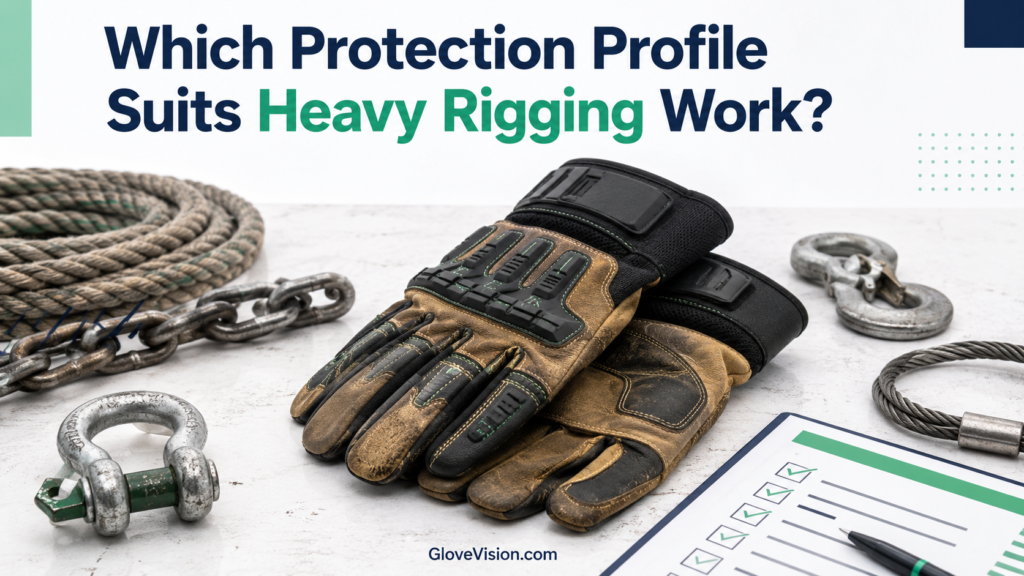
Which protection profile suits heavy rigging work?
The protection profile that suits heavy rigging work is a task-matched combination of abrasion resistance, tear and puncture performance, reinforced palm and thumb-web zones, secure fit, grip stability, and documented back-of-hand impact protection when impact hazards exist. No leather type, synthetic composite, TPR-style impact element, reinforcement, EN 388 marking, ANSI/ISEA 105 rating, ANSI/ISEA 138 rating, or heavy-duty wording guarantees protection.
This article covers heavy rigging exposure profiles, mechanical and impact rating limits, leather/composite/impact-zone selection, fit and cuff alignment, line-handling control, degradation response, and a final site-safety checklist.
This article is educational only. Heavy rigging glove suitability must be determined by hazard assessment, manufacturer documentation, current standards, SDS review, compatibility data, rigging rules, machine guarding, lockout/tagout, supervisor instruction, site PPE policy, signal-person communication, exact glove model, task, exposure, fit, cuff, and site procedure.
Why do standard Heavy Rigging Gloves use durable leather, composites, or reinforcements for heavy-load handling?
Standard Heavy Rigging Gloves use durable leather, composites, or reinforcements for heavy-load handling when abrasion, friction, pinch, impact, grip, and wear-zone demands require a documented task-specific glove profile.
Use Rigger Gloves as the near-parent glove-type context, then narrow the selection to the heavier rigging task, impact exposure, line-handling risk, and site approval boundary.
What hazards can Heavy Rigging Gloves help address?
Standard Heavy Rigging Gloves may help reduce selected exposure around steel wire rope, rough chain, shackles, sling handling, rough concrete, steel edges, timber surfaces, pinch points, friction heat, load-guidance contact, and documented impact, tear, or puncture risks. OSHA hand-protection rules require appropriate hand protection when hands are exposed to hazards such as harmful substances, cuts, abrasions, punctures, chemical burns, thermal burns, and temperature extremes. [OSHA]
What materials and features may be used?
Heavy Rigging Gloves may use split leather, grain leather, goatskin, cowhide, synthetic leather, textile liners, reinforced palms, thumb-web reinforcement, back-of-hand impact elements, TPR-style guards where documented, safety cuffs, cut-resistant liners where documented, and high-wear stitching patterns. No single material or feature should be treated as mandatory for every heavy rigging task.
How can rugged construction help?
Leather, reinforced panels, synthetic composites, or impact-zone elements may help reduce selected friction, abrasion, and contact exposure when the glove is matched to the task. They do not prove cut resistance, puncture resistance, crushing protection, chemical resistance, heat resistance, or machinery safety unless product documentation supports those claims.
What should the article avoid saying?
Avoid saying Heavy Rigging Gloves must have TPR armor, dual-layer defense is always required, reinforced double stitching is mandatory, gloves absorb fixed force values, gloves prevent blisters, burns, or lacerations, TPR protects bones from crushing, leather is always safer than synthetic material, or one glove handles every rigging hazard.
What is the safe explanation?
Heavy Rigging Gloves may help reduce selected abrasion, friction, impact, and handling risks when the material, reinforcement, rating, fit, and task exposure are matched and the glove remains intact. For broader glove-category boundaries, compare the profile with Work Gloves rather than treating heavy-duty wording as a decision rule.
Table 1. Heavy rigging hazards matched to features, benefits, limits, and verification needs.
| Hazard | Possible Glove Feature | Possible Benefit | What It Does Not Prove | Verification Needed |
|---|---|---|---|---|
| Steel wire rope abrasion | Leather/synthetic palm with reinforcement | May reduce selected palm wear | Cut, puncture, or crushing protection | EN/ANSI/product data |
| Chain handling | Reinforced palm and thumb web | May support friction-zone durability | Full-hand protection or pinch safety | Product construction data |
| Shackle or hook contact | Back-of-hand impact element where documented | May reduce selected impact exposure | Fracture or crush prevention | ANSI/ISEA 138 / product data |
| Sling handling | Secure fit and grip surface | May support handling control | Sling safety or load-control guarantee | Site rigging procedure |
| Rough concrete/steel | Abrasion-rated shell where documented | May reduce selected surface wear | Universal jobsite durability | EN/ANSI / product data |
| Pinch zones | Fit, dexterity, and impact coverage | May support hand-position control | Pinch injury prevention | Site procedure / lift plan |
| Friction heat | Palm reinforcement and task control | May reduce selected contact exposure | Burn prevention or heat proof | Heat/task documentation |
| Wet or oily handling | Product-specific material/care guidance | May support handling if documented | Water/oil resistance | Manufacturer data |
| Chemical contamination | Compatible material where documented | May reduce exposure if suitable | Chemical resistance from material name | SDS / compatibility data |
| Rotating equipment nearby | No glove feature alone solves this | Requires guarding/LOTO/site controls | Safe use near moving parts | OSHA/site machine procedure |
Use this matrix to separate task-matched protection logic from unsupported heavy-duty claims.
How do industrial Heavy Rigging Gloves compare under mechanical and impact performance classifications?
Industrial Heavy Rigging Gloves should be compared under mechanical and impact classifications by treating EN 388, ANSI/ISEA 105, and ANSI/ISEA 138 as laboratory-derived selection aids, not guarantees of field protection.
Which standards may apply to Heavy Rigging Gloves?
Industrial Heavy Rigging Gloves may carry markings or documentation linked to EN 388, ANSI/ISEA 105, ANSI/ISEA 138 for impact-rated gloves where applicable, manufacturer mechanical data, manufacturer impact documentation, and site PPE requirements.
What does EN 388 help classify?
EN 388 may help classify selected mechanical properties such as abrasion, blade cut, tear, puncture, and impact where applicable. SATRA describes EN 388 as covering physical tests for abrasion, cutting, tearing, and puncture. [EN 388]
What does ANSI/ISEA 105 help classify?
ANSI/ISEA 105 may help classify selected glove performance properties using standardized methods and performance levels. The ANSI Blog describes ANSI/ISEA 105-2024 as addressing hand and arm protection classification and cut levels such as A1 through A9. [ANSI 105]
What does ANSI/ISEA 138 help classify?
ANSI/ISEA 138-2019 may help classify back-of-hand impact performance for gloves designed and tested for that purpose. The ANSI Blog describes ANSI/ISEA 138-2019 as a performance and classification standard for impact-resistant gloves focused on fingers and knuckles. [ANSI 138]
What do mechanical and impact ratings not prove?
Mechanical and impact ratings do not prove immunity from injury, protection from every sharp edge, safe use near rotating machinery, chemical resistance, oil resistance, water resistance, heat resistance, crushing protection, individual defect-free status, or continued protection after wear, saturation, impact damage, or contamination.
What is the safe rating rule?
Use mechanical and impact ratings to narrow selection, then verify the glove against the exact hazard, material handled, impact zone, wet or oily condition, chemical exposure, heat exposure, fit, and site procedure. Rough-material comparisons may overlap with Construction Gloves, but heavy rigging adds load guidance, line handling, and impact-zone review.
Table 2. Mechanical and impact ratings interpreted as laboratory-derived selection aids.
| Standard / Rating | What It Classifies | What It Does Not Prove | Heavy-Rigging Question | Verification Needed |
|---|---|---|---|---|
| EN 388 abrasion | Abrasion performance under defined test conditions | Universal jobsite durability | What surface is wearing the glove? | EN marking / product data |
| EN 388 blade cut | Blade-cut test context | Puncture, crush, chemical, heat, or machinery safety | Are slicing edges present? | EN marking / cut method |
| EN 388 tear | Tear resistance under test conditions | Seam integrity after misuse, saturation, or snagging | Will pulling or snagging stress the glove? | EN data / seam inspection |
| EN 388 puncture | Puncture test context | Cut resistance or all puncture safety | Are sharp points, wire ends, or hardware present? | EN marking / task review |
| EN 388 impact where applicable | Impact category under EN context | Full impact, crush, or fracture protection | Is the impact claim documented? | EN marking / product data |
| ANSI/ISEA 105 cut or puncture | Cut/puncture performance classification | Field guarantee or impact protection | What sharp-edge or puncture hazard exists? | ANSI/ISEA data / task hazard |
| ANSI/ISEA 105 abrasion | Abrasion-related classification | Oil, chemical, heat, or wet performance | What rough surface dominates? | Product marking / standard context |
| ANSI/ISEA 138 impact level | Back-of-hand impact classification for tested gloves | Crush protection, fracture prevention, or pinch safety | Which dorsal impact zones are exposed? | ANSI/ISEA 138 / product data |
| Manufacturer impact data | Product-specific impact-zone claim | Universal impact protection | Does coverage match the task? | Product spec / test report |
| Site PPE rule | Local approval | Public universal standard | Is this glove approved for this rigging task? | Site PPE policy / JHA / lift plan |
Ratings narrow selection, but exact task exposure, impact zone, fit, site procedure, and product data decide suitability.
Which specialized Heavy Rigging Gloves match rope handling, abrasion, and impact hazards?
Specialized Heavy Rigging Gloves match rope handling, abrasion, and impact hazards only when leather, synthetic materials, reinforcements, impact zones, ratings, fit, and site controls align with the exact rigging task.
How should goatskin, cowhide, and other leather options be described?
Goatskin, cowhide, split leather, grain leather, and other hide types may differ in flexibility, surface feel, abrasion behavior, wet response, and durability. Do not say one hide type is always superior for friction wear, fingertip control, wet work, or impact protection.
How should synthetic composites and cut-resistant liners be described?
Synthetic composites, reinforced textiles, aramid blends, HPPE blends, or other liners may support selected durability, cut-risk, dexterity, or wear needs depending on the product. Tool-control and maintenance comparisons may belong near Mechanic Gloves when the task shifts away from rigging and toward equipment handling.
How should TPR-style impact elements be described?
TPR-style back-of-hand elements or impact guards may support selected impact-zone cushioning when the glove is documented for that use. Do not say TPR absorbs fixed crushing energies or protects bones from crushing forces.
How should wet, oily, or chemical exposure be handled?
Leather, synthetic materials, coatings, and impact elements may stiffen, swell, soften, crack, lose grip, or lose integrity after incompatible exposure. Chemical-exposure decisions require SDS review and manufacturer compatibility or care data; OSHA’s SDS guidance describes safety data sheets as including chemical hazards, protective measures, and precautions. [SDS]
What is the material selection rule?
Select materials, reinforcements, and impact zones based on abrasion exposure, impact exposure, pinch points, tear risk, puncture risk, wet conditions, oily conditions, chemical exposure, heat exposure, dexterity, grip need, manufacturer data, and site PPE policy. Heat and welding exposure should be checked against Welding Gloves instead of inferred from leather or reinforcement.
Table 3. Workflow for selecting material, reinforcement, impact-zone coverage, and site-approved glove profile.
| Workflow Step | Verification Question | Safe Action | Documentation Needed |
|---|---|---|---|
| Identify Rigging Task | Is the task rope, chain, sling, shackle, steel, timber, concrete, crane support, or load guidance? | Define main hand exposure before glove choice | Task review / JHA / lift plan |
| Check Abrasion/Tear/Puncture Risk | Are rough surfaces, sharp points, wire rope, edges, pulling stress, or repeated friction present? | Match mechanical performance separately | EN / ANSI / product data |
| Check Impact Zones | Are knuckles, fingers, or back-of-hand exposed to hooks, chains, tools, or load contact? | Verify impact-zone coverage if needed | ANSI/ISEA 138 / product data |
| Check Wet/Oil/Chemical Exposure | Will water, mud, oil, grease, fuel, cleaner, or chemicals contact the glove? | Verify compatibility, care, and replacement rules | SDS / manufacturer data |
| Check Dexterity Need | Does the task require signal response, shackle handling, sling placement, or rope control? | Choose build that supports control without ignoring hazards | Fit trial / product spec |
| Review Ratings | Does the rating match the actual mechanical or impact hazard? | Do not use one rating as total proof | EN / ANSI / manufacturer data |
| Select Documented Glove | Is the glove approved for the exact task and site? | Use documented and approved option only | Site PPE policy / JHA / lift plan |
This workflow keeps leather, synthetics, impact elements, and ratings tied to the actual rigging task.
How should operators don and align high-performance Heavy Rigging Gloves to reduce wrist strain and pinch risk?
Operators should don and align high-performance Heavy Rigging Gloves by verifying fit, inspecting shell and impact zones, aligning cuff and reinforcement, controlling line-handling risks, and following machinery-risk procedures.
Step 1: Verify size and fit
Select the best-fitting approved size or model. The glove should avoid excess palm slack, fingertip overhang, severe thumb-web tension, restricted finger flexion, reduced circulation, loose cuff material, palm bunching, poor grip control, and early hand fatigue.
Step 2: Inspect shell, seams, impact zones, and cuff
Before use, check seam condition, palm patches, thumb webbing, cuff structure, holes, tears, loose stitching, hard or cracked leather, damaged synthetic panels, cracked or loose impact elements, oil or water saturation, chemical contamination, and worn grip zones.
Step 3: Don Heavy Rigging Gloves without stressing seams
After donning, confirm that fingers are seated correctly, thumb webbing is not overstretched, palm material is not twisted, cuff is secure but not restrictive, reinforcements sit over intended wear zones, and impact elements sit over intended back-of-hand zones.
Step 4: Clean hands according to site procedure
Hand cleaning should match the contaminant and workplace procedure. Heavy rigging tasks may involve dust, oil, grease, water, metal dust, rope fibers, concrete residue, fuel, cleaners, mud, sweat, and general jobsite grime.
Step 5: Control line-handling and snag risk
During rigging tasks, avoid wrapping lines around the hand, keep fingers away from pinch zones, avoid placing hands between suspended loads and fixed objects, maintain communication with signalers, pause if grip or glove condition changes, and replace gloves when fit, grip, or protection is compromised. OSHA rigging-equipment rules require rigging equipment for material handling to be inspected before use on each shift and as necessary during use, with defective equipment removed from service. [OSHA]
Step 6: Control rotating-machinery risk
Do not assume high-performance Heavy Rigging Gloves are safe near rotating spindles, drills, lathes, shafts, belts, pulleys, conveyors, powered rollers, or moving machine components. OSHA machine-guarding requirements address hazards including point of operation, ingoing nip points, rotating parts, flying chips, and sparks. [OSHA]
Supporting workflow table. This is not a sixth proof asset.
| Workflow Step | What to Check | Safe Action | Safety / Control Outcome |
|---|---|---|---|
| Select Size | Does glove fit without excess slack, severe tension, or poor control? | Choose best-fitting approved size/model | Better grip and reduced fatigue |
| Inspect Shell / Impact Zones | Are seams, panels, impact elements, or cuffs damaged? | Remove damaged glove from service | Lower failure risk |
| Don Without Twisting | Is material twisted, overstretched, or forced? | Reseat glove gently | Reduced seam stress |
| Check Cuff and Reinforcement | Are cuffs secure and reinforcements aligned with wear zones? | Reposition or choose a better model | Better task match |
| Check Line-Handling Risk | Are ropes, chains, slings, hooks, or loads creating pinch or snag zones? | Confirm hand-placement and stop-work rules | Reduced pinch/snag exposure |
| Check Machinery Risk | Are rotating or moving parts present? | Follow guarding/LOTO procedures | Reduced entanglement risk |
| Replace If Compromised | Is glove torn, cracked, saturated, impact-damaged, loose, slick, or contaminated? | Remove and replace | Maintained task suitability |
Use this supporting workflow to check fit, cuff alignment, line-handling risk, machinery risk, and replacement triggers.
What immediate protocols address structural degradation or failures in compromised Heavy Rigging Gloves under heavy tension?
Immediate protocols for compromised Heavy Rigging Gloves under heavy tension should signal a safe pause, secure the load or tool, remove the damaged glove, check for injury or exposure, and replace it with Heavy Rigging Gloves documented for the task.
What should happen after a seam split or liner tear?
If compromised Heavy Rigging Gloves split, tear, expose the hand, or lose reinforcement during work, signal a safe pause if load movement is involved, secure the tool, rope, sling, shackle, chain, or material, remove the glove, inspect skin, clean hands, and replace with task-documented gloves.
What should happen after impact-element damage?
If impact elements crack, detach, shift, flatten, or expose the back of the hand, stop the task safely, move away from impact or pinch-point exposure, inspect the glove, check whether the product still meets site requirements, and replace damaged gloves before returning to impact-prone work.
What should happen after wet or oil saturation?
If Heavy Rigging Gloves become saturated with water, mud, oil, grease, or sweat, pause when grip or control is affected, remove the saturated glove if needed, clean and dry hands, inspect for stiffness or grip loss, dry according to manufacturer care instructions where reuse is allowed, and replace if structurally compromised.
What should happen after chemical exposure?
If fuels, solvents, cleaners, lubricants, concrete chemicals, or other substances contaminate Heavy Rigging Gloves, stop exposure safely, remove the contaminated glove, reduce skin exposure risk, prevent continued contact, clean hands, review documentation, and replace with gloves documented for the exact substance. Chemical compatibility boundaries may require comparison with Chemical-Resistant Lab Gloves.
What should happen after friction heat or grip loss?
If Heavy Rigging Gloves become hot, slick, stiff, torn, or difficult to control during rope, sling, chain, cable, steel, timber, or load handling, stop the task safely, secure the load, inspect wear zones, check for thinning or surface glazing, and replace the glove if grip or structure is compromised.
What wording should be avoided?
Avoid skin absorption prevention, knuckle exposure prevention, guaranteed impact protection, fixed impact-force absorption without test context, TPR protects bones from crushing, saturated leather can never be safely dried, fixed temperature or time thresholds, or automatic machine approval without site procedure. OSHA lockout/tagout requirements apply to service and maintenance where unexpected energization or stored energy could injure workers. [LOTO]
Table 4. Response matrix for seam splits, liner tears, impact damage, saturation, contamination, grip loss, snagging, and task mismatch.
| Problem | Possible Cause | Immediate Action | Documentation Check | Future Prevention |
|---|---|---|---|---|
| Seam split | Poor fit, pulling stress, heavy tension, wear | Signal pause, secure load/tool, remove glove | Product quality / fit / seam design | Reassess size and model |
| Liner tear | Sharp edge, abrasion, wrong glove, wear | Stop, inspect hand, replace | Rating / product suitability | Match glove to hazard |
| Lost reinforcement | Patch wear, failed stitching, task mismatch | Stop if protection/control affected | Product construction data | Choose better reinforcement |
| Impact-element damage | Impact, abrasion, flex fatigue, aging | Stop impact-prone work and replace | ANSI/ISEA 138 / product data | Select correct impact-rated glove |
| Wet saturation | Water, mud, sweat, wet material | Pause if grip/control drops, dry or replace | Care instructions | Set change-out/drying rule |
| Oil saturation | Oil, grease, lubricant exposure | Remove if grip/control or exposure risk exists | Compatibility/care data | Use documented glove or replace |
| Chemical contamination | Solvent, fuel, cleaner, concrete chemical | Stop exposure, remove, clean hands | SDS / manufacturer data | Use compatible glove |
| Friction heat | Rope/sling/cable movement, rough handling, heavy load | Stop, secure load, inspect wear zones | Task hazard review | Use documented glove and controls |
| Grip loss | Saturation, slick surface, worn palm, poor fit | Stop, secure load/tool, replace if needed | Product grip/task data | Improve glove match |
| Snagging | Loose cuff, oversized glove, moving part | Stop safely and follow machinery procedure | Site machine procedure | Improve fit and guarding controls |
| Task mismatch | Wrong material, rating, impact coverage, or fit | Stop using glove for task | Site PPE policy / JHA / lift plan | Update selection/training |
Compromised heavy rigging gloves need a signal-pause, secure, remove, inspect, clean, review, and replace workflow.
Which checklist verifies that alternative Heavy Rigging Gloves satisfy site safety and hazard requirements?
A checklist verifies that alternative Heavy Rigging Gloves satisfy site safety and hazard requirements by checking task hazard, mechanical rating, impact rating, material and reinforcement, wet/oil/chemical exposure, fit, cuff, line handling, hand cleaning, rotating machinery, and failure response.
Electrical or energized-work boundaries should be handled under Electrician Gloves rather than assumed from heavy rigging impact or abrasion features.
Heavy Rigging Gloves site safety and hazard verification checklist
Use a checklist matrix, not a checkbox box. The goal is to verify the glove against the actual hazard, impact zone, exposure, fit, line-handling control, and site procedure.
Table 5. Checklist for task hazard, ratings, impact zones, materials, exposure, fit, line handling, machinery, and failure response.
| Checklist Category | Core Verification | Tactical Action | Documentation Needed |
|---|---|---|---|
| Task Hazard | Does work involve steel wire rope, chains, hooks, shackles, slings, concrete, steel beams, timber, suspended loads, pinch points, impact, wet work, oil, chemicals, heat, or moving equipment? | Select gloves by hazard assessment | Site JHA / task review / lift plan |
| Mechanical Rating | Does glove carry current EN 388, ANSI/ISEA 105, or required mechanical data? | Verify abrasion, tear, puncture, cut, and impact where relevant | Product marking / standard context |
| Impact Rating | Are back-of-hand impact, swinging hooks, chains, falling objects, pinch zones, or load-contact hazards present? | Verify documented impact protection such as ANSI/ISEA 138 where applicable | ANSI/ISEA 138 / product data |
| Material / Reinforcement | Is leather, synthetic composite, reinforced palm, thumb-web reinforcement, cut-resistant liner, or impact element needed? | Match material and coverage to friction, dexterity, and impact zones | Product spec / care data |
| Wet / Oil / Chemical Exposure | Will gloves contact water, mud, oil, grease, fuel, solvent, cleaner, concrete chemical, or contaminants? | Confirm compatibility/care or replace when uncertain | SDS / manufacturer data |
| Fit / Cuff / Seam Stress | Does glove flex without slack, severe tension, poor circulation, or palm bunching? | Perform hand-flexion and grip checks; confirm cuff is secure but not restrictive | Fit trial / supervisor review |
| Line Handling | Will operators guide ropes, chains, slings, shackles, hooks, or suspended loads? | Confirm hand-placement rules, communication, pinch-zone avoidance, and stop-work triggers | Site rigging procedure / lift plan |
| Hand Cleaning | Are cleaning and drying procedures available before/after glove use? | Clean and dry hands according to contaminant and site procedure | Site procedure / SDS |
| Rotating Machinery | Are spindles, drills, lathes, shafts, belts, pulleys, conveyors, or powered rollers nearby? | Follow guarding, lockout, supervision, and entanglement controls | OSHA/site machinery procedure |
| Failure Response | Are workers trained for seam splits, liner tears, impact damage, saturation, stiffness, cracking, contamination, grip loss, or snagging? | Stop, secure load/tool, remove glove, inspect, replace | Site PPE response procedure |
The final checklist ties glove profile selection to hazard assessment, lift planning, and site procedure.
Sources & Evidence Boundaries
This page uses 8 reduced, exact public sources. Manufacturer product specifications, care instructions, SDS/manufacturer compatibility data, site PPE policy, job hazard analysis, and lift plan remain verification requirements inside the article logic, not public source rows.
- ANSI Blog — ANSI/ISEA 105-2024: Hand Protection & Cut Level Ratings supports ANSI/ISEA 105 mechanical and classification boundaries.
- ANSI Blog — ANSI/ISEA 138-2019: Performance and Classification for Impact-Resistant Gloves supports ANSI/ISEA 138 back-of-hand impact classification boundaries.
- SATRA — EN 388: Protective Gloves Against Mechanical Risks supports EN 388 mechanical-risk test boundaries.
- OSHA — 29 CFR 1910.138 Hand Protection supports hazard-matched hand-protection selection.
- OSHA — 29 CFR 1926.251 Rigging Equipment for Material Handling supports rigging-equipment inspection and removal-from-service boundaries.
- OSHA — Hazard Communication Standard: Safety Data Sheets supports SDS chemical-hazard and protective-measure boundaries.
- OSHA — 29 CFR 1910.212 General Requirements for All Machines supports machine-guarding boundaries.
- OSHA — 29 CFR 1910.147 Control of Hazardous Energy Lockout/Tagout supports hazardous-energy procedure boundaries.
Conclusion
Heavy Rigging Gloves may help reduce selected abrasion, friction, tear, puncture, impact, and handling risks when matched to the task and used within documented limits. The useful profile combines material choice, palm and thumb-web reinforcement, back-of-hand impact-zone coverage where needed, fit, cuff control, grip stability, line-handling procedure, and replacement discipline.
Leather, synthetic composites, TPR-style impact elements, reinforced palms, EN 388 markings, ANSI/ISEA 105 ratings, ANSI/ISEA 138 ratings, or heavy-duty wording does not guarantee protection. Damaged, torn, liner-torn, impact-damaged, saturated, stiff, cracked, contaminated, slick, snagged, or task-mismatched gloves need a signal-pause, secure, remove, inspect, clean, review, and replace workflow.
Frequently Asked Questions
Do Heavy Rigging Gloves guarantee impact protection?
No. Heavy Rigging Gloves may include documented back-of-hand impact protection, but impact ratings do not guarantee protection from crushing, fractures, pinch-point injuries, or every impact hazard.
Does ANSI/ISEA 138 prove a glove prevents crushing injuries?
No. ANSI/ISEA 138 helps classify back-of-hand impact performance for gloves designed and tested for that purpose. It should not be treated as proof of crushing protection or fracture prevention.
Are leather Heavy Rigging Gloves always better than synthetic gloves?
No. Leather and synthetic composites vary by product design, rating, flexibility, wet response, grip, durability, impact-zone coverage, and care requirements.
Does EN 388 prove Heavy Rigging Gloves are safe for every rigging task?
No. EN 388 helps compare mechanical-risk categories such as abrasion, blade cut, tear, puncture, and impact where applicable. It does not prove chemical resistance, heat resistance, water resistance, or machine safety.
Can Heavy Rigging Gloves be used when wet or oily?
Only when the glove is documented for that condition and grip/control remain safe. Saturated, stiff, slick, contaminated, impact-damaged, or structurally compromised gloves should be removed and replaced according to site procedure.
Should Heavy Rigging Gloves be worn near rotating machinery?
Not automatically. Loose or unsuitable gloves may create entanglement risk near drills, lathes, shafts, belts, pulleys, conveyors, powered rollers, or other moving components. Follow guarding, lockout, supervision, and site procedures.