
Why do leather gardening gloves suit dry abrasion?
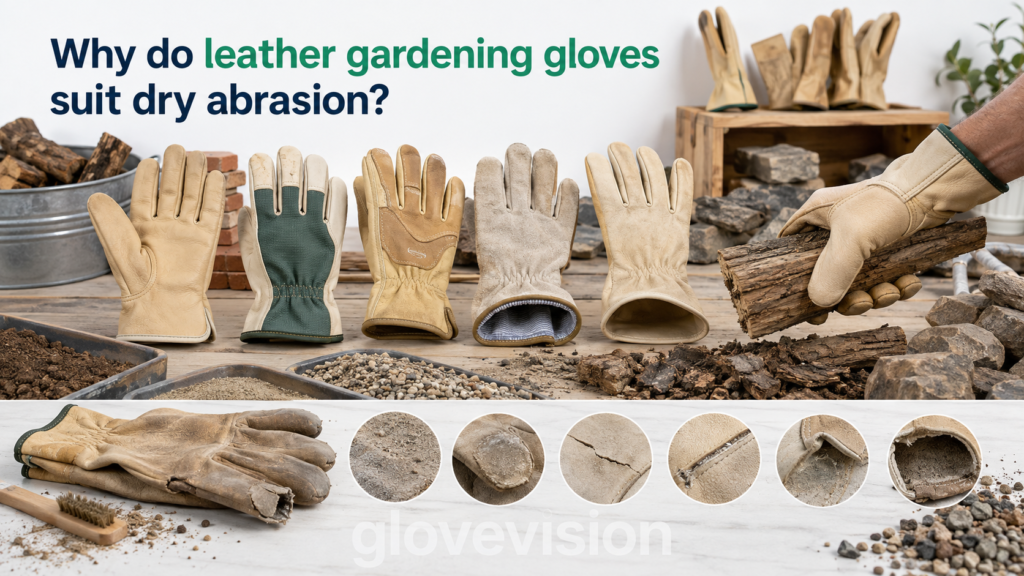
Leather gardening gloves may suit dry abrasion because some leather constructions provide a durable gripping surface and repeated-wear protection against dry, rough materials. Suitability still depends on the complete glove, exact task, surface roughness, pressure, repetition, fit, grip and current condition.
No leather category is automatically superior. Dry-soil digging, gravel handling, rough bark, firewood, stone and brick tasks create different wear patterns, while wet soil, thorns, cuts, chemicals, heat and powered equipment require separate evidence.
Why Do Leather gardening gloves Suit Some Dry-Abrasion Tasks?
Leather gardening gloves may suit selected dry tasks because some complete constructions provide useful surface durability, grip and repeated-wear resistance. The decision must begin with the exact abrasive material and contact pattern rather than the hide name.
Which dry surfaces can create abrasion?
Dry soil, sand, grit, gravel, rough bark, dry branches, firewood, stone, brick and garden edging may rub the palm, fingertips, thumb web and seams repeatedly.
How may Leather gardening gloves help?
A durable outer surface, suitable thickness, local reinforcement and stable grip may reduce direct wear on the hand while supporting controlled tool use.
When may Leather gardening gloves be unnecessary?
Low-friction tasks may not justify a heavy glove. Another construction may provide better dexterity, ventilation or comfort when abrasion severity is limited.
| Dry Task | Abrasion Pattern | Required Glove Features | Main Trade-Off | Decision Check |
|---|---|---|---|---|
| Dry-soil digging | Repeated grit and tool-handle friction | Secure fit, palm durability, fingertip control | Breathability versus coverage | Confirm soil and gloves are dry |
| Gravel handling | High local pressure and rubbing | Palm and fingertip reinforcement, secure seams | Thickness may reduce dexterity | Check stones have no sharp puncture edges |
| Rough-bark handling | Irregular rubbing and snagging | Flexible leather, protected thumb web, stable cuff | Grip versus surface drag | Use another product if splinters become pointed hazards |
| Firewood handling | Repeated carrying and rough fibers | Palm coverage, grip, seam stability | Bulk versus finger control | Do not infer cut or puncture protection |
| Brick or stone moving | High pressure, hard rough surfaces | Reinforcement, fit, safe carrying control | Durability versus tactile feedback | Choose specialist protection for sharp edges |
| Dry sweeping | Low pressure but repeated handle friction | Comfort, secure grip, flexible palm | Heavy construction may be unnecessary | Use only when abrasion exposure justifies it |
How Do Leather gardening gloves Reduce Exposure to Dry Abrasion?
Abrasion is progressive surface wear. It is not puncture, cutting, chemical contact or heat exposure. Leather may delay surface wear only when thickness, finish, reinforcement and the complete glove construction remain appropriate.
How can thickness affect Leather gardening gloves?
Additional thickness may increase material between the hand and rough surfaces, but it can also reduce finger control, flexibility and tool feedback.
How can surface construction affect Leather gardening gloves?
Grain, split, finish and surface treatment can influence wear, flexibility and grip, but none proves suitability without exact product information.
How can reinforcement affect Leather gardening gloves?
Reinforcement may support high-wear zones such as palms and fingertips. Areas outside that reinforcement remain separate exposure zones.
How can repeated friction affect Leather gardening gloves?
Pressure, sliding, gripping, carrying and duration can turn light scuffing into progressive fiber loss or structural thinning.
Which Dry Tasks Should Leather gardening gloves Be Matched To?
Confirm that the task is genuinely dry and identify the material, roughness, pressure, repetition and required tool control before choosing a pair.
What should be assessed for dry-soil work?
Assess grit, tool-handle friction, dirt entry, fingertip control and whether the glove can be cleaned and dried as instructed.
What should be assessed for gravel and stone handling?
Check pressure points, hard edges, lifting technique, palm reinforcement, secure fit and whether any pointed or cutting hazard changes the task.
What should be assessed for rough bark and firewood?
Consider irregular friction, snagging, splinters, grip and thumb-web wear. Sharp splinters require a separate puncture assessment.
What should be assessed for garden bricks and edging?
Evaluate repeated carrying pressure, hard rough surfaces, fingertip wear and safe control. Do not infer cut protection from abrasion suitability.
When should another glove construction be selected?
Select another product when the task becomes wet, chemical, sharp, hot, powered, or more abrasive than the glove’s documented construction can manage.
Which Construction Features Improve Leather gardening gloves for Dry Abrasion?
The full product—not the leather name—determines how wear is distributed across the hand.
How does palm construction affect Leather gardening gloves?
Check leather coverage, reinforcement, thickness, grip and whether high-pressure zones are protected without unsafe bunching.
How do fingertips affect Leather gardening gloves?
Fingertips need adequate material, controlled seams and sufficient flexibility for gripping, lifting and tool use.
How does the thumb web affect Leather gardening gloves?
The thumb web flexes repeatedly and may experience local friction, seam stress and thinning.
How do finger sides affect Leather gardening gloves?
Finger sides may contact handles, stones and rough materials even when the palm is reinforced.
How do seams affect Leather gardening gloves?
Seam placement, thread condition and tension influence comfort, wear concentration and structural integrity.
How does the lining affect Leather gardening gloves?
A lining may support comfort but can bunch, tear or retain dampness. It must be intact and fully dry before reuse.
| Glove Area | What to Assess | Possible Failure |
|---|---|---|
| Palm | Coverage, thickness, reinforcement, grip surface | Thinning, glazing, cracks, lost grip |
| Fingertips | Wear, seam position, reinforcement | Worn tips, holes, reduced control |
| Thumb web | Flexing, local pressure, stitching | Cracking, thinning, seam opening |
| Finger sides | Material and seam exposure during gripping | Local wear or splitting |
| Back of hand | Leather or textile construction and coverage | Unprotected or worn backing |
| Seams | Placement, tension, thread and opening | Split seam or exposed lining |
| Cuff | Stability, closure and task coverage | Slipping, debris entry or poor fit |
| Lining | Dryness, bunching, tears and contamination | Damp interior, discomfort or failed fit |
How Should Different Leather gardening gloves Be Compared?
Compare exact glove models through complete construction, intended use, manufacturer information, fit, grip and current condition. Do not rank hide species universally.
Which information should be checked for Leather gardening gloves?
Verify manufacturer, model, intended use, leather construction, tested area where available, reinforcement, seams, lining, size guidance and care instructions.
Why is “cowhide” insufficient to rank Leather gardening gloves?
Cowhide does not establish thickness, grade, finish, seam design, reinforcement, fit or abrasion performance for the exact glove.
Why is “goatskin” insufficient to rank Leather gardening gloves?
Goatskin does not automatically prove maximum flexibility, tool control or durability.
Why is “pigskin” insufficient to rank Leather gardening gloves?
Pigskin does not automatically prove breathability, dust performance, moisture recovery or suitability for every dry task.
| Construction | Possible Benefit | Important Limitation | Verification |
|---|---|---|---|
| Grain leather | May provide a durable outer surface in some products | Not universally superior to split leather | Check exact grade, thickness, finish and product claim |
| Split leather | May provide useful abrasion performance | Quality and consistency vary by product | Review exact specification and tested area |
| Leather palm | Targets the gripping surface | Textile back remains a separate exposure zone | Verify palm, fingertips and thumb-web coverage |
| Full-leather glove | Wider leather coverage | May affect ventilation, weight and drying | Assess fit, flexibility and full construction |
| Reinforced palm | Adds material over high-wear zones | Unreinforced areas may wear differently | Confirm placement and attachment |
| Reinforced fingertips | Supports repeated fingertip contact | May reduce fine control | Inspect tips and seams closely |
| Lined construction | May improve comfort or interior management | Can retain dampness or bunch | Confirm lining is intact and fully dry |
How Do Fit, Grip, and Dexterity Affect Leather gardening gloves?
Fit determines where material folds, where seams move and how securely the user can grip tools and materials.
What happens when Leather gardening gloves are too loose?
Loose gloves may fold, twist, move seams, reduce tool control and concentrate friction in unintended areas.
What happens when Leather gardening gloves are too tight?
Tight gloves may stretch materials, restrict movement, increase fatigue and make removal difficult.
How should grip be checked in Leather gardening gloves?
Test the actual dry handle or material using controlled force. Stop if the glove slips, rotates or requires excessive grip pressure.
How should dexterity be checked in Leather gardening gloves?
Confirm that fingers can close naturally, manipulate tools and release objects without unsafe resistance.
How should fit be tested before work?
Check fingertip reach, thumb movement, palm bunching, seam position, cuff stability and full hand closure.
How Should Wear in Leather gardening gloves Be Recognized?
Visible wear should be described by what can be observed. Do not diagnose “dry rot” or one exact failure mechanism from appearance alone.
What does light scuffing mean in Leather gardening gloves?
Light marking may be cosmetic when thickness, grip, flexibility and seams remain reliable, but it should be monitored for progression.
What does a suede-like worn area mean in Leather gardening gloves?
Surface roughening may be superficial or may indicate fiber loss and progressive thinning. Compare it with adjacent material.
What does stiffness mean in Leather gardening gloves?
Stiffness may relate to age, residue, wetting and drying, heat, storage, care history or deterioration. Replace the glove when stiffness impairs safe function.
What does local heat or friction sensation mean in Leather gardening gloves?
Stop work and inspect for pressure, bunching, thin material, a shifted seam or excessive task friction.
What do cracks or seam openings mean in Leather gardening gloves?
Deep cracks and opened seams are structural failure inputs and generally require replacement.
| Finding | Possible Concern | Required Verification | Action |
|---|---|---|---|
| Light surface scuffing | May be cosmetic | Check thickness, cracks, grip and progression | Monitor and inspect after use |
| Suede-like worn area | Surface fiber loss or progressive thinning | Compare with adjacent material | Reassess; replace if thickness is uncertain |
| Local heat or friction sensation | Excess pressure, bunching or local wear | Stop and inspect glove and task technique | Do not continue until resolved |
| Permanent stiffness | Possible deterioration or care-related change | Check fit, movement, cracking and instructions | Replace when function is unsafe |
| Deep cracking | Structural material failure | Flex gently and inspect depth and surrounding wear | Replace |
| Worn fingertip | Reduced thickness and control | Check for hole, exposed lining or seam damage | Replace when protection is uncertain |
| Seam opening | Loss of structural integrity | Inspect full seam and lining | Replace |
| Loose or twisting fit | Reduced control and shifted wear zones | Recheck size, closure and task grip | Choose another size or product |
How Should Leather gardening gloves Be Cleaned, Conditioned, Dried, and Stored?
Care must follow the exact manufacturer instructions. No universal soap, brush, water, soaking, conditioner or drying method applies to every leather glove.
How should debris be removed from Leather gardening gloves?
Use only a permitted method that does not abrade, stretch or damage the surface, seams or reinforcement.
Can Leather gardening gloves be cleaned with water?
Some products permit water cleaning. Others restrict washing or soaking. Follow the exact product instructions rather than a universal rule.
Should Leather gardening gloves always be conditioned?
No. Condition only when the manufacturer permits it. Conditioner cannot restore lost thickness, torn fibers, split seams or original abrasion performance.
How should Leather gardening gloves be dried?
Dry the exterior and interior fully using the approved method. Unless permitted, avoid radiators, hair dryers, tumble dryers, flames, hot surfaces and prolonged intense sunlight.
How should Leather gardening gloves be stored?
Store them clean, fully dry, uncompressed, ventilated and away from heat, direct sunlight, chemicals and sharp objects.
| Care Group | Required Check | Do Not Assume |
|---|---|---|
| Review the product | Identify exact model and care instructions | That all leather accepts one method |
| Identify previous exposure | Confirm dry soil, grit, water, chemicals or heat history | That visible dirt tells the full history |
| Remove debris safely | Use only an approved method | That stiff brushing is universally safe |
| Clean as permitted | Follow water, soap, washing and soaking instructions | That water is always prohibited or always permitted |
| Dry completely | Dry exterior and interior using approved conditions | That high heat is acceptable |
| Inspect after care | Check thickness, seams, stiffness, grip and fit | That cleaning restored protection |
| Store correctly | Keep clean, dry, uncompressed and ventilated | That conditioner repairs worn structure |
When Should Leather gardening gloves Be Replaced?
Replacement may be necessary before a large hole appears. Protective thickness, seams, grip, flexibility and fit must remain reliable for the next task.
Which holes and thinning require Leather gardening gloves replacement?
Replace when a hole, worn-through area, exposed lining or severe thinning affects a required protective zone.
Which seam failures require Leather gardening gloves replacement?
Replace after a seam opening, torn stitching or separation that compromises glove shape or coverage.
Which material changes require Leather gardening gloves replacement?
Deep cracking, brittleness, permanent stiffness, distortion and detached reinforcement are replacement inputs.
Which functional failures require Leather gardening gloves replacement?
Unsafe grip, failed fit, loss of dexterity or unstable control require another product even when no large hole is visible.
| Replacement Group | What to Check | Replacement Trigger |
|---|---|---|
| Palm and finger integrity | Thinning, holes, worn fingertips, exposed lining | Protective thickness cannot be relied upon |
| Structural integrity | Tears, seam opening, detached reinforcement | Construction is no longer intact |
| Material condition | Deep cracks, brittleness, permanent stiffness or distortion | Material cannot flex or protect reliably |
| Functional condition | Unsafe grip, failed fit, bunching or poor tool control | Safe performance is lost |
| Final decision | Task match, condition and manufacturer guidance | Select another glove or do not proceed when uncertain |
Which Mistakes Reduce the Performance of Leather gardening gloves?
- Declaring leather, cowhide, goatskin, pigskin, grain or split leather universally superior.
- Using abrasion information as proof of puncture, cut, chemical, heat or powered-equipment protection.
- Assuming greater thickness always means better protection.
- Ignoring unreinforced zones, seams, fingertips, thumb webs, cuffs or linings.
- Continuing after local heat, friction, pressure or suspected material failure.
- Using universal saddle soap, mild soap, stiff brushing, soaking, conditioning or high-heat drying.
- Assuming cleaning or conditioner restores lost thickness or structure.
- Waiting for a large hole after protective thickness, grip or fit has already become uncertain.
What Should Users Check Before Wearing Leather gardening gloves?
Final approval applies only to the next defined dry-abrasion task. Complete every readiness group before use.
| Inspection Group | What Must Be Verified | Stop or Reassess When |
|---|---|---|
| Confirm the task | Dry condition, surface, roughness, pressure, repetition and movement | The task includes wet, sharp, chemical, heat or powered hazards |
| Confirm the glove product | Exact model, intended use and manufacturer information | The product or intended use is unknown |
| Check complete construction | Palm, fingertips, thumb web, finger sides, back, seams, cuff, lining | Coverage or reinforcement does not match the task |
| Check material condition | No severe thinning, holes, tears, deep cracks or brittleness | Integrity is damaged or uncertain |
| Check fit and function | Secure fit, grip, flexibility, dexterity and tool control | The glove folds, twists, slips or restricts movement |
| Check care readiness | Clean, fully dry, correctly stored, approved care followed | Dampness, residue or unverified care remains |
| Make the final decision | Use, clean, dry, reassess, choose another glove, replace or do not proceed | Any required condition cannot be confirmed |
Evidence note: The supplied brief does not contain a fixed public source pack. Before publication, verify 5–7 authoritative sources and exact manufacturer documentation for product-specific abrasion, construction, washing, drying, conditioning and replacement claims.
Conclusion
Leather gardening gloves may suit dry abrasion when the exact glove construction, reinforcement, seams, fit, grip, flexibility, care history and current condition match the dry task and abrasion severity.
Leather is not universally superior, hide names do not prove performance, abrasion resistance does not establish puncture or cut protection, and care cannot restore lost structure. Stop, inspect and replace the glove whenever thickness, seams, grip, fit or safe control can no longer be relied upon.
Frequently Asked Questions
01Why may Leather gardening gloves suit dry abrasion?
Some complete leather-glove constructions provide a durable gripping surface and repeated-wear resistance when their construction, reinforcement, fit, condition and intended use match the exact dry task.
02Are Leather gardening gloves always better for abrasion?
No. Leather products vary, and textile, coated or synthetic gloves may be more suitable for some tasks. Compare exact products rather than material categories alone.
03Is grain leather always better than split leather?
No. Performance depends on the exact leather grade, thickness, finish, reinforcement, seams, fit, care history and complete glove construction.
04Can Leather gardening gloves be washed with water?
Only when the exact manufacturer instructions permit it. Water is not universally prohibited, but washing, soaking and machine cleaning are not universally allowed.
05Can conditioner restore worn Leather gardening gloves?
No. Approved conditioner may support flexibility in some products, but it cannot restore lost thickness, torn fibers, split seams, holes or original abrasion performance.
06When should Leather gardening gloves be replaced?
Replace them when thinning, holes, tears, deep cracks, seam openings, detached reinforcement, permanent stiffness, unsafe grip, failed fit or uncertain protective thickness prevents reliable use.