
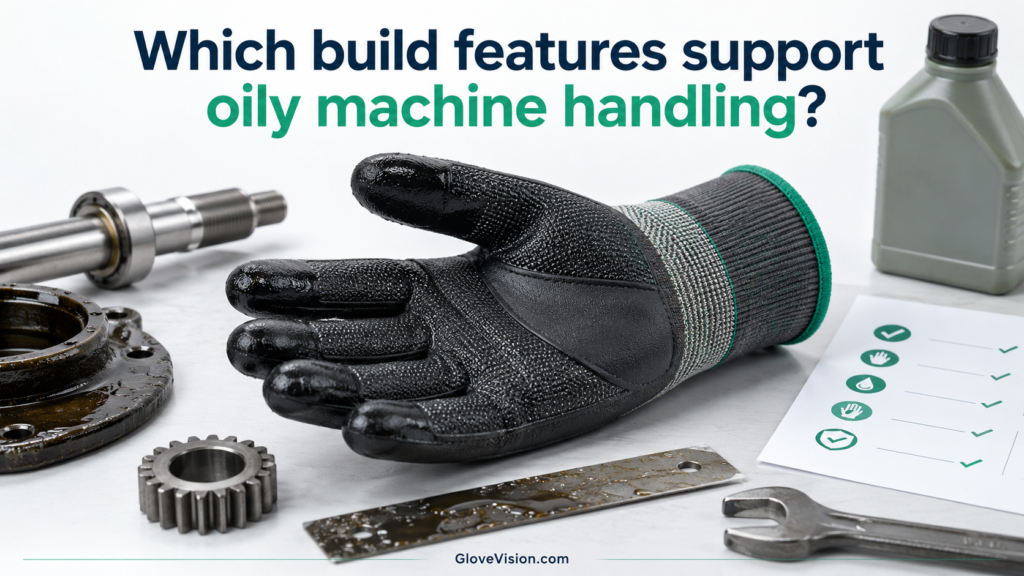
Which build features support oily machine handling?
Build features that may support oily machine handling include documented oil-compatible materials, task-matched palm coatings, textured grip surfaces, coated fingertips, secure fit, reinforced handling zones, and manufacturer-supported fluid-contact data. However, oil-resistant wording, palm texture, nitrile, PVC, polyurethane, latex, leather, EN 388, ANSI/ISEA, or any coating name does not prove universal oil resistance, chemical compatibility, grip security, heat resistance, or machinery safety.
This article covers oil-slip and grip-control problems, mechanical ratings versus oil-compatibility limits, coating and fluid matching, fit and trapped-fluid control, degradation response, and a final site safety and grip verification checklist.
This article is educational only. Oil-resistant glove suitability must be determined by hazard assessment, manufacturer documentation, current standards, SDS review, compatibility or permeation data, machine guarding, lockout/tagout, site PPE policy, exact fluid, duration, temperature, surface condition, fit, task, and supervisor instruction.
Why do standard Oil-Resistant Work Gloves balance selected fluid-contact protection with mechanical grip in oily conditions?
Standard Oil-Resistant Work Gloves balance selected fluid-contact protection with mechanical grip because oily surfaces can reduce friction, increase slippage, and create prolonged contact with fluids when glove materials are not matched to the exposure.
Use Work Gloves as the broader category boundary, then narrow the choice to the exact fluid, surface condition, machine task, fit, and site procedure.
Why does oil make machine handling harder?
Oil, grease, coolants, cutting fluids, and lubricants can create slipping, dropped parts, reduced feedback, trapped liquid, prolonged skin contact, and coating degradation when materials are not compatible. Treat fluid contact as a task-specific exposure issue, not as a grip-only problem.
What can textured palms do?
Some textured palm coatings may support grip in selected wet or oily handling conditions, but texture does not guarantee grip. Grip depends on oil type, fluid thickness, surface shape, pressure, coating wear, temperature, glove fit, contamination level, and manufacturer testing.
What does “oil-resistant” not prove?
Oil-resistant wording does not automatically prove chemical resistance, solvent resistance, fuel resistance, brake-fluid resistance, cutting-fluid compatibility, heat resistance, puncture resistance, cut resistance, safe use near rotating machinery, or guaranteed dry grip after saturation.
What is the safe explanation?
Oil-Resistant Work Gloves may help reduce selected oil-contact and grip-loss risks when the exact glove material, coating, surface texture, exposure duration, and manufacturer documentation support the task. OSHA hand-protection rules require appropriate hand protection for hazards such as harmful substances, cuts, abrasions, punctures, chemical burns, thermal burns, and temperature extremes. [OSHA]
Table 1. Fluid and surface conditions compared against grip problem, coating feature, limits, and verification needed.
| Fluid / Surface Condition | Possible Grip Problem | Possible Coating Feature | What It Does Not Prove | Verification Needed |
|---|---|---|---|---|
| Light machine oil on smooth metal | Tool or part slippage | Textured nitrile or documented grip surface | Universal oily grip | Product grip data / work trial |
| Grease on rough hardware | Reduced fingertip feedback | Reinforced or textured handling zone | Chemical compatibility | Manufacturer documentation |
| Coolant or cutting fluid | Wet liner or skin-contact risk | Fluid-compatible coating where documented | All-fluid resistance | SDS + compatibility data |
| Fuel or solvent residue | Coating swelling or softening | Chemically documented material only | Fuel/solvent proof from coating name | SDS + permeation/compatibility data |
| Wet/oily pipes or shafts | Loss of lifting stability | Patterned or sandy texture where documented | Machinery safety | Site handling procedure |
| Hot oily surface | Heat and fluid combined exposure | Product with documented thermal/fluid limit | Heat resistance from oil-resistance wording | Product heat data |
| Rotating machine surface | Entanglement risk | No glove feature alone solves this | Safe use near rotating parts | Machine guarding / LOTO procedure |
| Saturated glove palm | Grip failure and fluid contact | Replace, do not rely on texture | Continued safe use | Change-out rule |
Use this matrix to separate grip support from chemical compatibility, heat limits, and machine safety.
How do industrial Oil-Resistant Work Gloves use mechanical ratings without proving oil resistance?
Industrial Oil-Resistant Work Gloves use mechanical ratings to communicate tested abrasion, cut, tear, puncture, or impact performance, but those ratings do not prove oil resistance or chemical compatibility.
Which standards may appear on Oil-Resistant Work Gloves?
Industrial Oil-Resistant Work Gloves may include mechanical performance markings tied to ANSI/ISEA 105-2024, EN 388:2016+A1:2018, manufacturer mechanical test data, manufacturer chemical compatibility data, and site-specific PPE requirements. SATRA describes EN 388 as including physical tests for abrasion, cutting, tearing, and puncture. [SATRA]
What do mechanical ratings help show?
Mechanical ratings may help compare selected performance areas such as abrasion, cut resistance, tear resistance, puncture resistance, and impact where applicable. ANSI describes ANSI/ISEA 105-2024 as classifying hand and arm protection for performance properties, including cut levels such as A1–A9. [ANSI]
What do mechanical ratings not show?
Mechanical ratings do not directly prove oil resistance, chemical compatibility, solvent resistance, fuel resistance, brake-fluid compatibility, grip in oil, thermal safety, safe use near rotating machinery, real-world durability after saturation, or individual glove defect-free status.
Why should abrasion ratings not be treated as coating-density proof?
A high abrasion rating may reflect material, liner, coating, reinforcement, construction, or test behavior. EN 388:2016+A1:2018 specifies mechanical-risk requirements, test methods, marking, and information; it does not convert abrasion data into oil compatibility. [EN 388]
What is the safe standard-use rule?
Use mechanical ratings to understand abrasion, cut, tear, and puncture performance. Use separate manufacturer compatibility or permeation data to evaluate oil, coolant, fuel, solvent, or chemical exposure.
Table 2. Mechanical, chemical, permeation, workplace trial, and site signals interpreted separately.
| Signal Type | What It Measures | What It Does Not Prove | Where to Verify | Selection Rule |
|---|---|---|---|---|
| ANSI/ISEA 105 rating | Cut, abrasion, puncture and other classified properties | Oil resistance or oily grip | Product marking / standard context | Use as mechanical selection aid |
| EN 388 marking | Abrasion, blade cut, tear, puncture, impact where applicable | Oil compatibility or chemical resistance | EN marking / product data | Use only for mechanical-risk context |
| Manufacturer oil claim | Product-specific fluid-contact claim | Compatibility with every oil or coolant | Product spec / test report | Match exact fluid and exposure |
| SDS | Chemical hazards and precautions | Glove compatibility by itself | SDS + glove compatibility chart | Use with manufacturer data |
| Permeation data | Chemical movement through protective material under test conditions | Universal field performance | ASTM F739-style data / product report | Match chemical, duration, temperature |
| Workplace trial | Fit, grip, comfort, and task handling | Standardized chemical proof | Site PPE evaluation | Pair with documentation |
| Site PPE rule | Local approval | Public universal standard | Site policy / JHA | Follow local requirement |
Mechanical ratings and oil-compatibility data should be read together but verified separately.
Which high-performance Oil-Resistant Work Gloves may match specific machine-handling fluids?
High-performance Oil-Resistant Work Gloves may match specific machine-handling fluids only when the material, coating, texture, exposure duration, temperature, grip need, and manufacturer compatibility data support the exact task.
How should nitrile-coated Oil-Resistant Work Gloves be described?
Nitrile, foam nitrile, sandy nitrile, or other textured nitrile coatings may support grip in some light-oil, wet, or mixed handling conditions when documentation supports the task. Automotive and tool-control tasks may overlap with Mechanic Gloves, but oil compatibility still requires exact fluid verification.
How should PVC Oil-Resistant Work Gloves be described?
PVC-coated Oil-Resistant Work Gloves may be considered for some industrial liquid-handling or oily-work conditions when documented by the manufacturer. PVC should not be treated as automatic compatibility for every oil, solvent, fuel, coolant, or heat condition.
How should polyurethane Oil-Resistant Work Gloves be described?
Polyurethane-coated gloves may support tactile control in some dry or light-duty tasks, but polyurethane should not be treated as a universal oil-resistant or chemical-resistant coating. Broader abrasion and cut comparisons belong near Construction Gloves when jobsite handling becomes the dominant risk.
How should latex-coated or leather Oil-Resistant Work Gloves be handled?
Latex-coated or leather-based work gloves may support selected dry or coarse handling tasks, but they are not automatically oil-resistant. Heavy lifting and coarse load handling may need comparison with Rigger Gloves rather than an oil-resistance claim.
What is the safe coating rule?
No single coating provides universal grip, oil resistance, chemical resistance, dexterity, and durability. CDC PPE-Info describes ASTM F739-20 as a method for measuring permeation of liquids and gases through protective clothing materials under continuous contact; this kind of testing boundary still must be matched to the exact material and fluid. [ASTM F739]
Table 3. Workflow for identifying fluid, surface condition, mechanical hazard, exposure, documentation, and approval.
| Workflow Step | Verification Question | Safe Action | Documentation Needed |
|---|---|---|---|
| Identify Fluid | Is the exposure oil, grease, coolant, cutting fluid, fuel, solvent, lubricant, or cleaner? | Name the exact fluid first | SDS / task review |
| Identify Surface Condition | Is the surface smooth, rough, oily, wet, hot, cold, rotating, or contaminated? | Match grip surface to real condition | Site hazard assessment |
| Check Mechanical Hazard | Are abrasion, cuts, punctures, tear risk, or impact present? | Match mechanical rating separately | ANSI/ISEA / EN / product data |
| Check Chemical/Heat Exposure | Is there fuel, solvent, brake fluid, heated oil, or hot surface contact? | Verify compatibility and heat limits separately | SDS / manufacturer data |
| Check Latex Sensitivity | Is latex coating being considered? | Verify worker sensitivity and site policy | Product label / workplace policy |
| Review Manufacturer Data | Does documentation support this fluid, surface, duration, and task? | Reject unsupported assumptions | Product spec / compatibility report |
| Select Approved Glove | Is the glove approved by site procedure? | Use documented and approved glove only | Site PPE policy / JHA |
This workflow prevents coating names from replacing exact fluid and site verification.
How should operators don and fit protective Oil-Resistant Work Gloves to maintain hand control and reduce skin exposure risk?
Operators should don and fit protective Oil-Resistant Work Gloves by selecting secure fit, inspecting coating condition, preventing fluid entry, maintaining grip control, and following machinery-risk procedures.
Step 1: Select the best-fitting approved glove
Choose Oil-Resistant Work Gloves that fit securely without excess fingertip slack, palm bunching, severe webbing tension, restricted thumb movement, reduced circulation, loose cuff material, poor grip control, or early hand fatigue.
Step 2: Do not treat correct fit as rotating-machinery protection
Loose gloves can increase snag risk, but correct fit does not make gloves safe near rotating machinery. OSHA machine-guarding rules require guarding for hazards including point of operation, ingoing nip points, rotating parts, flying chips, and sparks. [OSHA]
Step 3: Inspect gloves before use
Before use, check for tears, pinholes where visible, seam splits, coating peeling, stiff areas, sticky coating, swelling, cracking, worn grip texture, liquid contamination, cuff damage, and wrong glove type for the task.
Step 4: Don Oil-Resistant Work Gloves without forcing the material
Don gloves without aggressive pulling, twisting, overstretching, or forcing the cuff. Wet cleaning tasks and household or sanitation chemicals should be checked against Cleaning Gloves boundaries rather than assumed from oil-resistant wording.
Step 5: Clean hands according to industrial contaminants
Machine-handling tasks may involve oil, grease, coolant, cutting fluid, metalworking fluid, fuel, solvents, metal dust, grime, sealants, and lubricants. A NIOSH HHE report on metalworking fluid exposure and dermatitis documented workplace skin exposure to metalworking fluids and recommended avoiding direct skin contact where it occurred. [NIOSH HHE]
Step 6: Monitor grip and trapped-fluid risk
Replace or reassess gloves if the operator notices glove slippage, wet liner feel, trapped oil, slick palm surface, coating swelling, softening, peeling, stickiness, cracking, reduced grip, hand fatigue, skin irritation, or fluid entry inside the cuff. Electrical-risk tasks require Electrician Gloves boundaries rather than fluid-handling assumptions.
Supporting checklist table. This is not a sixth proof asset.
| Checklist Item | What to Verify | Safe Action | Safety / Control Outcome |
|---|---|---|---|
| Size | Does glove fit without slack or severe tightness? | Choose best-fitting approved size/model | Better grip control |
| Palm Alignment | Is coating aligned with handling zones? | Reseat glove before work | More consistent contact |
| Coating Condition | Is coating cracked, peeling, swollen, or sticky? | Replace if compromised | Reduced failure risk |
| Fluid Entry | Is oil/coolant entering cuff or liner? | Stop, remove, clean hands, replace | Reduced skin exposure risk |
| Grip Control | Is the palm slick or surface unstable? | Secure tool/part and reassess | Reduced dropping/slipping |
| Machinery Risk | Are rotating or moving parts present? | Follow guarding/LOTO procedures | Reduced entanglement risk |
| Replacement Trigger | Is glove saturated, torn, degraded, or mismatched? | Remove and replace | Maintained task suitability |
Use the supporting checklist during donning, work pauses, and replacement decisions.
What immediate steps address failure or physical degradation in compromised Oil-Resistant Work Gloves?
Immediate steps for compromised Oil-Resistant Work Gloves should stop the task safely, maintain control of tools or parts, remove the degraded glove, reduce skin exposure risk, and replace it with a glove documented for the exact fluid and task.
What should happen after tearing, seam split, or cut breach?
If Oil-Resistant Work Gloves tear, split, puncture, lose coating, or expose the hand, stop the task safely, maintain control, move away from the hazard if needed, remove the compromised glove, clean hands or follow exposure response, inspect for injury or fluid contact, and replace with a glove documented for the task.
What should happen after oil saturation or grip loss?
If Oil-Resistant Work Gloves become saturated, slick, or difficult to control, stop the task safely, secure the tool or component, inspect the palm surface, check for oil, coolant, grease, fuel, or contamination, and replace the glove if grip is compromised.
What should happen after solvent exposure or chemical softening?
If gasoline, parts-cleaner solvent, cutting fluid, coolants, fuels, lubricants, or other chemicals cause swelling, softening, cracking, peeling, stickiness, or integrity loss, remove the glove and check manufacturer compatibility or permeation data. Chemical-contact tasks should be checked against Chemical-Resistant Lab Gloves boundaries and the exact SDS.
What should happen after snagging or tool-binding?
If Oil-Resistant Work Gloves catch, bind, or snag on a shaft, spindle, belt, fan, pulley, drill, conveyor, part edge, or moving component, stop movement safely if possible, do not pull forcefully, maintain control, remove the glove if compromised, and follow machinery or entanglement procedure. OSHA lockout/tagout rules cover service and maintenance where unexpected energization, startup, or stored energy could injure workers. [LOTO]
What wording should be avoided?
Avoid barrier bypass, direct skin absorption prevention, stable dynamic coefficient of friction, guaranteed oily grip, oil-resistant means chemical-proof, EN 388 proves oil resistance, ANSI/ISEA proves oil compatibility, one coating is best for all oily tasks, AQL proves industrial glove safety, and correct fit makes gloves safe around rotating spindles.
Table 4. Failure, saturation, softening, fluid entry, grip loss, and snag-risk response matrix.
| Failure Type | Possible Cause | Immediate Action | Documentation Check | Future Prevention |
|---|---|---|---|---|
| Tear or cut breach | Sharp edge, worn glove, wrong rating | Stop, remove, inspect hand, replace | Product rating / task hazard | Match glove to hazard |
| Seam split | Poor fit, stress, wear | Stop and replace | Product quality / fit | Reassess size and model |
| Coating peeling | Abrasion, aging, incompatible fluid | Stop if grip or barrier is affected | Manufacturer wear/compatibility data | Choose documented coating |
| Oil saturation | Exposure beyond glove/task limit | Stop, secure part, remove glove | Fluid/contact-duration review | Set change-out rule |
| Chemical softening | Incompatible fuel, solvent, coolant, cleaner | Stop exposure and remove glove | SDS / compatibility or permeation data | Use compatible glove |
| Grip loss | Oil, coolant, grease, wear, smooth surface | Secure tool/part and replace if needed | Grip/coating documentation | Match grip to surface |
| Fluid entry | Loose cuff, immersion, splash, wrong glove | Remove glove, clean hands, reassess | Site procedure / product design | Improve cuff/task controls |
| Snagging | Loose fit, cuff issue, moving part | Stop safely and follow machinery procedure | Site machine procedure | Improve fit and guarding controls |
| Task mismatch | Wrong coating/material/rating | Stop using glove for task | Site PPE policy / JHA | Update selection/training |
A compromised glove needs stop, removal, inspection, documentation review, and replacement.
Which checklist verifies that alternative Oil-Resistant Work Gloves satisfy site safety, grip, and fluid-contact requirements?
A checklist verifies that alternative Oil-Resistant Work Gloves satisfy site safety, grip, and fluid-contact requirements by checking task hazard, mechanical rating, exact fluid compatibility, grip surface, coating or material choice, latex sensitivity, fit, rotating machinery, chemical or heat limits, hand cleaning, and failure response.
Use broad category pages only after the exact oily-machine task is defined; otherwise, general work-glove categories can become too broad for fluid-contact decisions.
Oil-Resistant Work Gloves safety, grip, and fluid-contact verification checklist
Use a checklist matrix, not a checkbox box. The goal is to connect grip stability, fluid compatibility, mechanical ratings, fit, machinery controls, and replacement triggers.
Table 5. Verification checklist for site safety, grip, and fluid-contact requirements.
| Checklist Category | Core Verification | Tactical Action | Documentation Needed |
|---|---|---|---|
| Task Hazard | Are oil, grease, coolant, cutting fluid, lubricants, fuel, solvents, abrasion, burrs, pinch points, heat, cold, or grip loss present? | Select glove by hazard assessment | Job hazard analysis / site SOP |
| Mechanical Rating | Does glove carry current ANSI/ISEA, EN 388, or required mechanical information? | Use ratings for abrasion, cut, tear, puncture, or impact; not oil compatibility | Product marking / standard context |
| Fluid Compatibility | What oil, coolant, fuel, lubricant, solvent, or cleaner will contact the glove? | Confirm exact fluid, formulation, duration, temperature, material, and coating | SDS / manufacturer data |
| Grip Surface | Is the handled surface smooth, polished, rough, wet, oily, or textured? | Match palm texture/coating to actual surface | Product grip data / site trial |
| Coating/Material | Is nitrile, foam nitrile, sandy nitrile, PVC, PU, latex, leather, or another option considered? | Treat each as task-specific, not universal | Product documentation |
| Latex Check | Are latex-coated or latex-containing gloves considered? | Check worker sensitivity and site latex policy | Product label / site policy |
| Fit/Snag Risk | Is there slack, loose cuff, palm wrinkling, tightness, or poor finger control? | Avoid loose glove use around tools and moving parts | Fit trial / supervisor review |
| Rotating Machinery | Are spindles, belts, shafts, fans, pulleys, drills, lathes, conveyors, rollers, or moving parts involved? | Follow guarding, lockout, supervision, and entanglement controls | OSHA/site machinery procedure |
| Chemical/Heat Limit | Are fuels, harsh solvents, heated fluids, hot surfaces, cold surfaces, or high-friction parts involved? | Verify limits before use; do not infer from oil-resistant wording | SDS / manufacturer data |
| Hand Cleaning | Are contaminants managed before and after glove use? | Clean and dry hands according to site procedure | Site procedure / SDS |
| Failure Response | Are users trained for tearing, seam split, peeling, saturation, softening, grip loss, fluid entry, or snagging? | Stop, secure tools/materials, remove glove, inspect, replace | Site PPE response procedure |
The checklist keeps grip, fluid contact, coating choice, machinery risk, and replacement response connected.
Sources & Evidence Boundaries
This page uses 8 reduced, exact public sources verified for the specific claims they support. Product-specific manufacturer specifications, SDS documents, compatibility or permeation reports, and site PPE policies remain separate task-specific verification documents and are not treated as universal public proof.
- ANSI Blog — ANSI/ISEA 105-2024: Hand Protection & Cut Level Ratings supports ANSI/ISEA 105-2024 context and cut-level classification boundaries.
- SATRA — EN 388: Protective Gloves Against Mechanical Risks supports EN 388 mechanical-risk test context.
- SATRA — EN 388: Assessing Mechanical Risks supports EN 388:2016+A1:2018 requirements, test methods, marking, and information boundaries.
- OSHA — 29 CFR 1910.138 Hand Protection supports hazard-matched hand-protection selection.
- CDC/NIOSH HHE Report — Evaluation of Metalworking Fluid Exposure and Dermatitis supports workplace metalworking-fluid skin-contact caution.
- OSHA — 29 CFR 1910.212 General Requirements for All Machines supports machine-guarding boundaries.
- OSHA — 29 CFR 1910.147 Control of Hazardous Energy Lockout/Tagout supports hazardous-energy procedure boundaries.
- CDC PPE-Info — ASTM F739-20 supports chemical permeation testing boundary context.
Conclusion
Oil-Resistant Work Gloves may help reduce selected fluid-contact and grip-loss risks during oily machine handling when the glove is documented for the exact fluid, surface condition, exposure duration, and task. Textured palms, coated fingertips, nitrile, PVC, polyurethane, latex, leather, and reinforced zones must still be matched to the actual oil, coolant, lubricant, fuel, solvent, surface, temperature, and site procedure.
Oil-resistant wording, coating type, palm texture, EN 388 marking, ANSI/ISEA rating, or product-quality language does not guarantee chemical compatibility, heat resistance, grip security, defect-free performance, or safe use near rotating machinery. Damaged, saturated, softened, sticky, peeled, cracked, slick, torn, punctured, snagged, fluid-filled, or task-mismatched gloves need stop, removal, review, and replacement.
Frequently Asked Questions
Do Oil-Resistant Work Gloves guarantee grip in oil?
No. Oil-Resistant Work Gloves may support grip under documented conditions, but oil type, surface shape, fluid thickness, coating texture, wear, fit, and manufacturer testing all matter.
Does EN 388 prove oil resistance?
No. EN 388 is a mechanical-risk standard. It helps compare abrasion, cut, tear, puncture, and impact where applicable, but it does not prove oil resistance or chemical compatibility.
Does ANSI/ISEA prove oil compatibility?
No. ANSI/ISEA ratings may classify mechanical and other hand-protection properties, but oil compatibility must be verified separately through manufacturer compatibility or permeation data.
Are nitrile Oil-Resistant Work Gloves best for all oily tasks?
Not always. Some nitrile coatings may support oily or mixed handling, but no nitrile, foam nitrile, or sandy nitrile claim should be treated as universal for every oil, fuel, coolant, solvent, or contact duration.
Should Oil-Resistant Work Gloves be worn near rotating machinery?
Not automatically. Loose or unsuitable gloves may create entanglement risk near spindles, shafts, belts, pulleys, drills, lathes, conveyors, rollers, or moving machine components. Follow guarding, lockout, supervision, and site procedure.
When should Oil-Resistant Work Gloves be replaced?
Replace them when they tear, split, peel, saturate, swell, soften, crack, become sticky, lose grip, allow fluid entry, expose the hand, or no longer match the exact fluid and task.